

ecommerce conversion
customer experience strategy
digital customer experiences
If you want to unlock real, sustainable growth for your store, you have to look beyond surface-level metrics like conversion rates. The secret lies in understanding the why behind every click, purchase, and abandoned cart. It’s about decoding the psychology of your shoppers to turn raw data into a revenue-generating machine.
In e-commerce, the distance between a curious browser and a loyal customer is paved with missed signals and lost opportunities. Industry benchmarks show that nearly 70% of all shopping carts are abandoned. That’s a staggering number, representing massive revenue left on the table. It's rarely because the products are bad; it's because of friction or hesitation somewhere in their journey.
This is where a deep customer behavior analysis gives you a serious edge. It’s more than just tracking clicks—it’s about tapping into the psychological triggers that actually drive buying decisions. Behavioral economics and consumer psychology studies have shown us time and again that shoppers are swayed by subtle but powerful cues.
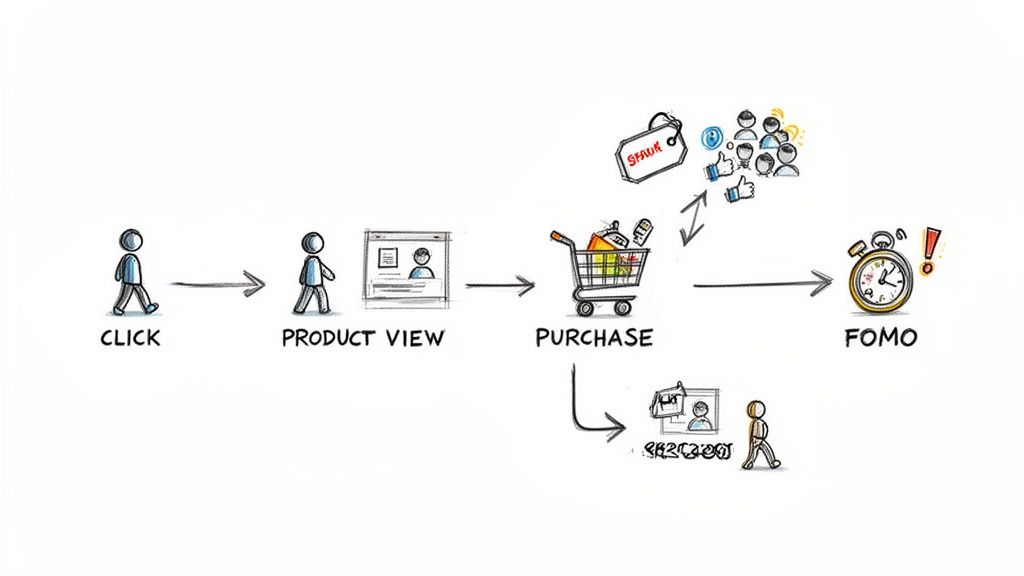
Many Shopify stores install a generic countdown timer or an email pop-up on their site and call it a day. While these basic tools can sometimes work, they often lack intelligence, blasting the same message to every single visitor. This quickly leads to banner blindness and often generates low-value leads rather than immediate revenue.
The real goal of understanding shopper behavior is to find smarter ways to improve ecommerce conversion rates by making these interactions personal and timely.
True urgency marketing isn't about manipulation. It's about using the science of consumer psychology to enhance the shopping journey. Quikly is the expert in this science, syncing your marketing with the shopper's natural decision-making process to make the path to purchase feel exciting and effortless.
Once you start analyzing behavior, you can deploy advanced behavioral triggers that actually mean something. Instead of a generic timer, you might show a low-stock warning only to a shopper who has viewed a specific product three times. That signals high intent and makes the message incredibly relevant. This smarter, more nuanced approach doesn't just boost sales—it protects your profit margins by avoiding lazy, store-wide discounts and helps you manage inventory more effectively.
Great customer analysis starts with knowing where to look. Your Shopify ecosystem is a goldmine of behavioral data, but the real magic happens when you stitch multiple sources together to see the entire shopper journey, not just a few isolated stats.
This is what separates basic reporting from a true, revenue-generating intelligence operation.
Start with your store’s native analytics. Shopify gives you a quick pulse on your store’s health, but you have to look beyond top-line revenue to find the metrics that really signal what shoppers are thinking and where they’re getting stuck.
While Shopify Analytics is a great starting point, Google Analytics 4 (GA4) gives you a much deeper, event-based look at the user journey. It helps you understand the tiny behaviors—the micro-moments—that lead up to a purchase or an abandoned cart.
With GA4, you can trace the exact paths shoppers take, seeing where they pause, circle back, or just give up. This data is critical for pinpointing the perfect moment to introduce a psychological trigger and nudge them over the finish line.
For example, if you see a huge drop-off between "add-to-cart" and "begin-checkout," you know the friction isn't on your product page—it's somewhere in the cart experience. That’s your cue to deploy a cart-level offer or a social proof message to keep the momentum going.
Tying behavioral data directly to profit is the whole point. The question isn't just, "What did they do?" It's, "How can we use what they did to generate more revenue?" This shift in perspective turns analytics from a chore into a growth engine.
The real power kicks in when you start integrating data from your entire marketing stack. By connecting Shopify and GA4 with platforms like Klaviyo for email or your favorite SMS tool, you build a comprehensive profile for every single shopper.
This unified view links browsing behavior to email clicks, purchase history, and even loyalty status. Suddenly, you can see which customers only buy during sales, who jumps on new product announcements, and who might be about to churn.
This level of detail allows for seriously sophisticated, automated marketing that goes way beyond generic pop-ups. It sets the stage for deploying targeted Quikly "Moments"—like a ranked offer exclusively for your VIPs or a limited-time drop for customers who have been eyeing a specific category.
For more ideas on building out your tech stack, check out our guide on the top apps for your Shopify store. This is how you translate customer behavior analysis directly into more revenue and smarter inventory management.
Once you have all that rich data flowing in, the real work begins. You've got to apply specific analysis techniques to sift through the noise and find those hidden gems—the patterns and opportunities that can genuinely move the needle. Just staring at a dashboard won’t cut it. You need structured methods to turn raw numbers into a clear story about your shoppers.
This is where you graduate from just seeing what happened to understanding why it happened. More importantly, it's how you figure out what to do next.
The whole idea is to bring data from key places like Shopify, Google Analytics, and Klaviyo into one unified view.
When these sources talk to each other, you get a 360-degree picture of the customer journey, from the first ad they clicked to their latest purchase. That complete picture is the foundation for everything we're about to cover.
What is funnel analysis? Funnel analysis is a method used to understand the steps a user takes to complete a goal, such as making a purchase. It maps out the customer journey—from landing on your homepage, to viewing a product, adding it to the cart, and finally, checking out. The entire point is to pinpoint where the biggest drop-offs are happening because those are your most expensive revenue leaks.
For example, a typical Shopify store might discover that 80% of users who add an item to their cart bail before buying. This isn't just a lost sale; it's a huge red flag. It shows high intent followed by a sudden roadblock. A generic countdown timer isn't the answer here. Instead, a strategically placed social proof banner in the cart—like "250+ people bought this today!"—can give them that final nudge they need.
Actionable Takeaway: Use GA4's Funnel Exploration report to visualize your checkout process. If you see a major drop-off at the shipping information step, consider adding an express checkout option like Shop Pay to reduce friction.
Not all customers are created equal. RFM (Recency, Frequency, Monetary) analysis is how you segment your audience based on what really matters—their buying behavior. This lets you focus your energy (and budget) where it will have the biggest impact.
Using this model, you can identify valuable groups like your "Champions" (bought recently, buy often, spend big) and your "At-Risk Customers" (used to be regulars but haven't been back in a while). This is worlds more effective than basic demographic segmentation. Instead of a generic store-wide sale that eats into your margins, you can send an exclusive, limited-time ranked offer only to that "At-Risk" segment. It's a powerful psychological tactic designed to win them back.
RFM analysis shifts your marketing from a megaphone blasting one message to everyone, to a private conversation with your most important customer groups. This is the essence of building a brand that customers feel understands them.
While funnel and RFM analysis give you snapshots in time, cohort analysis tracks how specific groups of customers behave over their entire lifecycle. A cohort is just a group of people who share a common trait, most often the date they made their first purchase (e.g., the "Black Friday 2023 Cohort").
This technique is invaluable for Shopify Plus merchants focused on sustainable growth. It answers the tough questions: Do customers we acquired during that huge sale have a lower lifetime value? Did our new shipping policy in March actually improve the repeat purchase rate for new customers?
By understanding how different cohorts perform over time, you can make much smarter decisions about your acquisition spend and retention strategies. These techniques aren't just academic exercises; they form the bedrock of sophisticated, data-driven marketing. To dig even deeper, check out the science behind data analytics and how it's powering modern e-commerce.
All that raw data from your customer behavior analysis is just the starting point. Its real value comes to life when you spin it into strategic, revenue-focused marketing campaigns. This is where you translate those abstract patterns into tangible ROI by creating compelling moments that drive immediate action.
It’s about moving beyond generic tactics and actually architecting experiences grounded in the science of consumer psychology.
By truly understanding what motivates your shoppers, you can deploy powerful psychological triggers like scarcity, anticipation, and social proof with surgical precision. This is how your marketing transforms from a blunt instrument into a set of sophisticated tools designed to enhance the shopper's journey, not disrupt it. The goal is to make the path to purchase feel both urgent and exciting.
Remember that funnel analysis we talked about? It’s not just for finding problems—it’s for pinpointing the exact moments where a psychological nudge can have the biggest impact on your bottom line.
Let's say your funnel data shows a huge drop-off on a product page for a high-demand item. People are interested enough to click, but something is making them hesitate before adding it to their cart. A generic countdown timer isn't the fix here because it doesn't address that specific friction point.
A better move? Deploy a dynamic stock alert.
This approach directly tackles page abandonment and can seriously improve your add-to-cart rate. You've just turned a leaky funnel into a high-conversion checkpoint.
By connecting a specific behavioral signal (hesitation on a product page) to a tailored psychological trigger (scarcity), you create a marketing 'Moment' that feels relevant and compelling, not manipulative. This is the core of next-generation urgency marketing.
Your RFM analysis is gold for identifying your most valuable customers, like your "Champions" and "Loyal Customers." Blasting these high-value groups with the same store-wide promotions you send to everyone else is a huge missed opportunity. It can erode their sense of exclusivity and, frankly, hurt your profit margins.
A much smarter strategy is to create ranked offers. This is where you reward your best customers with progressively better, limited-time deals based on their loyalty.
For example, your Shopify and Klaviyo data can power a Quikly campaign that looks something like this:
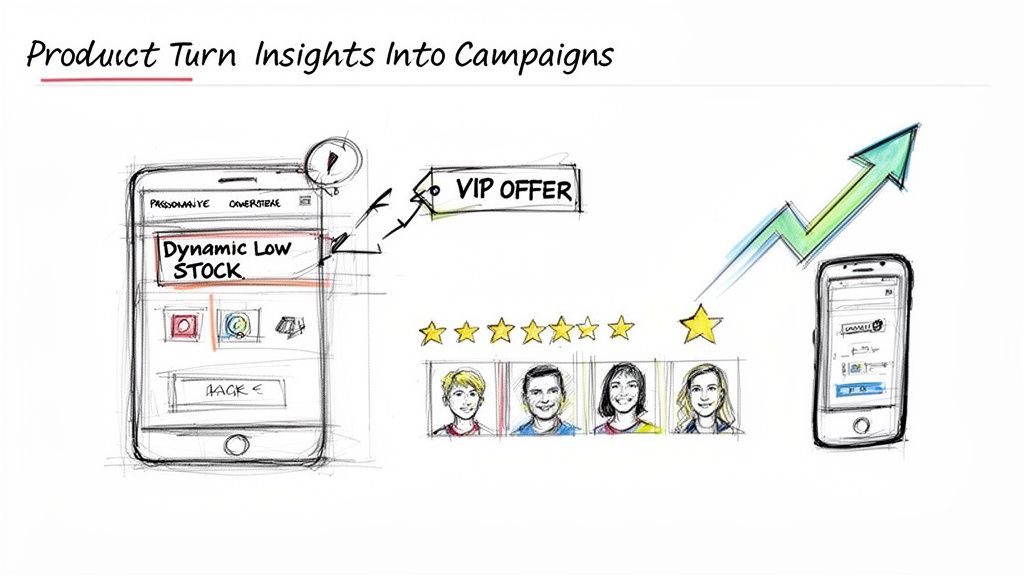
This kind of automated, tiered approach uses the principle of exclusivity to make your best customers feel seen and valued, driving repeat purchases without sacrificing margin on one-time buyers. As you analyze the results, you'll need a solid framework for measuring your marketing campaign effectiveness to keep refining these segments over time.
Actionable Takeaway: Connect your Shopify store to an email/SMS platform that supports dynamic segmentation (like Klaviyo). Create a segment for "At-Risk Customers" (e.g., purchased 2+ times but not in the last 90 days) and build an automated "win-back" flow that triggers a compelling, limited-time offer.
If you're not looking at your customer behavior through a mobile-first lens, your analysis is already obsolete. Modern e-commerce happens on a smartphone, a world of short attention spans and sky-high expectations for a perfect experience. If you drop the ball here, you're not just leaving a little money on the table—you're leaving most of it.
The explosion of mobile shopping isn't just a trend; it's a fundamental shift in how people buy. Industry forecasts show mobile commerce is on track to claim roughly 59% of all online retail sales globally by 2025. We're talking about a market value hitting a staggering $4 trillion.
For any brand on a platform like Shopify, this is a wake-up call. Retailers who ignore this pivot are staring down cart abandonment rates as high as 70% on sites that aren't built for mobile. That's a leaky bucket you can't afford.
On a phone, everything is different. Shopping sessions are shorter, your customer is probably distracted, and any friction is a deal-breaker. This is precisely why smart, psychological urgency marketing works so well in this environment. You have to be simple and visually clear.
Forget the complex banner ads. A clean, dynamic stock alert like "Only 5 left!" or a quick social proof notification—"15 people are viewing this now"—is what cuts through the noise. These tactics tap directly into the psychological principles of scarcity and social proof, which are especially powerful in a fast-paced mobile journey where buying decisions are made in seconds, not minutes.
A mobile shopper's hesitation is your signal to act. The right psychological trigger delivered at the right moment can be the difference between a completed purchase and an abandoned cart. This is where automated, behavior-driven "Moments" outperform static timers.
Looking forward, your customer analysis needs to keep evolving. The lines between social media and e-commerce are practically gone. Platforms like Instagram and TikTok are now major channels for both discovery and purchase. Your analysis has to track referral traffic and conversions from these sources to really get a grip on how social proof and influencer-driven desire are shaping what people buy.
As the landscape keeps changing, you have to stay on top of new technologies. For instance, it's worth taking time to explore the role of Large Language Models (LLMs) in predicting trends and creating truly personal experiences. By staying agile and embracing tools that can adapt to these new behaviors, you make sure your marketing stays sharp and effective for the shoppers of tomorrow.
When e-commerce managers first dig into customer behavior analysis, a few practical questions always seem to pop up. Let's tackle them head-on, because the goal here is always about boosting revenue and making the customer journey better with ethical, psychology-backed strategies.
Absolutely not. If anything, proper customer behavior analysis is designed to protect your profit margins.
Instead of running store-wide sales that treat every single shopper the same, this kind of analysis helps you pinpoint specific segments—like customers who are about to churn or your high-value VIPs—and hit them with precise, limited-time offers.
This whole approach is grounded in behavioral economics, creating real urgency without cheapening your brand. It’s about generating incremental revenue from specific groups, not just handing over margin to customers who were going to buy from you anyway. The goal is smarter promotions, not just more of them.
Think of standard countdown timers and pop-up apps as blunt instruments. They're usually just broadcasting the same generic message to every visitor, which quickly leads to banner blindness and can feel pretty manipulative.
A smart strategy built on customer behavior analysis uses advanced behavioral triggers instead.
This subtle shift turns urgency marketing from a simple tactic into a personalized experience. It actually enhances the shopper’s journey and keeps the focus squarely on generating revenue, not just capturing an email address.
The core difference is intelligence. Instead of a one-size-fits-all approach, you're using data to deploy the right psychological cue—like scarcity or social proof—at the exact moment it will be most effective for that specific shopper.
You might be surprised by how fast you can see the impact of behavior-driven campaigns. While a deep cohort analysis might take a full quarter to give you those juicy long-term insights, you can spin up targeted campaigns based on an initial funnel analysis or RFM segmentation in a matter of days.
For example, finding a major drop-off point in your checkout funnel and deploying a cart-level social proof banner can lift conversion rates almost immediately. We've seen plenty of Shopify Plus merchants get a measurable ROI within the first month just by focusing on these high-impact "quick wins" before they move on to more complex, long-term optimizations.
Ready to turn your customer insights into a powerful revenue engine? Quikly helps you move beyond basic timers and deploy sophisticated, psychology-driven campaigns that enhance the customer journey and protect your profits. Discover how our automated "Moments" can drive immediate action and measurable growth for your Shopify store. Learn more about Quikly's approach.