

ecommerce conversion
customer experience strategy
digital customer experiences

A social commerce platform is a powerful tool that transforms a social media channel from a simple broadcast medium into a fully integrated storefront. It enables the entire shopping experience—from product discovery in a friend's post to checkout—to occur seamlessly within a social media application. This eliminates extra clicks and browser tabs, creating a frictionless path from inspiration to purchase.
Consider the significant amount of time consumers spend scrolling through social feeds. A modern social commerce platform converts that passive browsing into an active, effortless shopping experience. This isn't just about placing an advertisement in a feed; it's a fundamental strategic shift that embeds your storefront directly into your customer's daily digital life, meeting them precisely where their attention is already focused.
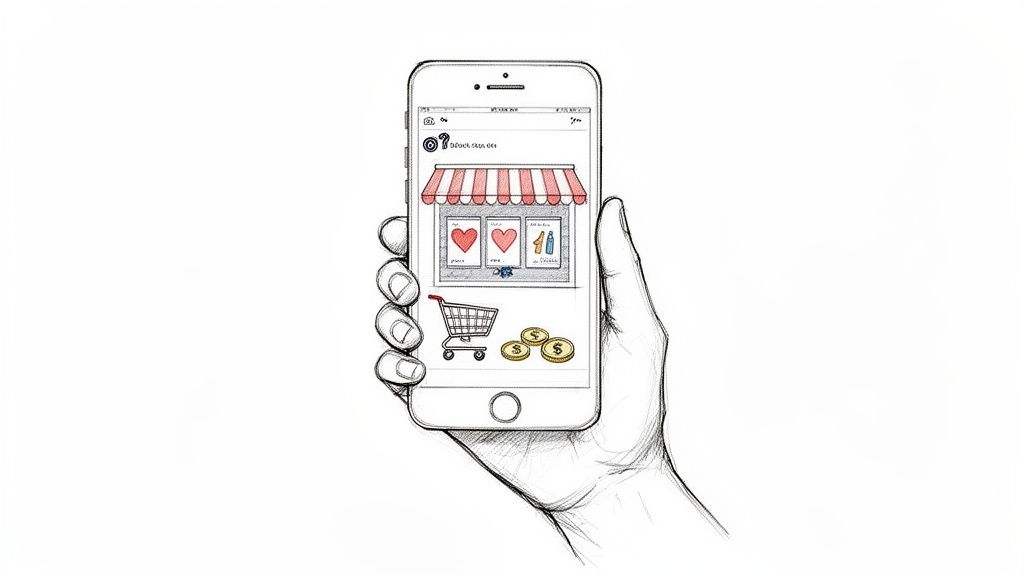
This approach is remarkably effective because it taps into the core psychological principles that make social media compelling. A major advantage is the drastic reduction in friction. Forcing a customer to navigate to an external website is a primary contributor to the industry's staggering 70% average cart abandonment rate. By keeping the entire transaction in-app, these platforms leverage the principle of instant gratification. When a customer feels an impulse to buy, they can act on it immediately, boosting conversion and overall revenue.
To fully grasp the impact, it's useful to compare social commerce with the traditional e-commerce model.
| Attribute | Traditional E-commerce | Social Commerce |
|---|---|---|
| Customer Journey | Linear: land on a site, search for products, add to cart, check out. | Non-linear and integrated: discovery happens organically within social content. |
| Point of Purchase | A dedicated website or online store. | Directly within a social media app (e.g., Instagram, TikTok, Facebook). |
| Discovery Method | Intent-based: customers actively search for specific products. | Serendipitous: users discover products through feeds, stories, and influencers. |
| Key Driver | Search and navigation. | Social proof, recommendations, and impulse. |
| Interaction | Primarily transactional and one-way. | Community-driven and interactive, with likes, comments, and shares. |
Social commerce is not merely a new sales channel; it's a fundamentally different approach to customer engagement, built on community, trust, and immediate action.
The success of social commerce is deeply rooted in consumer psychology, leveraging key behavioral triggers identified in behavioral economics research:
This potent combination of convenience and psychology has ignited the market. The global social commerce market grew from $81.9 billion in 2018 to $570.7 billion in 2023, with projections to exceed $1 trillion by 2028. You can explore the data behind the incredible growth of the social commerce market for more details. For Shopify merchants, the message is clear: overlooking this channel means leaving significant revenue on the table.
A truly effective social commerce platform is more than just another sales channel. It is a sophisticated engine designed to convert social engagement into tangible ROI. While many tools offer basic functionality, the platforms that deliver a significant business impact are those that move beyond simple metrics like likes and shares to focus on revenue generation and profit margin protection.
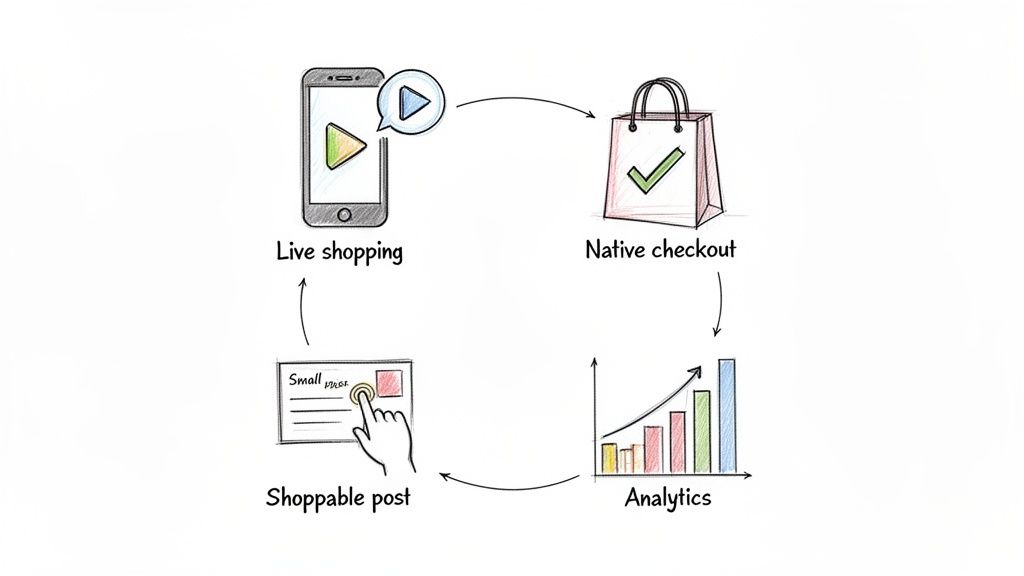
This is more critical than ever, as social media platforms are projected to command a 73.5% market share in social commerce by 2025. Their success stems from mastering the art of frictionless shopping, weaving it directly into the user experience.
For retail brands, this necessitates finding a platform that can replicate that seamless appeal. With 58% of U.S. shoppers making a purchase after seeing a product on social media, the opportunity is immense. You can review this report on the dominant role of social platforms in commerce for a deeper analysis.
The cornerstone of a high-impact social commerce platform is native checkout. This feature allows a customer to complete a purchase without ever leaving their social media app. It directly combats the industry's 70% cart abandonment rate by eliminating the friction of being redirected to an external site. By reducing the journey from discovery to purchase to just a few taps, the probability of capturing an impulse buy increases dramatically.
This is enabled by shoppable content formats:
Another powerful feature is live shopping integration. This is not merely a product demonstration but an interactive, high-energy sales event. A well-executed live sale masterfully blends several psychological drivers, far surpassing the effectiveness of a basic countdown timer:
A well-run live shopping event isn’t just about selling a product. It creates a memorable brand "Moment" that drives immediate sales and long-term loyalty. This is a core idea in advanced urgency marketing. For a deeper dive, read our guide on how an e-commerce marketing automation platform can help structure these high-impact campaigns.
For growing brands, particularly Shopify Plus merchants managing large order volumes, the backend infrastructure is critical. A top-tier social commerce platform must provide deep, revenue-centric analytics that go beyond vanity metrics to focus on KPIs like social-attributed revenue and customer lifetime value.
Furthermore, seamless, real-time inventory synchronization with Shopify is non-negotiable. Overselling during a flash sale erodes both profit margins and customer trust. This level of sophisticated automation distinguishes true growth platforms from simpler, less scalable applications.
Your social commerce platform cannot operate in a silo; it must function as a deeply integrated extension of your primary e-commerce hub. For most brands, this means a seamless, API-driven integration with Shopify or Shopify Plus. This connection creates a unified experience for both your customers and your operational teams.
A failed integration leads to disjointed customer journeys and significant operational challenges. For instance, if a customer is excited by a product on Instagram but finds it out of stock on your site due to a sync delay, that friction destroys trust and results in a lost sale.
Real-time inventory synchronization is the bedrock of a robust integration, especially when executing high-velocity sales events on social media where demand can spike instantaneously.
Proper synchronization protects your business by:
For merchants connecting social commerce to their store, understanding how platforms like Shopify integrate is essential. A good starting point is researching the specifics of the Shopify Facebook integration to optimize your social sales channels.
A powerful social commerce platform must also integrate with the rest of your marketing stack to connect social discovery with a long-term, profitable customer relationship. This data flow creates a holistic view of the customer journey.
Connecting your social sales channel to your core marketing tools isn't just a technical step—it's a strategic imperative. It transforms a one-time social transaction into a long-term customer relationship, dramatically increasing lifetime value.
Consider these essential integrations:
This level of automation is a hallmark of a professional e-commerce operation. For more ideas on enhancing your store's capabilities, review our guide on the best apps for your Shopify store. By focusing on these deep, API-driven connections, you ensure every social commerce effort contributes directly to scalable, profitable growth.
High-intent traffic from a social commerce platform represents a prime opportunity. These shoppers arrive motivated by social proof and visual appeal, ready to act on impulse. Allowing that momentum to dissipate with a passive shopping experience is a costly mistake that directly impacts revenue.
The key is to meet this initial enthusiasm with a compelling, psychologically-grounded reason to purchase now. This is the science of urgency marketing.
This goes beyond simply adding a generic countdown timer to a product page. Effective urgency marketing is a sophisticated application of consumer psychology designed to convert the fleeting attention from a social scroll into an immediate sale. It involves moving beyond basic pop-ups, which primarily capture emails, to create high-impact "Moments" that generate revenue and protect profit margins.
This is the seamless flow to aim for—from social discovery straight into an integrated Shopify experience, which serves as the perfect launchpad for a powerful urgency campaign.
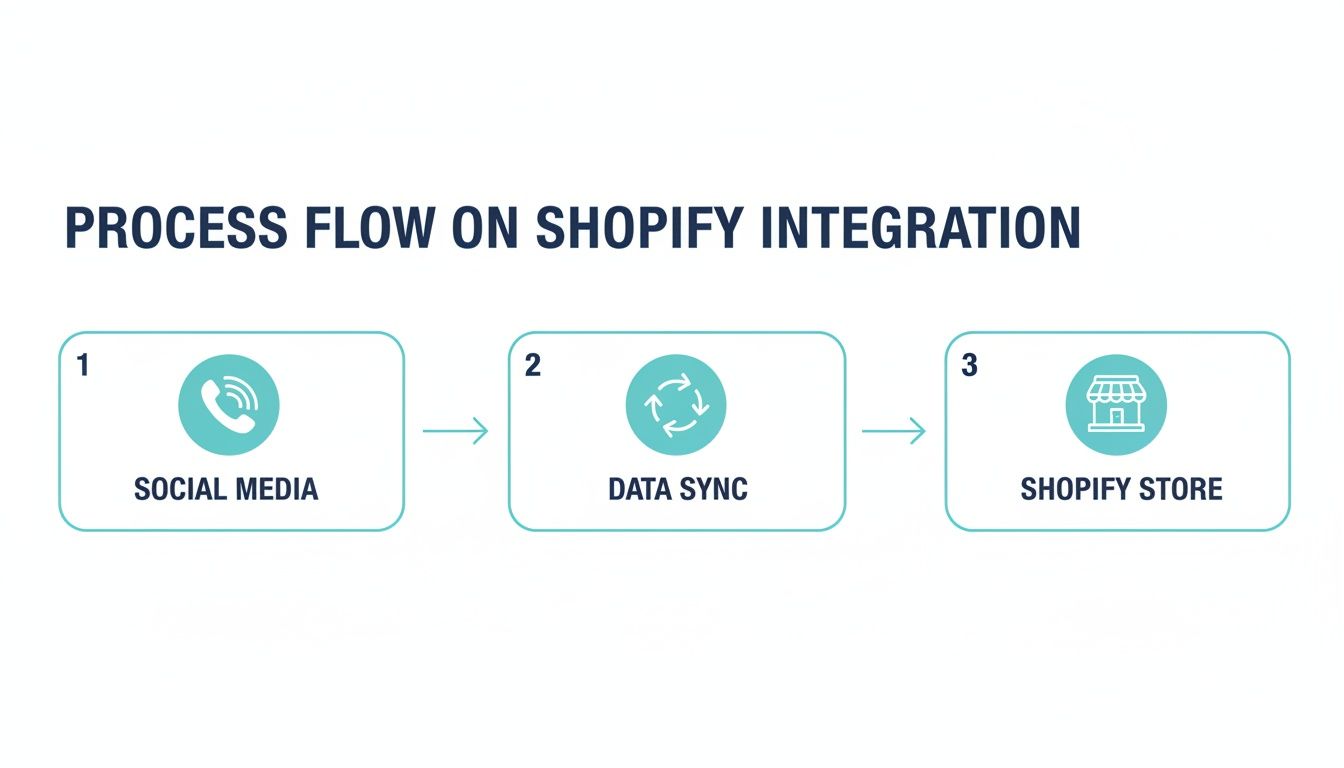
A synchronized system allows you to capture social intent and funnel it directly into a controlled, high-conversion environment on your own site.
The social shopper's mindset is driven by a powerful combination of FOMO and the desire for immediate gratification. A well-designed urgency campaign taps directly into these behavioral triggers, creating an exclusive and time-sensitive event.
This strategy is grounded in behavioral economics, particularly the principle of scarcity: people assign higher value to items that are less available.
Consider a limited-edition product drop promoted on Instagram. The social post builds anticipation. Instead of linking to a standard product page, you direct users to a Quikly-powered campaign on your Shopify store. This is where advanced psychology comes into play:
This sophisticated approach ensures the excitement generated on social media is converted into sales. To learn more, see how urgency marketing can help boost your social media engagement and conversions.
This table contrasts basic tactics with the advanced psychological triggers used by a platform like Quikly to convert high-value social media traffic.
| Tactic Type | Example | Primary Goal | Business Impact |
|---|---|---|---|
| Basic Scarcity | "Only 5 left in stock!" message | Create surface-level panic | Often feels artificial; may slightly increase conversion but risks brand trust if not authentic. |
| Advanced Scarcity | A limited-edition product drop available only to the fastest responders | Create a competitive, exclusive event | Drives massive, immediate sales velocity, protects profit margins, and reinforces product desirability. Boosts long-term brand equity. |
| Basic Urgency | Countdown timer on a product page | Encourage immediate checkout | Often ignored due to banner blindness; can devalue the brand if overused. Minimal impact on undecided shoppers. |
| Advanced Urgency | A time-sensitive notification for a "go-live" event where speed determines the reward | Gamify the purchase and reward swift action | Generates high engagement and converts passive interest into active participation. Creates a memorable brand moment and drives revenue. |
While basic tactics may yield a minor lift, a psychologically-driven approach creates a high-velocity sales event with a much stronger ROI.
Executing this strategy is more achievable than it may seem with smart automation. For your next flash sale, frame it as a cohesive event that bridges your social platform and your Shopify store.
The goal is to create a seamless psychological journey. The social post is the invitation, sparking desire. The on-site campaign is the main event, converting that desire into revenue through structured, time-sensitive action.
Begin by announcing an upcoming limited-time offer exclusively on your social channels. Drive traffic to a dedicated landing page on your Shopify site where the urgency campaign is hosted. This gives you full control over the experience, allowing for precise tracking and seamless integration with your inventory and fulfillment systems. The result is a high-velocity sales event that boosts return on ad spend and helps you manage inventory efficiently, protecting your margins from slow-moving stock and costly markdowns.
Selecting the right social commerce platform is a strategic decision that will either accelerate revenue growth or constrain it. The market is saturated with options, from simple plugins to comprehensive enterprise solutions. The key is to look beyond flashy dashboards and focus on the core engine that drives measurable business results, not just vanity metrics like likes and shares.
Think of it this way: a truly effective platform is an extension of your growth strategy, not just another tool in your stack.
The first criterion is deep integration capability. Your platform must connect flawlessly with your Shopify or Shopify Plus store for real-time inventory synchronization. This is non-negotiable. Without it, you risk overselling during high-traffic events, which damages profit margins and erodes customer trust. It also needs to integrate with your marketing stack—especially tools like Klaviyo and SMS platforms—to create a unified journey from social discovery to post-purchase engagement.
Next, assess the platform's performance capabilities. Can it handle a flash sale that drives tens of thousands of users to your site in minutes? Many simpler solutions will fail under such pressure, resulting in site crashes and lost revenue. You need a social commerce platform architected for high-volume traffic and sophisticated automation.
This is where you differentiate from basic tools. Simple popup apps and generic timers are designed for lead capture, not significant revenue generation. A sophisticated platform leverages psychology-driven automation to manage complex campaigns without manual intervention. As you evaluate options, consider how they integrate with or offer high-impact AI tools for fashion brands to elevate your strategy.
The right platform doesn't just display your products on social media; it provides the infrastructure to convert social buzz into measurable profit through intelligent automation. It's the difference between running a manual campaign and orchestrating a high-ROI, psychology-driven event.
Finally, be selective about analytics. A growth-focused platform will provide data that ties directly to your bottom line. Ignore the fluff.
Look for these specific metrics:
Choosing a platform with these capabilities is about building a sophisticated, scalable social commerce engine that becomes a primary driver of business growth.
It is easy to become distracted by vanity metrics like likes and shares. However, to justify your investment in social commerce, you must focus on its direct impact on revenue and profitability. True success is not measured by popularity but by financial outcomes.
This requires shifting focus from surface-level stats to the KPIs that truly matter. A smart measurement strategy connects social activity to tangible business results, demonstrating the real value of your social channels.
Your analytics must draw a direct line from a social media interaction to your bottom line. Prioritize tracking these core performance indicators:
A winning social commerce strategy does more than just capture impulse buys; it acquires high-value customers who drive long-term profitability. That’s the ultimate measure of a platform’s effectiveness.
Once you begin tracking these KPIs, you can benchmark your performance against industry standards and identify areas for improvement. Consider the industry's 70% average cart abandonment rate.
A well-integrated social commerce platform, especially when combined with urgency marketing, can significantly reduce this rate. By creating a frictionless purchase path that keeps the user within the app, you convert high-intent social traffic that would otherwise be lost. This provides a clear, measurable return on investment, proving the platform's value in the universal language of business: revenue.
Let's clarify some common questions about implementing a social commerce strategy.
While related, the distinction is straightforward.
Social media marketing operates at the top of the funnel. Its purpose is to build brand awareness, create engagement, and drive traffic to your website. The primary goals are reach and consideration.
A social commerce platform operates at the bottom of the funnel. It enables the final transaction, allowing a customer to move from discovery to purchase confirmation within the social app itself. Its goal is conversion and revenue generation, capturing the impulse to buy at the moment of inspiration.
There is no single "best" platform; the ideal choice depends on your target audience and product category. For visual-heavy industries like fashion and beauty, Instagram and TikTok are often the most effective channels.
The most critical factor is a deep, real-time integration with Shopify. Your inventory and order data must sync flawlessly to prevent operational issues. The platform must also integrate with your wider marketing stack, including tools like Klaviyo for email and urgency marketing platforms, to create a cohesive and powerful customer journey.
The most effective urgency is built on genuine psychological triggers, not manipulation. Move beyond basic countdown timers. Instead, create authentic excitement around real scarcity, such as limited-edition product drops or exclusive access for a select group of customers.
Announce these events on your social channels and drive traffic to a dedicated campaign on your site. This creates genuine FOMO that motivates action because customers do not want to miss a real opportunity.
Ready to turn your social media buzz into actual, immediate revenue? See how Quikly uses the science of urgency marketing to launch high-impact sales events that protect your profit margins and move inventory fast. Explore Quikly today.