

ecommerce conversion
customer experience strategy
digital customer experiences

Content marketing ROI is a simple but critical question: "Are we generating revenue from our content?" It's the bottom-line metric that shows how much revenue your blog posts, videos, and social media campaigns are bringing in compared to what you spent creating them.
This calculation transforms content from an expense into a measurable driver of profit and business growth.
Tracking content marketing ROI isn't an academic exercise for your analytics dashboard. It's about making smarter decisions that directly impact revenue and profit margins. It’s the hard proof you need to justify your marketing budget, fine-tune your strategy, and build a predictable growth engine for your Shopify store.
Without it, you're just creating content and hoping something works.
Think of it this way: a paid ad is like renting an apartment. The moment you stop paying, your visibility vanishes. A great blog post, on the other hand, is like owning a home. You put in the upfront investment, but it becomes a valuable asset that appreciates over time. It can pull in organic traffic and generate sales for months—even years—delivering compounding returns long after you've paid the writer.
This shift in mindset is crucial. You stop asking, "How much did this blog post cost?" and start asking, "What's the long-term revenue this asset is going to generate for my business?"
When you truly understand your ROI, you can pinpoint exactly what's resonating. You discover which topics your audience craves, which formats lead directly to a sale, and which channels are sending you customers ready to buy.
This data-driven focus strips away the guesswork, letting you double down on what works and confidently cut what doesn’t.
And the business impact is massive. For example, studies consistently show that content marketing costs 62% less than traditional marketing tactics but generates about three times as many leads. It gets even better for e-commerce stores: businesses that make blogging a priority are 13 times more likely to see a positive ROI. If you want to dive deeper, you can explore more data on marketing ROI statistics to get the full picture.
Before we jump into the formulas, let's break down the three core pieces of the ROI puzzle. Each one tells a critical part of the story, from the cash you spend to the revenue you earn. Getting these fundamentals right is the foundation for measuring anything accurately.
To make it crystal clear, here’s a quick-reference table defining each variable and what it looks like for a typical Shopify store.
| Component | Definition | E-commerce Example |
|---|---|---|
| Return | The total revenue generated directly or indirectly from your content marketing efforts. | A customer reads a blog post about "the best skincare routine," clicks a product link, and makes a $150 purchase. |
| Investment | The total cost associated with creating, publishing, and promoting your content. | This includes freelance writer fees, SEO software subscriptions, and the hourly cost of your marketing team's time. |
| ROI (%) | The final percentage that shows the profitability of your content investment. | If you spent $500 on content and generated $2,000 in sales, your ROI would be 300%. |
As you can see, the concept itself is straightforward. The real magic—and the challenge—is in accurately tracking the return and the investment, which is exactly what we’ll cover next.
Let's move from theory to practice. This is where you see the real power of measuring your content marketing ROI. The basic formula is simple, but its real muscle comes from accurately tracking the two big pieces: the money coming in (revenue) and the money going out (investment).
Let's break down how to actually calculate this for a Shopify store, using a real-world example to make it less abstract.
The first, and often trickiest, part of the puzzle is tying revenue back to a specific piece of content. How do you really know that blog post you published last month is what led to a sale today? This is where attribution models come in.
For most Shopify stores, a multi-touch model paints a much clearer picture of how all your content works together to nurture someone from a curious visitor into a happy customer.
Next up, you need a painfully honest list of all your expenses. This is more than just what you paid a freelance writer. To really get the full picture, you have to understand your overall content marketing return on investment, and a thorough accounting of your costs is step one.
Your investment checklist should include things like:
This infographic shows the simple but powerful flow of turning your initial investment into measurable growth and, ultimately, a positive ROI.
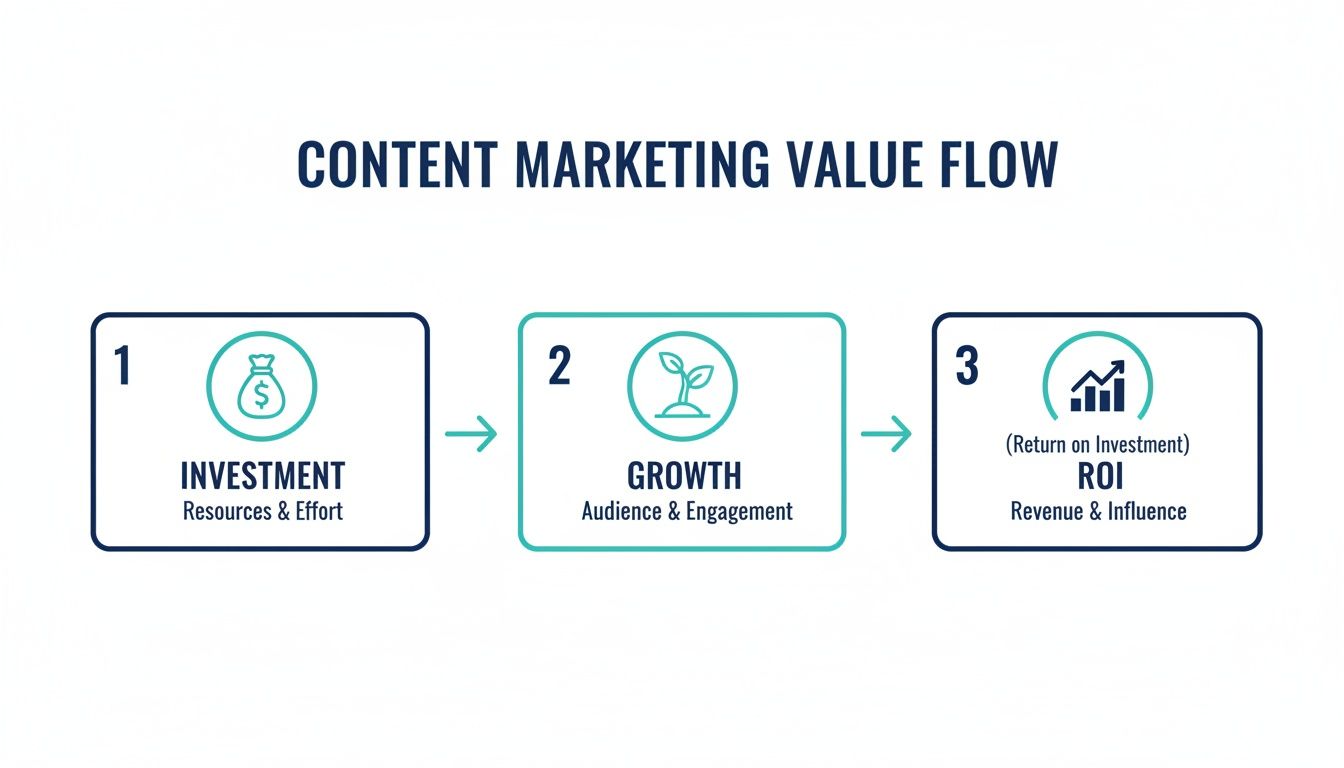
As you can see, every dollar you put into quality content is like planting a seed. With nurturing, it sprouts into growth and eventually blossoms into a return you can actually count.
Let's imagine you run a direct-to-consumer apparel brand on Shopify. You decide to go all-in on a comprehensive guide called "How to Build a Capsule Wardrobe" to attract new customers.
Step 1: Calculate Your Investment
First, you'll add up every single cost associated with creating and promoting this guide.
Step 2: Track Your Return
Using Google Analytics and your Shopify reports, you watch the guide's performance for one quarter. You discover that it directly contributed to $3,500 in sales. This revenue came from customers who clicked product links right inside the article and made a purchase. Accurately tracking this is a critical part of the process when you drive traffic to your Shopify store.
Step 3: Calculate Your ROI
Now for the fun part. You get to plug these numbers into the ROI formula:
ROI (%) = [ (Return - Investment) / Investment ] x 100
Here’s how it works out for our apparel brand:
A 307% ROI means that for every $1 you invested in that capsule wardrobe guide, you generated $3.07 in profit. That’s not just a vanity metric; it’s a powerful data point you can take straight to your team or stakeholders to justify future content budgets and prove that what you're doing is working.
That final content marketing ROI number? It's the end of the story, not the beginning. It tells you what already happened. To actually steer your content engine toward growth, you need to watch the leading indicators—the vital signs that tell you if you're on the right track long before the sales numbers come in.
Think of these metrics as the dashboard in your car. They give you the real-time feedback you need to speed up, slow down, or change direction. Focusing on them helps you spot problems early, double down on what’s working, and ultimately build a predictable system for generating returns.
While it’s a thrill to see your traffic numbers spike, raw traffic doesn't pay the bills. The real gold is in tracking the metrics that are directly tied to business outcomes. This is how you turn abstract data into strategic insights that actually impact your bottom line.
Here are the crucial KPIs every Shopify store should have on its radar:
Keeping an eye on these leading indicators is the foundational first step in truly understanding and improving the effectiveness of your marketing campaigns.
This is where the magic happens. You have to connect the dots between your content metrics and real, tangible business results. A high-ranking blog post is great, but its true worth is measured by the impact it has on sales and customer loyalty. You've got to start translating content performance into the language of revenue.
Think about how these KPIs directly feed your store’s success:
A classic mistake is looking at content metrics in a silo. The goal isn't just to rank higher; it's to rank higher for the keywords that attract customers who stick around and contribute to a higher Customer Lifetime Value. This simple shift in perspective changes the game from chasing short-term traffic wins to building long-term profitability.
To make any of this actionable, you need one central place to see what's going on. Luckily, if you're a Shopify merchant, you've got some seriously powerful tools ready to go.
The metrics you track are only half the battle. The content you actually create is the other. And when it comes to getting a powerful content marketing ROI, not all formats are created equal.
Of course, foundational, long-form blog posts are your bread and butter for building a long-term SEO asset. But in today's e-commerce world, you need formats that grab attention and drive a sale in seconds, not months.
This means you have to be strategic, prioritizing content that shortens the customer journey and turns passive viewers into active buyers. It’s all about a balanced approach, blending that deep-value, evergreen content with formats built for high impact and immediate returns.
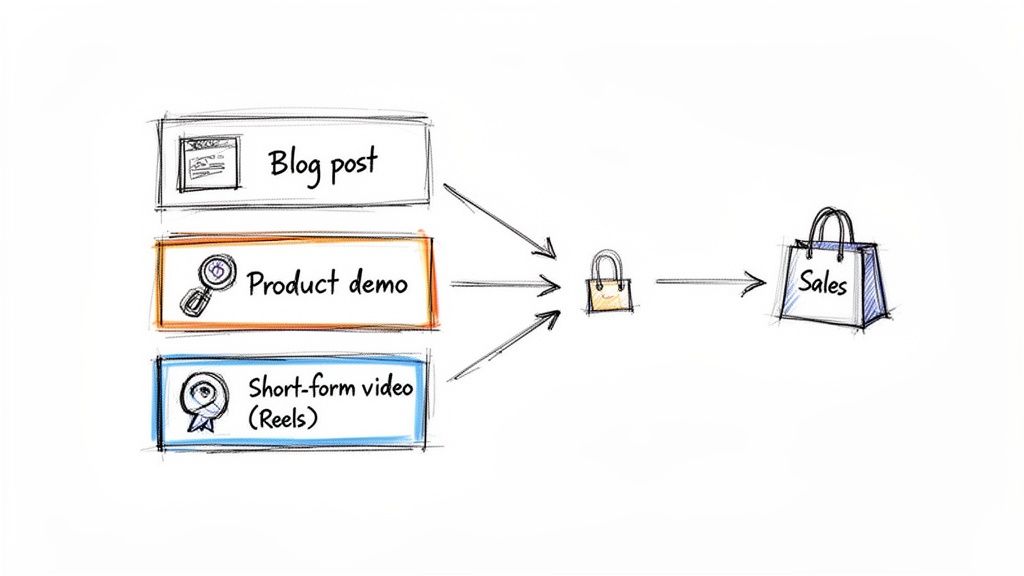
When you get this blend right, you create a powerful flywheel. The foundational stuff attracts organic traffic and builds trust over time, while the fast-paced formats convert that trust into revenue right now.
If you're serious about accelerating your ROI, short-form video isn’t optional anymore—it’s absolutely essential. Platforms like TikTok and Instagram Reels have completely rewired how people shop, creating a direct line from discovery to purchase. A well-made, shoppable Reel isn't just a piece of marketing; it's an entire sales funnel packed into 30 seconds.
And the data doesn't lie. Video is crushing it, with a staggering 93% of video marketers reporting positive returns from their efforts. Within that, short-form video is the undisputed champ.
Industry analysis predicts that 21% of marketers will point to short-form video as their highest-ROI format in the coming year. Why? Because it delivers results 49% faster than text-based content. It’s built for immediate action.
Think about the psychological impact for a second. A quick, compelling product demo taps into social proof, especially if it features user-generated content. Or it can build a huge amount of anticipation for an upcoming launch. It’s a low-commitment, high-engagement way for a potential customer to see your product in their life.
A winning strategy doesn't ditch one format for another. It uses each one to make the others stronger. Think of your foundational content as the hub of your expertise and the high-velocity formats as the spokes, driving traffic and conversions back to the center.
This combination lets you meet customers at every single stage of their journey, maximizing the return you get from every piece of content you create. An effective plan for organic lead generation truly depends on this multi-format approach.
The real magic happens when you pair this integrated strategy with smart urgency marketing. This isn't about slapping a generic countdown timer on a product page. This is about using consumer psychology to create genuine excitement and a compelling reason for people to act now. Quikly positions itself as an expert in this science, enhancing the shopper journey far beyond basic banners and popups.
A product launch video on Instagram isn't just content—it's an event. By pairing it with a time-limited "Moment" or a ranked offer, you trigger a powerful sense of FOMO (fear of missing out). Viewers aren't just watching a video; they are participating in an exclusive opportunity.
This approach transforms your content from a passive asset into an active, revenue-generating machine. For example, a behind-the-scenes video teasing a new product can be followed up with a Quikly campaign announced through Klaviyo or your SMS platform. This sequence builds anticipation and then gives customers an immediate, compelling way to release that excitement.
The result is a direct and measurable boost to your content marketing ROI. You convert engaged viewers into immediate customers and protect your profit margins by avoiding the need for deep, sitewide discounts.
Great content gets people to pay attention, but smart psychology gets them to act. To truly maximize your content marketing ROI, you must tie your content strategy to the behavioral triggers that push customers from browsing to buying. This is about applying the science of urgency, not just adding a countdown timer.
This approach isn't about deep, margin-killing discounts that devalue your brand. Instead, it’s about applying principles from behavioral economics. By creating genuine moments of scarcity, social proof, and anticipation, you can drive immediate sales. The goal is to turn shopping into an event—a high-stakes, competitive "Moment" that feels special, not like just another sale.
Many basic pop-up apps have a simple goal: capture an email. They often use generic timers without a compelling reason behind them, which feels manipulative. Sophisticated urgency, by contrast, builds a narrative that leverages real human behavior. It's about revenue generation, not just lead capture.
The core principle here is loss aversion—a concept from behavioral economics showing that people feel the pain of losing something more strongly than the pleasure of gaining something of equal value. An exclusive offer that’s about to vanish for good is a much stronger motivator than a standard discount that might return next week.
When you give a customer a real reason to act now, you’re converting the passive interest your content created into a direct, immediate sale.
Let’s say you just published a blog post showing off a new product. Instead of just ending it with a generic "shop now" link, you can pair it with a powerful conversion trigger. This is how you directly connect your content investment to a revenue number.
Here’s how a Shopify Plus store could put this into action:
This kind of sophisticated, automated campaign turns a simple content launch into a dynamic, revenue-generating event. Quikly's "Moments" are next-generation urgency marketing that goes far beyond what you can do manually, creating a far more engaging—and profitable—customer journey.
One of the biggest business impacts of this psychological approach is how it protects your bottom line. Instead of offering a flat 20% discount to everyone (including those who would have paid full price), you can create tiered or ranked offers. The most engaged customers get the best deals, protecting your overall profit margin.
This is also a fantastic way to manage inventory. You can use targeted urgency campaigns to clear out seasonal stock or move overproduced items fast, turning potential losses into profitable sales.
To take it a step further, you can combine these psychological triggers with other proven ecommerce conversion rate optimization tips. When you blend smart psychology with solid optimization practices, you create a powerful system for boosting your content marketing ROI.
If you want consistent growth, you need a consistent way to measure it. It’s time to move beyond one-off calculations and build a real reporting workflow. This turns content marketing ROI from something you look at in the rearview mirror into a forward-looking tool that actually guides your strategy.
Think of it like this: are you just occasionally checking your store's temperature, or do you have a real-time health monitor hooked up?
A structured system ensures you’re not just hoarding data, but actively using it to make smarter, faster decisions. It also happens to be the clearest way to show leadership what's working, justifying your budget and proving your team's impact in plain numbers.
This kind of formal process is quickly becoming non-negotiable. The content marketing industry is on track to hit an almost unbelievable $1.95 trillion by 2032, and that's because its return is undeniable. Still, while 83% of leaders say demonstrating ROI is a top priority, very few marketing teams have a formal system.
The ones that do? They're the ones who can point directly to the sales revenue that content is driving. You can dig into more of these ROI measurement trends in the full report.
For a Shopify store, a good reporting system doesn't have to be a beast to manage, but it does have to be consistent. Your goal is to create a single source of truth that tells a clear story to everyone involved, from your marketing coordinator to the C-suite.
Your workflow should follow a steady rhythm—monthly or quarterly—to track how you're doing against your goals. Here’s a simple blueprint to get you started.
1. Centralize Your Core Tools: Your reporting all comes down to pulling data from a few key places.
* Google Analytics 4 (GA4): This is your command center for user behavior, traffic sources, and seeing which content pieces lead to conversions.
* Shopify Analytics: This is where you get the hard sales numbers. Think average order value (AOV) and customer lifetime value (CLV), sliced and diced by traffic source.
* Google Search Console: You can't fly blind on organic search. This is crucial for watching your keyword rankings and seeing how many people are actually clicking through from your blog posts.
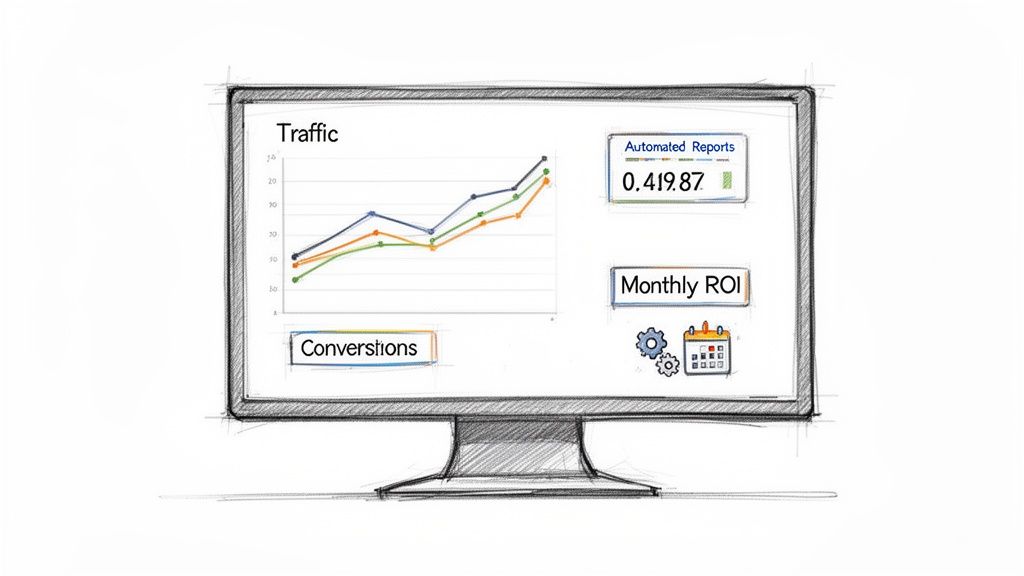
2. Design a Purpose-Built Dashboard: Don't fall into the "death by data" trap. Your dashboard should tell a story, not just throw numbers on a screen. Using a tool like Looker Studio, you can pull everything from those sources into one visual report that makes sense at a glance.
Your dashboard's main job is to answer one question quickly: "Is our content strategy working and driving revenue?" Focus on visualizing the direct line between content engagement (like organic traffic to a blog) and business outcomes (like actual sales).
3. Automate and Schedule: The secret to making this sustainable is automation. Set up your dashboard to refresh on its own and schedule it to be emailed to key people on the first of every month. This one simple step takes the manual work off your plate, guarantees consistency, and keeps content marketing ROI at the center of the conversation.
When you start digging into the numbers behind content marketing ROI, a few questions always seem to pop up. Let's tackle them head-on so you can get a clearer picture of what to expect and how to prove the value of your work.
It's the million-dollar question. While a "good" ROI can definitely vary between industries, a solid benchmark to shoot for is a 5:1 ratio. That means for every $1 you put into content, you get $5 back.
Of course, it's not always that straightforward. A new brand just getting its feet wet might aim a bit lower while building up its audience. On the flip side, well-established stores with a library of high-performing content can often hit a 10:1 ratio or even higher. The most important thing is to see consistent, positive growth over time.
Think of content marketing as a long game, not a quick win. While a punchy video campaign paired with an urgency offer can show returns in just a few days, your foundational SEO content—like blog posts—needs time to breathe. It typically takes a good 6-12 months for those pieces to start climbing the search rankings and delivering a real, measurable ROI.
The key is patience. Keep an eye on leading indicators like organic traffic growth and keyword rankings to know you're on the right track.
Remember, the goal of foundational content isn't just a quick sale; it's to build an appreciating asset. Unlike paid ads that stop working when you stop paying, a high-ranking blog post can drive revenue for years, delivering compounding returns.
The most common trap people fall into is getting hyper-focused on last-touch attribution. This means giving 100% of the credit for a sale to the very last thing a customer clicked on. It completely ignores the rest of their journey.
Think about it: a customer might discover your brand through a blog post, see a retargeting ad on social media a week later, and then finally click a promotional email to make a purchase. A multi-touch attribution model gives you a much more honest look at how all your content works together to guide customers from discovery to checkout.
Ready to turn content views into immediate sales? Quikly helps Shopify's top brands use the science of urgency marketing to create high-engagement shopping "Moments" that maximize ROI. See how Quikly can amplify your content strategy.