

ecommerce psychology
brand loyalty
best brand experiences
Getting traffic to your Shopify store is one thing, but getting the right traffic—the kind that converts into profitable revenue—is a completely different ballgame. It requires a smart mix of channels, from organic search (SEO) and paid advertising to compelling content marketing.
The most successful stores don't just chase visitor numbers. They focus on attracting high-intent shoppers and then leverage consumer psychology to guide them from discovery to purchase, maximizing the ROI of every click.
Learning how to drive traffic is just the starting line. The real goal is profitable growth, not vanity metrics like session counts that look good in a report but don't pay the bills.
Too many store owners pour money into ads only to watch visitors click away without buying a thing. It’s a classic, costly mistake that happens when you treat traffic generation as a separate task from your on-site conversion strategy. With the average ecommerce cart abandonment rate sitting around a painful 70%, it's clear there's a huge disconnect between getting people to your store and convincing them to check out.
A solid traffic strategy is like an engine—all the parts have to work together. It kicks off with pulling in the right crowd through channels like SEO and paid ads, but it must immediately shift gears into turning that attention into sales. This is where the science of behavioral economics becomes your secret weapon.
Instead of just celebrating clicks, you need to build a customer journey that smoothly guides shoppers from the moment they discover you to the final thank-you page. This means every single traffic source, whether it's an Instagram ad or a blog post, should lead to an experience designed to build trust and create buying momentum.
Here’s a simple way to visualize this process, moving from that initial spark of interest to sustainable, long-term growth.
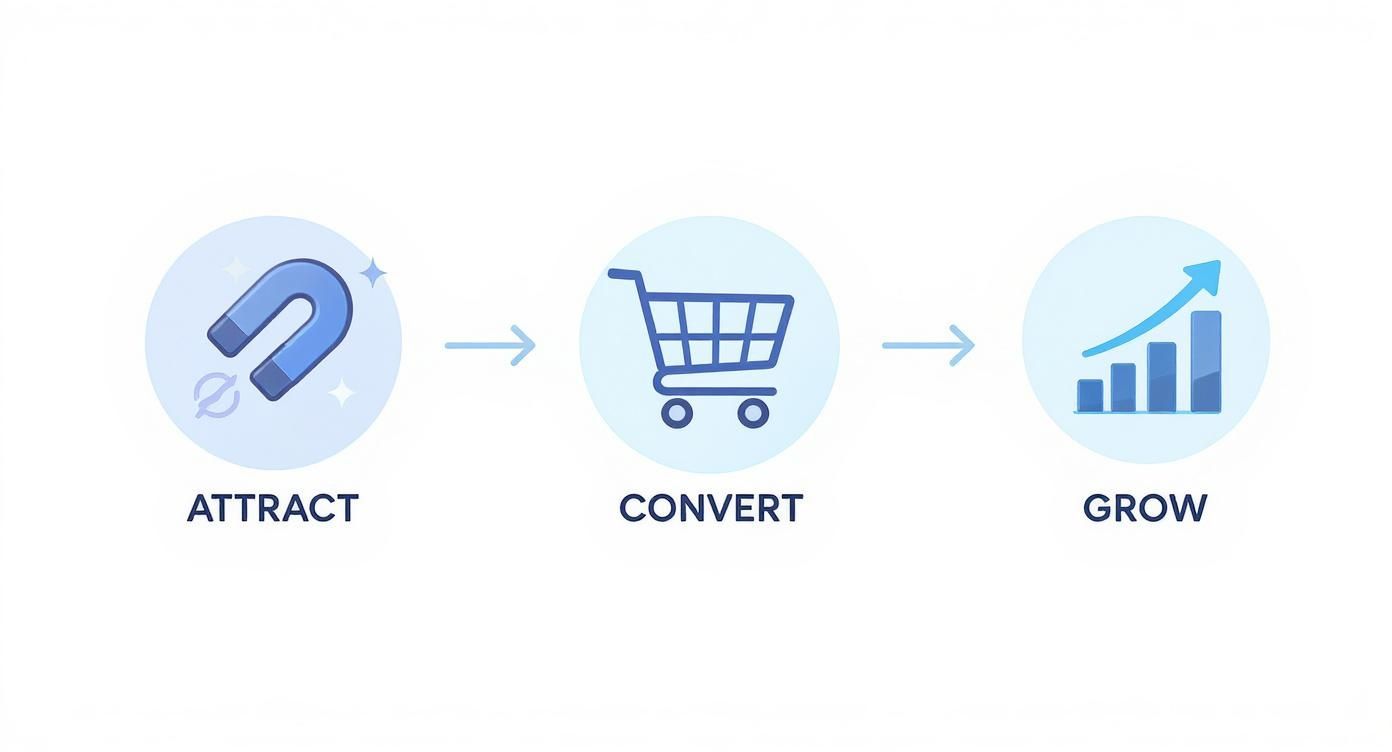
This flow really drives home the point that getting visitors is just step one. The real magic—and revenue—is in converting them and growing that customer base over time.
To give you a clearer picture of your options, here’s a quick breakdown of the primary traffic channels and what they can do for your business.
| Traffic Channel | Primary Goal | Potential ROI | Key Business Impact |
|---|---|---|---|
| SEO | Long-term organic visibility | High | Builds brand authority and sustainable, "free" traffic over time. |
| Paid Ads | Immediate, targeted traffic | Medium to High | Provides scalable, predictable traffic and sales with quick feedback. |
| Social Media | Community building and engagement | Low to Medium | Fosters brand loyalty and drives top-of-funnel awareness. |
| Content Marketing | Educate and build trust | High | Attracts qualified leads and establishes expertise in your niche. |
| Email Marketing | Nurture and retain customers | Very High | Drives repeat purchases and builds direct relationships with your audience. |
| Referrals & Partnerships | Leverage existing audiences | High | Taps into trusted networks for high-converting, warm leads. |
| Marketplaces | Expand reach | Medium | Accesses a built-in customer base ready to buy. |
Each channel has its place, but the key is making sure the traffic you generate from them actually converts once it hits your store.
Every visitor you pay to bring to your store is an investment. To maximize that return, you have to convert them efficiently. This is where sophisticated urgency marketing, powered by platforms like Quikly, goes beyond basic countdown timers.
By weaving psychological triggers like scarcity (limited quantity) and FOMO (fear of missing out) directly into the shopping journey, you create compelling "Moments" that nudge shoppers to act now. This isn't manipulation; it's the application of proven consumer psychology.
By grounding marketing tactics in behavioral economics, brands can significantly lift conversion rates without resorting to margin-killing discounts. The goal is to create authentic motivation, turning your store into a dynamic selling environment.
This sophisticated approach turns your website from a passive product catalog into an active, dynamic selling environment. It helps you protect your profit margins and move inventory faster by encouraging people to make a decision, enhancing everything from banners to popups.
The following sections will dig into the specific channels you can use to attract visitors and, more importantly, how to apply these conversion principles to every single person who lands on your store.
Paid ads can get you traffic today, but SEO is the asset that brings in high-intent customers for free, month after month. When someone types a search into Google, they have a real problem or a specific need. SEO is how you position your products as the exact solution they're looking for, right at that moment.
Done right, it's the most powerful way to generate consistent, profitable traffic for your Shopify store. This isn’t about trying to trick Google. It's about deeply understanding what your customers want and building your store to meet that demand. A solid SEO foundation turns your store into a magnet for qualified buyers, which means you can pull back on expensive ad spend and watch your organic revenue grow.

Good SEO starts when you get inside your customer’s head. What words are they actually typing into the search bar when they’re ready to pull out their wallet? The real goal is to look past the obvious, generic product names and dig up the long-tail keywords that signal someone is serious about buying.
Just think about the difference in intent here:
That second person knows exactly what they need and is way closer to making a purchase. You can use free tools like Google Keyword Planner or more advanced platforms like Ahrefs to build a list of these valuable phrases that real people are searching for. Your sweet spot is finding keywords with decent search volume that aren't impossible to rank for.
By targeting long-tail keywords, you attract a more qualified audience. These shoppers have already done their initial research and are now looking for a specific solution, making them significantly easier to convert into customers.
Once you’ve got your keywords, it’s time to put them to work. For an ecommerce store, your product and collection pages are your most valuable SEO assets. Every single one needs to be carefully optimized for its target keywords.
Here’s a practical checklist you can run through right in your Shopify admin:
/products/womens-trail-running-shoes.womens-trail-shoe-side-view.jpg).This isn't a "set it and forget it" task. You'll want to revisit your pages periodically to make sure they're still performing well. For more help, checking out the top apps for your Shopify store can uncover some powerful SEO tools to help automate and improve these optimizations.
So many Shopify stores sleep on this, but a blog is one of the best traffic-drivers you can have. It lets you rank for all sorts of keywords that your product pages could never target, establishing your brand as a go-to authority in your niche.
Let’s say you sell high-end coffee beans. You could create amazing content like:
Each blog post pulls in potential customers at different stages of their buying journey. This approach builds trust, helps you capture email subscribers, and earns valuable backlinks from other websites—a huge signal to Google that your site is a credible resource. A content strategy like this elevates your store from just a place to buy things into an indispensable resource for your customers.
SEO is a fantastic long-term play, a sustainable asset you build over time. But sometimes you just need traffic now. Hitting those aggressive revenue goals often requires a more direct approach, and that's where paid advertising becomes your best friend. It’s the fastest way to put your products right in front of a hand-picked audience on platforms like Google and Meta, driving clicks and sales from day one.
Unlike organic efforts that can take months to really get going, paid ads give you instant feedback. You can quickly test new products, different messaging, and various audiences to find a winning formula. The trick isn't just about spending money; it's about investing it smartly. You need to be obsessed with your Return On Ad Spend (ROAS) to make sure you're not just covering costs, but actually fattening your profit margins. A well-oiled paid ad machine can completely change the growth trajectory of your store.
Before you even log into an ad platform, you have to get crystal clear on who you're talking to. This is the bedrock of any good campaign. Who is your ideal customer? What keeps them up at night? What gets them excited? What kind of slang or phrases do they use?
Once you have that person pictured in your head, you can start creating ad copy and visuals that actually connect with them. A great ad doesn't just rattle off product features; it sells an outcome, a feeling, a solution to their problem. For any Shopify store, this means your visuals have to be top-notch. We’re talking scroll-stopping, high-quality product shots, lifestyle images that tell a story, or quick, engaging videos.
If you're on a platform like Shopify Plus, you can easily integrate your product feeds directly with Google and Meta, which is a lifesaver for keeping your ads updated with the latest pricing and inventory, a critical need for enterprise merchants.
When someone types a search into Google, they have a problem and are actively looking for the answer. That kind of high-intent traffic is pure gold, and Google Ads is the best tool for panning it.
For Shopify merchants, a few campaign types consistently deliver the goods:
Your success here really boils down to solid keyword research and writing ad copy that feels like a direct answer to what the person just searched for.
While Google is great for capturing existing demand, platforms like Facebook and Instagram are incredible for creating it. People scrolling through their feeds are in discovery mode, which makes it the perfect opportunity to introduce your brand to someone who doesn't even know they need your product yet.
A couple of advanced strategies can really pour fuel on the fire:
Retargeting is non-negotiable. Someone who has already visited your site and looked at a product is infinitely more likely to buy than a total stranger. Dynamic ads are that personalized little nudge that brings them back to finish what they started.
When you combine Google's demand-capture power with Meta's demand-generation muscle, you build a complete, full-funnel advertising strategy. This doesn't just drive sales today; it builds a healthy pipeline of future customers, giving you a predictable and profitable way to scale your Shopify store.
If SEO is your foundation and paid ads are your rocket fuel, then content and social media are the soul of your brand. This is where you stop thinking about one-off transactions and start building a real community—a group of loyal fans who not only buy from you repeatedly but also become your biggest advocates.
It’s all about creating an ecosystem where your brand is seen as a source of genuine value. This goes way beyond just having a blog. We're talking about connecting with your audience where they already spend their time, whether that's through the visual storytelling of Instagram, the viral energy of TikTok, or a tight-knit Facebook Group. The goal isn't just to be another store; it's to become a trusted voice.
One of the biggest mistakes brands make is spreading themselves too thin. You don't need to be everywhere. You need to be where your ideal customers are actually hanging out and engaging.
Think about it: a high-fashion brand is going to kill it on Instagram and Pinterest. But if you’re selling complex tech gadgets? You’d be better off creating deep-dive tutorials on YouTube.
Once you’ve picked your channels, consistency is the name of the game. Get a content calendar in place. It doesn't have to be fancy, but you need a plan for what you're posting and when to keep your audience hooked and your brand top of mind.
Your content needs to do more than just scream "buy now!" It should educate, entertain, or inspire. This is how you build trust and position your brand as an expert, making it a no-brainer for customers to buy from you when they're ready.
For instance, a skincare brand could create tutorials on nailing a morning routine. A home goods store could share quick tips on seasonal decorating. You're answering their questions and solving their problems, which naturally leads them to the products you sell.
A huge part of this ecosystem is encouraging user-generated content (UGC). When a customer posts a photo of themselves loving your product, it’s pure gold. It’s authentic social proof that’s infinitely more powerful than any ad you could create.
A Stackla study found that 79% of people say UGC highly impacts their purchasing decisions. It’s a clear signal to other shoppers that your products actually deliver.
Your social media channels should be a direct pipeline to your other marketing efforts, especially email. Your followers are already warm leads. They're the perfect people to invite onto your email list, where you can build a much deeper, one-on-one relationship. For a full playbook on this, check out our guide on building an email list.
When you connect your social strategy to an email platform like Klaviyo, things get really powerful. Imagine running a contest on Instagram where people enter by signing up for your newsletter. You can then tag those new subscribers and drop them into a tailored welcome series that introduces your brand and offers a special discount. It's a smooth journey from casual follower to first-time buyer.
Influencer marketing is another way to pour gas on the fire. When you partner with creators who your target audience already knows and trusts, you get to tap into a pre-built community. For a deep dive into making this work, these Shopify influencer marketing strategies are a great resource. This kind of integrated approach makes sure your social media efforts don't just rack up likes—they generate real revenue.
Getting traffic to your Shopify store is a great start, but it's only half the battle. The real magic—where revenue and profit actually happen—is in turning those visitors into paying customers.
With the average ecommerce store converting at just 2.5%, if you're only focused on driving more traffic without a solid plan to convert it, you're essentially just pouring water into a leaky bucket.
This is where the science of urgency marketing becomes your secret weapon. It’s all about applying proven principles from behavioral psychology to give shoppers a gentle nudge toward making a purchase. Instead of letting visitors browse and leave, you create an environment that turns their interest into action. Right now.
Effective urgency isn't about slapping a generic countdown timer on a product page. Today's shoppers are too savvy for that. Real urgency is rooted in the fundamental psychological triggers that quietly influence our decisions.
When you understand these drivers, you can move past clunky, manipulative tactics and create genuine motivation. The goal is to make the decision to buy feel like the smartest, most natural choice for the customer in that moment. For a deeper dive into how to apply these, you can explore a whole range of Shopify urgency tactics that are built on these very principles.
The old-school timer apps just don't cut it anymore. They're usually static, a pain to manage manually, and they apply the same generic pressure to every single visitor. This one-size-fits-all approach feels impersonal and, frankly, inauthentic.
A much smarter strategy involves creating dynamic "Moments" of urgency that are personalized and automated. This is where a platform like Quikly really shines, transforming your whole site into a responsive selling machine. Instead of using a single blunt instrument, you can deploy a series of subtle, intelligent behavioral triggers all along the customer journey.
The most effective conversion strategies are deeply integrated into the shopping experience, not just bolted on. By using automated behavioral triggers, you create a seamless sense of momentum that guides the shopper from discovery to checkout without feeling forced.
Imagine this: a shopper lands on a product page. An automated banner pops up showing how many other people are looking at that same item (social proof). They add it to their cart but then hesitate. A moment later, a subtle notification reminds them the item is low in stock and their cart reservation will expire (scarcity).
This is next-generation urgency. It's contextual, personal, and far more effective at driving revenue than a basic timer or an email-capture popup.
One of the biggest business impacts of intelligent urgency is its ability to protect your profit margins. Instead of running deep, site-wide discounts that kill your bottom line, you can use targeted, limited-time offers to create sales velocity where you need it most.
This approach is perfect for moving specific inventory, clearing out seasonal items, and avoiding the trap of becoming a brand that's always on sale.
This is especially critical in today's mobile-first world. A staggering 79% of all traffic to Shopify stores now comes from mobile devices, and an impressive 69% of purchases are completed on mobile. An optimized mobile experience combined with clear, urgent calls-to-action is non-negotiable for converting this massive audience.
To really get the most out of all the traffic you're working so hard to acquire, putting conversion rate optimization best practices into place is the final, crucial step. It’s what ensures every dollar you spend on SEO, paid ads, and social media delivers a measurable and profitable return. By converting visitors more efficiently, you make every single one of your marketing channels work that much harder for your business.
Trying to drive traffic to your Shopify store without a solid measurement plan is like driving with your eyes closed. You can't fix what you don't measure, and if you’re tracking the wrong things, you’re just lighting your marketing budget on fire.
To actually grow profitably, you have to get past the vanity metrics—things like website sessions or how many likes your last Instagram post got. It's time to focus on the key performance indicators (KPIs) that actually put money in your bank account. A data-first mindset helps you see which channels are pulling their weight and which are just dead weight, letting you double down on the winners and cut the losers.
If you want a real snapshot of your store's health, you need to obsess over a few core metrics. These are the numbers that shift the conversation from "How many visitors did we get?" to "How much money did those visitors make us?"
Get a handle on these four metrics, and you can diagnose almost any problem in your marketing funnel. For example, if a Facebook ad campaign has a sky-high CPA but the customers it brings in have a low CLV, that's your cue to pull the plug on that campaign right now and put the money somewhere else.
Your Shopify dashboard is a great place to start. It gives you a quick, clean overview of sales, top-selling products, and where your traffic is coming from. It’s perfect for those daily check-ins to see how things are trending.
But when you're ready to get serious and really understand how people behave on your site, plugging in Google Analytics is a total non-negotiable.
Google Analytics lets you follow the entire customer journey, from the exact search term they used to find you to the pages they clicked on before they finally bought something (or bailed). You can see which channels are sending you your most profitable customers and, just as importantly, where people are dropping off during checkout. It's like having a roadmap to fixing the leaks in your funnel.
For bigger stores on Shopify Plus, this kind of granular data is even more critical. You're not just optimizing a single campaign; you're fine-tuning a massive engine and personalizing the experience for thousands of customers at once.
When you're trying to grow your Shopify store, a ton of questions pop up about how to get more of the right kind of traffic. Here are answers to a few of the most common ones.
SEO is a marathon, not a sprint. It’s an investment in your brand’s long-term health and authority.
You might start seeing a little bit of movement in as little as three to four months, especially if you’re targeting very specific, long-tail keywords. But for the kind of significant, sustainable organic traffic that really moves the needle? You're typically looking at 6 to 12 months of consistent, focused effort. That means creating genuinely helpful content, obsessively optimizing your product pages, and earning quality backlinks.
Paid ads can get you traffic tomorrow, but a solid SEO strategy builds a free, high-intent source of customers that becomes one of your most valuable business assets over time.
This is the million-dollar question. A practical starting point for most new Shopify stores is somewhere between $500 and $1,000 per month.
That budget is usually just enough to get your feet wet. It gives you enough runway to gather meaningful data on what’s working, test a few different ad creatives and audiences, and start dialing in your campaigns for actual conversions.
Don't just obsess over clicks. The metric that truly matters is your Return On Ad Spend (ROAS). Once you find a campaign that's consistently making you more money than you're putting in, you can scale that budget with confidence and pour gas on the fire.
Yes, you absolutely can. Building a steady stream of traffic without spending a dime on ads is totally possible, but it requires a different kind of currency: your time and effort. It's all about "sweat equity."
And these organic channels are incredibly powerful for building a real brand. Here’s where you should focus your energy:
These aren't just traffic tactics; they're the foundation for a loyal customer base and a much more sustainable, long-term business.
Driving traffic is only half the battle. Converting that hard-earned traffic is where the profit is made.
Quikly is the expert in urgency marketing science, helping you turn more visitors into buyers by weaving proven behavioral psychology into your store's shopping experience. You can create dynamic, margin-friendly moments of urgency that get shoppers to take action.
See how Quikly can transform your conversion rates at https://hello.quikly.com.