

ecommerce conversion
customer experience strategy
digital customer experiences
At its core, the fear of missing out (FOMO) is a psychological response to the possibility of missing a rewarding experience others are having. In e-commerce, this translates into a powerful principle from behavioral economics that motivates customers to act decisively.
Understanding this concept is the key to creating authentic excitement and urgency around your products, protecting profit margins, and driving measurable revenue growth.
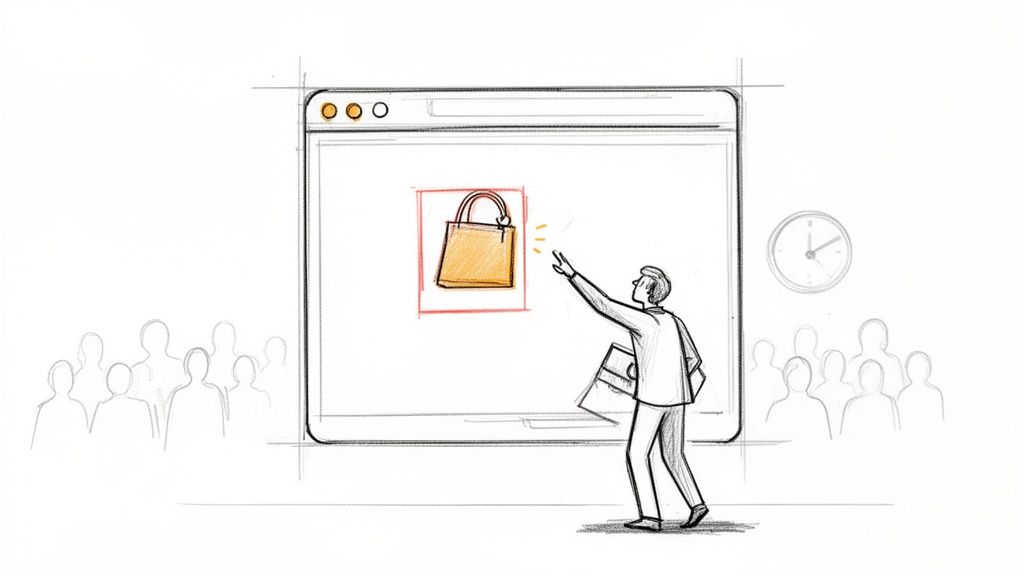
We've all felt it. You see friends posting from a concert you skipped, or you hear about an amazing flash sale hours after it ended. That feeling is FOMO, and it’s a fundamental driver of human behavior, rooted in our deep-seated desire for social connection and our fear of being left behind.
In the world of e-commerce, FOMO isn’t just a fleeting emotion; it’s a major force in consumer psychology that directly impacts buying decisions. When a shopper on your Shopify store sees a product is almost gone or a special deal is about to expire, FOMO kicks in and creates a powerful sense of urgency.
That urgency is what collapses the time between "just browsing" and "add to cart," turning passive lookers into decisive buyers and helping to overcome the industry's average 70% cart abandonment rate.
This isn’t just a hunch—consumer psychology studies back it up. Research shows that roughly 69% of people in the U.S. have experienced FOMO. More importantly for e-commerce brands, 60% of millennial consumers admit to making a reactive purchase because of it, usually within 24 hours. If you want to dig deeper into the subject, you can explore the benefits of FOMO for consumers.
To really grasp how FOMO works in an online store, it helps to break it down into its core psychological triggers. Each one taps into a specific human instinct that encourages a shopper to act.
This table unpacks the key psychological drivers behind FOMO and shows how they translate directly into shopper actions on your site.
| Psychological Trigger | Definition in E-Commerce | Resulting Shopper Action |
|---|---|---|
| Social Proof | Seeing others buying or enjoying a product, creating a desire to join the "in-group." | Purchasing a popular or trending item to feel part of the community. |
| Scarcity | The perception that a product is in limited supply, making it seem more valuable or desirable. | Buying now to avoid the product selling out, often without hesitation. |
| Urgency | A time constraint on an offer or product availability, compelling immediate action. | Making a purchase quickly to secure a deal before it expires. |
| Exclusivity | The feeling of being part of a select group with special access to products, sales, or information. | Signing up for a loyalty program or buying from a limited-access drop. |
| Loss Aversion | The instinct to avoid losing a potential gain (like a discount or a unique item) more than seeking one. | Completing a checkout to avoid the regret of missing out on the opportunity. |
By weaving these elements into your marketing, you're not just selling a product; you're creating an experience that resonates on a much deeper, psychological level.
When used thoughtfully, FOMO is much more than a marketing tactic. It’s a strategic lever for achieving real business goals. By building campaigns around genuine scarcity or exclusivity, brands can unlock significant benefits:
Ultimately, understanding what fear of missing out truly means for your customers helps you move beyond basic popups and countdown timers. You stop just capturing emails and start architecting compelling "Moments" that generate immediate revenue and build long-term brand equity. This approach, grounded in urgency marketing science, turns your marketing from a simple cost center into a predictable revenue driver.
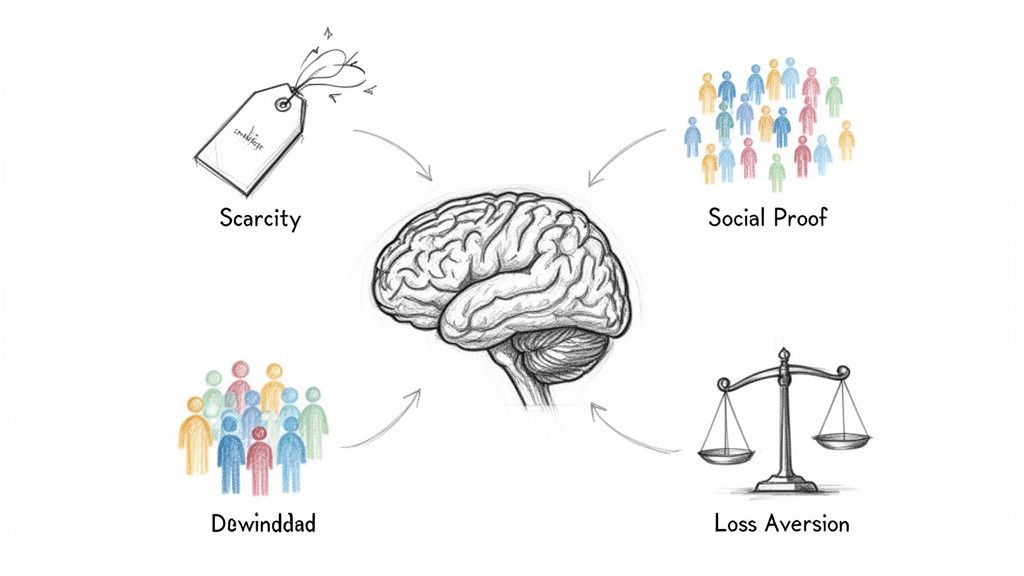
To effectively leverage FOMO, you have to understand the behavioral science that makes it work. It isn't a random feeling—it's a hardwired human response to specific psychological triggers. When you understand these triggers, you can elevate a standard marketing campaign into an event that customers can’t ignore.
Ultimately, FOMO marketing is applied behavioral economics. It’s about moving past generic popups and basic timers to tap into the fundamental wiring of your customer's brain. The goal isn't manipulation; it’s about aligning your offers with the mental shortcuts people naturally use to make decisions every day.
Three core principles combine to create that powerful urge to buy: loss aversion, scarcity, and social proof. Each one activates a different part of our human psychology, and when combined, they create a genuine sense of urgency that feels completely natural.
Here’s a fascinating principle from behavioral economics: research consistently shows that the pain of losing something feels about twice as intense as the pleasure of gaining something of equal value. That’s the core idea behind loss aversion.
For a Shopify merchant, this means your customers are often more motivated by the fear of losing a great deal than they are by the excitement of getting one. An expiring offer isn't just a sales tactic; it's a direct line to this powerful cognitive bias. The thought of "missing out" on a discount actually triggers a stronger emotional reaction than the deal itself, pushing shoppers to check out now just to avoid that feeling of future regret.
By framing an offer around what your customer stands to lose, you create a much stronger reason to act immediately. It shifts their mindset from "I'll think about it" to "I can't let this get away."
It’s a simple rule of human nature: when something is limited, our brains automatically perceive it as more valuable. This is the principle of scarcity. Whether it's a limited-edition sneaker drop or a special deal for the first 100 people, scarcity signals exclusivity and makes the item feel more desirable.
This is a world away from a simple countdown timer that just puts a clock on an offer. Real scarcity is based on quantity. When a customer sees there are only a handful of items left in stock, the product instantly seems more special and unique, creating a powerful nudge to buy it before someone else does.
We are inherently social creatures. We’re wired to look at what other people are doing to determine how we should act. That, in a nutshell, is social proof. When we see other people buying a certain product, our brain interprets that as a signal that it's the right choice.
In e-commerce, this plays out in several key ways:
When you demonstrate that an item is in high demand, you’re not just manufacturing hype. You’re providing shoppers with a mental shortcut that cuts through indecision and gives them the confidence they need to click the "buy now" button.
If FOMO is a fire, social media is the gasoline. It’s a never-ending stage where the fear of missing out plays out in real-time. Platforms like Instagram and TikTok are a constant stream of product reveals, live unboxings, and flash drops that can spark an immediate, almost primal, desire to buy.
For Shopify brands, this means every single post has the potential to become an urgency trigger, nudging shoppers from casual scrolling straight to checkout. By weaving scarcity, social proof, and anticipation into your content, you’re not just posting—you’re creating genuine excitement that translates into real revenue.
Social media platforms have essentially become the world's most effective distribution system for FOMO. A staggering 72% of FOMO is driven by Facebook, with 14% from Instagram, and 11% from Twitter. Think about that. With 20% of people checking their feeds at least once an hour, every post you don't make is a potential sale you've missed. You can dig into more of these stats over at OptinMonster.
This creates a constant feedback loop. Shoppers are primed for urgency-based marketing because they’re constantly seeing what others have. When they repeatedly see their peers celebrating a new product, their brains start to equate its availability with its value, dramatically shortening the path from "that's cool" to "I need it now."
When an influencer unboxes your product, they're tapping directly into the power of social proof. What was once a single person’s endorsement quickly snowballs into a communal desire. A case study with a skincare brand showed that timing a new product drop with an influencer reveal led to a sales spike of over 30% in just a few hours.
User-generated content is also critical. Posts tagged with your brand hashtag are authentic stories from real customers, and that kind of organic buzz resonates far more deeply than a polished ad ever could. Plus, it gives you a treasure trove of fresh visuals for dynamic retargeting campaigns.
“When social proof meets scarcity, consumer urgency spikes up to 25% in the first 24 hours.”
Start by using Shopify’s own social sales channels to create shoppable posts right on Instagram and Facebook. Take it a step further by pairing these posts with Quikly Moments that show live inventory counts and timed offers for specific products.
Keep the momentum going by reposting user-generated images in your Stories and feeds. You can then connect these social touchpoints to your Klaviyo email flows and SMS alerts, segmenting audiences based on how they've engaged with you on social.
Here are a few actionable takeaways:
Tapping into your community's engagement on social media doesn't just amplify FOMO—it builds the kind of trust that drives full-price sales. By becoming a part of this ecosystem, Shopify merchants can turn every like, comment, and share into a tangible impact on their bottom line.
For a deeper dive into this, check out our guide on the psychology of influencer marketing to get more actionable insights.
Knowing the psychology behind FOMO is one thing. Turning that knowledge into actual revenue is another game entirely. It’s about moving past basic tactics and building high-impact campaigns that create a genuine sense of urgency—all while protecting your profit margins and boosting ROI.
Many Shopify stores get stuck using generic countdown timers. While a simple clock can create a bit of a push, it often feels disconnected from the shopper's real experience. It lacks the behavioral triggers that drive truly exceptional results. Real urgency marketing gets to the "why" behind the "buy now" impulse, using real scarcity and social proof to make the sale.
This is the difference between just showing a clock and creating a compelling "Moment" that customers are genuinely excited to be a part of. One captures an email address; the other generates immediate revenue.
This is how FOMO works in the wild—it's an interconnected cycle between brands, influencers, and the users watching it all unfold.
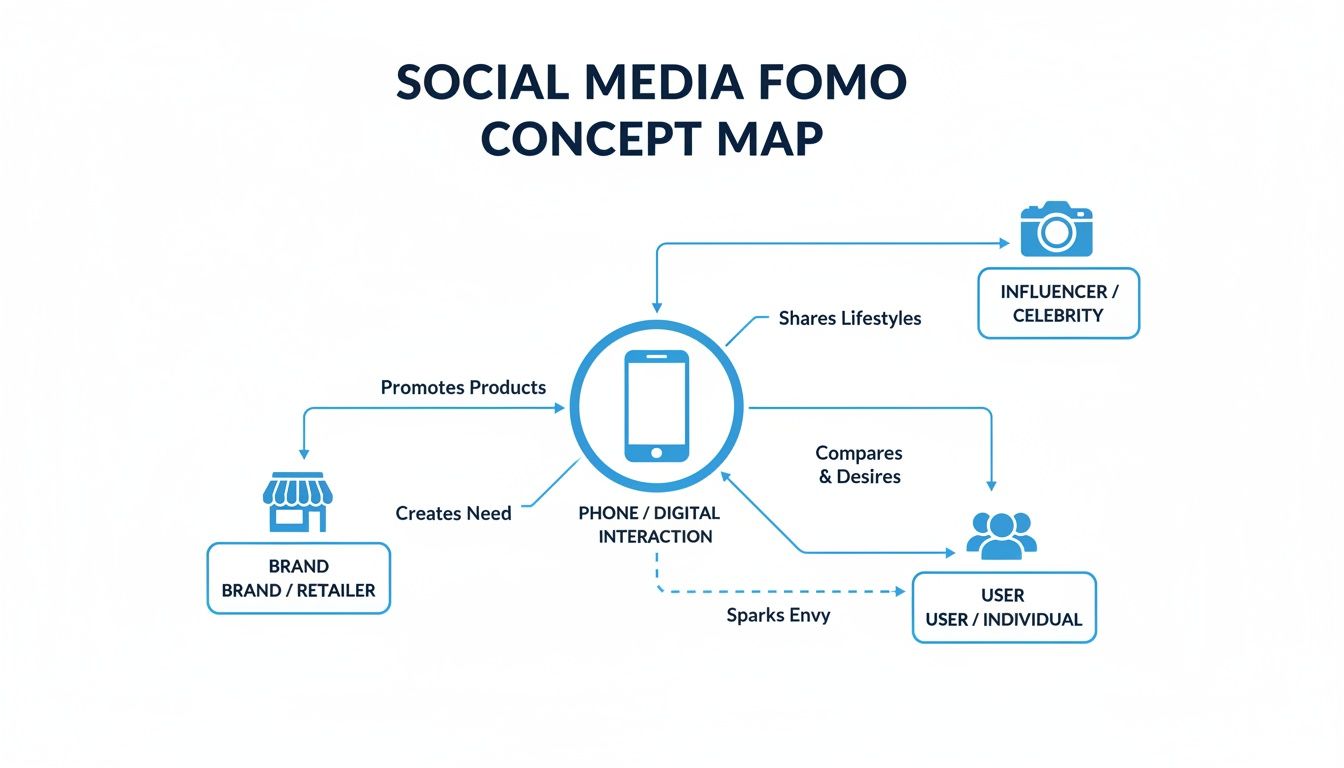
As you can see, a brand's message gets a massive boost from influencers, creating the social proof that directly nudges shoppers toward the checkout.
Instead of a one-size-fits-all approach, the smartest FOMO marketing uses different campaign structures that match specific business goals, whether that’s moving inventory faster or rewarding your most loyal fans.
Most merchants are familiar with basic urgency tactics, but the real growth comes from layering in sophisticated behavioral triggers. Here’s a quick breakdown of the difference.
| Feature | Basic Countdown Timers/Popups | Advanced Urgency (Quikly) | Primary Business Impact |
|---|---|---|---|
| Personalization | Generic, one-size-fits-all offers | Offers tailored to individual behavior & loyalty | Higher conversion rates & AOV |
| Scarcity | Often artificial or site-wide | Based on real-time inventory and demand | Authentic urgency, protects brand trust |
| Social Proof | Basic "X people are viewing this" | Dynamic, competitive environment (e.g., ranked offers) | Creates a viral "event" shoppers want to join |
| Integration | Limited; works in isolation | Seamlessly connects with Klaviyo, Attentive, etc. | Cohesive, multi-channel campaigns that scale |
| Margin Impact | Can lead to "discount training" | Protects margins via true scarcity & ranked rewards | Increased profitability and revenue |
While basic tools can provide a small lift, they simply can't create the kind of high-stakes, engaging shopping moments that advanced platforms deliver—moments that drive significant, measurable revenue. These next-generation urgency marketing "Moments" are powered by sophisticated automation, not manual campaign management.
The real magic happens when you weave these campaigns into your existing marketing tools. For Shopify Plus merchants, this kind of automation is the key to scaling revenue without piling on more manual work.
Actionable Tip: Announce a limited drop in a Klaviyo email. Customers click through to a landing page where a Quikly campaign shows the inventory dwindling in real time. At the same moment, SMS alerts from a tool like Attentive hit the waitlist subscribers, letting them know the drop is live. You’ve just created a powerful, multi-channel urgency event that enhances the entire shopper's journey.
To really nail down a core tactic in this space, check out this ultimate guide to personalized countdown clocks.
The numbers don't lie. Research shows 73% of millennials have spent money they didn't have because of FOMO, and a whopping 60% of them make reactive purchases within 24 hours of feeling it. When you connect these psychological triggers to your campaigns, you turn a powerful emotion into predictable revenue.
There’s a fine line between a powerful marketing moment and outright manipulation. When we talk about the fear of missing out, the key to staying on the right side of that line is authenticity. The goal isn't to create short-term anxiety; it's to build genuine urgency that actually adds value to your customer's experience, making your brand a trusted source for exciting opportunities.
When urgency is tied to real business conditions—like actual inventory levels or a planned promotion—it feels authentic and helpful. But fabricated scarcity? That erodes trust almost instantly. A customer who rushes to buy something labeled "almost gone" only to see it fully stocked the next day doesn't feel rewarded. They feel deceived. This positions urgency marketing not as manipulation, but as sophisticated psychology.
Building an ethical FOMO strategy is all about aligning your marketing with reality. This isn’t just about dodging shady tactics; it’s about creating a predictable and rewarding experience that turns one-time buyers into loyal fans who can’t wait to see what you do next.
Here are the core principles to keep in mind:
An ethical FOMO campaign answers the customer's question, "Why should I act now?" with a truthful and compelling reason. It’s the difference between a helpful heads-up and an unnecessary panic.
This is where things get interesting. Sophisticated urgency marketing platforms like Quikly are moving beyond basic countdown timers to create engaging "Moments" that transform anxiety into positive anticipation. Instead of just cranking up the pressure, these campaigns are designed as events people want to be a part of. It’s an approach that respects the shopper's intelligence and fosters a much healthier, more exciting relationship with your brand.
By grounding your strategy in real-world constraints and transparent communication, you do more than just drive sales. You prove to your customers that your brand is a reliable guide to great opportunities, making them feel confident and respected with every single purchase.
Good marketing isn’t just about getting clicks or seeing a temporary spike in conversions. To really understand what your FOMO campaigns are bringing to the table, you have to look at the metrics that signal genuine, sustainable growth for your business.
It’s easy to get excited about surface-level data, but the real story is always in the ROI and revenue impact. While a higher conversion rate is obviously a great start, a truly effective FOMO strategy should be driving bigger business outcomes—the kind that protect your revenue and build a stronger brand.
If you want to build a solid business case for your efforts, these are the KPIs you need to be watching. They tell you the real ROI of what you’re doing.
Looking at these metrics together gives you a much richer picture of a campaign's health. Of course, you’ll also want a firm grasp on how to calculate marketing ROI to connect your strategy directly to the bottom line.
When you put your results into context—especially against industry benchmarks like the average 70% cart abandonment rate—the lift from a well-run FOMO campaign becomes impossible to ignore. For a complete guide on looking at the numbers, check out our post on how to measure marketing campaign effectiveness. This is how you prove that strategic urgency is more than just a gimmick; it’s a powerful engine for real growth.
As you think about weaving urgency marketing into your Shopify store, a few questions are bound to pop up. Let’s tackle some of the most common ones we hear from merchants.
This is the big one, and the answer comes down to one word: authenticity.
Ethical FOMO marketing is all about giving your customers a heads-up about real opportunities. Think of it as enhancing their shopping journey by letting them know about genuine scarcity or a fleeting deal. You’re being transparent, and that builds trust.
Where things get sketchy is when brands invent false scarcity just to create anxiety. The goal should always be to provide real value that earns long-term loyalty, not to pressure someone into a single purchase they might later regret.
It’s a fair question. A standard timer app puts a clock on a page, creating a simple, one-dimensional sense of urgency. But more advanced platforms use a much richer psychological playbook, pulling in elements like social proof, competition, and tiered rewards to build a far more compelling experience.
Instead of just sticking a generic clock on your site, this strategy helps you create a dynamic, engaging "event" or "Moment." It’s an approach that drives way more engagement and revenue, while also letting you connect everything to your marketing stack, like Klaviyo and SMS platforms. Basic timers generate clicks; sophisticated urgency generates revenue.
If you’re looking for the perfect entry point, start with a limited-quantity drop. It’s ideal for a brand-new product or a special edition of a fan favorite.
This tactic naturally has both scarcity (only so many are available) and social proof (everyone’s scrambling for the exclusive item) baked right in.
The reason for the urgency is crystal clear and authentic, making it easy to shout about across your email, SMS, and social media channels. You’ll see a concentrated burst of full-price sales and generate some serious brand excitement, which is the perfect foundation for more ambitious campaigns down the road.
Ready to turn those casual browsers into committed buyers? With Quikly, you can create high-impact urgency campaigns that boost your revenue and build a loyal following, all integrated seamlessly with your Shopify store. See how we make it happen at https://hello.quikly.com.