

ecommerce conversion
customer experience strategy
digital customer experiences
Think of your social media feed as the new digital mall. Instead of seeing an ad and clicking away to some other website, your customers can now browse, pick out what they want, and buy it—all without ever leaving their favorite app. That’s the magic of social commerce platforms.
Your brand's social feed stops being just a marketing channel and becomes a fully functional, shoppable storefront that drives immediate ROI.
This shift is more than just a convenience; it's a total rewrite of the path to purchase based on consumer psychology. The old-school sales funnel—where you guide customers from awareness to consideration and hope they eventually land on your separate online store—is being compressed into a single, seamless interaction.
For Shopify merchants, this is an absolute game-changer. It turns passive scrolling into active, in-the-moment buying.
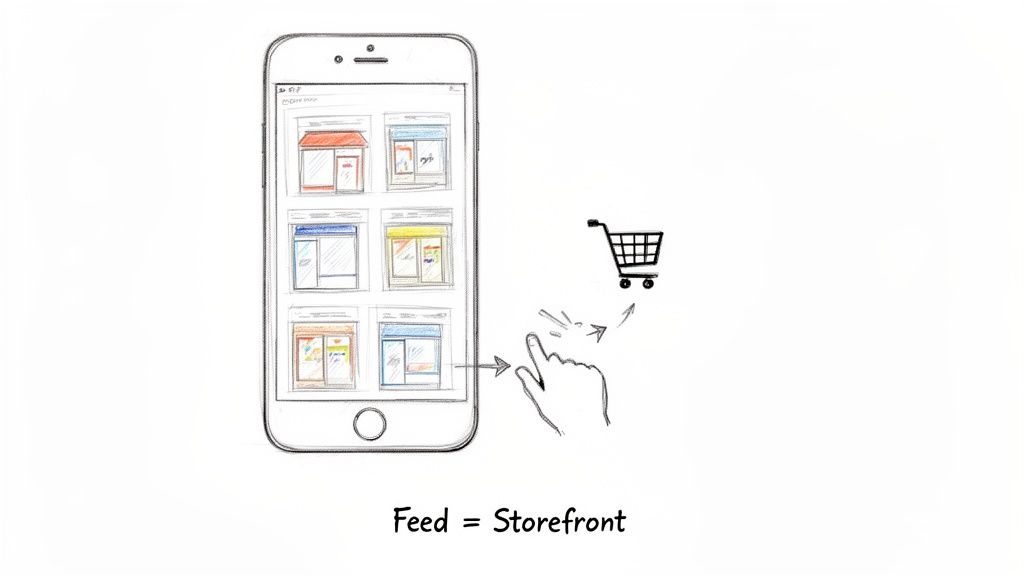
The real power here is capturing impulse purchases driven by discovery and social proof. When someone sees a product they love in a post or a video, the friction to buy is practically zero. This immediacy significantly impacts core business metrics:
The numbers are compelling. The global social commerce market has seen explosive growth, flying past the $500 billion mark in 2023 and hitting $570.7 billion. The momentum kept going into 2024 with a 22.6% year-over-year jump, pushing the market to $699.4 billion.
These figures point to a critical new reality: social commerce is on track to make up 19.4% of all global e-commerce sales in 2024.
To see how much the game has changed, let's compare the old way with the new.
| Attribute | Traditional E-commerce | Social Commerce |
|---|---|---|
| Customer Journey | Linear: Awareness > Consideration > Purchase | Integrated: Discovery and Purchase happen in one place |
| Point of Sale | Dedicated website or online store | Directly within the social media app |
| Marketing Focus | Driving traffic to an external site | Creating shoppable, engaging content |
| Key Metric | Click-Through Rate (CTR) | In-app Conversion Rate & Revenue |
| Sales Driver | Intent-based search and promotions | Impulse, discovery, and social proof |
This table highlights the core difference: Traditional e-commerce is a destination you must lead people to. Social commerce meets them right where they are.
At its core, social commerce aligns your sales strategy with how people actually behave today. It puts your products right where customers are already spending their time, creating a natural, intuitive shopping experience that feels less like a transaction and more like part of their daily scroll.
In this fast-paced environment, creating a sense of urgency is what turns attention into action. This is where consumer psychology becomes your most valuable asset. Behavioral economics principles like scarcity (limited stock) and FOMO (Fear of Missing Out) are profoundly effective in a social setting.
We're not talking about basic countdown timers that shoppers ignore. Sophisticated urgency marketing, the science Quikly perfects, uses real behavioral triggers to enhance banners, popups, and the entire shopper journey, compelling an immediate purchase.
For businesses ready to dive in, learning how to create a shop on Instagram is a direct line to your customers. It lets you build a dedicated storefront inside one of the most powerful social commerce platforms out there. If you want to zoom out and see the bigger picture, you might be interested in the core benefits of social media marketing.
By combining a native storefront with smart, psychologically-grounded marketing, brands can protect their profit margins and drive significant ROI.
To maximize revenue in social commerce, you have to know where the game is being played. While it’s a global phenomenon, North America—and the United States in particular—is a massive opportunity for Shopify merchants. Why? Because of high digital adoption rates and sophisticated platform integrations.
Understanding these regional dynamics isn't just about chasing trends. It's about making smarter investments in your marketing stack, allocating ad spend effectively, and carving out a significant competitive edge.
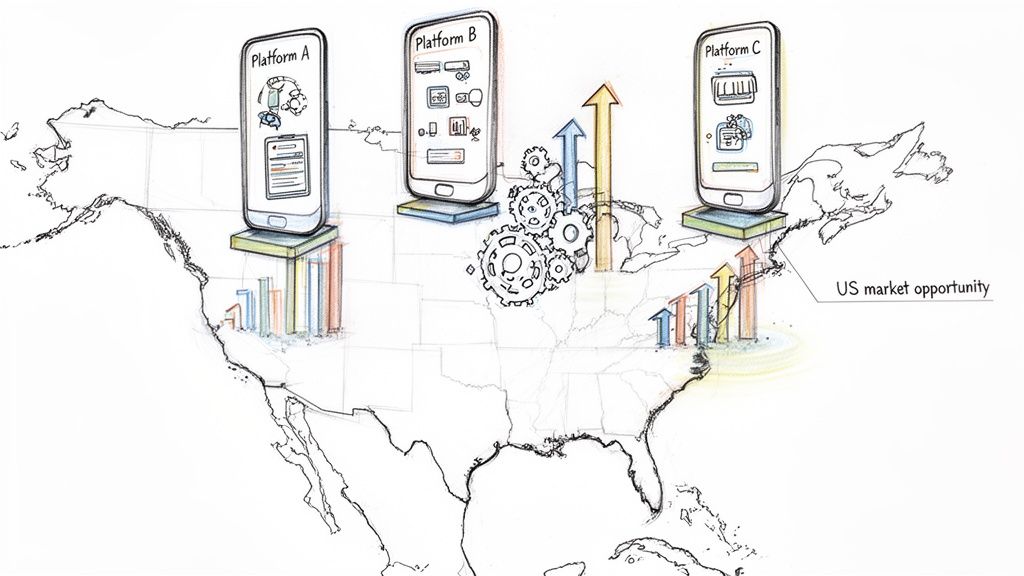
The American consumer base is not just large; it's also incredibly comfortable with in-app shopping. North America commands a huge piece of the global social commerce pie, accounting for roughly 34% of the market share.
By 2026, U.S. sales are projected to exceed $85.58 billion, making it the second-largest market in the world. For anyone on Shopify and Shopify Plus, this is a clear signal: the U.S. is fertile ground for growth, where the right strategy can lead to substantial revenue. You can find more insights on the social commerce landscape and its massive potential.
This explosive growth is being fueled by major social commerce platforms that have perfected the art of turning casual scrolling into sales. The enterprise brands that master these dominant platforms will capture a giant share of this expanding market.
Not all social platforms are created equal when it comes to driving revenue. For Shopify merchants, the key is to focus on the ecosystems with the most powerful, built-in shopping features to achieve the best ROI.
Here’s a look at the heavy hitters shaping the U.S. market today.
Facebook Shops: As an original player, Facebook still holds immense power. Its Shops feature attracts over 250 million monthly engagers, and the platform is on track to hit 80 million social shoppers in the U.S. by 2026. Its greatest strength? A very broad demographic reach that’s perfect for brands targeting Gen X and Millennial buyers.
Instagram Checkout: More than just a photo-sharing app, Instagram has evolved into a full-blown sales engine. It excels with visually driven products—think fashion, beauty, and home decor. The user base leans younger, primarily Millennials and Gen Z, who are highly influenced by influencer marketing and limited-edition drops.
TikTok Shop: This is the fastest-growing force in the space, completely redefining "shoppertainment." TikTok's algorithm is a powerful tool for product discovery, making it incredibly effective for launching new items and capturing impulse buys. This is Gen Z's territory, where authentic, user-generated-style content drives conversions.
By analyzing the demographic and behavioral data for each platform, brands can move beyond a one-size-fits-all approach. A winning strategy means tailoring your content, offers, and urgency triggers to the specific audience you're trying to connect with on each channel.
Knowing the trends is one thing; generating revenue from them is another. To turn market data into business impact, enterprise merchants should focus on a few key actions.
First, match products to platform strengths. Launch high-margin, visually stunning items on Instagram. Use TikTok to test new concepts and drive volume on more accessible products.
Second, invest in platform-native advertising and creator partnerships. Features like Collaborative Ads on Instagram and Spark Ads on TikTok amplify reach by leveraging the power of social proof.
Finally, implement sophisticated marketing automation. Connect your Shopify store to tools like Klaviyo and SMS platforms to build seamless, automated campaigns that trigger based on user behavior. This is how you scale your efforts, turning market trends into measurable financial results without manual oversight.
To truly excel at social commerce, brands must do more than just set up a digital storefront. The real success comes from understanding the subtle, powerful forces of consumer psychology that can convert a user from casual scroller to confirmed buyer in seconds.
This is not about manipulation. It's about aligning your marketing with the science of human decision-making, especially in the fast-paced, visual environment of a social feed where traditional ads often get ignored. Consider how often you scroll past a generic countdown timer—a classic case of banner blindness.
To break through, we need to leverage proven behavioral economics principles that create genuine motivation.
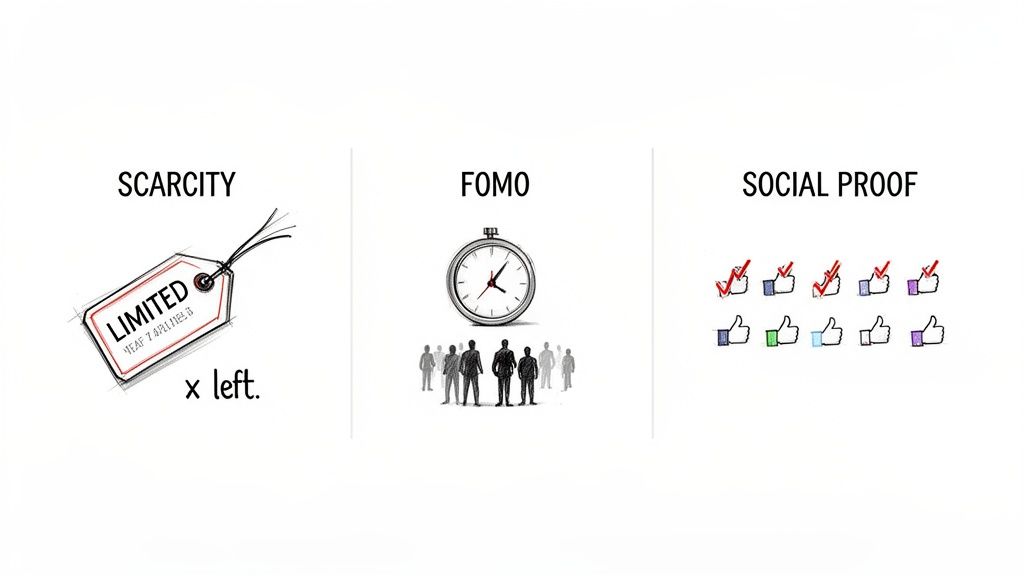
The social feed is the perfect environment for two of the most potent psychological triggers: scarcity and the Fear of Missing Out (FOMO). Unlike a static timer on a website, these principles can be woven directly into your content, making them feel natural and compelling.
Limited-Edition Drops: Announcing a product that's only available for 24 hours via an Instagram Story builds powerful anticipation. Your followers know the opportunity is fleeting, which collapses the consideration phase and drives immediate action. This is far more effective than a generic "sale ends soon" banner.
Inventory Transparency: Displaying low stock levels like "Only 3 left!" on a product tagged in a TikTok video creates tangible scarcity. That concrete limit makes the desire to purchase much stronger than an abstract deadline.
These tactics work because they fundamentally shift the customer's mindset from, "Should I buy this?" to, "Will I be able to buy this before it’s gone?" That subtle change is crucial for converting impulse-driven shoppers.
Another critical piece of the puzzle is social proof—the principle that people are influenced by the actions of others. In social commerce, this is your greatest asset. Every like, comment, and share on a shoppable post acts as a small endorsement, signaling to others that your product is desirable.
Behavioral economics tells us that people often use mental shortcuts (heuristics) to make decisions quickly. Seeing other people buy something is a massive shortcut; it validates the purchase and makes it feel less risky.
This is where Quikly excels. Platforms like Quikly can transform a standard promotion into a live "Moment," where users see others claiming an offer in real-time. This builds a palpable sense of shared excitement and competition. For brands looking to connect, incorporating witty marketing memes can also build community and tap into this shared experience. We dive deeper into this in our guide on the psychology of influencer marketing.
These psychological triggers are especially potent with younger consumers. Millennials and Gen Z are the engine of social commerce, with Millennials accounting for 33% of all spending and Gen Z right behind at 29%.
For these shoppers, authenticity is paramount. They can spot a sales gimmick from a mile away. That's why behavior-based triggers are so effective—they feel real because they are real. It’s not a fake timer; it’s a real product that’s about to sell out.
Actionable Takeaways:
By grounding your social commerce strategy in these proven psychological principles, you can stop just selling products and start creating can't-miss shopping experiences.
Knowing the psychology of urgency is one thing; turning it into revenue is another. For Shopify merchants, success comes from weaving these powerful triggers into the social commerce experience, converting passive scrollers into active buyers. The goal is to move beyond jarring pop-ups and instead create high-impact "Moments" that feel native to the social feed.
Sophisticated urgency marketing is no longer just for enterprise brands with custom-coded websites. Modern tools, especially those that integrate with Shopify Plus, allow merchants to launch these campaigns without ever touching their theme’s code.
The beauty of modern urgency marketing lies in its flexibility. You can adapt the same core ideas of scarcity and anticipation to fit perfectly on any social platform, amplifying their effectiveness.
Here are three practical campaign ideas you could roll out tomorrow:
Limited-Edition Drop for Instagram Stories: Use Instagram's "Drops" feature to build hype for a new product. Announce the exact drop time only in your Stories and use the countdown sticker to generate excitement. When it's time, perhaps the first 50 buyers get an exclusive gift. This combines the scarcity of a limited product with the social proof of shared anticipation.
Ranked Offers for a Facebook Ad Campaign: Instead of a flat "10% off" coupon, try a ranked offer for a specific Facebook ad audience. For example: "First 100 people get 25% off, the next 200 get 15% off, and everyone else gets free shipping." This gamifies the promotion, tapping into competitive instincts and giving users a reason to click now, all while protecting your margins from deep, site-wide discounts.
Live Countdown for a TikTok Product Launch: Before a new product goes live, tease it with several TikTok videos. Then, host a TikTok LIVE session for the big reveal, complete with a real-time countdown to the moment it becomes available on TikTok Shop. This builds a captive audience and channels buying energy into one explosive launch—a perfect fit for a platform built on live engagement.
Here's the critical difference: A simple timer on a website just shows time ticking away. Advanced behavioral triggers, like a ranked offer or a limited drop, create a dynamic, competitive space where a user's action directly impacts their reward. They shift from passive watching to active participation.
This is where you unlock the true power of these strategies: automation. Manually managing drops, offers, and countdowns across multiple channels isn't scalable. You need seamless integration with the marketing tools you already use.
By connecting your urgency marketing platform with tools like Klaviyo and your SMS platform, you can build a customer journey that runs itself.
This level of automation transforms your campaigns from one-off events into an intelligent system that nurtures interest and drives sales across every channel. For more ideas, check out our guide on how to add a countdown timer to a Shopify store for free. When you automate these psychologically-driven campaigns, you create a powerful, revenue-generating machine that works for you 24/7.
Running clever campaigns on social commerce platforms is a great start, but it's only half the story. True success is tying those efforts to measurable business growth.
Likes and shares are vanity metrics; they don't impact your bottom line. To understand what's working, you must focus on key performance indicators (KPIs) that directly correlate with revenue and profitability. We’re moving beyond surface-level engagement to the hard data that builds a predictable, high-performing sales channel.
To get a clear picture of campaign performance, zero in on three essential metrics. Together, they provide a complete view of not just the immediate sale but the long-term value you're creating.
Conversion Rate: This is your most direct feedback loop. It's the percentage of people who see your offer and complete a purchase. A high conversion rate indicates your message, urgency triggers, and product are resonating with your audience. An average e-commerce conversion rate is around 2.5%, so any lift here directly impacts revenue.
Average Order Value (AOV): This metric measures how much the average customer spends per transaction. Increasing AOV is a powerful way to grow revenue without increasing customer acquisition costs. Strategic upsells or product bundles within a limited-time offer can significantly lift AOV.
Customer Lifetime Value (LTV): LTV represents the long game, forecasting the total revenue you can expect from a single customer over their entire relationship with your brand. A rising LTV means your social commerce strategy is attracting and retaining loyal, repeat customers, not just one-time buyers.
The process flow below shows how a well-executed urgency marketing campaign moves from concept to an automated, revenue-driving machine.
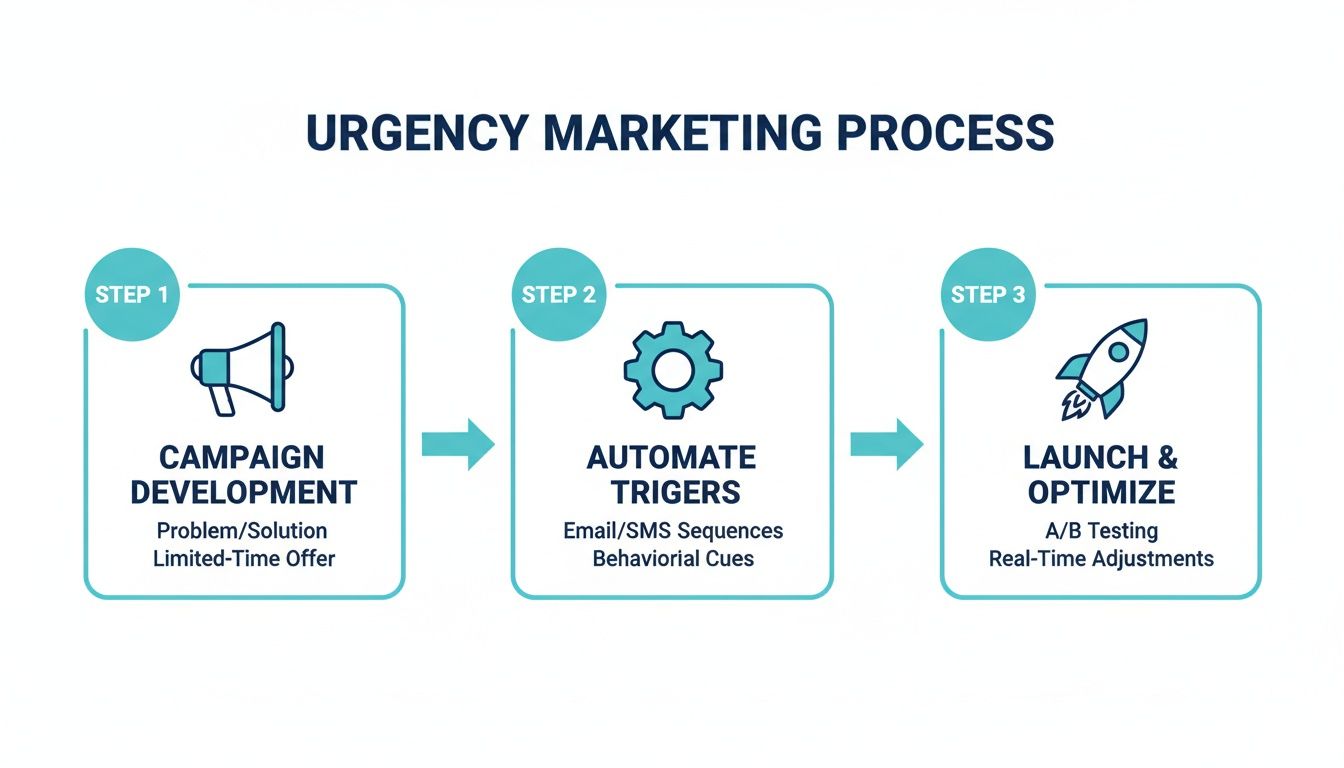
This streamlined approach—from campaign design to automated launch—is how you efficiently test and optimize strategies to maximize ROI.
One of the most significant benefits of a sophisticated urgency strategy is profit margin protection. Instead of resorting to deep, site-wide discounts that erode your profits, you're using behavior-based triggers to create value and drive organic demand.
A standard 20% off sale merely trains customers to wait for the next promotion. But a ranked offer that rewards the first few buyers, or a limited-edition drop that could sell out at any moment, creates genuine excitement without devaluing your products.
By leaning on psychological principles like scarcity and anticipation, you give customers a reason to buy at or near full price. This is the direct opposite of the race-to-the-bottom discounting that can slowly kill a brand's value and profitability.
This is crucial when considering the industry benchmark: a staggering 70% average cart abandonment rate. Many of those carts are abandoned by shoppers waiting for a coupon code. Smart urgency provides a compelling reason to complete the purchase now, capturing revenue you would have otherwise lost while keeping your margins intact.
Success in social commerce isn't just about what you do; it's also about what you avoid. Launching without a clear strategy can lead to audience fatigue, decreased profit margins, and a frustrating shopper experience. To build a sustainable and profitable channel, you must steer clear of common mistakes.
One of the biggest traps is relying on generic urgency tactics. We’ve all seen it: a countdown timer that seems to be permanently active on every product page. These tactics quickly lose their impact. When overused, you train your customers to ignore you—a classic case of banner blindness—and can make your brand feel desperate rather than desirable.
Most off-the-shelf timer and pop-up apps are blunt instruments focused on email capture, not revenue generation. They operate on a one-size-fits-all logic, missing the nuance of individual customer behavior. That's why they so often fail to create genuine urgency. Instead of inspiring a purchase, they interrupt the experience, contributing to the industry's staggering 70% average cart abandonment rate.
The difference between these basic tools and a smarter, psychology-driven approach is night and day:
The core difference is authenticity. A constant, generic countdown feels manufactured. A notification that says, "Only 5 items are left," based on real-time inventory, provides a believable reason to act now. That's how you protect brand integrity while driving sales.
Another critical pitfall is the disconnect between a marketing promotion and your operational reality. Launching a viral TikTok campaign for a product with only 50 units in stock is a recipe for disaster. You're not just losing sales; you're disappointing potential new customers.
This is where a sophisticated platform makes all the difference. Quikly prevents this by integrating directly with your Shopify inventory. Your campaigns are always synced with real stock levels, running on sophisticated automation.
Actionable Takeaways to Avoid Pitfalls:
Got questions about diving into social commerce? You're not alone. Here are the answers to the most common questions we hear from Shopify merchants.
Traditional e-commerce is a destination; you have to drive traffic to your website. Social commerce brings the store directly to the customer.
The entire shopping journey—from product discovery to the final purchase—happens within a social media app. This closes the gap between inspiration and action, making it a powerful tool for capturing impulse buys and boosting conversion rates.
The best platform is where your customers already spend their time. This is not a one-size-fits-all decision.
Urgency marketing taps into fundamental human psychology—like FOMO (Fear of Missing Out) and scarcity—to drive immediate action. In the fast-paced scroll of a social feed, this is incredibly effective. However, this is not about using a generic countdown timer. A true strategy uses authentic urgency with behavioral triggers.
It’s about creating genuine scarcity with tactics like limited-edition product drops or ranked offers that reward the first buyers with the best deal. This approach builds real demand and excitement without slashing prices, directly increasing conversion rates while protecting your profit margins and bottom line.
Absolutely, and you should. Ensuring your urgency platform integrates with your existing tech stack is critical for scalability. A robust platform must connect directly to your Shopify inventory to prevent overselling.
Look for integrations with tools like Klaviyo or your SMS marketing platform. This enables automated follow-up sequences, transforming a single campaign into a complete customer journey that recaptures shoppers who might have otherwise drifted away.
Ready to stop the scroll and turn your social feed into a serious revenue driver? Quikly uses the science of urgency to create those can't-miss moments for your customers, driving immediate action and maximizing your ROI.
Find out how Quikly can transform your social commerce strategy by visiting us at https://hello.quikly.com.