

ecommerce conversion
customer experience strategy
digital customer experiences
Launching a new product is a high-stakes moment for any e-commerce brand. Yet, industry benchmarks reveal a critical gap between excitement and sales, with average conversion rates hovering around a mere 2.5% and nearly 70% of shopping carts abandoned. The difference between a launch that fizzles out and one that shatters revenue goals lies not in a bigger marketing budget, but in a strategic, psychologically-informed approach. A basic to-do list is no longer sufficient; success requires a framework grounded in behavioral science to convert anticipation into immediate action.
This definitive product launching checklist moves beyond simple tasks. It integrates the proven science of urgency marketing, systematically leveraging principles like scarcity, social proof, and Fear Of Missing Out (FOMO) to dismantle purchase hesitation at every stage. We will provide a phase-based guide, from meticulous pre-launch planning and launch day execution to post-launch analysis, designed to not only boost conversions but also protect profit margins and optimize inventory management.
Throughout this guide, you will find actionable steps tailored for Shopify and Shopify Plus merchants. We’ll demonstrate how sophisticated automation and behavioral triggers can transform a standard product drop into a high-impact revenue event, moving far beyond the limited capabilities of basic countdown timers or generic pop-up apps that primarily focus on email capture. This comprehensive checklist provides the structure needed to ensure your next launch doesn’t just make an impression, it makes a significant impact on your bottom line.
The first, non-negotiable step in any successful product launching checklist is establishing what success actually looks like. Without clear, measurable objectives, your launch becomes a series of disjointed actions rather than a coordinated strategy. This foundational step aligns your entire team, from marketing to operations, and provides the benchmarks you need to evaluate performance and justify your investment.

This process involves translating broad business aims into specific Key Performance Indicators (KPIs). Instead of just "selling more," a defined goal would be "achieve a $50,000 revenue lift during launch week." This specificity is crucial when deploying urgency marketing. Knowing your primary goal, whether it's revenue growth, increasing average order value (AOV), or accelerating customer acquisition, directly informs which psychological triggers to use. For a deep dive into the metrics that matter most, explore these essential sales performance metrics and dashboards.
Effective KPIs are the guardrails of your campaign, keeping your efforts focused on high-impact outcomes.
Actionable Takeaway: Align your KPIs with your broader business strategy, not just isolated marketing metrics. A successful launch should contribute directly to long-term growth, customer loyalty, and profitability. Focus on 3-5 primary KPIs to avoid data overload and maintain a clear vision of success.
A one-size-fits-all launch strategy is a recipe for missed opportunities. The next critical step in your product launching checklist is to move beyond generic messaging and embrace segmentation. By identifying distinct customer groups based on behavior, purchase history, and engagement level, you can tailor your urgency marketing campaigns to resonate on a personal level, which is proven to dramatically increase relevance and conversion rates.
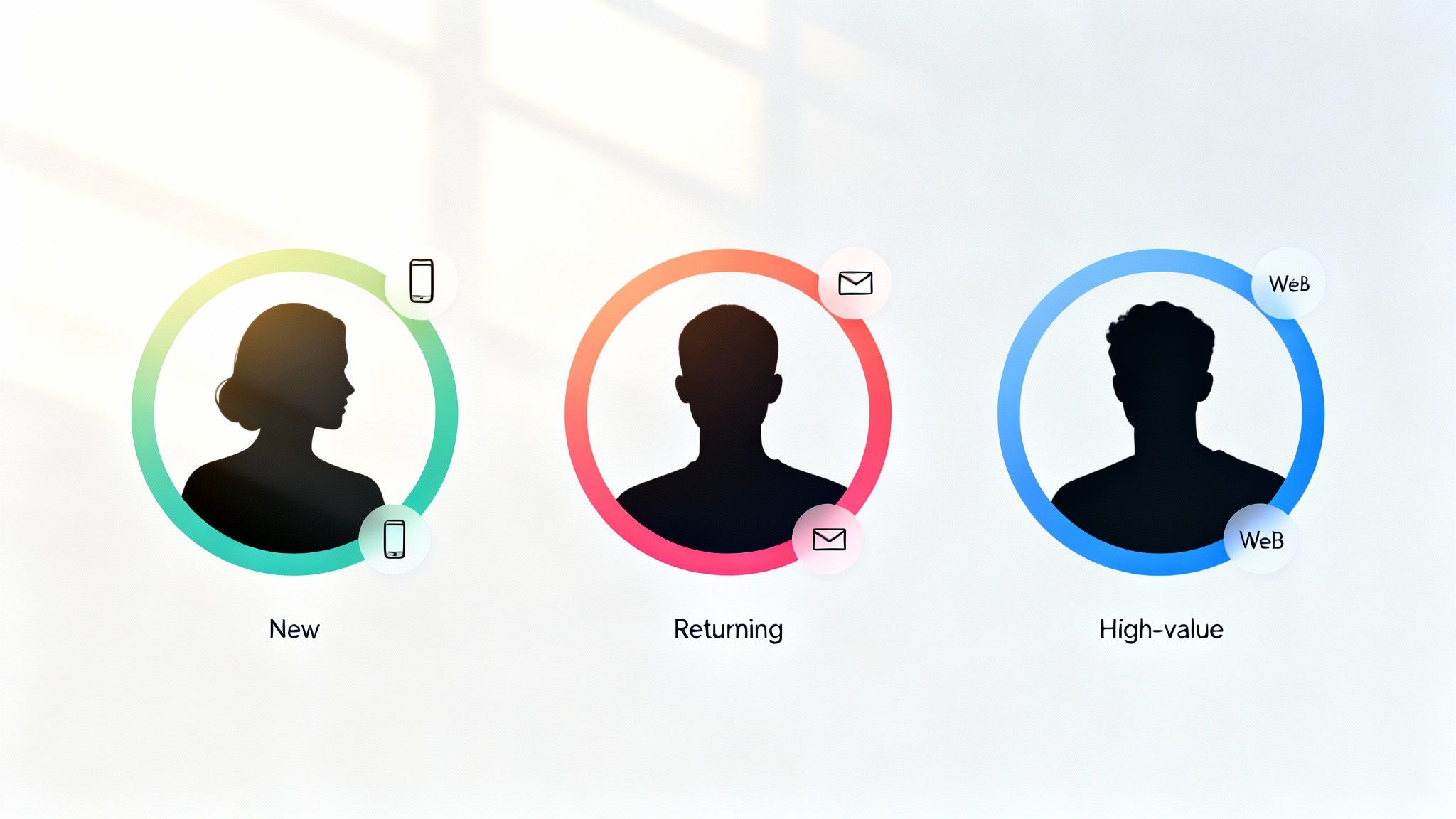
This approach recognizes that a new visitor driven by a social media ad and a loyal VIP customer require entirely different psychological triggers. A high-value returning customer might respond best to an exclusive, ranked offer that acknowledges their loyalty—a tactic grounded in the principle of reciprocity—while a new visitor might be more influenced by a simple, clear countdown timer creating a sense of immediate opportunity. Personalization ensures you deliver the right urgency message to the right audience at the right moment. For an in-depth guide, explore these effective customer segmentation examples and strategies.
Start with a few high-impact segments and test different urgency mechanics to see what drives the best performance for each.
Actionable Takeaway: Effective segmentation is rooted in behavioral psychology. It's not just about demographics; it’s about understanding a customer's mindset and intent. By aligning your urgency triggers with their specific journey, you move from basic promotion to a sophisticated, revenue-driving conversation.
Your product page is the final conversion battleground. Sending a flood of engaged traffic from an urgency campaign to a poorly optimized page is like pouring water into a leaky bucket; the interest evaporates before it can convert. This step in your product launching checklist ensures your online storefront is perfectly primed to capture and capitalize on the heightened attention your launch generates.
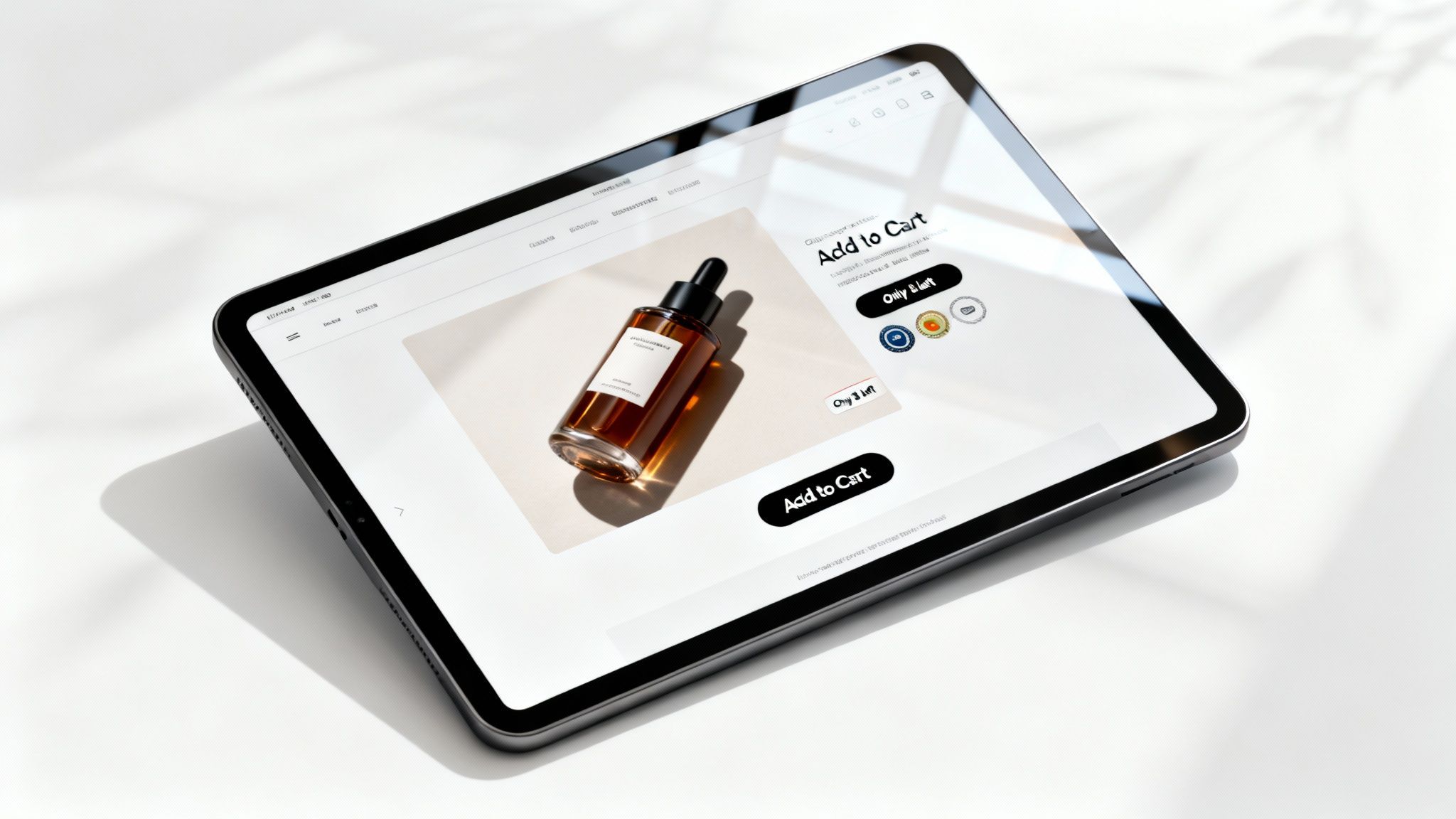
Optimizing your product pages involves a comprehensive audit of every element that influences a buyer’s decision, from visual appeal to technical performance. For instance, many Shopify stores have boosted conversions by 20-30% simply by adding product videos. With over 60% of e-commerce traffic coming from mobile, ensuring every image, button, and text block is perfectly responsive isn't a recommendation; it's a requirement for profitability. This foundation of trust and clarity makes psychological triggers like scarcity and social proof exponentially more effective.
A well-oiled product page works in tandem with your launch strategy, building confidence and reducing friction at the most critical moment.
Actionable Takeaway: Your product page optimization must directly support your urgency mechanics. A live stock indicator showing "Only 5 left!" creates real scarcity, while a "250 sold this week" badge provides powerful social proof. These elements validate the urgency you create, transforming a marketing message into a believable, action-driving reality.
Launching a product without proper tracking is like navigating a ship without a compass. You can’t measure success, diagnose problems, or optimize performance if you aren't collecting the right data from day one. Setting up a comprehensive analytics infrastructure before your launch is a critical step in any product launching checklist, transforming guesswork into a data-driven strategy.
This process involves more than just installing Google Analytics. It means meticulously tagging every marketing channel, tracking specific user interactions, and ensuring every conversion is correctly attributed. For instance, a Shopify store running a Quikly campaign needs to distinguish traffic from that campaign versus organic search or paid social. A cornerstone of this setup is understanding what conversion tracking is and how it works, which is vital for accurately measuring your launch's ROI and proving its impact on your bottom line.
Properly configured tracking ensures data integrity and provides the insights needed for agile, real-time decision-making during your launch week.
utm_campaign=product-launch-quikly to isolate that specific campaign's performance.Actionable Takeaway: Don’t wait until launch day to test your tracking. Create a pre-launch tracking verification checklist and run thorough tests in a staging environment. A single misconfigured pixel or broken UTM link can corrupt your entire launch dataset, making it impossible to evaluate your success accurately.
Once you've defined your offer, the next critical step in a high-performing product launching checklist is to avoid guesswork. Instead of launching a single campaign and hoping for the best, you must develop and test multiple variations to discover what truly motivates your specific audience. This data-driven approach allows you to optimize messaging, design, and urgency mechanics before committing your full budget, ensuring maximum ROI from day one.
This process involves systematically A/B testing different elements of your launch campaign to see which combination drives the most conversions and revenue. Rather than simply throwing a generic countdown timer on a page, you can test fundamentally different psychological triggers against each other. For example, you can pit the scarcity of a ranked offer against the time-based urgency of a limited drop to see which one resonates more deeply with your customers' buying psychology. This is where advanced behavioral triggers differentiate themselves from basic timer apps.
Testing removes subjectivity and replaces it with concrete performance data, turning your launch into a predictable revenue engine.
Actionable Takeaway: A sophisticated testing strategy goes beyond simple design tweaks. It tests the core psychological drivers of your campaign. By documenting every test parameter and outcome, you build an invaluable playbook of what works for your brand, making every future product launch more successful than the last.
A product doesn't launch itself; it's launched by a carefully orchestrated wave of communication that builds anticipation and drives action. This crucial step in your product launching checklist involves creating a detailed, multi-channel strategy to announce your new offering and any associated urgency campaigns. Without a coordinated plan, your message gets lost, momentum flatlines, and your launch traffic will be a trickle instead of a flood.
This process ensures that every customer touchpoint, from an email inbox to a social media feed, tells a consistent and compelling story. It's about building psychological momentum through anticipation and scarcity. A well-timed email sequence, paired with social media teasers and an SMS blast at the exact moment of launch, creates a powerful sense of FOMO (Fear of Missing Out). For a complete guide on building this excitement before the big day, explore these effective pre-launch marketing strategies.
An effective plan is a timeline of precisely timed messages designed to maximize reach and impact.
Actionable Takeaway: Consistency is the engine of a successful launch communication plan. Every message, regardless of the channel, should have the same core value proposition, call-to-action, and branding. Prepare all creative assets and copy at least one week in advance to ensure a seamless and stress-free launch day execution.
An otherwise flawless urgency campaign can quickly derail if your internal teams are unprepared for the influx of activity. This crucial step in your product launching checklist involves equipping every customer-facing and operational department with the knowledge and resources to handle the launch-day surge. Preparing your infrastructure prevents operational bottlenecks, protects your brand reputation, and ensures a smooth customer experience from click to delivery.
When leveraging a sophisticated urgency platform, team alignment is non-negotiable. Customer service needs to understand the mechanics of ranked offers to answer questions confidently, while the fulfillment team must be ready for a potential 2-3x increase in order volume. This proactive training transforms potential chaos into a well-orchestrated operation, ensuring the psychological power of your campaign isn’t undermined by poor execution. Explore how a well-prepared team can amplify campaign results in this guide to creating high-converting urgency campaigns.
Effective preparation turns your staff into an extension of your marketing strategy, creating a seamless experience for every customer.
Actionable Takeaway: Designate a campaign "champion" within each key department (support, fulfillment, marketing). These individuals act as the primary point of contact, facilitating clear communication channels between teams and empowering them to resolve issues quickly without escalating every minor problem. This distributed leadership is vital for a smooth launch day.
A high-converting launch campaign can quickly turn into a customer service nightmare if your operations aren't prepared for the surge in demand. This crucial step in your product launching checklist involves synchronizing your marketing efforts with your physical inventory and fulfillment capabilities. Overlooking this can lead to stockouts, shipping delays, and damaged brand reputation, negating the revenue gains from your successful campaign.
This process is about more than just checking stock levels; it’s about proactively building resilience into your supply chain. An effective urgency marketing campaign driven by FOMO and scarcity will naturally create demand spikes. Therefore, you must coordinate with operations, procurement, and warehouse teams to ensure you can meet that demand flawlessly, from click to delivery. This alignment protects your profit margins and ensures a positive customer experience that encourages repeat business.
Robust operational readiness is the backbone of a profitable product launch, ensuring your marketing promises are met with real-world efficiency.
Actionable Takeaway: Your fulfillment capacity is a core component of your launch strategy, not an afterthought. Review inventory levels at least two weeks before launch and document a clear plan for which products to prioritize if stock becomes constrained, ensuring you protect the availability of your highest-margin items.
A launch is a dynamic, high-stakes event, and treating it as a "set it and forget it" campaign is a costly mistake. The ninth item on your product launching checklist is establishing a system for real-time monitoring and creating clear response protocols. This operational command center allows your team to track performance as it happens, identify anomalies instantly, and make data-driven adjustments on the fly to maximize success and mitigate potential issues.
During the critical first hours and days of a launch, data is your most valuable asset. Monitoring allows you to see how urgency triggers, like a time-sensitive Quikly campaign, are directly impacting conversion rates and revenue per minute. If you notice a sudden drop in click-through rates on a campaign banner, your response protocol might be to immediately test new copy or adjust its placement on your Shopify storefront. This agility turns potential failures into optimization opportunities, ensuring you capitalize on every moment of launch day excitement.
An effective monitoring system is about having the right data and a clear plan of action.
Actionable Takeaway: Don't just watch the numbers; have a pre-approved plan for what to do when they change. A documented response protocol, including an emergency "pause campaign" procedure, removes panic-driven decision-making. This transforms your team from reactive problem-solvers into proactive launch managers.
The final, critical step in your product launching checklist is planning what happens after the launch window closes. A successful launch doesn’t end when the campaign does; it concludes with a structured analysis that turns performance data into actionable intelligence. This process ensures that every dollar spent and every tactic deployed informs a smarter, more profitable strategy for your next initiative. It’s about creating a cycle of continuous improvement.
This analysis involves a deep dive into your results, comparing what actually happened against the KPIs you established in step one. Instead of just noting that sales were high, you’ll investigate why. Was it the time-sensitive offer that drove conversions, or the anticipation built during the pre-launch phase? This data-driven approach, championed by platforms like Shopify and HubSpot, transforms your launch from a one-time event into a valuable business asset.
A systematic review is the only way to extract meaningful, repeatable lessons from your campaign. Schedule this review 5-7 days after your launch concludes to allow for complete data attribution.
Actionable Takeaway: The goal of post-launch analysis is not just to report on what happened, but to decide what to do next. Isolate the highest-performing variables from your campaign and build a plan to test or scale them in your evergreen marketing efforts or your next major product drop.
| Item | Implementation complexity | Resource requirements | Expected outcomes | Ideal use cases | Key advantages |
|---|---|---|---|---|---|
| Define Your Launch Goals and KPIs | Low–Medium (strategic planning) | Analytics access, stakeholder time, historical data | Clear targets and benchmarks; aligned team priorities | New campaign launch; selecting urgency mechanics | Data-driven direction; measurable ROI |
| Segment Your Audience and Personalize Campaigns | Medium–High (data segmentation & targeting) | CRM/analytics, segmentation tools, tailored creatives | Higher relevance and conversion; reduced spend waste | Personalized urgency campaigns; varied customer behaviors | Improved conversion and AOV; better targeting |
| Audit and Optimize Your Product Pages | Medium (design/dev + content) | Design/dev resources, product assets, reviews management | Increased conversion, lower bounce, better UX | High-traffic product pages before urgency drives traffic | Maximizes traffic value; builds trust |
| Set Up Analytics and Tracking Infrastructure | High (technical integrations) | Developers, analytics platforms, QA/testing | Accurate attribution and actionable performance data | Multi-channel campaigns; ROI-focused launches | Precise measurement; improved optimization |
| Create and Test Campaign Variations | Medium–High (A/B testing & analysis) | Traffic volume, testing tools, multiple creatives | Identifies best-performing elements; reduced launch risk | When mechanic or messaging is uncertain | Evidence-based winners; higher campaign confidence |
| Develop a Launch Day Communication Plan | Medium (cross-channel coordination) | Content creators, scheduling tools, channel list | Strong initial traffic and consistent messaging | Product launches, time-limited promotions | Maximizes awareness; coordinated reach |
| Train Your Team and Prepare Support Infrastructure | Medium (training + process setup) | Trainers, documentation, staffing plans | Fewer operational errors; faster customer support | High-volume launches; complex campaign mechanics | Smoother operations; better customer experience |
| Confirm Inventory and Fulfillment Readiness | Medium (operations & forecasting) | Inventory data, suppliers, warehouse staffing | Reduced stockouts; timely fulfillment | Physical goods with expected volume spikes | Prevents lost sales; maintains satisfaction |
| Set Up Real-Time Monitoring and Response Protocols | Medium–High (dashboards & alerts) | Monitoring tools, assigned monitors, alerting systems | Rapid issue detection and on-the-fly optimization | High-stakes launches; volatile traffic patterns | Quick response; prevents escalation |
| Plan Post-Launch Analysis and Optimization | Medium (reporting & insights) | Analysts, exported data, reporting/dashboard tools | Learnings, optimization plan, documented ROI | Continuous improvement cycles; post-campaign reviews | Actionable insights; informs future strategy |
A successful product launch isn't a finish line; it’s the starting lap of a continuous growth cycle. This comprehensive product launching checklist provides the framework to move beyond simple tactical to-dos and into a repeatable strategic discipline. The difference between a launch that fizzles and one that accelerates your brand lies in this transition from merely checking boxes to orchestrating a symphony of well-timed actions grounded in consumer psychology.
By meticulously defining goals, segmenting your audience, and preparing your technical and operational infrastructure, you lay the foundation for predictable success. The pre-launch phase isn't just about building hype; it's about building a data-informed hypothesis. The launch day execution then becomes the ultimate test of that hypothesis, while the post-launch analysis provides the crucial insights that fuel your next, even more successful, initiative.
A critical takeaway is the evolution of urgency marketing from a blunt instrument to a precision tool. Basic countdown timers and generic pop-ups are no longer sufficient to cut through the noise. Today’s consumers are savvy, and true engagement comes from tapping into core behavioral principles like scarcity, anticipation, and social proof in a way that feels authentic and adds value to their journey.
This is where sophisticated psychology-driven tools differentiate themselves. Instead of simply showing a ticking clock, next-generation platforms allow you to:
This strategic approach transforms a launch from a high-stakes gamble into a calculated, scientific process. For Shopify and Shopify Plus merchants, this level of precision is paramount, enabling you to manage inventory effectively, maximize ROI on ad spend, and build long-term customer loyalty with every new product you introduce.
The ultimate goal is to turn this checklist into a dynamic playbook-a living document that evolves with each campaign. The data you gather from your analytics, the feedback from your customer support team, and the performance of your urgency marketing campaigns all become invaluable assets. This iterative process of planning, executing, measuring, and optimizing is what separates high-growth e-commerce brands from the rest.
Ultimately, transforming your launch strategy into a growth engine requires a comprehensive approach, much like a complete checklist for crowdfunding success. Each component, from audience segmentation to post-launch analysis, builds upon the last. By embracing this holistic product launching checklist, you are not just preparing for a single event; you are building a powerful, scalable engine that will drive revenue and brand growth for years to come.
Ready to elevate your product launches with urgency marketing grounded in proven consumer science? Discover how Quikly can help you automate sophisticated behavioral triggers to maximize revenue, manage inventory, and turn every launch into a record-breaking event. See the platform in action at Quikly.