

ecommerce psychology
brand loyalty
best brand experiences
A successful product launch doesn't begin on launch day; it starts months earlier by engineering anticipation. For most e-commerce brands, the difference between a record-breaking launch and a silent one lies in the psychological groundwork laid beforehand. While the average e-commerce conversion rate hovers around 2.5% and cart abandonment rates often exceed 70%, strategic pre-launch marketing flips this script. It transforms passive interest into an active, urgent desire to purchase, directly impacting launch day revenue and long-term profitability.
This isn't about simple countdown timers or basic pop-ups focused on email capture. It's about applying proven principles of consumer psychology—like scarcity, social proof, and anticipation—to build a dedicated audience that is not just ready, but eager to buy the moment you go live. By mastering the right pre launch marketing strategies, you can significantly boost launch day revenue, protect profit margins by avoiding deep discounts, and create a powerful brand narrative from day one. This guide moves beyond generic advice to provide a blueprint for a high-impact launch.
We will unpack ten sophisticated, actionable pre-launch marketing strategies designed for modern Shopify brands. Each section details not just the 'what' but the critical 'why'—grounded in behavioral science—behind each tactic. We'll provide step-by-step implementation for Shopify, key performance indicators (KPIs), and examples of how to leverage sophisticated behavioral triggers to maximize your return on investment. You will learn how to build a powerful waitlist, execute compelling teaser campaigns, and cultivate a community that acts as your most effective sales force, ensuring your product launch is a resounding success.
One of the most foundational pre-launch marketing strategies is building a dedicated email list and waitlist. This approach centers on creating a simple, high-converting landing page designed to capture the email addresses of potential customers before your store officially opens. By offering a compelling incentive, you transform passive interest into a tangible, high-value marketing asset: a direct line of communication with your most eager future buyers, driving revenue from the first minute of your launch.

This strategy harnesses the psychological principle of anticipation. A waitlist signals exclusivity and creates a sense of being an insider, which drives sign-ups and builds buzz. For Shopify brands, this owned audience is invaluable, allowing you to bypass unpredictable social media algorithms and nurture leads directly. By integrating with tools like Klaviyo or other SMS platforms, you can build a community that’s primed to purchase on day one, maximizing initial sales velocity and protecting inventory.
Executing an effective waitlist campaign involves more than just a sign-up form. Follow these steps to maximize your pre-launch email acquisition and engagement:
Engaging with influencers and brand ambassadors is a powerful pre-launch marketing strategy that leverages trusted voices to build credibility and excitement. This approach involves partnering with creators in your niche to introduce your brand to their established, engaged audiences before you officially open for business. By providing these partners with exclusive previews, you generate authentic social proof and third-party validation that dramatically increases launch day revenue potential.
This tactic is rooted in the psychological principle of social proof, a concept extensively studied in consumer psychology. When potential customers see someone they admire and trust endorsing a new product, it significantly reduces purchase anxiety and builds immediate brand affinity. For e-commerce stores, influencer partnerships can rapidly expand reach, bypass ad fatigue, and cultivate an audience that is not just aware of your launch, but eagerly anticipating it. This strategy is about generating authentic desire, not just views.
A successful pre-launch influencer campaign is about building genuine relationships, not just transactional posts. Follow these steps to maximize your impact:
A masterfully executed teaser campaign is one of the most powerful pre-launch marketing strategies for generating palpable buzz and curiosity. This approach involves the strategic release of partial information, sneak peeks, and behind-the-scenes content across your marketing channels. Instead of revealing everything at once, you deliver "content drops" that build a narrative, encouraging your audience to follow along, speculate, and become invested in the launch, turning marketing into an event.

This strategy taps directly into the psychological principle of anticipation, leveraging the brain's reward system, as documented in behavioral economics research. Creating an information gap fuels conversation and speculation, turning passive observers into active participants. This is far more sophisticated than a basic countdown timer; it's about building a story that audiences feel compelled to follow, creating significant demand that translates into immediate revenue upon launch.
A successful teaser campaign requires careful planning and coordination to maintain momentum without giving too much away. Follow these steps to build maximum excitement for your brand.
A powerful method for generating immediate visibility and social proof is to launch on community-driven platforms like Product Hunt. This strategy involves presenting your new product to a tech-savvy and influential audience of early adopters, who can provide invaluable feedback, drive initial traffic, and create significant buzz. A successful launch can validate your concept and lead to press coverage, investor interest, and your first wave of paying customers, all of which directly impact your bottom line.
This approach taps into the psychological principle of social proof. When hundreds or thousands of users upvote and comment on your product, it signals to a wider audience that it's worth their attention. For e-commerce brands, especially those with a unique tech angle or innovative product, a well-executed Product Hunt launch is one of the most effective pre launch marketing strategies for achieving rapid, credible exposure and driving initial revenue.
Launching on platforms like Product Hunt requires careful preparation and active engagement. Follow these steps to maximize your chances of success:
One of the most powerful pre-launch marketing strategies involves granting a select group of users early access to your product before its public release. This approach, known as beta testing, transforms your most engaged potential customers into a crucial feedback engine and a team of early brand advocates. By giving them a behind-the-scenes look, you gather invaluable real-world data to refine your product and simultaneously build authentic, word-of-mouth momentum that drives profitable growth.
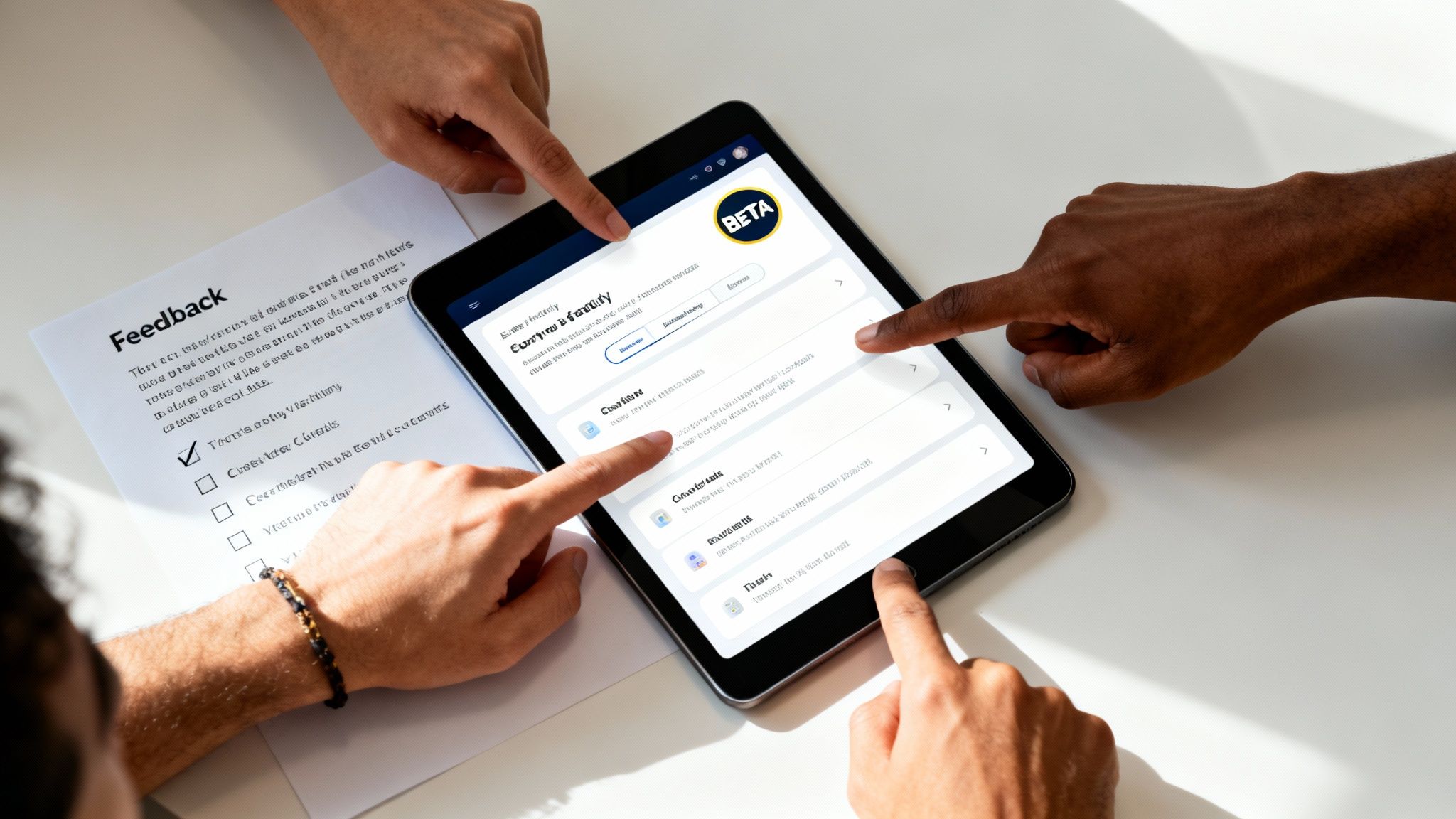
This strategy leverages the psychological principles of exclusivity and social validation. Being chosen for a beta program makes participants feel like valued insiders, fostering a deep sense of loyalty, a phenomenon known as the "IKEA effect" where involvement increases perceived value. Their feedback not only helps you identify bugs and improve usability but their eventual public testimonials serve as powerful social proof, validating your product's quality and priming the market for a successful full-scale launch.
A successful beta program is a structured partnership between you and your early users. Follow these steps to create a program that delivers actionable insights and builds pre-launch buzz:
Positioning your brand as an industry authority before you even sell a single product is one of the most powerful pre launch marketing strategies available. Content marketing and thought leadership focus on creating high-quality, valuable content that educates, entertains, and solves problems for your target audience. By addressing their pain points and questions through blog posts, guides, or videos, you build trust and establish credibility long before asking for a sale.
This approach leverages the psychological principle of reciprocity, as described by Dr. Robert Cialdini. When you provide immense value upfront with no strings attached, customers feel a natural inclination to support your brand when it launches. For e-commerce stores, this means attracting a highly qualified audience through organic search and social channels, creating a sustainable traffic source that reduces reliance on paid advertising and improves profit margins from day one.
A successful pre-launch content plan requires strategic planning and consistent execution. Use these steps to build authority and drive organic interest before your store goes live:
Generating third-party credibility is one of the most powerful pre-launch marketing strategies, and a proactive Public Relations (PR) and media outreach plan is the key to unlocking it. This strategy involves building relationships with journalists, bloggers, and media outlets to secure press coverage before your official launch. A well-placed article or interview lends your brand instant authority and social proof, reaching a much wider audience than your owned channels alone and driving high-intent traffic.
This approach taps into the psychological principle of authority bias, where consumers place greater trust in information from established, credible sources like news publications. When a respected journalist validates your brand's story, it's perceived as earned praise rather than paid advertising. For e-commerce brands, this earned media can drive significant referral traffic, build brand reputation, and attract high-value customers who are ready to trust and buy on launch day.
A successful PR campaign requires a compelling story and a strategic, personalized approach to pitching. Follow these steps to maximize your chances of securing valuable media coverage:
Beyond broadcasting your message, one of the most powerful pre-launch marketing strategies is to build a dedicated space where your first fans can gather. This involves creating a community on platforms like Discord, Slack, Reddit, or a private Facebook Group. The goal is to cultivate a hub for early adopters to connect with each other and your founding team, transforming them from passive followers into active brand evangelists who drive early sales and social proof.
This strategy taps into the psychological need for belonging and identity. By giving your audience a place to share their excitement and offer feedback, you build immense social proof and create an invested group that feels a sense of ownership in your brand's success. For Shopify merchants, this community becomes an invaluable source of user-generated content, product feedback, and day-one customers who are eager to purchase and promote, lowering customer acquisition costs.
Building a thriving pre-launch community requires deliberate effort and genuine engagement. Follow these steps to create a space that generates real buzz and loyalty:
While organic growth is crucial, one of the most direct and scalable pre-launch marketing strategies is paid advertising. This approach involves running highly targeted ad campaigns on platforms like Meta (Facebook and Instagram), Google, and TikTok to rapidly build brand awareness, drive traffic to your waitlist landing page, and generate a pre-qualified audience ready for launch. Unlike waiting for organic reach, paid ads allow you to place your message directly in front of your ideal customer from day one, maximizing the ROI of your pre-launch phase.
This strategy capitalizes on the power of precision targeting and data. Platforms like Meta allow you to build audiences based on specific demographics, interests, and behaviors, ensuring your pre-launch budget is spent efficiently. By creating a direct funnel from ad to landing page, you can systematically convert ad spend into a high-value email list, building a predictable pipeline of launch-day customers.
Executing a successful pre-launch ad campaign requires a structured, test-driven approach to maximize your return on investment.
Event marketing, particularly through virtual webinars and online summits, is a powerful pre-launch marketing strategy for establishing authority and building a community. This approach involves hosting or participating in events to connect directly with your target audience, demonstrate expertise, and create memorable experiences that generate buzz and capture high-quality leads before you officially launch.
This strategy capitalizes on the principle of reciprocity and authority. By providing genuine value and expertise upfront through a webinar or a talk, you build trust and establish your brand as a credible leader in its niche. For e-commerce brands, this is a chance to move beyond the product and connect with potential customers on a deeper level, transforming attendees into educated, engaged, and loyal advocates who are ready to buy when your store opens.
A successful pre-launch event requires more than just a presentation; it's a strategic campaign to build momentum and convert interest into action.
| Strategy | Implementation complexity | Resource requirements | Expected outcomes | Ideal use cases | Key advantages |
|---|---|---|---|---|---|
| Email List Building & Waitlist Strategy | Low–Medium — landing page + automation | Moderate — email platform, copy, creatives | Pre-launch leads, segmented audience, high ROI | SaaS, DTC, launches needing repeat engagement | Owned channel, personalization, creates FOMO |
| Influencer & Ambassador Partnerships | Medium–High — coordination and contracts | Variable — budget, relationship management, content co-creation | Rapid reach, social proof, higher engagement | B2C, fashion/beauty, niche audiences | Authentic endorsements, access to engaged followers |
| Teaser Campaigns & Content Drops | Medium — content calendar and timing | Low–Moderate — content production, scheduling | Sustained curiosity, social buzz, organic sharing | Consumer products, entertainment, high-anticipation launches | Builds anticipation, cost-effective, narrative-driven |
| Product Hunt & Community Platform Launch Strategy | Medium — pre-engagement and launch day ops | Low–Moderate — community outreach, assets, team on launch day | Early-adopter traffic, feedback, community validation | Developer tools, startups seeking validation | Targeted early adopters, credibility, press potential |
| Beta Testing & Early Access Programs | High — managing testers, feedback loops | High — dev support, bug tracking, community channels | Product validation, bug fixes, advocates and testimonials | Complex software, SaaS, hardware, iterative products | Reduces launch risk, real-world insights, loyal champions |
| Content Marketing & Thought Leadership | Medium–High — long-term strategy and execution | Moderate–High — writers, SEO, production resources | Organic traffic, authority, long-term leads | B2B, education-heavy products, long sales cycles | Sustainable visibility, SEO benefits, credibility |
| PR & Media Outreach Strategy | Medium — pitch crafting and relationship building | Moderate–High — PR expertise or agency, media assets | Third‑party validation, broad reach, potential viral coverage | High-profile launches, investor-backed startups, consumer tech | High credibility, large audience amplification |
| Community Building & Forum Strategy | High — continuous moderation and nurturing | Moderate–High — community managers, platform tools | Loyal user base, rapid feedback, organic advocacy | Platforms, developer tools, creator communities | Deep engagement, word-of-mouth, sustainable retention |
| Paid Advertising & Retargeting Campaigns | Medium — setup, targeting, optimization | High — ad spend, creatives, analytics tools | Immediate traffic, measurable conversions, scalable growth | Demand-gen campaigns, mobile apps, performance-driven launches | Fast results, precise targeting, clear metrics |
| Event Marketing & Webinar Strategy | High — planning, logistics, live delivery | High — production, speakers, promotion resources | Direct engagement, qualified leads, demos and testimonials | Enterprise sales, product demos, educational launches | Real-time interaction, relationship building, demo effectiveness |
The journey from a promising product idea to a profitable launch day is paved with deliberate, strategic action. We've explored ten distinct pre-launch marketing strategies, from building a high-intent email waitlist to orchestrating viral influencer campaigns and leveraging community platforms like Product Hunt. Each tactic serves as a critical building block, designed not just to announce your arrival but to create an undeniable gravitational pull toward your brand before you ever make a sale.
The difference between a launch that fizzles and one that skyrockets is rarely the product itself; it’s the meticulously crafted anticipation. The strategies outlined in this article are the proven tools for building that anticipation. They are the mechanisms for transforming passive interest into active desire, turning a cold audience into a community of eager advocates ready to buy the moment you go live.
Viewing these ten strategies as isolated items on a checklist is the most common mistake brands make. Their true, exponential power is unlocked through integration. Your content marketing efforts should feed your email list. Your influencer partnerships should amplify your teaser campaigns. Your beta testing program should generate the authentic testimonials and social proof that fuel your paid advertising.
Think of your pre-launch campaign as an ecosystem where each element supports and amplifies the others. The goal is to create a multi-channel narrative that surrounds your ideal customer, making your launch feel like an unmissable cultural event rather than just another product release. This integrated approach ensures that every dollar and every hour you invest works harder, contributing to a groundswell of momentum that peaks precisely on launch day.
At the heart of every successful launch is an understanding of consumer psychology. Principles like scarcity (limited availability), social proof (validation from others), and anticipation are not just marketing buzzwords; they are fundamental drivers of human action. While basic tactics like a simple countdown timer scratch the surface, they often fail to create genuine urgency and can feel manipulative. Modern consumers are savvy and can distinguish manufactured hype from a truly exclusive opportunity.
This is where a more sophisticated, science-based approach becomes a competitive advantage for brands using platforms like Shopify Plus. Instead of merely telling your audience a product is "coming soon," you create an environment where they feel compelled to act.
By embedding these behavioral triggers into the core of your pre-launch marketing strategies, you transform your campaign from a passive announcement into an active, revenue-generating event. You are not just building a list; you are building a primed audience of buyers, ensuring that when you finally open your digital doors, the result is predictable, profitable, and powerful.
Ready to transform your pre-launch plan from a simple checklist into a high-ROI revenue engine? Quikly is the authority in urgency marketing science, providing the technology to layer sophisticated, psychology-driven urgency across your entire shopper journey. Enhance your banners, popups, email, and SMS campaigns with advanced behavioral triggers. See how leading e-commerce brands use Quikly to move beyond basic timers and create record-breaking launch events.