

ecommerce psychology
brand loyalty
best brand experiences
To truly maximize ROI when you launch new products in today's market, you must engineer a sales event, not just add an item to your store. A successful launch is a carefully orchestrated experience. It’s about leveraging the psychological principles of anticipation, scarcity, and social proof to drive sales from the second you go live, protecting precious profit margins right from the start.
This is a fundamental shift from passively listing a product to actively marketing it with a strategy grounded in behavioral science.
The e-commerce world is saturated. Simply dropping a new product on your Shopify store and sending a single email is a recipe for missed revenue. The opportunity is immense, with global e-commerce sales hitting between $6.42 trillion and $6.86 trillion, but that growth brings fierce competition. Your brand must stand out to capture its share.
Traditional launch methods, like a simple "new arrival" banner or a generic email capture popup, are no longer effective. They fail to tap into core human behavioral drivers that compel a purchase. This is where a new playbook, one that understands the science of urgency, becomes mission-critical for revenue generation. To gain an edge, innovative companies are even exploring the best AI tools for fashion brands to sharpen their launch strategies.
A modern launch strategy isn't about manipulation; it’s about applying proven consumer psychology to create an event customers genuinely want to participate in. It all comes down to three key pillars grounded in behavioral economics:
Many brands believe they’re creating urgency by adding a basic countdown timer to their site. While a timer is a visual cue, it’s a passive, one-dimensional tool. It simply displays the passage of time.
A true urgency-driven approach, like the one enabled by a platform like Quikly, transforms your launch from a passive announcement into an interactive experience. Instead of just showing a clock, you can create dynamic "Moments" where customers are directly rewarded for their speed and engagement. This leverages sophisticated behavioral triggers that go far beyond a simple timer.
To illustrate the difference, let’s contrast the old way of doing things with a modern, urgency-driven strategy.
| Launch Element | Traditional Approach (Basic Timers and Popups) | Modern Urgency-Driven Approach (Quikly) |
|---|---|---|
| Customer Experience | Passive and one-way. Customers see a timer or an announcement. | Interactive and engaging. Customers participate in the launch. |
| Psychological Trigger | Relies on basic FOMO with a generic clock. | Taps into anticipation, competition, and tiered rewards. |
| Demand Generation | Collects emails with a simple "notify me" form for lead capture. | Builds a segmented, high-intent audience ready to buy on day one, focusing on revenue generation. |
| Launch Day Impact | Unpredictable sales spike, often followed by a sharp drop-off. | Creates a massive, predictable sales event with sustained momentum. |
| Business Outcome | Lower conversion rates, often requires post-launch discounts that erode margins. | Higher ROI, protects profit margins, clears inventory efficiently. |
The takeaway is clear: a modern approach doesn't just look different—it delivers fundamentally better business results.
A modern launch playbook is laser-focused on ROI and revenue, not just vanity metrics. It's about engineering a sales event that protects your margins, moves inventory efficiently, and builds a high-value customer base for future growth.
This playbook is your guide to leaving those basic tactics behind. We’ll walk through how to generate real pre-launch demand (you can get a head start by learning more about demand generation marketing), design offers that leverage consumer psychology, and run a flawless launch day that leads to predictable, profitable growth.
A high-impact launch doesn't start the day you publish the product on Shopify. The real work begins weeks—or even months—beforehand. This pre-launch phase is your golden opportunity to do more than just capture emails. It's where you convert passive social media followers into an engaged community, primed to buy the moment your product drops.
The goal here isn't just to build a list; it's to manufacture genuine anticipation. This is a core psychological driver. When people anticipate an event, their brain assigns it a higher value. You're no longer just selling a product—you're offering them exclusive access to an event they feel invested in before spending a single dollar.
That basic "Notify Me" pop-up for email capture is obsolete. A modern pre-launch strategy treats the waitlist as a dynamic engine for engagement and social proof. Instead of a passive sign-up form, create a pre-launch landing page that feels like an exclusive club people are clamoring to join.
Actionable Takeaway: Your mission is to build an experience that rewards early interest and encourages sharing. Transform a static email list into a self-perpetuating hype machine. A great starting point is to set up dedicated coming soon pages that build buzz and serve as the central hub for all pre-launch activity.
The most effective pre-launch campaigns do more than collect contacts—they create a sense of belonging and status. By rewarding early adopters, you generate powerful social proof that signals to others that this launch is an event not to be missed.
One of the most effective ways to amplify anticipation is to gamify the pre-launch experience with tiered access. This moves beyond a simple countdown timer by tapping into sophisticated behavioral triggers. You’re not just telling people when the product is coming; you’re giving them a compelling reason to want to be first in line.
Here are a few ways to implement this on your Shopify store:
These strategies leverage two powerful psychological principles: scarcity (limited spots for early access) and social proof (a rapidly growing waitlist that validates everyone's interest).
Your pre-launch strategy is only as effective as your ability to communicate with the audience you're building. This is where seamless integration with your marketing stack—especially for Shopify Plus enterprise merchants—is essential. Your waitlist sign-ups must flow directly into your communication channels.
By connecting your sign-up forms to Klaviyo and your SMS platform (like Attentive or Postscript), you can trigger automated, multi-channel nurture sequences that keep the hype building.
A Sample Pre-Launch Communication Flow:
This cohesive, multi-channel approach ensures your message isn’t just seen, but felt. It turns your pre-launch phase into the perfect runway for a seriously profitable product launch.
You’ve done the work. The audience is primed, buzzing, and ready to purchase. Now, it's time to execute a launch day campaign that converts that anticipation into a surge of revenue.
This is where many brands falter, reverting to the same margin-killing "20% off" sale that consumers have become desensitized to. A successful launch is an event. It requires an interactive buying experience that leverages powerful psychological triggers like scarcity and competition.
Instead of a passive product release, you're orchestrating an active, can't-miss moment. This not only protects your average order value (AOV) and profit margins but also drives an incredible burst of sales right at go-live.
A simple countdown timer is no longer sufficient. While that ticking clock can signal that an offer is ending, it’s a one-dimensional tactic. It tells customers when something is over, but it does little to compel them to act now. Most basic timer apps are passive display tools, not strategic revenue drivers.
This is where a more sophisticated, psychology-first approach is necessary. Platforms like Quikly create dynamic "Moments" where the offer itself is tied directly to customer behavior. It's the difference between watching a clock on the wall and running a race where your speed earns you a bigger prize. It’s an automated approach that separates an average launch from a record-breaking one.
This process flow is a great visual for how to build that crucial pre-launch hype.
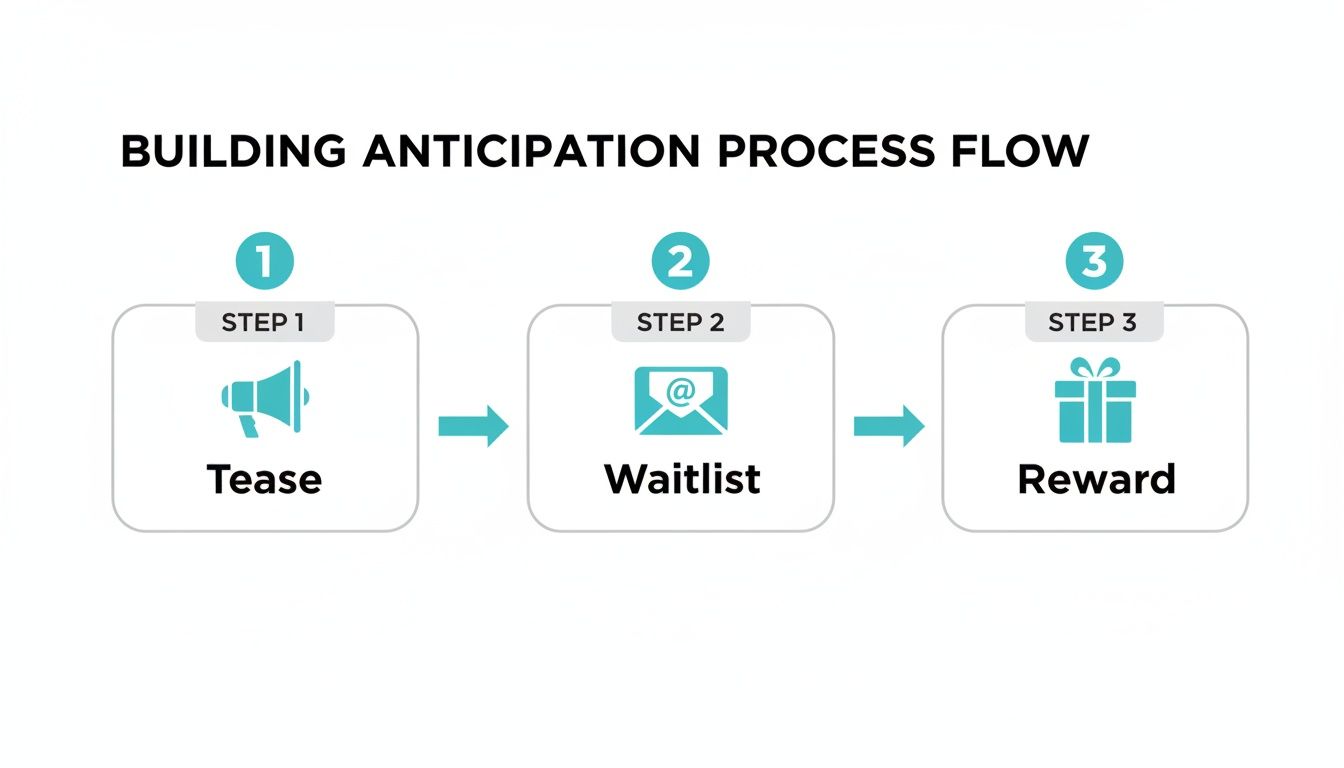
This simple model—tease the product, capture leads with a waitlist, and reward early interest—is the perfect setup for the high-impact campaign models we're about to dive into.
Forget generic discounts. Let’s examine a few advanced campaign structures designed for maximum ROI.
A Ranked Offer is a game-changer. It's a campaign where the value of the reward is directly tied to how fast a customer checks out. You're gamifying the purchase process and rewarding the quickest individuals with the best deals.
This model is effective because it taps into the powerful principle of loss aversion—a key concept in behavioral economics where people are more motivated by avoiding a loss than acquiring an equivalent gain. Nobody wants to miss out on the best possible deal. It also creates immense social proof as top-tier rewards are claimed, signaling to others that they must act quickly. For Shopify stores, this is a brilliant way to protect margins since the deepest discount is limited to a small, hyper-motivated group.
The Limited Quantity Drop is a classic for a reason. It creates intense demand by making the product supply feel exclusive and rare. This is perfect for limited-edition colorways, special collaborations, or the initial run of a new item.
Scarcity dramatically increases a product's perceived value. When something is limited, our brains automatically assign it a higher status. The buying decision shifts from, "Do I want this?" to "Can I get this before it's gone?"
When planning your drops, consider how influencer marketing campaigns can amplify the effect. Tying an exclusive drop to a specific influencer's audience creates an explosive combination of scarcity and social proof that is difficult to replicate.
Data is your guide to profitability. For example, Shopify's sales data from major shopping holidays shows that top-performing categories were Cosmetics, Clothing, Activewear, and Fitness & Nutrition. The average cart value in these categories hit $114.70.
This kind of industry benchmark data provides a solid baseline for setting price points and offer thresholds that align with customer expectations. By combining these smarter campaign models with real data, you can create a launch day event that doesn't just drive massive sales but builds an unforgettable experience for your customers.
You've designed a high-impact campaign and built an eager audience. Now comes launch day—the moment all that meticulous planning converts into profit.
Flawless execution separates a chaotic, stressful event from a smooth, revenue-generating success. The key is a synchronized, multi-channel promotion strategy that ensures your message cuts through the noise when it matters most.
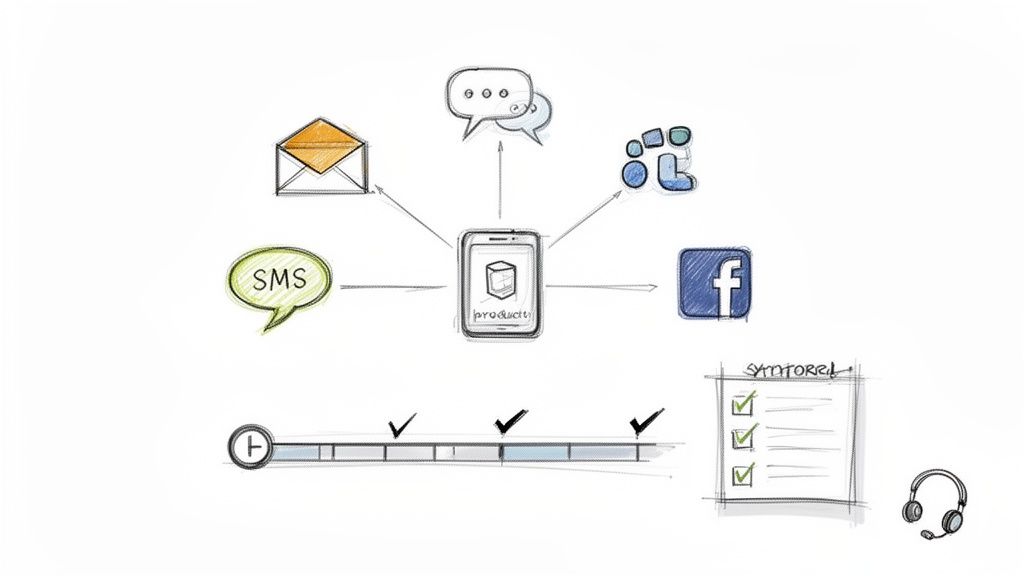
This isn’t about sending a single "we're live!" email. It's a coordinated broadcast across every customer touchpoint—email, SMS, social media—to create an unmissable event around your launch. Each channel has a unique role in driving customers to your Shopify store and converting anticipation into immediate sales.
The final hours before you go live are critical for building peak anticipation. A well-timed communication sequence primes your audience to act the second the "buy" button is available. This isn't just about sending messages; it's about strategic scheduling that maximizes the initial sales velocity that defines a successful launch.
Here’s a practical timeline to implement:
While marketing campaigns drive traffic, the backend of your Shopify store must run like a well-oiled machine. For Shopify Plus enterprise merchants, operational readiness is non-negotiable. A single technical hiccup can kill momentum and damage brand credibility.
The biggest benefit of automating your offer delivery with a platform like Quikly is that it frees up your team. Instead of manually managing discount codes or watching inventory, they can focus on high-value tasks—like engaging with customers on social media and capitalizing on the sales momentum in real-time.
Get your store ready with this launch day checklist:
By syncing multi-channel marketing with a robust operational plan, you create a seamless experience from promotion to purchase. That coordination is the final, crucial step in executing a launch that blows past your revenue goals.
The initial sales rush from a product launch is exhilarating. But once the launch-day notifications subside, the strategic work begins. The true value isn't just in the sales figures; it's in the rich data you've collected. This post-launch analysis is your opportunity to understand what really happened, get to know your new customers, and transform a one-time sales spike into a sustainable growth strategy.
It's easy to focus on surface-level stats like conversion rates, but building a durable brand means looking deeper. The true measure of success is the overall financial health of your launch, which requires focusing on the numbers that impact your bottom line.
To get an accurate picture of your launch's business impact, you must focus on metrics directly tied to profitability and customer value. This moves your launch strategy from a hopeful guess to a calculated, repeatable process.
Here are the key performance indicators to analyze:
Many brands celebrate a high conversion rate—often benchmarked around 2.5%—without scrutinizing the cost. A 5% conversion rate is impressive, but not if it required such deep discounts that you erased all your profit. The goal is profitable growth, not just moving units.
One of the most valuable assets from a launch is a freshly segmented audience. Every person who participated—whether they purchased or not—provided valuable behavioral data. This is where you can move beyond a simple email pop-up and leverage sophisticated automation.
Do not lump everyone who engaged with your launch into a single marketing bucket. Segment them into distinct groups for hyper-targeted follow-up campaigns.
This is where your Klaviyo or SMS platform integration becomes a strategic weapon. You can create precise segments based on launch day behavior. For example, you can isolate users who clicked launch announcements multiple times, added to cart, but never completed the purchase. This segment is pure gold; they were on the verge of buying.
Actionable Takeaway: Target this "cart abandoner" segment with a "second-chance" offer a few days post-launch. A targeted message with a different hook—perhaps free shipping or a small bonus gift—can effectively recover sales you nearly lost and demonstrate attentive customer service.
By analyzing performance and segmenting your audience, you build a powerful feedback loop. You can learn more by exploring strategies for measuring marketing campaign effectiveness. Each launch makes you smarter, more targeted, and ultimately, more profitable.
Even with a strong playbook, launching a new product can present challenges. The small details often differentiate a launch that merely happens from one that generates significant revenue. Let's address some of the most common questions from Shopify merchants.
The goal is to apply consumer psychology to build genuine excitement and create an event your customers want to be part of.
This is a critical concern for protecting profit margins. Deep discounts can be a trap; they erode margins, potentially devalue your brand, and train customers to wait for sales.
The key is to shift from monetary value to psychological value. Instead of a flat 30% off, use urgency and the desire for status to build a more compelling offer.
A ranked offer model is a fantastic solution. It directly rewards speed and urgency.
Another powerful strategy is value-stacking. Instead of cutting the price, you add value for a limited time.
These tactics protect your average order value and keep margins healthy while giving customers a compelling reason to buy now. The conversation shifts from a race to the bottom on price to a desire for exclusivity and a superior experience.
This is a crucial distinction. A basic countdown timer is a visual gimmick. It’s a static clock on your page that can create surface-level urgency but is a passive tool lacking real strategic depth.
An urgency marketing platform, like Quikly, is an entirely different system built on behavioral science. It doesn’t just display a timer; it creates dynamic, interactive events that pull the customer into the experience.
Think of it this way: a basic timer is a sign on a shop door that says "Sale Ends Friday." An advanced platform turns that sale into an interactive game where the customer's actions directly influence their reward. They become a participant, not a spectator.
Here’s how they compare:
| Feature | Basic Countdown Timer App | Advanced Urgency Platform (like Quikly) |
|---|---|---|
| Functionality | Displays a static clock, usually for a site-wide sale. | Creates dynamic, interactive "Moments" with unique rules. |
| Psychological Trigger | Relies only on basic time scarcity. | Taps into competition, social proof, and loss aversion. |
| Offer Structure | Typically tied to a single, flat discount for everyone. | Enables sophisticated models like ranked offers and tiered rewards. |
| Business Focus | A visual add-on for a page. | An integrated revenue generation engine. |
| Integration | Limited integration capabilities. | Seamlessly connects with Klaviyo, SMS platforms, and Shopify. |
The fundamental difference is the objective. A basic timer is a passive display tool. An advanced platform is an active revenue generation engine designed to maximize sales velocity and ROI from the very start.
There's no single magic number, as it depends on your product and audience engagement. However, for most Shopify launches, the sweet spot is 2 to 4 weeks. This provides enough runway to build genuine hype with a multi-phase campaign without your audience losing interest.
A shorter timeline may not build sufficient momentum. A longer one risks the initial excitement fizzling out.
Here’s a practical three-week pre-launch timeline:
Week 3 (The Tease): Start dropping hints. Share behind-the-scenes content on social media or cryptic images of the new product. Launch your pre-launch waitlist page to begin capturing high-intent emails and phone numbers.
Week 2 (The Reveal): Pull back the curtain. Officially announce the product with high-quality photos and videos. Solidify the exact launch date and time. Emphasize the exclusive nature of the launch offer to drive more sign-ups to your waitlist.
The Final 48 Hours (The Peak): This is the final push. Send multiple reminders across every channel—email, SMS, social stories. Reinforce the specific launch mechanics, especially for a ranked offer. Your goal is to build peak anticipation so your brand is top-of-mind when the "buy" button goes live.
Ready to move beyond basic timers and launch new products with campaigns that drive predictable revenue? See how Quikly can turn your next product release into a record-breaking sales event. Request a demo today.