
ecommerce psychology
brand loyalty
best brand experiences
Forget what you think you know about "coming soon" pages. They aren't just a digital placeholder or an "under construction" sign you throw up before the real work begins. Done right, this single page is your most powerful pre-launch asset, turning a future product drop into a strategic, revenue-driving event by building an engaged audience from day one.
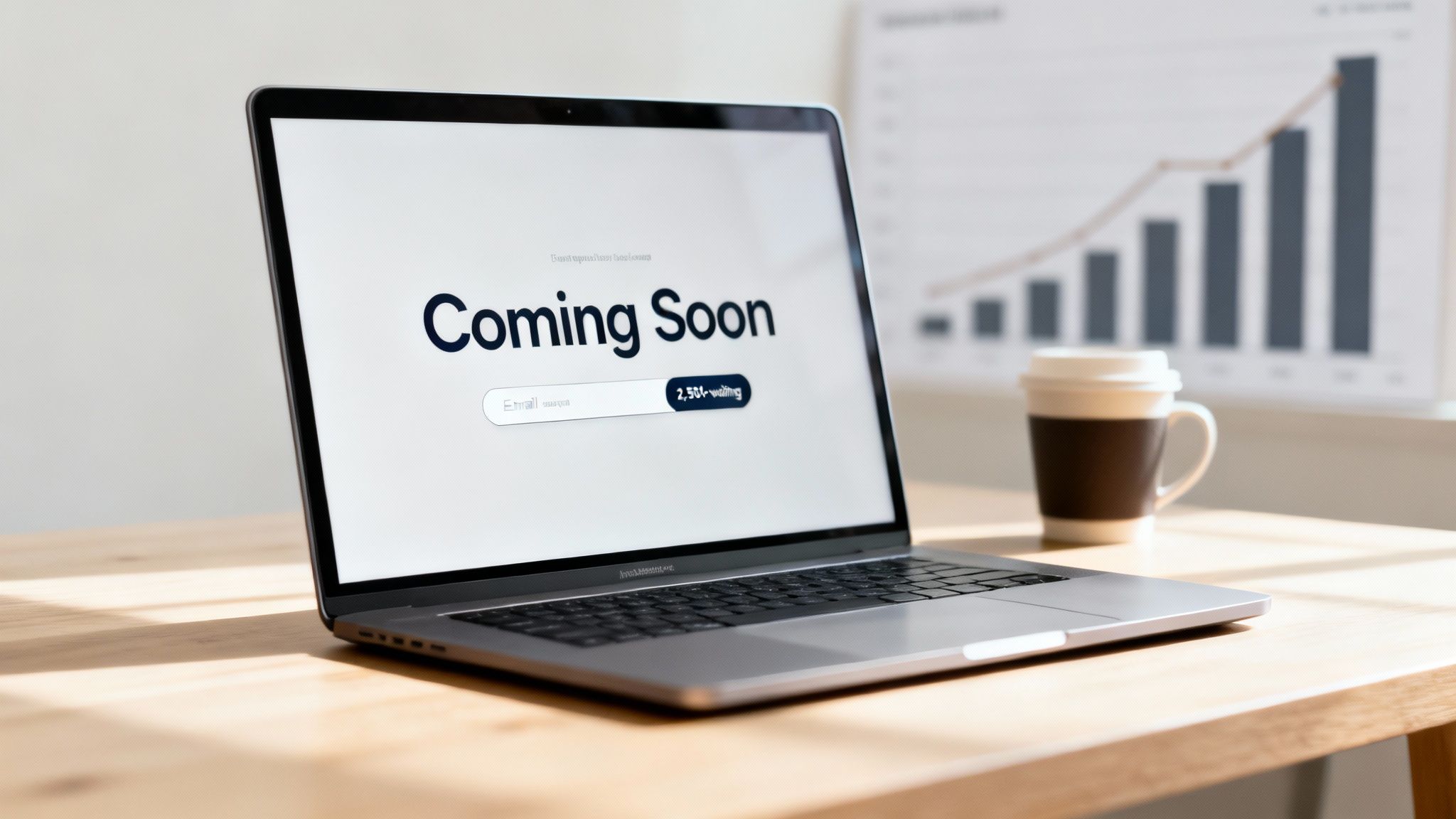
Many e-commerce brands treat their coming soon page like a locked door. This is a massive missed opportunity that directly impacts ROI. A well-designed page isn’t a barrier; it's a conversion engine that lets you validate product-market fit before sinking capital into inventory, protecting your profit margins from the start.
By capturing interest early, you're building a direct line of communication with your most enthusiastic future customers via email or SMS. This "owned audience" is a high-value asset. It drastically lowers your Customer Acquisition Cost (CAC) once you go live. Instead of paying a premium for ads targeting cold traffic, you're marketing to a warm, expectant list of people who asked to hear from you.
The primary job of a coming soon page is to turn vague interest into a tangible asset—your email list. You're essentially converting pre-launch hype into an audience that protects your profit margins by cutting down the need for expensive, last-minute ad campaigns.
This page is a critical first move in the bigger chess game of how to launch a new product successfully. It's your first touchpoint and the perfect place to start applying consumer psychology to build real excitement.
A coming soon page isn't just about collecting emails; it’s about starting a relationship. By framing the pre-launch phase as an exclusive opportunity, you trigger powerful psychological levers like anticipation and scarcity, making your first subscribers feel like true insiders.
For Shopify merchants, this is where integrations with tools like Klaviyo become incredibly powerful. You can set up automated nurture sequences to keep the conversation going and the engagement high. The goal is to build momentum so that when you finally open your digital doors, you're greeting a crowd, not an empty room.
Beyond building an audience, this page is your low-cost laboratory. It gives you early data on which messaging, visuals, and value props actually connect with your target market. Treat it like your very first A/B test.
This data-driven validation is essential in a crowded market. A solid pre-launch page can slash initial customer acquisition costs by an estimated 15–40% at launch. This direct impact on your bottom line turns a modest marketing effort into a powerful email list that fuels day-one sales and sets the stage for sustained growth.
To get your strategy locked in, it helps to break down the core components that make these pages work.
What is a coming soon page? It is a single landing page designed to build anticipation and capture leads for a product, service, or business before its official launch. This table breaks down the essential components that turn a static page into a conversion machine. It's a quick-reference guide to make sure you're hitting all the right notes.
| Component | Psychological Principle | Business Impact |
|---|---|---|
| Compelling Headline | Curiosity & Clarity | Immediately grabs attention and communicates the core value proposition. |
| Email/SMS Opt-In | Reciprocity & Exclusivity | Builds an owned audience, reducing future Customer Acquisition Costs (CAC). |
| Launch Countdown | Urgency & Scarcity | Creates a sense of anticipation and drives immediate action. |
| Social Sharing Links | Social Proof & Virality | Encourages word-of-mouth marketing and expands reach organically. |
| Sneak Peeks/Behind-the-Scenes | Anticipation & Connection | Fosters a deeper brand relationship and makes subscribers feel like insiders. |
Each of these elements works together to create an experience, not just a landing page. By combining them, you're not just announcing a launch; you're building a community before you even have a product to sell.
The real difference between a coming soon page that collects a handful of emails and one that builds a massive pre-launch list isn't the design—it's the psychology behind the words. Your copy is the most direct tool you have for tapping into the fundamental human drivers that make people act. This isn't manipulation; it's about understanding the behavioral science of why people buy.
A simple "Sign up for updates" offers no immediate value to the visitor. Instead, you need to frame the sign-up as a clear win for them, leaning into powerful principles from behavioral economics like scarcity, anticipation, and the ever-present fear of missing out (FOMO).
FOMO is a very real, deeply ingrained social anxiety. It’s that nagging feeling that you might miss out on a rewarding experience that everyone else is having. Consumer psychology studies have shown time and again that this feeling is a huge motivator, pushing people to act now to avoid future regret.
For your coming soon page, this means you need to stop thinking of your waitlist as a line and start treating it like an exclusive club.
That feeling that others are getting a leg up or a unique experience is a powerful trigger. Your copy can—and should—speak directly to it.
Closely related to FOMO is the principle of scarcity. It's simple: people place a higher value on things they believe are less available. In his groundbreaking research on influence, Dr. Robert Cialdini showed how scarcity creates an immediate sense of urgency, compelling people to act before the opportunity is gone forever.
You can weave this directly into your coming soon page with carefully chosen language.
A simple countdown timer tells people when to act. Psychologically-driven copy tells them why they must act now. This is the core difference between a basic popup and sophisticated urgency marketing. The goal isn't just to capture an email, but to generate genuine excitement that translates directly into launch-day revenue.
For Shopify Plus merchants, this gets really powerful when you integrate these tactics with platforms like Klaviyo or your SMS marketing tool. You can create entirely different pre-launch nurture sequences for your "Founder's Circle" versus your general waitlist, constantly reinforcing their exclusive status and building that anticipation. You can explore more on these tactics in our guide to consumer psychology in marketing.
Finally, your copy needs to build anticipation by telling a compelling story and teasing the value that’s on its way. This isn’t just about announcing a product. It's about creating a narrative that your future customers desperately want to be a part of. Use language that paints a vivid picture of the problem you're solving or the desire you're about to fulfill.
This is where you make that crucial emotional connection. Great pre-launch copy doesn't just list features; it sells a future state of being. It transforms a simple product launch into a highly anticipated event, making sure that when you finally open your doors, you have a crowd of eager fans ready to buy.
Your coming soon page has one primary job: get the visitor to sign up. That's it. So the design can't just look pretty; it needs to be ruthlessly efficient, cutting out every possible distraction to laser-focus attention on your value proposition and that all-important call-to-action.
Clutter is the enemy of conversion.
The visuals you choose are your first real handshake with a potential customer. A striking hero image isn't just window dressing—it’s your opening line. It's where you start telling your brand's story and showing the transformation your product offers. For anyone on Shopify, this is the perfect spot for high-quality product mockups or even some authentic, behind-the-scenes shots. These images make an abstract idea feel tangible, desirable, and trustworthy.
Great design isn't random; it creates a deliberate path for the user's eye. Your headline should grab them first—make it the most dominant thing on the page. Next, a short, punchy description that builds on that hook. Finally, their eyes should land directly on the email capture form. Everything else is just there to support that journey.
Many of the best practices for landing page design apply directly here. The goal is a clean, uncluttered layout where the sign-up form is impossible to miss. White space is your best friend. It gives the design room to breathe, reduces cognitive load, and makes your CTA pop right off the page.
People often make the mistake of treating design as purely aesthetic. It’s not. Think of it as a strategic tool for managing attention. Every color, font, and image should be chosen to build anticipation and funnel the visitor toward that opt-in form.
A basic page with an email field is a decent start, but you're leaving potential revenue on the table. The most effective coming soon pages feel alive, using dynamic elements grounded in real behavioral science. This is what separates a simple placeholder from a sophisticated pre-launch marketing machine.
This is where understanding why people act comes into play.
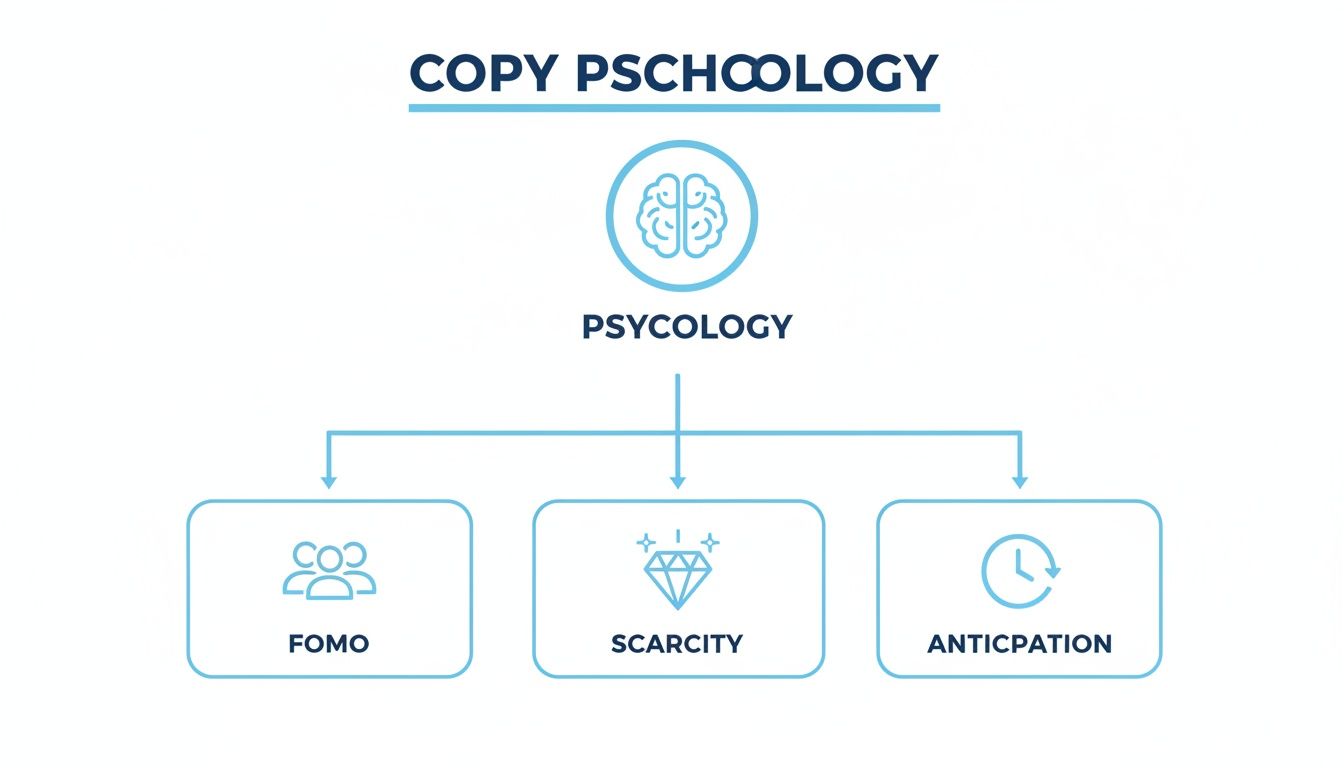
As the diagram shows, effective marketing isn't about guesswork. It starts with human psychology, tapping into powerful triggers like FOMO, scarcity, and anticipation that you can bake right into your page design.
A static page is passive. It just sits there. To get a return on your pre-launch efforts, you need to create an active, engaging experience. This is where advanced behavioral triggers come in, and they go way beyond what a simple popup app can do.
Think about adding elements like these:
These aren't just fancy features; they transform your page from a flat announcement into an interactive event. For a Shopify Plus merchant, integrating advanced tools can automate these triggers, creating a personalized and powerful experience without any manual work. You're not just capturing emails—you're generating revenue from day one.
A standard countdown timer on a coming soon page is table stakes. It’s a good start, but it’s a passive tool in a game that demands active engagement. The real revenue opportunity isn't just collecting emails; it’s about transforming that static waitlist into a dynamic, revenue-generating community before you even launch.
This is where we move beyond simple pop-up apps and embrace a more sophisticated approach grounded in behavioral economics. The goal is to turn anticipation into immediate sales, not just a list of names that might convert later.
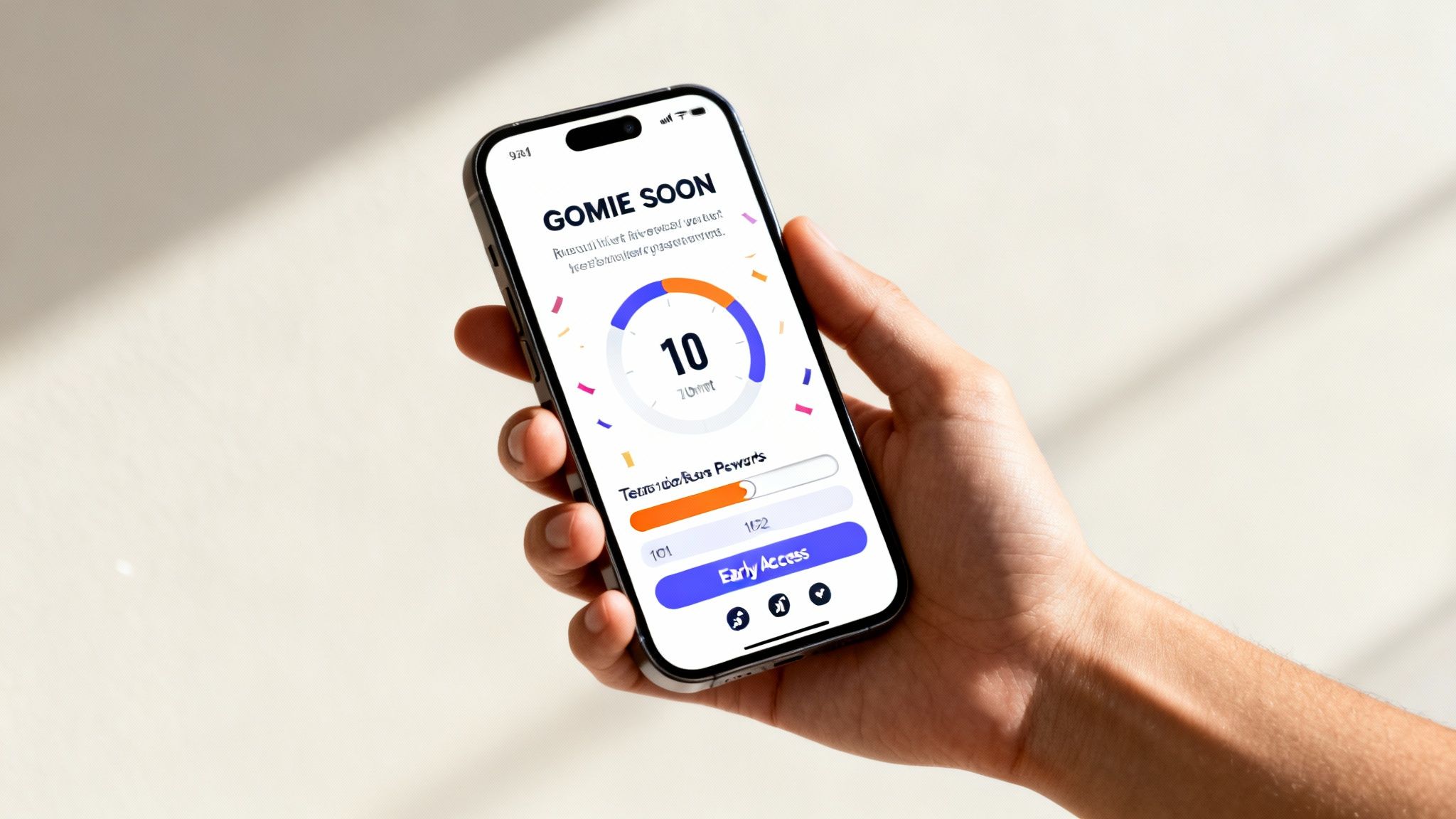
The fundamental flaw with most coming soon pages? They ask your visitors to wait quietly. Sophisticated urgency marketing, on the other hand, asks them to participate. You want to create a pre-launch experience that feels exclusive, a little competitive, and genuinely rewarding—all principles that drive human action.
Gamified launches are a perfect example of this in action. Instead of just signing up, visitors can complete actions to climb the waitlist. This simple shift taps into our innate desire for status and competition, keeping your brand top-of-mind long after they've left the page.
The most successful pre-launch campaigns don't just announce a future event; they create a present one. By giving subscribers a tangible way to engage and improve their standing, you're not just building a list—you're cultivating an active, invested community ready to purchase on day one.
These strategies are built for direct revenue impact. You’re not just building a bigger audience; you’re building one that's primed to convert at a higher rate. This means less reliance on expensive launch-day ads and healthier profit margins from the get-go.
One of the most powerful ways to get your waitlist working for you is to implement tiered rewards. It's a brilliant strategy for incentivizing the exact behaviors that lead to viral growth: sharing and advocacy.
Here’s a simple way to structure it:
This does more than just encourage sharing. It creates powerful social proof. When people see others climbing the ranks and unlocking rewards, it reinforces the idea that your launch is an event they can't afford to miss. This is a world away from a basic pop-up that has one isolated goal: capture one email.
For Shopify merchants, the real magic happens when you connect these advanced urgency tools directly into your marketing stack, especially with platforms like Klaviyo. This is how you build a pre-launch hype machine that runs on autopilot.
Let’s walk through a common scenario for a Shopify Plus store using an advanced platform like Quikly:
This creates a self-perpetuating marketing engine. While a well-optimized coming soon page can hit email capture rates of 10–20%, adding a gamified, time-bound element can boost signups significantly further. When you connect those psychological triggers to your marketing automation, you amplify their impact exponentially.
To really nail this down, it’s worth comparing the old way with the new. A simple countdown app just tells time. An advanced platform actively builds your business.
| Feature | Basic Countdown App | Advanced Platform (e.g., Quikly) |
|---|---|---|
| Primary Goal | Create passive urgency | Drive active engagement & pre-launch revenue |
| User Action | View timer, enter email | Sign up, share, refer, complete actions |
| Incentives | Static (e.g., 10% off for all) | Dynamic & tiered (e.g., better rewards for more referrals) |
| Social Proof | Minimal to none | Built-in via leaderboards & social sharing |
| Integration | Basic email list connection | Deep integration with ESPs/SMS for automated, personalized flows |
| Analytics | Tracks signups | Tracks referrals, engagement, and projects launch-day ROI |
| ROI | List building | Measurable revenue generation & audience cultivation |
As you can see, the focus shifts entirely from simply having a list to building a powerful, pre-qualified pipeline of customers who have already engaged with your brand multiple times. Quikly "Moments" are next-generation urgency campaigns that transform this process through sophisticated automation.
You’re not just managing a spreadsheet of emails; you’re deploying a system designed to maximize launch-day revenue and long-term loyalty. For more actionable strategies, check out our complete guide to Shopify urgency tactics.
A coming soon page is a hypothesis about your customer. Measuring its performance isn't just about vanity metrics—it’s about sharpening your strategy to maximize launch-day revenue.
Forget about page views. The real story is in the Key Performance Indicators (KPIs) that actually predict your Return on Investment (ROI). The mission is to build a hungry list of motivated buyers, and that requires a laser focus on data that shows genuine engagement.
To get a true read on the health of your pre-launch campaign, you have to track the numbers that matter. These metrics will tell you everything you need to know about the quality of your traffic, the punch of your messaging, and the future value of this brand-new audience.
Here are the three KPIs you must track:
Email Capture Rate: This is your north star. It's the percentage of unique visitors who actually sign up. While industry benchmarks hover around 2.5%, a page with compelling psychological triggers and strong incentives can achieve 10-20% or even higher.
Referral Rate: If you're running any kind of tiered rewards or social sharing campaign, this metric is your secret weapon. It shows you the percentage of new signups that came directly from user referrals. A high referral rate is gold—it means your offer is so good that people are willing to put their own reputation on the line to share it.
Lead-to-Customer Conversion Rate (Post-Launch): This is the final report card. After you go live, what percentage of your pre-launch email list actually made a purchase? This single KPI tells you the unvarnished truth about the quality of the audience you built.
The most profitable Shopify stores don't just count sign-ups; they measure the intent behind them. A smaller, highly-engaged list built with compelling offers will always outperform a massive, passive list you got with a generic "Join our newsletter" button. It’s about revenue potential, not just list size.
You can't optimize what you can't see. Getting your tracking in place from day one is completely non-negotiable. Luckily, for Shopify merchants, this is straightforward and plugs right into the tools you're already using.
First, set up a specific goal in Google Analytics 4 (GA4) for your email form submission. This simple step lets you see exactly which traffic sources—paid ads, a specific Instagram post, an influencer link—are driving the most valuable signups. Go one step further and connect this to your Klaviyo or SMS platform to automatically tag these users in a "Pre-Launch" segment.
By segmenting this audience from the jump, you'll be able to look back later and see which channels brought in the customers with the highest lifetime value. That's pure gold for optimizing your future ad spend.
Your coming soon page should never be a "set it and forget it" project. Think of it as a live laboratory for testing your launch messaging. A/B testing, or split testing, is just showing two different versions of your page to visitors to see which one gets more signups.
And you'd be shocked at how small changes can lead to huge lifts in your email capture rate.
Every test gives you hard data that inches you closer to a perfectly tuned page. This process of constant tweaking means that by the time you launch, your messaging is already proven, massively de-risking your investment and setting you up for maximum ROI on day one.
When you're in the pre-launch phase, a lot of questions come up. Let's tackle the most common ones, focusing on practical advice that actually drives results.
There's no magic number, but the sweet spot is typically 4 to 8 weeks before you plan to go live.
This window gives you enough time to build real momentum, grow a solid email list, and get a head start with search engines. But it's not so long that the initial excitement dies down. Any shorter, and you're rushing. Any longer—say, over a few months—and people start to forget why they were excited in the first place. You want to keep that drumbeat of anticipation steady and consistent.
Yes, it absolutely can. Think of it as giving Google a heads-up.
By publishing a simple coming soon page, you're letting search engines know your domain exists. They can start indexing it right away. While you won't be ranking for major keywords overnight, you're laying the groundwork and starting to build domain authority from day one.
You can even get strategic by targeting some long-tail keywords in your page title, meta description, and the copy itself. When people land on the page and sign up, that engagement sends positive signals to Google, telling them your site is relevant long before you’ve even launched a single product.
This really comes down to who you're talking to and how you plan to talk to them.
Email Capture: This is your bread and butter. It's perfect for storytelling—sharing behind-the-scenes content, deep dives into your products, and building a real narrative around your brand. Plus, it plugs right into platforms like Klaviyo for crafting those all-important automated welcome sequences.
SMS Capture: This is your tool for immediacy. With text messages boasting 98% open rates, SMS is incredibly powerful for things that can't wait. Think launch day reminders, flash sales, and last-chance alerts.
The smartest brands offer both. Let your audience choose how they want to hear from you. This simple choice maximizes your reach and makes your messaging far more effective.
Pro Tip: If you offer both, treat your SMS list like gold. Someone giving you their phone number is showing a much higher level of interest. Segment them out, make them feel like VIPs with exclusive offers, and tap into that psychological principle of reciprocity. It builds incredible loyalty.
An incentive is one of the quickest ways to get sign-ups, but you have to be smart about it. A generic "10% off" can attract people who just want a deal, not genuine fans who will stick around.
Instead of just offering a coupon, frame the incentive to feel more valuable. Play with a little consumer psychology.
See the difference? You're positioning the reward as a privilege for being an early supporter, not just a transaction. This shifts the dynamic entirely, helping you build a stronger, more qualified audience that's much more likely to buy from you again, even at full price.
Ready to turn that passive waitlist into an active, revenue-driving community? Quikly goes way beyond basic countdown timers. As experts in urgency marketing science, we help you build sophisticated, psychology-driven campaigns that create massive pre-launch hype and enhance the entire shopper's journey, setting you up for a profitable launch day. See how it works.