

ecommerce conversion
customer experience strategy
digital customer experiences
An exit intent popup is your last, best chance to change a visitor's mind. It's a smart tool that senses when someone is about to click away from your site and, in that final moment, presents them with a targeted offer to convince them to stay. This is a critical touchpoint, especially when you consider that industry benchmarks show nearly 70% of e-commerce shopping carts are abandoned.
Most e-commerce brands see exit intent popups as a simple email capture tool. This perspective misses the much larger opportunity: its primary function is to recover revenue and protect your profit margins.
Instead of a basic interruption, think of it as a sophisticated engagement play rooted in consumer psychology. It’s your final opportunity to overcome the friction—like surprise shipping costs or decision fatigue—that causes a potential customer to abandon their purchase. By understanding the behavioral science at play, you can turn this tool from an annoyance into a significant revenue driver.
Ultimately, the goal of an exit intent popup is directly tied to learning how to reduce website bounce rate by converting a potential loss into a definite win.
While growing your email list is valuable, the immediate business impact of a sharp exit intent strategy comes from its power to convert a sale that was moments away from vanishing. A generic "Join our newsletter" popup is insufficient for a high-intent user who already has items in their cart.
A smarter approach uses advanced behavioral triggers to present a compelling, relevant offer at that precise moment of hesitation. This is where psychology meets technology. The goal isn't just to grab an email; it's to deploy urgency marketing science that enhances banners, popups, and the entire shopper's journey.
This is a classic example of what I mean—an exit-intent popup offering a direct incentive to seal the deal.
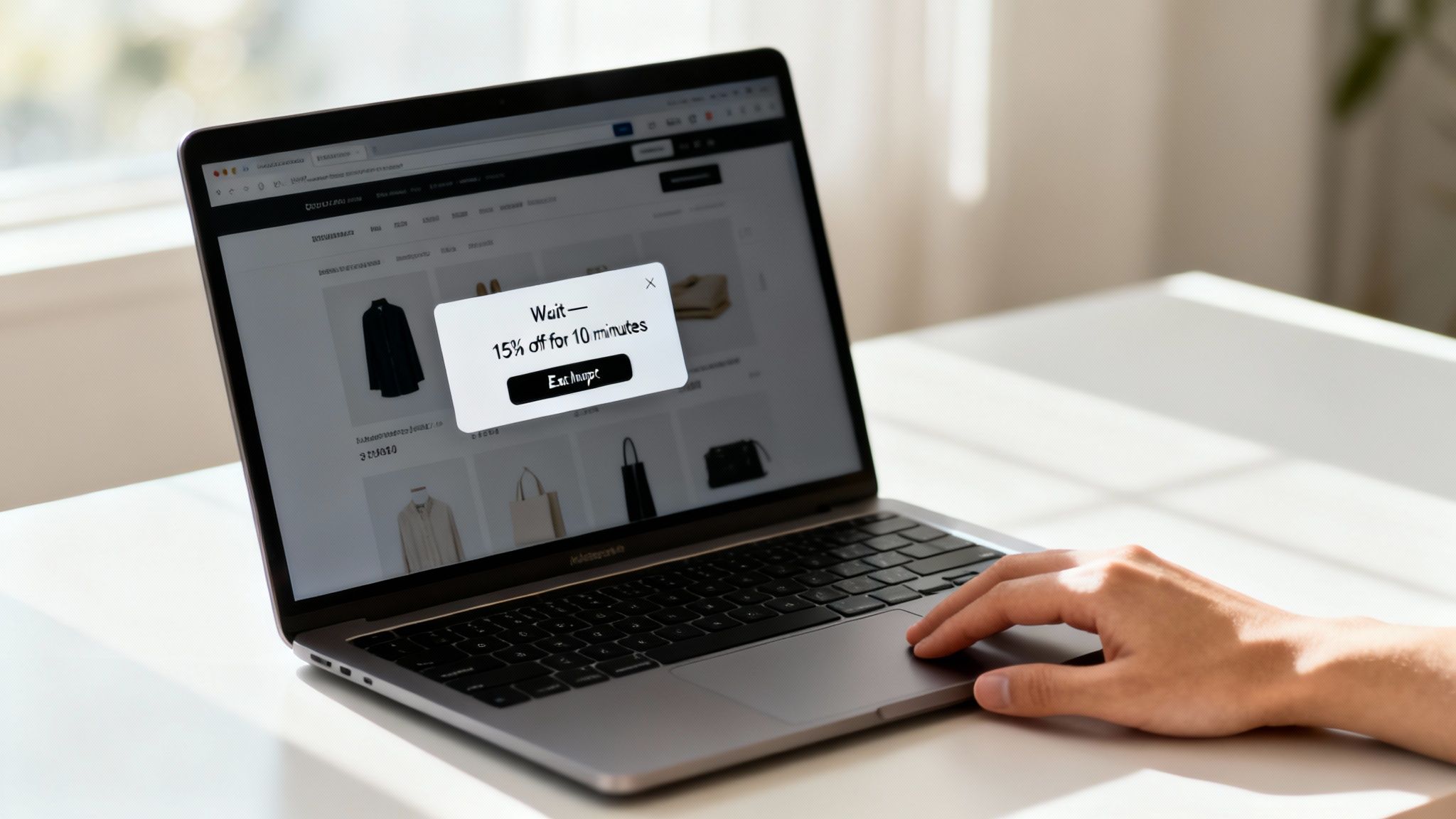
The key insight here is the move from a passive request to an active, value-driven intervention designed to immediately recover revenue.
The ROI on this strategy is clear and directly measurable. Let's look at the numbers.
Well-crafted exit-intent popups can save abandoned carts and significantly boost revenue. They directly address the staggering 70% cart abandonment rates that plague e-commerce. On mobile, where abandonment can reach 78%, this intervention is even more critical.
Case studies have shown that merchants can recover a significant portion of exiting visitors and see substantial jumps in mobile conversions by using mobile-friendly popups with strong offers. The evidence is clear.
Let's break down how this strategy directly addresses common business challenges and delivers measurable results.
| Business Challenge | Exit Intent Solution | Expected ROI and Impact |
|---|---|---|
| High Cart Abandonment | Offer a compelling discount (e.g., 15% off) or free shipping to shoppers with items in their cart as they try to leave. | Directly reduces abandonment rates, potentially recovering 10-30% of otherwise lost sales and boosting overall revenue. |
| Low Conversion Rates | Present a time-sensitive offer to create urgency, or provide a "save my cart" option in exchange for an email. | Increases on-session conversion rates by overcoming purchase hesitation. Captures leads from undecided visitors for future marketing. |
| Low AOV | Suggest a relevant upsell or cross-sell in the popup. For example, "Add this for $10 to get free shipping!" | Encourages shoppers to add more to their cart, increasing the average order value and maximizing profit per transaction. |
| Poor Email List Growth | Offer a valuable lead magnet (e.g., a style guide, a setup checklist) or a "first to know" signup for new products. | Builds a high-quality email list with subscribers genuinely interested in your brand, leading to better long-term engagement and LTV. |
As you can see, a well-thought-out popup is far more than an email form; it's a versatile tool for tackling core business metrics head-on.
By focusing on revenue recovery, a single successful popup can have a more significant impact on your bottom line than capturing hundreds of low-intent email subscribers. It directly protects profit margins by preventing lost sales without offering blanket discounts to all shoppers.
This targeted approach ensures you’re not just increasing conversion rates, but also protecting your inventory and maximizing profit on every transaction. It's a fundamental shift from generic marketing tactics to a precise, data-driven strategy that delivers immediate financial returns—a critical advantage for any Shopify or Shopify Plus merchant.
A great exit-intent popup isn’t about the technology; it’s about applied behavioral science. To move past email capture and generate real revenue, you must understand the psychological triggers that make someone stop, reconsider, and complete their purchase. A basic popup simply asks for an email, but a sophisticated one presents an offer that taps directly into core human motivations.
The most powerful principle at play here is loss aversion. This foundational concept from behavioral economics demonstrates that people feel the pain of a loss far more intensely than the pleasure of an equivalent gain. When a shopper has items in their cart, leaving feels like a tangible loss. A perfectly timed exit-intent popup magnifies that feeling by framing the offer not as something they can get, but as something they're about to lose forever.
The Fear of Missing Out (FOMO) is an incredibly powerful driver of immediate action. An offer that’s only available "for the next 10 minutes" feels significantly more valuable than one with no deadline. This is a direct application of the scarcity principle—when something is limited, its perceived value increases dramatically.
This is a world away from basic countdown timer apps that merely display a ticking clock. A truly effective strategy, like Quikly's "Moments," creates genuine scarcity. It’s not just a timer; it’s a limited release of a special offer or product that, when it’s gone, is truly gone.
This shift changes a user's mindset from passive browsing to active participation. That fear of losing a unique opportunity can be the final push needed to overcome purchase hesitation.
A one-size-fits-all offer is ineffective because people abandon carts for different reasons. The psychology behind your offer must match the specific friction point causing them to leave. Effective urgency marketing isn't manipulation; it’s about providing the right solution at the precise moment of need.
Consider these real-world scenarios:
A truly sophisticated exit-intent popup strategy is an exercise in empathy. By diagnosing the likely reason for abandonment based on user behavior, you can deploy a psychologically-tuned offer that feels less like a sales pitch and more like a helpful hand guiding them across the finish line.
Understanding the deep-seated reasons why urgency causes action is the secret to creating offers that don't just convert, but also build brand affinity. When you focus on solving their problem—whether it's price shock or decision fatigue—your popup becomes a valuable part of their journey, driving immediate ROI while protecting your bottom line.
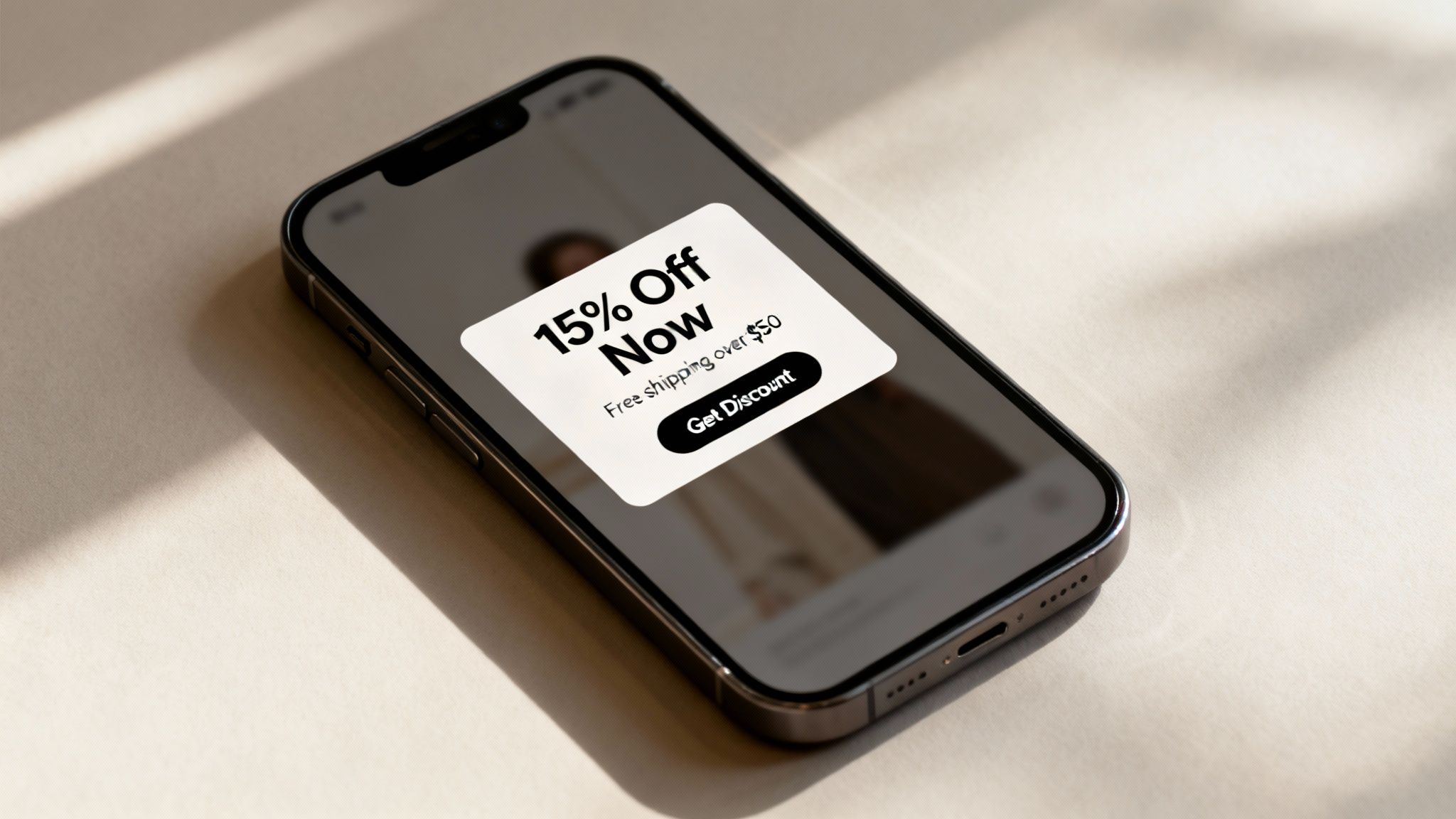
A great exit-intent popup is more than a last-ditch offer; it’s a strategic blend of sharp design and persuasive copy. The goal is to create an experience that feels helpful and native to your brand, not like another intrusive advertisement.
When someone decides to leave, you have only seconds to capture their attention, communicate value, and inspire action.
This comes down to a clear visual hierarchy. Your design must instantly guide their eyes to the most important elements: the headline, the offer, and the call-to-action (CTA) button. Eliminate clutter. Every element must serve a purpose.
Your popup copy needs to be direct and laser-focused on the benefit. This is not the time for clever wordplay; clarity is essential. The shopper is already leaving, so you need a powerful message to draw them back.
Headline: This is your hook. It should be short, punchy, and get straight to the value. Instead of a generic "Wait!", try something specific like "Before You Go, Take 15% Off" or "Get Free Shipping On This Order." This simple change reframes the popup as a gift, not a roadblock.
Body Text: Keep it brief—one or two sentences at most. Reinforce the headline's promise and add a touch of urgency. For example, "Complete your purchase now and we’ll ship it for free. This offer is only available on this page." That small addition creates a sense of scarcity, which is a powerful psychological motivator.
Call-to-Action (CTA): Your CTA button must be a clear command. Use action-oriented language that tells the user exactly what they'll receive. "Claim My Discount" is far more effective than a passive "Submit." Ensure the button itself stands out with a contrasting color that naturally draws the eye.
Mobile commerce dominates the landscape. If your popups are designed for desktop first, you are positioned for failure. Mobile requires a different mindset, one that respects the smaller screen and prioritizes a touch-friendly design.
Aggressive, full-screen takeovers on mobile can lead to penalties from search engines and will certainly frustrate your visitors. A good mobile popup is easy to close and presents its offer clearly without obstructing the entire page.
The golden rule for any exit-intent popup is to reduce cognitive load. A visitor should be able to understand the offer and decide what to do in less than three seconds. Anything more complicated will just get ignored.
Even with the best intentions, it’s easy to create a popup that does more harm than good. Avoid these common mistakes to protect your user experience and achieve optimal results.
| Mistake to Avoid | Why It Fails | The Better Approach |
|---|---|---|
| Confusing or Vague Offers | "Get a special deal!" forces the user to think. If they have to decipher the offer, they will close the popup. | Be crystal clear: "Take $10 Off Your First Order." |
| Aggressive Visuals | Flashing animations, jarring color combinations, or low-quality stock photos can make your brand appear untrustworthy. | Adhere to on-brand colors, use high-quality product images, and maintain a clean, professional layout. |
| Difficult to Close | Hiding the "X" button or using manipulative text like "No, I prefer to pay full price" is a quick way to erode trust. | Make the close button obvious and easy to find. Respect the user's choice to leave. |
| One-Size-Fits-All Copy | A new visitor and a loyal customer with a full cart have entirely different mindsets. Displaying the same message is a wasted opportunity. | Segment your audience and tailor the copy to their specific context. We explore this further in our guide to creating high-impact popups for Shopify. |
Ultimately, the best exit-intent popup feels like a helpful, natural part of the shopping experience. It's thoughtfully designed to intercept that final moment of hesitation and offer a clear, compelling reason to stay.
An effective exit-intent popup isn't a blunt instrument; it's a surgical tool. Displaying the same generic offer to every visitor is a sure way to erode profit margins, especially when you discount purchases that would have happened anyway. The real ROI is unlocked through smart, behavior-based segmentation.
This is what differentiates a simple popup app from the science of urgency marketing. Instead of merely reacting to cursor movement, a sophisticated system analyzes the who, what, and why behind the exit. This allows you to deploy a personalized offer that feels less like a desperate plea and more like a genuinely helpful, well-timed suggestion.
The most basic exit-intent popup triggers for every departing visitor. While better than nothing, this approach lacks critical context. A high-impact strategy layers multiple conditions to create precise, meaningful audience segments.
Your objective is to match the value of your offer to the value and intent of the visitor. You wouldn't offer a 40% discount to a first-time visitor who browsed a few pages. But for a loyal customer abandoning a $700 cart? That requires a different strategy entirely.
Key data points for segmentation include:
By segmenting your audience, you protect your margins and deliver a relevant experience. The goal is to make the user feel understood, transforming the popup from an interruption into a valuable part of their shopping journey.
Imagine you're a Shopify Plus merchant selling high-end outdoor gear. A one-size-fits-all popup would be detrimental to your brand image and bottom line. Instead, you can build a multi-layered, automated strategy.
Segment 1: The High-Value Cart Abandoner
Segment 2: The Hesitant First-Time Browser
Segment 3: The Price-Sensitive Return Visitor
Cart abandonment popups boast an impressive 17.12% average conversion rate because they intercept shoppers at that critical moment of indecision. One brand famously recovered 21% of their abandoned carts using behavior-matched popups, demonstrating the immense power of context. You can find more insights about how targeted offers recover sales on omnisend.com.
This sophisticated, layered approach, easily automated with a platform like Quikly, ensures your offers maximize revenue impact while protecting your brand's premium positioning. It's the difference between blindly shouting at everyone and having a quiet, persuasive conversation with the right person at the perfect time.
Implementing an exit-intent popup on your Shopify store is straightforward. The real value is unlocked when you integrate these tools into your broader marketing ecosystem and rigorously measure their impact on your bottom line.
A successful campaign is not a one-time setup. When a shopper provides their email for a discount, that data must instantly flow to your other marketing platforms to initiate a relevant and timely conversation.
For merchants on Shopify or Shopify Plus, seamless integration is non-negotiable. Your exit-intent tool should act as a powerful lead source that feeds your primary communication channels, creating a cohesive customer journey.
This is a cornerstone of effective ecommerce marketing automation strategies. You transform a single moment of engagement into a potentially lasting and profitable customer relationship.
This flow chart illustrates the core strategy: moving from a wide net to a precise, targeted offer.
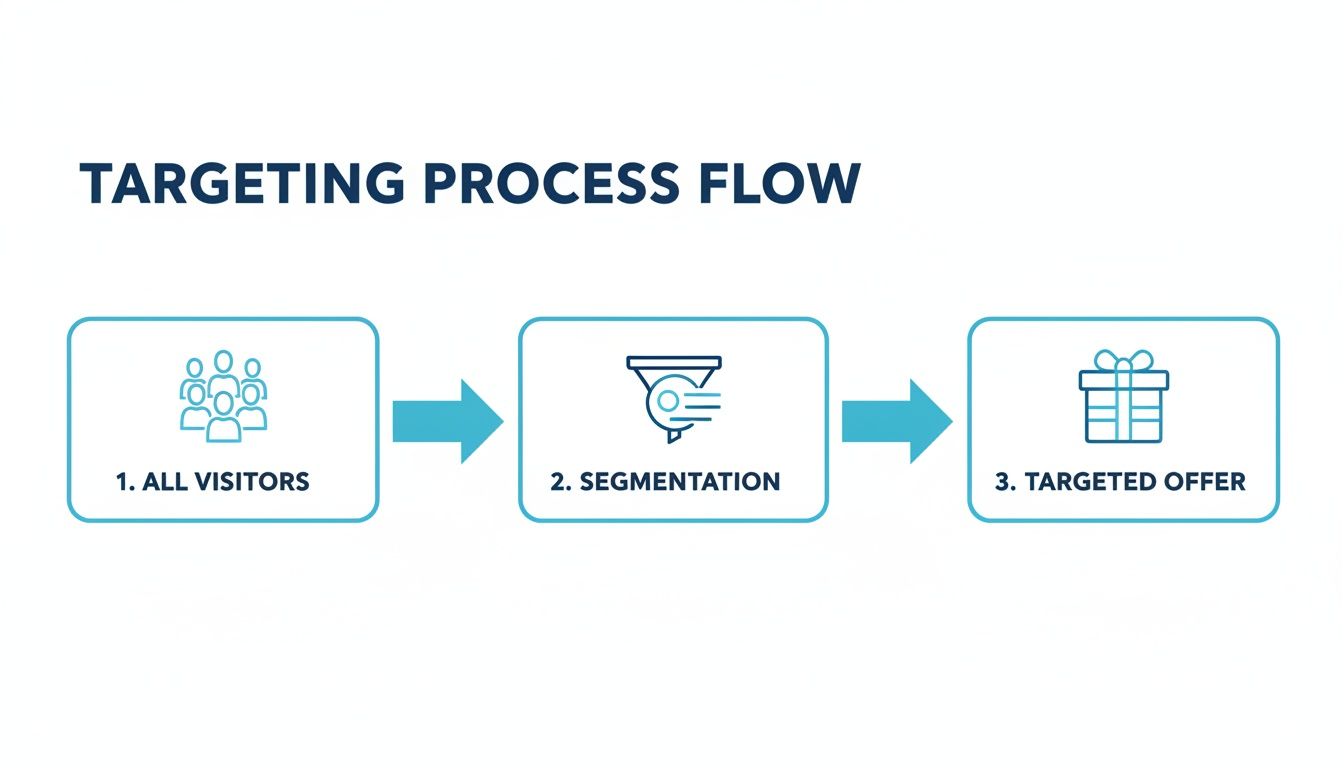
This shift from a scattergun approach to a surgical one, powered by segmentation, is key to maximizing impact.
To truly understand performance, you must look beyond vanity metrics. A high click-through rate is encouraging, but the metrics that matter are tied to revenue and profit.
Focus on these key performance indicators (KPIs):
A common mistake is obsessing over the popup's conversion rate while ignoring its effect on overall store revenue. A 10% conversion rate on a deep discount may look impressive, but if it's cannibalizing full-price sales, you are actually losing money.
For a deeper look, our guide on how to measure marketing campaign effectiveness provides a complete playbook for tracking what truly moves the needle.
Your first exit-intent popup will not be your best. The only way to systematically increase revenue is through continuous, data-driven A/B testing. Isolate one variable at a time, run the test until you have a statistically significant winner, and then iterate.
Here are a few high-impact A/B testing ideas to get you started.
This table breaks down simple yet powerful variables you can test to systematically improve your campaign performance.
| Element to Test | Variation A (Control) | Variation B (Test) | Key Metric to Watch |
|---|---|---|---|
| The Offer | 15% Discount | Free Shipping on Orders $50+ | Revenue Recovered, AOV |
| The Headline | "Wait! Before You Go..." | "Get 15% Off Your First Order" | Conversion Rate |
| The Visuals | Static product image | Animated GIF or video | Click-Through Rate |
| The Timing | Trigger immediately on exit | Trigger after a 3-second delay | Bounce Rate, Conversion Rate |
By methodically testing these elements, you will discover what truly resonates with your audience. Over time, this iterative process transforms your exit-intent strategy from a simple tool into a finely-tuned revenue engine.
Even with a solid game plan, questions are bound to arise when implementing exit-intent technology. Let's address some of the most common concerns from e-commerce managers to ensure you're enhancing the shopper's journey, not disrupting it.
This is a primary concern, and the short answer is no—a properly implemented exit-intent popup will not harm your SEO.
Google's main issue is with intrusive interstitials that block content immediately upon a user landing on a page, particularly on mobile. Since exit-intent popups only appear when a user is clearly leaving, search engines view them as far less disruptive.
The key to a positive user experience is to offer genuine, immediate value. A popup that solves a problem, such as offering free shipping to a shopper hesitating over extra costs, can actually improve their perception of your brand.
To ensure your popups have a positive impact:
While case studies often tout high numbers, a strong, realistic conversion rate for a well-designed exit-intent campaign is typically between 2% and 5%. However, this figure is highly dependent on context.
For instance, a popup targeting a shopper abandoning a high-value cart can achieve conversion rates as high as 17%. This is because you are engaging a user with extremely high purchase intent at the perfect moment.
The true metric for success is not a universal percentage, but a tangible business outcome.
The ultimate goal isn't just a high conversion rate, but a measurable increase in recovered revenue and customer lifetime value. Focusing on ROI over simple conversion percentages provides a much clearer picture of your campaign's true business impact.
Instead of chasing an arbitrary number, focus on making small, consistent improvements through methodical A/B testing. These incremental gains accumulate over time, leading to significant revenue recovery.
Implementing an exit-intent popup on Shopify is quite straightforward. The platform’s robust app ecosystem means you won't need to write any code. Most modern apps provide a simple, visual setup process.
The typical process looks like this:
This setup enables sophisticated automation, allowing Shopify and Shopify Plus merchants to run advanced, segmented campaigns that generate revenue without constant manual oversight. The best tools have evolved beyond basic timers to focus on these deeper, psychology-driven integrations that influence the entire customer journey.
Ready to turn those leaving visitors into loyal customers? Quikly provides the advanced urgency marketing science you need to create sophisticated, revenue-focused campaigns that go far beyond basic popups. See how our platform can protect your profit margins and enhance your shopper's journey.