

ecommerce conversion
customer experience strategy
digital customer experiences
An ecommerce marketing strategy isn't just a to-do list; it's the master plan for how you'll find new customers, convince them to buy, and turn them into raving fans. It’s the connective tissue that links every single marketing effort—from a Google Ad to an abandoned cart email—into one unified system that drives measurable revenue and profit.
This blueprint is what separates businesses that see random, unpredictable sales from those that build real, sustainable growth.
An effective ecommerce marketing strategy is the architecture for your store's growth. Without it, you’re just throwing tactics at the wall and hoping something sticks—a Facebook ad here, a blog post there, with no clear line connecting your efforts to actual revenue. A strategy provides a predictable, repeatable system for generating profitable customer relationships.
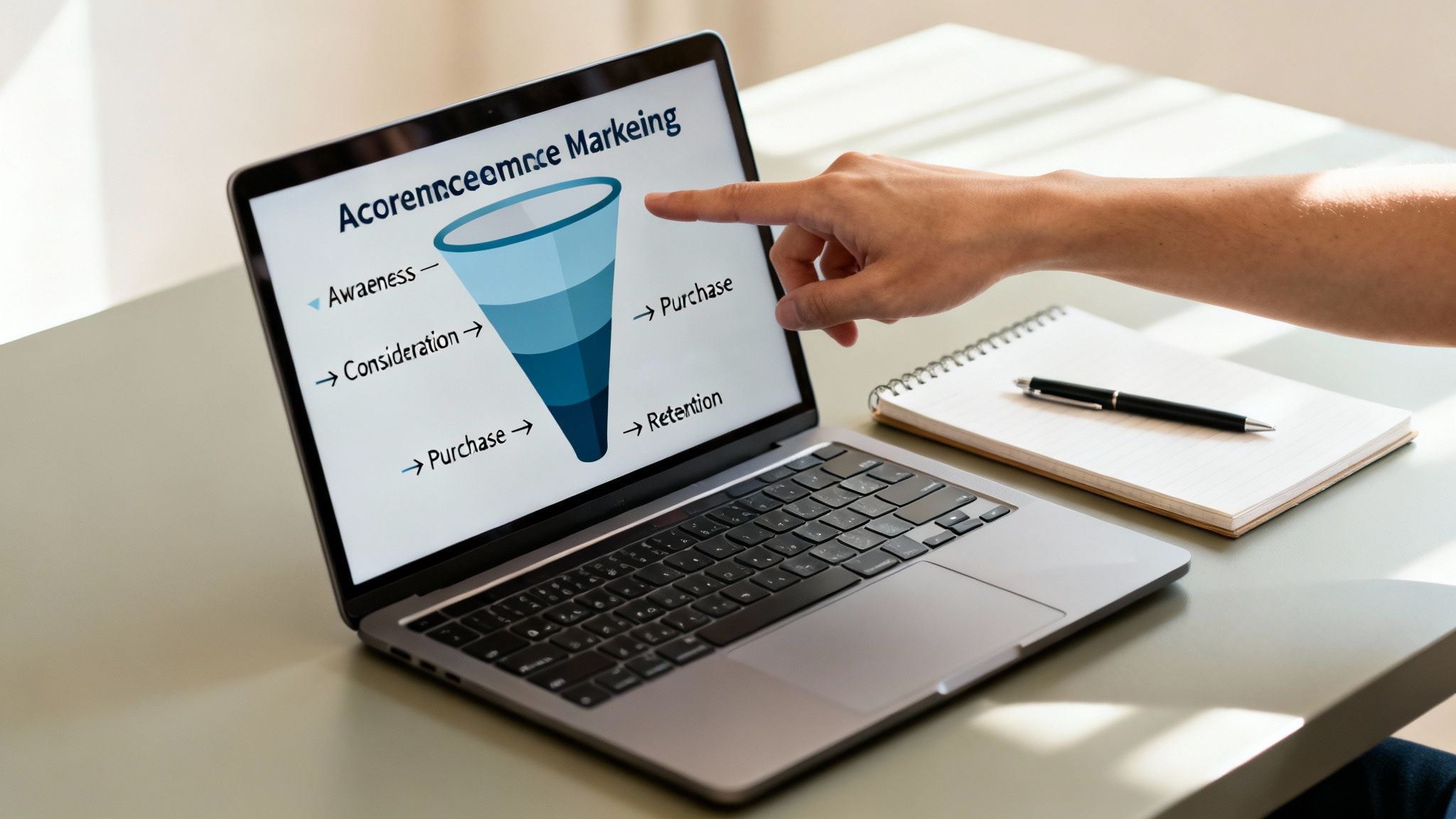
The point is to move away from constantly reacting with short-term, margin-eroding promotions and toward a proactive, long-term game plan that builds a powerful brand and protects profitability.
The stakes are high. The global ecommerce market is set to blow past $7.4 trillion in sales by 2025. That means nearly one out of every four retail dollars will be spent online. The opportunity is absolutely massive, but so is the competition. A sharp, well-defined strategy is your best weapon for carving out your piece of the pie. You can discover more insights about global ecommerce statistics and see exactly where the market is headed.
Every solid ecommerce marketing strategy is built on four core pillars. Each one maps to a critical stage in the customer’s journey, ensuring you aren't leaving money on the table. When you see how they all work together, you start to build a truly resilient business.
Here’s a look at the four pillars that form the foundation of any successful ecommerce marketing plan.
| Pillar | Objective | Key Channels & Tactics |
|---|---|---|
| Acquisition | Attract new, relevant visitors to your online store and build brand awareness. | SEO, Paid Ads (Google, Social), Content Marketing, Social Media Marketing |
| Conversion | Turn those visitors into paying customers. | Conversion Rate Optimization (CRO), A/B Testing, Compelling Product Pages, Streamlined Checkout |
| Retention | Maximize the value of every customer you've acquired by encouraging repeat purchases. | Email Marketing, Loyalty Programs, SMS, Personalized Post-Purchase Experiences |
| Advocacy | Turn happy customers into active brand promoters. | Reviews & Testimonials, Referral Programs, User-Generated Content (UGC) |
Mastering these four areas gives you a complete framework to not only grow your customer base but also maximize its long-term value.
A truly effective strategy doesn't just focus on acquiring new customers; it obsessively works to maximize the value of every customer already in your ecosystem. The highest ROI often comes from turning a one-time buyer into a lifelong fan.
Jumping into ads or social media without a real plan is like trying to build a house without a blueprint. You might get a wall up here and there, but you’re mostly just wasting materials. A killer ecommerce marketing strategy doesn’t start with tactics; it starts with a rock-solid foundation.
This groundwork makes sure every dollar you spend is pulling its weight, tying your day-to-day efforts to real business growth and long-term profit. It all begins by getting brutally honest about what “success” actually means for your store.
You have to move past fuzzy goals like "increase sales." That's not a goal; it's a wish. Clarity is your best friend here, because your goals are the "why" behind every single marketing move you make.
Are you trying to bump up your average order value (AOV) by 15% this quarter? Maybe you need to slash your customer acquisition cost (CAC) by 20% to stay profitable. Or perhaps the main game is boosting customer lifetime value (LTV) by getting people to come back and buy again.
These specific targets become your north star. They tell you which channels matter, what your ads should say, and how to tell if you're winning. This is how you turn your marketing from a cost center into a predictable revenue machine.
You can’t market to everyone. Trying to is the fastest way to go broke. The next step is to get an almost obsessive understanding of your ideal customer—and that goes way beyond basic demographics like age and location.
You need to get inside their head. Think about their psychographics:
When you can answer these questions, you can write copy that hits them on an emotional level and run ads where they’ll actually see them. This kind of precision is the secret to a killer return on ad spend (ROAS) and a tribe of loyal fans.
Knowing your competitors isn't just about having a list of names. It’s about sniffing out the gaps in the market—the opportunities they've completely missed. You need to break down what they’re doing, good and bad.
A smart competitive analysis isn't about copying your rivals. It’s about finding the strategic openings they've left wide open. It’s how you position your brand as the only choice for a certain type of customer.
Once you’ve got this foundation locked in—your goals, your customer, your competition—you can finally build your Unique Value Proposition (UVP). This is a simple, powerful statement that tells people exactly why they should buy from you and nobody else. It becomes the heart of your brand and the guiding light for your entire ecommerce marketing strategy.
Once you've nailed down your strategy, it's time to build the engine that's actually going to drive your growth. A solid ecommerce marketing plan doesn't just bet on one channel; it gets several working together in harmony, creating a system that brings in customers, converts them, and keeps them coming back—profitably.
Think of it like building a high-performance car engine. You need different parts doing different jobs. One part brings in the fuel (that's your traffic), another ignites it (that's conversion), and a third makes sure the whole thing runs smoothly for years to come (that's retention). Each channel you choose plays a specific, vital role.
This diagram shows how your goals, customer knowledge, and market research all lead up to this crucial step of picking your channels.
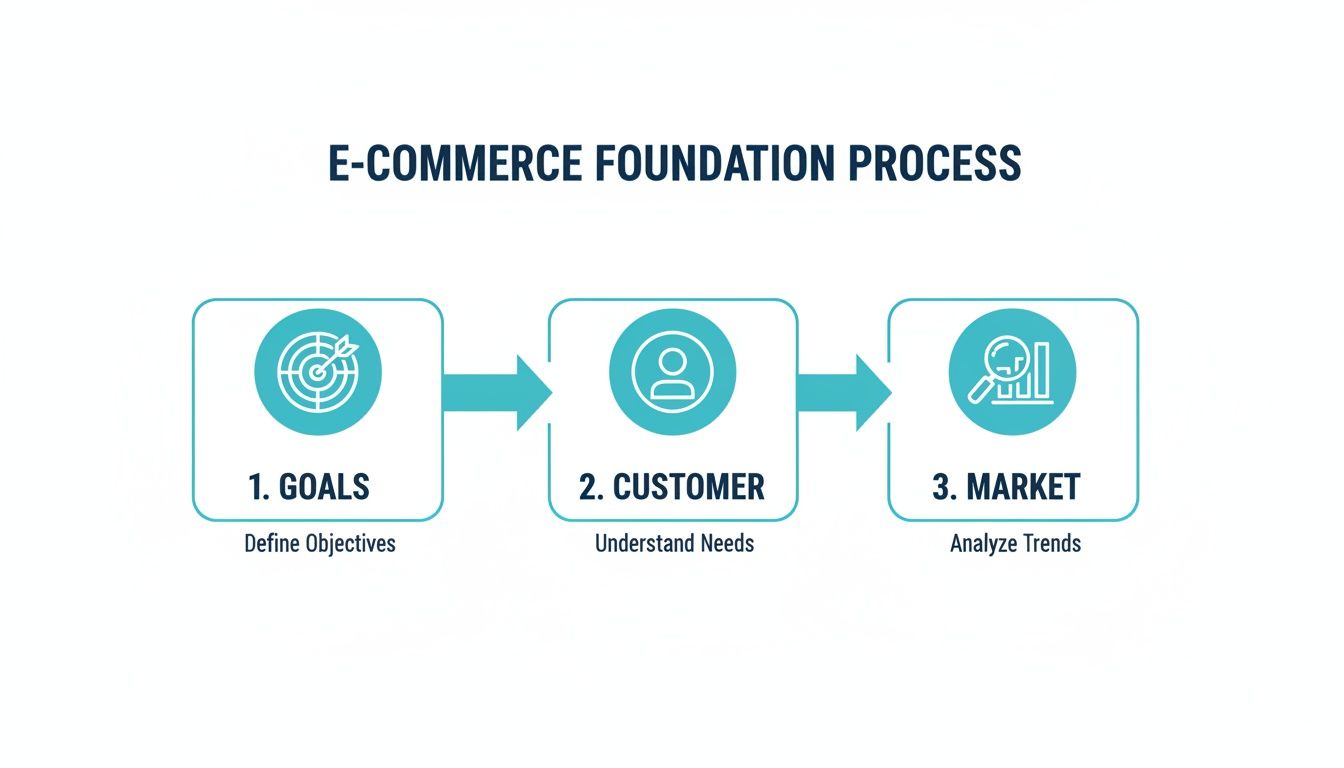
As you can see, choosing the right channels isn't a guessing game. It flows directly from having clear goals and a rock-solid understanding of who you're selling to and what your market looks like.
Search Engine Optimization (SEO) is all about getting your store to show up at the top of Google when people are searching for what you sell. The beautiful thing about SEO is that this traffic is "organic"—you aren't paying for every single click. The real magic of SEO is catching someone at the exact moment they're actively looking for a solution your product provides.
When a potential customer types "best waterproof running shoes for trails" into Google, they're not just window shopping. They have a problem and they're ready to buy a solution. Ranking for that search term puts your brand right in front of them, instantly establishing you as an authority and giving you a hot lead without paying for an ad.
A great ecommerce SEO strategy boils down to a few key areas:
Paid advertising, like Pay-Per-Click (PPC) campaigns on Google and social media ads, gives you instant visibility and results you can scale up or down. While SEO is a long game, paid ads let you open the traffic floodgates today. The trick is to build your campaigns around profitability and Return on Ad Spend (ROAS), not just vanity metrics like clicks.
Google Ads are fantastic for grabbing those high-intent searchers, just like SEO, but with a guaranteed spot at the top. Ads on platforms like Meta (Facebook and Instagram) let you get even more creative, targeting people based on their interests and online habits to create demand before they even know they need your product. For some brands, it's also worth looking into platform-specific experts, like specialized Amazon PPC agencies, to maximize performance.
The most sophisticated paid strategies don't just find customers; they create them. By targeting lookalike audiences and retargeting website visitors, you build a powerful system that guides users from initial awareness to final purchase.
Email and SMS are your direct lines to your most valuable people: your subscribers and your existing customers. These channels aren't just for finding new people; they're all about conversion and retention, and they consistently deliver some of the highest ROI in the game.
This is where automation becomes your best friend. Instead of blasting out random newsletters, you build automated "flows" that trigger based on what a customer actually does.
Essential Automated Flows for Shopify Stores:
Platforms like Klaviyo and Attentive are built for this stuff and plug right into Shopify, letting you create these complex, money-making flows with incredible precision. This is how you make sure you're nurturing every single lead without having to do it all by hand. You can see how these tools become part of a bigger system by reading about the ideal ecommerce marketing platform.
Sure, you can make direct sales on social media, but its real power lies in building brand awareness, community, and trust. Social is where you get to tell your story, chat with your audience, and show off your products in a more authentic, real-world setting.
Different platforms have different vibes. Instagram is a visual playground, perfect for fashion, beauty, or home goods. TikTok is all about short, raw, and entertaining videos that feel genuine. Facebook is still a giant for building communities in Groups and reaching very specific types of people.
The goal isn't to just spam your followers with product shots. It's about creating content they actually care about—whether it's entertaining, educational, or just plain inspiring. When you do that, you build a loyal following of people who feel a real connection to your brand, making them way more likely to buy from you and tell their friends about you.
Getting traffic to your online store is just half the battle. The real work—and where you actually build a profitable business—is in turning those visitors into paying customers. This whole process is called Conversion Rate Optimization (CRO), and it's an absolutely critical piece of any ecommerce marketing strategy. It’s all about fine-tuning every little piece of the user experience, from making sure your site looks great on a phone to creating a checkout process that’s smooth as silk.
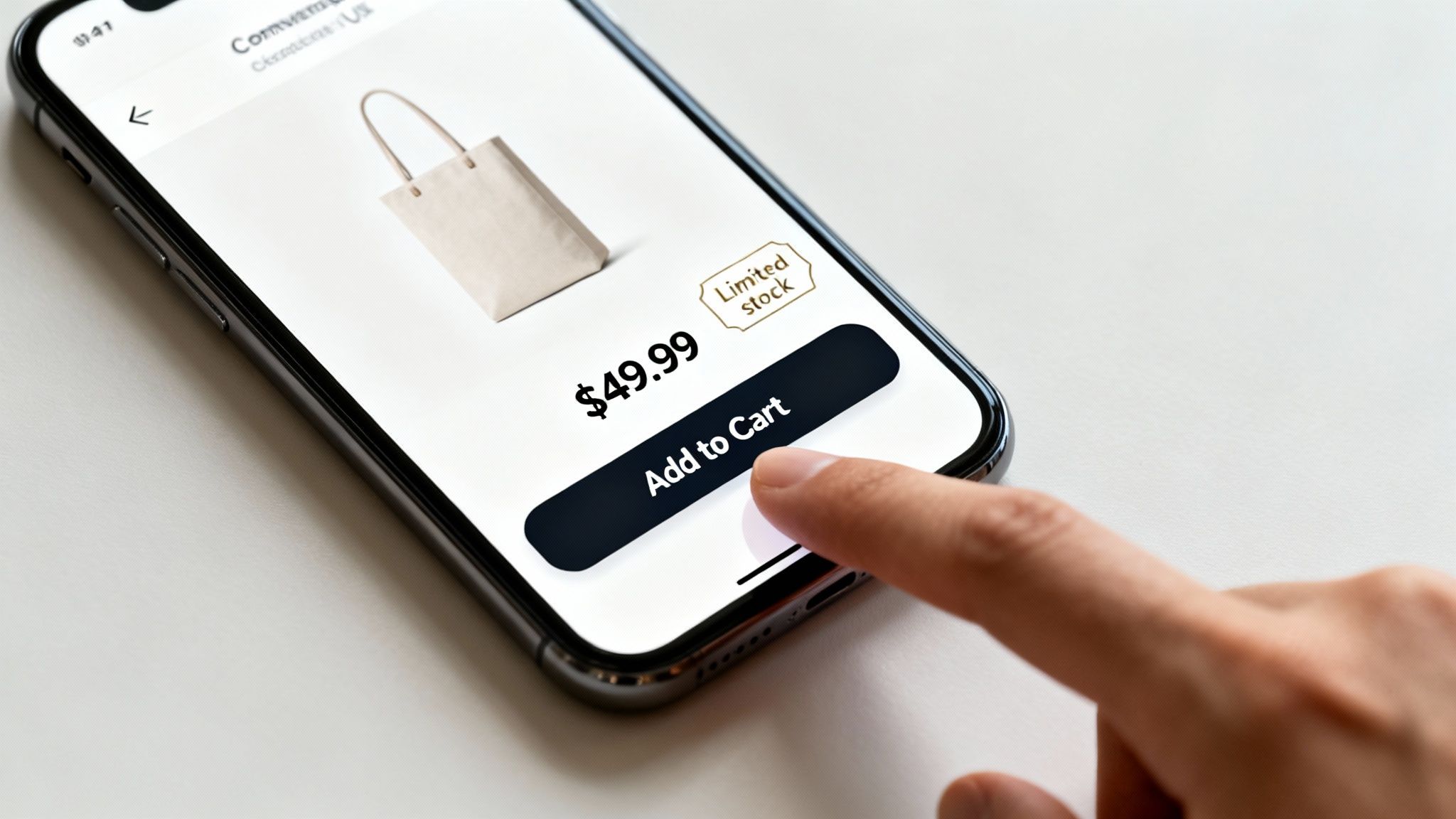
The opportunity here is massive. While ecommerce sales continue to grow, industry benchmarks show the average cart abandonment rate is still stuck at nearly 70%. Think about that. It represents a huge amount of lost revenue for brands that can't convince interested browsers to click "buy."
Once you've got your marketing foundation humming, it's time to actively improve your ecommerce conversion rates and turn those hard-won visitors into loyal fans.
At its core, great CRO is really about understanding how people think. Shoppers aren't robots making decisions based on pure logic; their choices are swayed by all sorts of cognitive biases. The smartest brands get this and use these psychological principles to give customers a compelling reason to act now. This is where urgency marketing, when done thoughtfully, becomes your secret weapon.
This isn't about slapping a generic countdown timer on a product page. That approach feels cheap, can damage brand equity, and savvy consumers see right through it. Real, sophisticated urgency is rooted in behavioral economics and feels completely natural to the shopper.
Here are a few key psychological triggers you can use:
By weaving these triggers into what we at Quikly call "Moments," you create an environment where buying feels like a smart, timely decision—not a pressured one. The goal is to boost conversions and revenue without having to resort to deep, margin-killing discounts across your entire site.
Behavioral science shows us that decision-making is often emotional. The most effective urgency marketing doesn't create pressure; it aligns with the shopper's natural desire to secure a good opportunity, turning hesitation into confident action.
Optimizing your store isn’t a one-and-done project; it's a continuous cycle of testing and tweaking. Instead of trying to rebuild your whole site at once, focus on the high-impact areas that directly affect a customer's journey to purchase. If you're on Shopify or Shopify Plus, you can implement many of these changes pretty quickly.
These are just a few places to start. For a deeper dive into specific techniques, check out our guide on how to improve your Shopify conversion rate with data-backed strategies. The most important takeaway is to see CRO not as a quick fix, but as a fundamental, ongoing part of your ecommerce marketing strategy.
New customers get all the attention in most ecommerce marketing strategies, but your most profitable customer is almost always one you already have. Advanced customer retention is about looking past the basic loyalty program and building a system that makes your customer lifetime value (LTV) skyrocket.
It means obsessing over the entire post-purchase journey. You’ll use data to build a genuine connection with your brand, turning one-time buyers into loyal repeat customers and, eventually, vocal advocates. The real win here isn't just more sales—it's creating a stronger, more predictable revenue stream that actually increases the value of your entire business.
A killer retention strategy is all about personalization. Today’s shoppers expect brands to get them—their needs, their tastes, their habits. In fact, personalization pretty much runs modern ecommerce, with about 80% of online shoppers saying they’d rather buy from brands that offer tailored experiences. For more on this, you can explore detailed ecommerce marketing statistics here.
This means the old one-size-fits-all approach is dead. Forget generic "points for purchase" programs. The real goal is to create personalized experiences after the sale that make each customer feel seen and valued.
You can make this happen with a few key moves:
The best retention strategies make customers feel like insiders. It’s not just about rewarding a purchase; it's about acknowledging their loyalty and making them part of your brand’s story. That’s what drives higher LTV and gets people talking.
Think about it: your existing customer base is one of your most powerful—and most overlooked—marketing assets. Happy, loyal customers don't just spend more over their lifetime; they also become a super-credible source of social proof that brings in new business. Building a community is the key to unlocking this.
A fantastic way to do this is by encouraging user-generated content (UGC). When customers share photos or videos of themselves using your products, it’s authentic social proof that’s way more convincing than any ad you could run. You can kickstart this by running contests or featuring customer content right on your product pages and social feeds.
This creates a self-sustaining growth loop:
When you focus on advanced methods like these, retention stops being just another tactic and becomes a core pillar of your ecommerce marketing strategy. For a deeper look into building out a plan, our guide outlines 3 ways to successfully establish a customer retention strategy. This isn't just about playing defense; it's about actively fueling sustainable, long-term growth and protecting your bottom line.
An ecommerce strategy built on guesswork is like driving blind. You might be moving, but you have no idea if you're heading toward a cliff. That's why data is non-negotiable.
It's easy to get caught up in numbers that feel good but don't actually mean anything for your bank account. I'm talking about vanity metrics—things like social media likes or a spike in website visitors. They look great in a report, but they don't directly translate to revenue. To actually steer your business toward profitable growth, you need to laser-focus on the key performance indicators (KPIs) that tell you the real story of your marketing engine's health and efficiency.
This isn't just about tracking numbers; it's about making smart, informed decisions that ensure every dollar you spend is working to grow your bottom line. It’s the difference between being busy and being profitable.
Instead of drowning in a sea of data, let's concentrate on a handful of metrics that truly matter. These three KPIs are the bedrock of any solid measurement plan.
Here’s the golden rule for ecommerce health: your LTV should be at least 3x your CAC. This simple ratio is your gut check. It tells you that you’re not just acquiring customers, you’re acquiring them profitably.
You don't need some ridiculously complex, expensive system to keep an eye on these KPIs. You can get started with a simple but mighty dashboard using tools you're probably already familiar with.
For most Shopify stores, Google Analytics 4 (GA4) is the perfect place to start. You can build out custom reports to monitor your CAC, see which channels are driving the best conversions, and dig into how your customers behave over time.
When you're ready to level up, a business intelligence (BI) tool like Looker Studio (what used to be Google Data Studio) is a game-changer. It can pull data from all your different sources—your ad platforms, your email provider like Klaviyo, your ecommerce platform—and put it all into one clean, unified view.
By consistently keeping an eye on these core metrics, your ecommerce marketing stops being a collection of creative ideas and becomes a predictable, data-backed system for generating revenue and building a business that lasts.
Digging into a modern ecommerce marketing strategy is going to bring up some questions. It's only natural. So, let's get you some clear, practical answers to the stuff that’s probably on your mind. My goal here is to give you the confidence to get started right away.
When you're running lean and capital is tight, you need to focus on channels that trade time for money and deliver a high ROI. Your best bets are right here:
The honest answer? It completely depends on the channel.
The fastest way to boost revenue isn't always about getting more traffic. It's about getting more out of the traffic you've already got. This is where scientifically-backed CRO and smart urgency tactics deliver the quickest wins.
When you’re just starting out, you have no choice but to focus on acquisition. You need that initial customer base.
But as soon as you have some momentum, you need to pivot hard toward retention. The data doesn't lie: acquiring a new customer can cost five times more than keeping an existing one happy. A healthy, sustainable ecommerce strategy is all about increasing Customer Lifetime Value (LTV). That’s the real path to long-term profitability.
Ready to turn your existing traffic into immediate revenue? Quikly is the urgency marketing platform built on proven consumer psychology, not manipulative timers. See how our automated "Moments" can boost your conversion rate and protect your margins by visiting https://hello.quikly.com.