

ecommerce conversion
customer experience strategy
digital customer experiences
In e-commerce, the average cart abandonment rate hovers around 70%, and a standard conversion rate is a mere 2.5%. These industry benchmarks highlight a critical gap between browsing and buying, a gap that generic email marketing often fails to bridge. The solution isn't just getting emails opened; it's about driving immediate, profitable action with psychologically-driven, catchy email subject lines.
This guide moves beyond generic advice to dissect the behavioral economics behind high-performing email campaigns. We will explore the specific psychological triggers, like scarcity, FOMO (Fear of Missing Out), and social proof, that transform passive subscribers into active buyers. You'll learn how to craft subject lines that not only boost open rates but directly contribute to revenue growth, protect profit margins by avoiding deep, sitewide discounts, and improve inventory turnover.
We will position these strategies as a sophisticated form of marketing psychology, contrasting advanced behavioral triggers with the basic countdown timers found in simple apps. This approach focuses on creating genuine anticipation and urgency, enhancing the entire shopper journey from inbox to checkout. For further insights into crafting subject lines that consistently perform and move beyond basic open rates, explore this guide on 10 Proven Email Subject Lines That Get Opened.
Get ready for actionable templates grounded in consumer psychology that you can implement today, transforming your email marketing into a powerful and predictable revenue engine.
Countdown subject lines are a powerful tool for creating catchy email subject lines because they tap directly into the psychological principle of loss aversion. This concept, validated by behavioral economics research, suggests that people are more motivated by the fear of losing something than by the prospect of gaining something of equal value. By explicitly stating a deadline, you frame the offer not as a potential gain but as an impending loss if the subscriber fails to act.
This technique is highly effective for driving immediate action, especially for flash sales, end-of-season clearances, or limited-time promotions. The specificity of a number (e.g., “3 hours left”) creates a concrete mental anchor, making the deadline feel more real and pressing than vague phrases like “ending soon.” This sophisticated psychological approach moves beyond basic timers to create authentic urgency.
To maximize the impact of these subject lines, focus on precision and consistency. The key is to create a seamless urgency experience from the inbox to the final checkout.
Key Insight: The primary goal of a countdown subject line is not just to inform, but to shift the customer's mindset from passive browsing to active purchasing. The perceived scarcity of time is a powerful catalyst for this transition, directly impacting revenue by compressing the consideration phase of the buyer's journey.
Scarcity-based subject lines are among the most catchy email subject lines because they leverage the psychological principle of scarcity. Consumer psychology studies show this principle dictates that people place a higher value on items they perceive to be in short supply. By highlighting limited inventory, you create an inherent sense of exclusivity and urgency, which directly triggers a Fear of Missing Out (FOMO) and compels subscribers to act before the opportunity is lost forever.
This technique transforms a product from a "nice-to-have" into a "must-have-now." It is especially powerful for best-sellers, limited-edition collaborations, or seasonal items that are not restocked. This is a sophisticated automation strategy that protects profit margins by driving sales without discounts. The key is communicating that the window to purchase is closing due to demand, not just time.
To implement scarcity effectively, your messaging must be authentic and seamlessly integrated with your inventory management. Credibility is paramount; if customers suspect the scarcity is artificial, the tactic loses all its power.
Key Insight: The goal of scarcity messaging is to shift the purchase decision from "if" to "now." By framing availability as the primary constraint, you protect your profit margins by avoiding deep discounts while simultaneously accelerating sales velocity and efficiently clearing out inventory.
Exclusive access subject lines are a cornerstone of creating catchy email subject lines because they appeal to the fundamental human desire for status and belonging. This strategy is rooted in the principle of social identity theory, where individuals derive self-esteem from their group memberships. By framing an offer as exclusive to a specific tier, you aren't just selling a product; you are validating a customer's loyalty and making them feel like a valued insider.
This approach is exceptionally effective for nurturing high-value customer segments and increasing lifetime value. Instead of broadcasting a generic sale, you create a perceived privilege that strengthens the brand-customer relationship. The exclusivity implies that the offer is not available to everyone, transforming a simple promotion into a status symbol. This strategy drives significant ROI by focusing on your most profitable customer cohorts.
To execute this strategy, you must combine precise audience segmentation with clear, value-driven messaging. The goal is to make the recipient feel genuinely special, not just part of another marketing blast.
Key Insight: The power of an exclusive access subject line is its ability to reframe a transaction as a reward. This fosters an emotional connection and brand advocacy, turning your most valuable customers into repeat buyers who feel recognized and appreciated for their loyalty.
Curiosity gap subject lines are highly catchy email subject lines that leverage the human brain's intrinsic need for cognitive closure. This psychological principle, known as the information gap theory, suggests that when there is a gap between what we know and what we want to know, we feel a powerful drive to fill it. By intentionally withholding a key piece of information, you create an "itch" that subscribers feel compelled to scratch by opening the email.
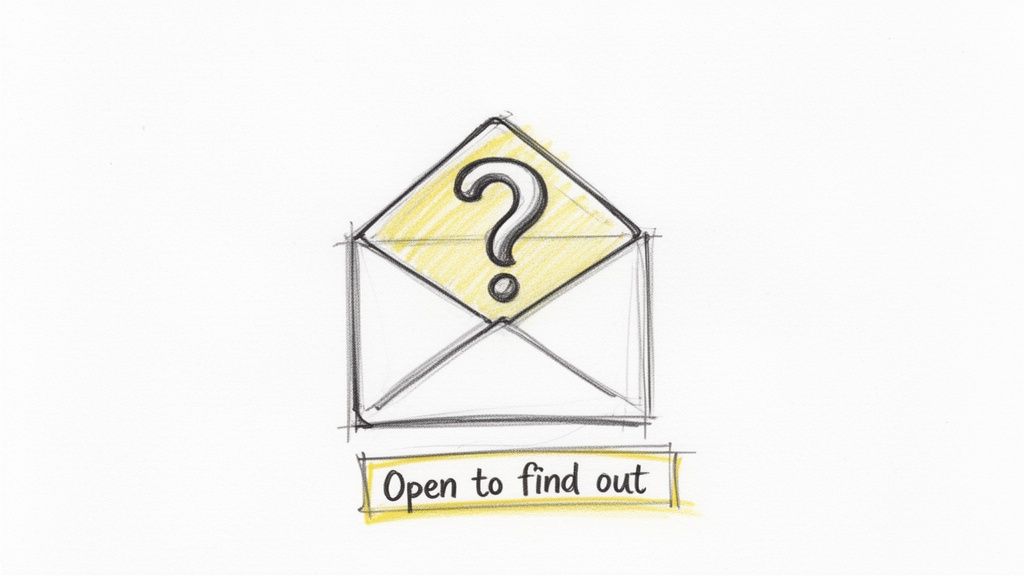
This technique is exceptionally effective for driving open rates, especially for re-engagement campaigns or when announcing a new, mysterious offer. Unlike a direct offer, which a subscriber can accept or reject from the inbox, a curiosity-driven subject line forces a decision to engage. This sophisticated psychological play contrasts sharply with basic pop-ups that simply capture emails without generating genuine anticipation.
To use the curiosity gap effectively, you must balance intrigue with relevance, ensuring the reveal inside the email is satisfying and not disappointing. The goal is to create anticipation, not clickbait.
Key Insight: The primary function of a curiosity gap subject line is to move the conversation from the inbox into the email itself. By creating a compelling need for information, you bypass the initial filtering process many users apply, significantly increasing the chance that your core message and call-to-action will be seen.
Personalized dynamic subject lines are one of the most effective strategies for creating catchy email subject lines because they directly address the consumer’s core desire to be seen and understood. By leveraging customer data such as names, purchase history, or browsing behavior, you shift from mass communication to a one-to-one conversation. This technique taps into the "cocktail party effect," a psychological phenomenon where individuals can easily pick out personally relevant information, like their name, from a complex environment. A personalized subject line cuts through inbox noise in the same way.
This method is crucial for e-commerce businesses aiming to build long-term relationships and increase customer lifetime value. It makes subscribers feel like the brand is catering specifically to their needs, dramatically improving relevance and connection. This data-driven approach is fundamental to increasing revenue per subscriber and overall campaign ROI.
To implement dynamic personalization effectively, your strategy must be data-driven and seamlessly integrated with your marketing automation tools.
Key Insight: The goal of dynamic personalization is to make marketing feel like a service rather than a sales pitch. By using data to anticipate a customer's needs and preferences, you transform the subject line from a simple hook into a valuable, relevant notification that strengthens brand loyalty and drives higher revenue per send.
Question-based subject lines are a highly effective strategy for crafting catchy email subject lines because they directly stimulate cognitive curiosity. When a person reads a question, their brain is automatically wired to seek an answer, a psychological reflex known as instinctive elaboration. This creates an open loop that subscribers feel compelled to close by opening the email, significantly boosting engagement before the message is even seen.
By combining this natural curiosity with a clear element of urgency, you create a powerful one-two punch. The question sparks initial interest, and the time constraint provides the necessary push to act immediately. This technique is particularly potent for re-engaging subscribers who may have become numb to standard promotional statements. This behavioral trigger is a more advanced tactic than simple, static promotional headlines.
To successfully deploy this technique, the question must be relevant and the urgency must be clear and believable. The goal is to make opening the email feel like the only logical next step to resolving the question posed.
Key Insight: The primary function of a question-based subject line is to shift the subscriber's role from passive recipient to active participant. By posing a direct question, you invite a mental dialogue that makes the subsequent call to action feel like a personal and time-sensitive opportunity, not just another mass-market promotion.
Social Proof subject lines are among the most catchy email subject lines because they leverage a core human psychological driver: the need for social validation. This approach is rooted in the principle that people tend to conform to the actions of others in an attempt to reflect correct behavior. When a subscriber sees that a product is a “bestseller” or “trending,” it lowers their perceived risk and creates an immediate sense of trust and desirability, triggering a fear of missing out (FOMO).
This technique is exceptionally effective for highlighting popular items, validating purchase decisions, and accelerating conversions. By showcasing an item’s popularity, you are not just selling a product; you are selling an experience that thousands of others have already approved. This is a powerful behavioral economics principle that directly impacts revenue and inventory turnover for popular items.
To harness the power of social proof, your subject lines must be credible and directly tied to real-time customer behavior. The goal is to make the subscriber feel they are part of a larger, validated trend.
Key Insight: Social proof subject lines work by shifting the focus from the brand's claims to the collective wisdom of other customers. This external validation is often more persuasive than any marketing copy, as it taps into our innate trust in peer behavior and the fear of being left behind.
Value proposition subject lines are among the most catchy email subject lines because they focus on the "why" behind a purchase, appealing directly to a subscriber's desired outcome. Instead of just announcing a product or a discount, they articulate the specific transformation or problem solved. This approach taps into the psychological need for gain and improvement, connecting the product to a deeper emotional driver like saving time, achieving a goal, or enhancing one's lifestyle.
This technique is exceptionally effective for aspirational, wellness, or problem-solving products where the result is more compelling than the feature set. It shifts the focus from a transactional offer to a transformational promise. This strategy directly impacts ROI by anchoring the product's value in a tangible outcome, which helps protect profit margins.
To craft effective benefit-driven subject lines, you must deeply understand your customer's pain points and aspirations. The goal is to articulate the end-result they crave in a concise, compelling way.
Key Insight: A benefit-driven subject line’s primary goal is to sell an outcome, not just a product. It elevates the conversation from price to value, allowing brands to protect margins while building a stronger emotional connection with customers, which is a key driver of long-term loyalty and higher lifetime value.
Emoji-enhanced subject lines are a proven method for creating catchy email subject lines because they leverage visual cues to stand out in a text-heavy inbox. Functioning as pictorial language, emojis tap into the brain's rapid image processing capabilities, allowing subscribers to decode the tone and content of an email almost instantly. This visual disruption can significantly increase open rates by breaking the monotony of standard text, making a message more memorable and emotionally resonant.
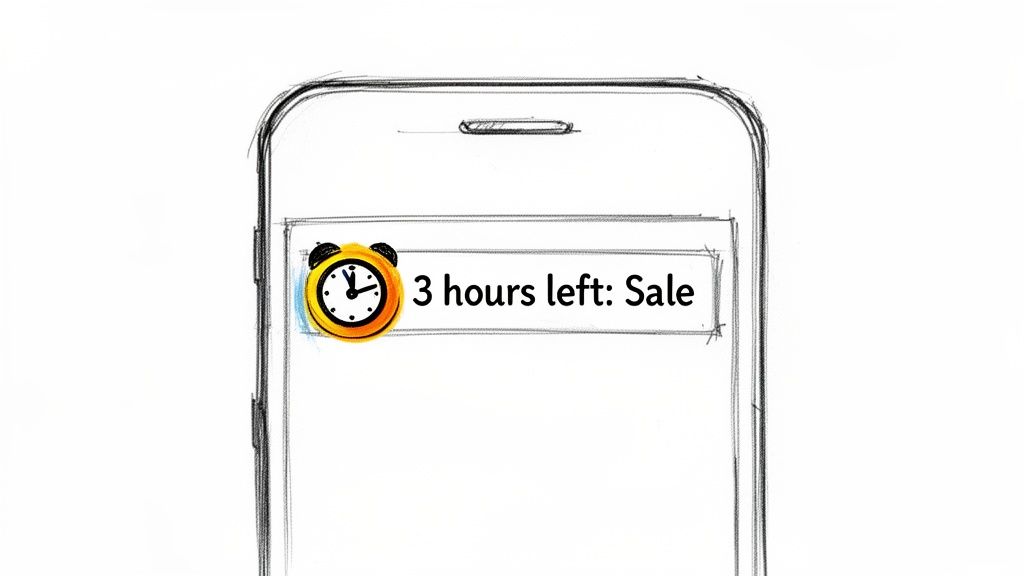
This technique is especially effective for communicating urgency, promotions, or brand personality. Emojis like ⏰, 🔥, or 🎁 act as universal signifiers for time-sensitivity, popular deals, or exclusive offers. This tactic is a simple way to apply principles of consumer psychology to grab attention quickly.
To harness the power of emojis without appearing unprofessional, focus on relevance, moderation, and consistent brand application. The goal is to enhance your message, not distract from it.
Key Insight: The primary function of an emoji in a subject line is to act as a visual heuristic, or mental shortcut, that helps subscribers quickly categorize and prioritize your email. By conveying emotion and context before the email is even opened, you dramatically increase the likelihood of engagement and action.
Action-oriented command subject lines are a direct and effective way to craft catchy email subject lines by telling the subscriber precisely what to do next. This approach leverages the psychological principle of cognitive ease, reducing the mental effort required for a user to decide on an action. By using strong, imperative verbs like "Shop," "Claim," or "Act," you eliminate ambiguity and create a clear path from the inbox to your desired conversion event.
This technique is exceptionally powerful for promotions where the next step is straightforward, such as flash sales, new product drops, or exclusive offer redemptions. The direct command creates a sense of psychological commitment, subtly framing the action as an instruction rather than a suggestion. This directness can significantly boost revenue when the value proposition is clear and compelling.
To use command subject lines effectively, you must balance a direct tone with clear value, ensuring the command feels like a helpful directive, not an aggressive demand.
Key Insight: The primary function of a command subject line is to shorten the consideration-to-action cycle. By providing a clear, direct instruction, you remove decision fatigue and create a frictionless path to conversion, making it an ideal strategy for time-sensitive campaigns designed for immediate revenue impact.
| Subject line type | Implementation complexity | Resource requirements | Expected outcomes | Ideal use cases | Key advantages |
|---|---|---|---|---|---|
| Urgency-Driven Countdown Subject Lines | Low–Medium — dynamic time tokens and frequent updates | Live countdown widgets, frequent content edits | Higher opens (20–40%) and immediate conversions | Flash sales, short-term promos | Strong FOMO; drives instant action |
| Scarcity-Based Stock Limitation Subject Lines | Medium — requires real-time inventory sync | Accurate inventory tracking, legal validation | Increased purchase urgency and perceived value | Low-stock items, restocks, limited editions | Encourages fast buys; supports inventory goals |
| Exclusive Access Tier Subject Lines | High — advanced segmentation and tier logic | CRM segmentation, tier management, fulfillment | Higher loyalty and repeat purchases | VIP launches, member-only events | Builds exclusivity and lifetime value |
| Curiosity Gap Subject Lines | Low — creative copywriting focus | High-quality email content, A/B testing | Exceptional open rates (often 35%+ if delivered) | Teasers, re-engagement, announcements | Drives opens through intrigue across audiences |
| Personalized Dynamic Subject Lines | High — data integration and dynamic rendering | Robust CRM, data pipelines, privacy compliance | Higher opens (25–35%), improved CTR and relevance | Abandoned carts, behavior-triggered offers | Highly relevant messaging; better conversions |
| Question-Based Subject Lines with Urgency | Low–Medium — craft strategic interrogatives | Copy testing, optional countdown integration | Increased engagement and opens (15–30%) | Time-limited offers framed as questions | Prompts mental engagement and answer-seeking |
| Social Proof and FOMO Subject Lines | Medium — needs verifiable real-time data | Live sales/engagement metrics, testimonial assets | Improved conversions, especially for new buyers | Trending products, high-velocity items | Leverages herd behavior and validation |
| Benefit-Driven Value Proposition Subject Lines | Medium — requires clear benefit articulation | Supporting proof, testimonials, creative assets | Stronger emotional connection and engagement | Premium/lifestyle products, differentiation needs | Emphasizes outcomes over price; builds brand appeal |
| Emoji-Enhanced Attention-Grabbing Subject Lines | Low — simple to implement but audience-dependent | Emoji testing across clients, audience segmentation | Higher opens (25–50%) with younger audiences | Mobile-first B2C campaigns, promotions | Visual standout; quick emotional cue |
| Action-Oriented Command Subject Lines | Low — direct imperative copy | Clear offer alignment, brief testing | High conversion when offer is compelling | Direct response, flash sales, limited offers | Clear CTA; reduces friction to act |
| Social Proof and FOMO Subject Lines | Medium — needs verifiable real-time data | Live sales/engagement metrics, testimonial assets | Improved conversions, especially for new buyers | Trending products, high-velocity items | Leverages herd behavior and validation |
The journey from a crowded inbox to a completed purchase is paved with countless micro-decisions, and the email subject line is arguably the most critical one. Throughout this guide, we've deconstructed ten powerful categories of catchy email subject lines, moving beyond mere creativity to explore the psychological underpinnings that compel a subscriber to click. These aren't just clever phrases; they are precision-engineered tools designed to trigger specific consumer behaviors.
From the raw power of urgency-driven countdowns to the subtle influence of social proof and FOMO, the common thread is a deep understanding of human psychology. Concepts like scarcity, loss aversion, and the curiosity gap are not abstract theories. They are tangible levers that, when pulled correctly, transform a passive recipient into an active, engaged shopper. The key takeaway is to view your subject line not as a simple headline, but as the first and most vital step in a carefully orchestrated customer journey.
Mastering these templates is the first step. The true competitive advantage, especially for enterprise-level Shopify Plus merchants, lies in elevating these tactics into a cohesive, automated strategy. This means moving past the limitations of basic countdown timers or simple pop-up apps that often focus on email capture rather than revenue generation. The future of effective urgency marketing is about integrating these psychological triggers directly into your marketing automation stack.
By connecting sophisticated platforms with your core email and SMS tools like Klaviyo, you create a seamless, multi-channel urgency experience. Instead of manually launching flash sales, you can build automated 'Moments' that respond to user behavior in real-time. This approach doesn't just boost conversion rates; it protects profit margins by creating authentic scarcity, helps manage inventory by driving demand for specific products, and builds brand authority by delivering exciting, engaging experiences rather than manipulative discounts.
To truly harness the power of what you've learned, you must move from knowledge to action. Here is a clear roadmap to begin implementing these strategies immediately:
Ultimately, crafting catchy email subject lines is a blend of art and science. It requires creativity grounded in data and an ethical application of consumer psychology. By adopting this strategic mindset, you shift your email marketing from a broadcast channel into a powerful, automated revenue driver that nurtures customer relationships and delivers measurable ROI. For a broader perspective on effective copywriting and its strategic role in driving revenue, you might find valuable insights in the strategic marketing insights on the copycat247 blog.
Ready to automate these psychological triggers and transform your email strategy into a powerful revenue engine? Quikly helps the world's leading brands create sophisticated, high-ROI urgency campaigns that go far beyond basic timers. See how our platform can seamlessly integrate with your marketing stack to create engaging 'Moments' that captivate customers and drive sales by visiting Quikly.