

ecommerce conversion
customer experience strategy
digital customer experiences

A website with popup functionality is fundamentally about capturing a visitor's attention. But when grounded in the science of consumer psychology, popups transform from simple email collectors into powerful, revenue-generating tools that boost ROI and enhance the shopper's journey.
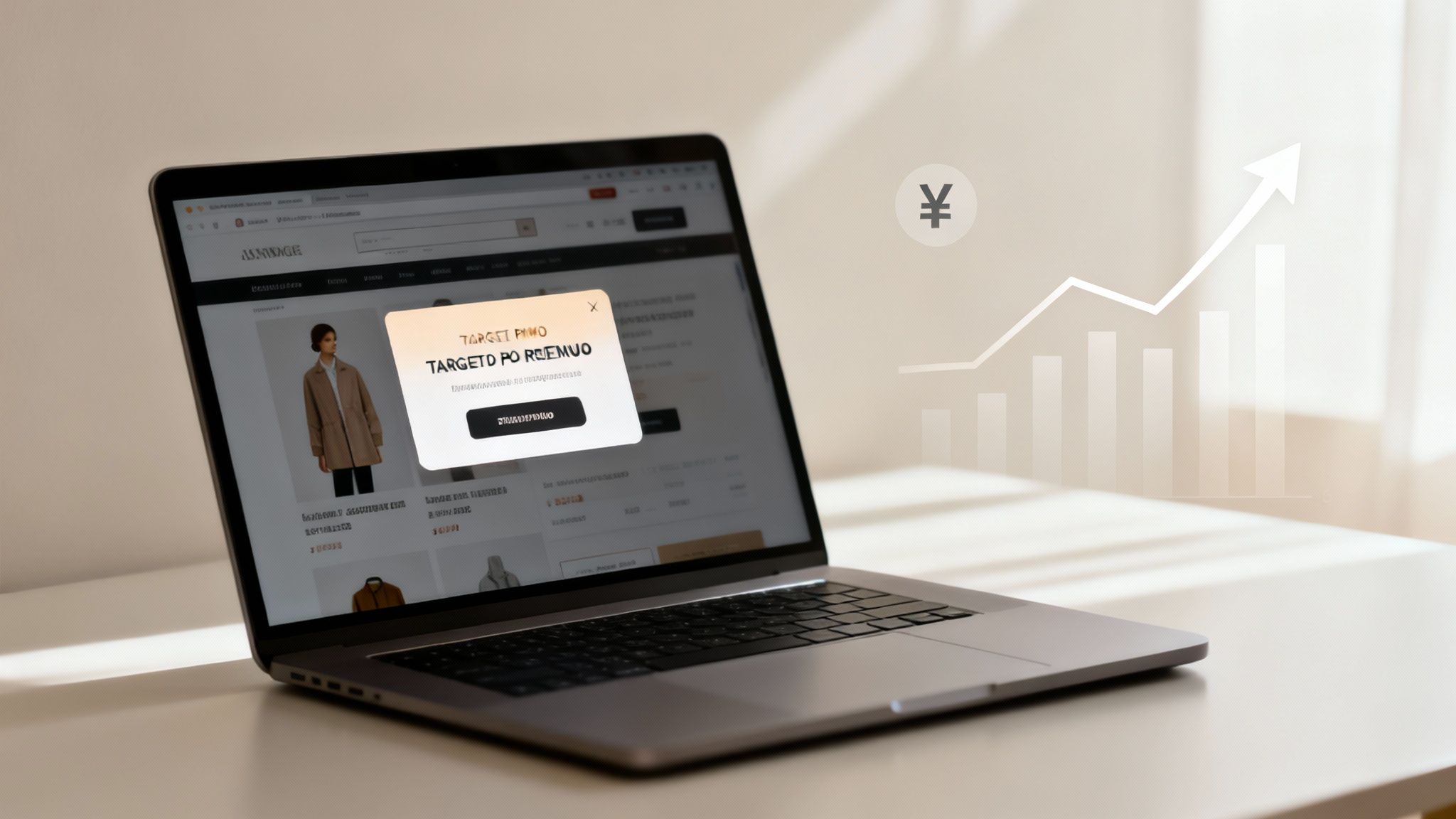
For too long, the primary function of a website popup was email list growth. While valuable, this narrow focus misses the far greater opportunity to drive immediate sales and protect profit margins. Today's competitive e-commerce landscape demands a more sophisticated approach—one less about interruption and more rooted in the science of consumer behavior.
This is about moving beyond generic, annoying popups to create interactions that are timely, relevant, and genuinely helpful. Instead of a blanket "10% off for your email" offer for every visitor, imagine a popup that appears based on specific shopper behaviors, creating authentic urgency. That is the essence of advanced urgency marketing science.
Many popup apps offer simple countdown timers, but these often feel inauthentic and can be perceived as manipulative. True urgency marketing is different. It's built on proven principles from behavioral economics—such as scarcity, social proof, and anticipation. This sophisticated approach connects offers to real-world conditions, like actual inventory levels or the number of other shoppers viewing a product.
The business impact of this shift is significant. A well-optimized popup doesn't just capture an email; it directly influences the purchase decision, driving revenue and protecting margins. In fact, a deep-dive analysis shows that popups can achieve an average conversion rate of 11.09%, far surpassing typical e-commerce benchmarks of around 2.5%. Mobile users are especially receptive, with click-through rates reaching 10%, indicating a high willingness to engage with the right message at the right time. You can discover more insights about these popup statistics to see the full picture.
Actionable Takeaway: A sophisticated popup strategy enhances the user journey. By deploying the perfect offer at the perfect moment based on behavioral triggers, you transform a potential annoyance into a powerful driver of immediate revenue.
To fully grasp the evolution, it's useful to compare the traditional approach with modern urgency marketing.
| Feature | Traditional Popup Apps | Advanced Urgency Marketing |
|---|---|---|
| Primary Goal | Email list growth | Immediate revenue & margin protection |
| Core Tactic | Interruption | Behavioral science (urgency, scarcity) |
| Triggers | Basic (time on page, exit-intent) | Hyper-specific (cart value, view count) |
| Offers | Generic discounts (e.g., "10% Off") | Contextual (e.g., "5 left in stock!") |
| User Experience | Often annoying, feels manipulative | Timely, relevant, and helpful |
This evolution is what separates tools that merely collect emails from platforms that become a core part of your revenue engine.
This advanced approach allows merchants, especially those on platforms like Shopify Plus, to automate complex campaigns that protect margins by avoiding store-wide sales. You can strategically move specific inventory, reward high-value customers, or rescue abandoned carts with hyper-relevant offers. Suddenly, your popup is no longer just a utility—it's an essential component of your sales and inventory management strategy.
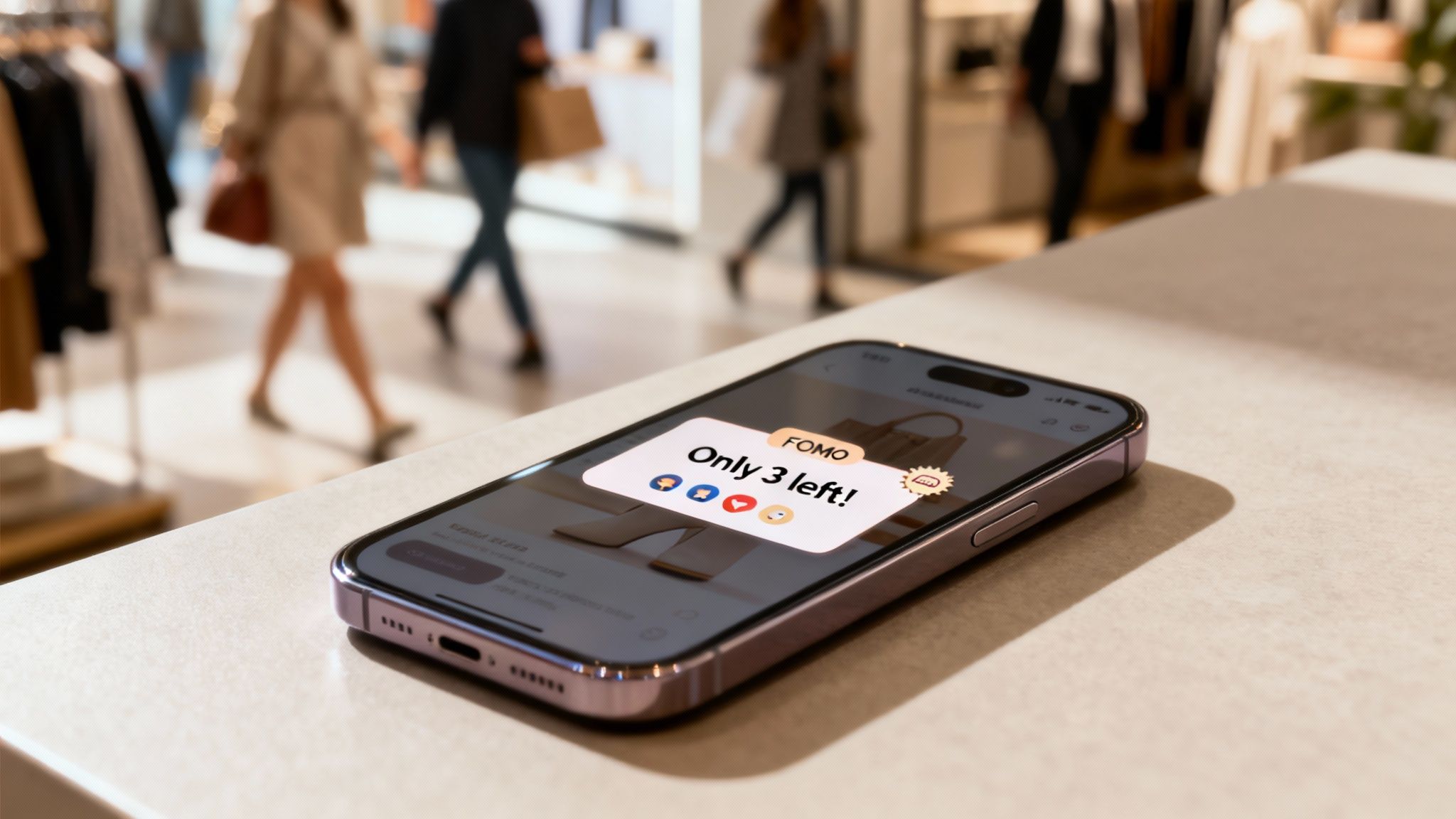
Effective popups are not a matter of chance; they are a direct application of consumer psychology. Forgetting guesswork, building popups that genuinely impact your bottom line requires understanding the psychological drivers behind purchasing decisions.
This isn't about manipulation. It's about communicating authentic value at the precise moment a shopper is most receptive. These principles are part of the broader discipline of Conversion Rate Optimisation (CRO), which focuses on maximizing the value of your existing traffic. By understanding why people make decisions, you can design popups that feel helpful, not intrusive.
Several core concepts from behavioral economics can dramatically improve your popup performance. Each connects with a fundamental human motivation, turning a simple message into a powerful reason to act now.
Scarcity (Limited Quantity): People place a higher value on items they perceive as being in short supply. A popup displaying real-time inventory—such as "Only 3 left in stock!"—is far more compelling than a generic discount. It creates an urgent, real-world limitation.
FOMO (Fear of Missing Out): A close relative of scarcity, FOMO is the anxiety that one might miss a valuable opportunity. A time-sensitive offer, like a popup announcing a limited "flash drop," triggers this perfectly, creating a genuine reason for immediate engagement.
Social Proof (Following the Herd): Humans are social creatures who look to others for cues on how to behave. Popups can leverage this by displaying messages like "15 other shoppers are looking at this item right now." This provides instant validation, reassures the visitor, and reduces purchase anxiety.
Anticipation (Building Excitement): Generating excitement for an event before it happens is a highly effective strategy. Use a popup to announce an upcoming sale or product launch and invite users to sign up for early access. This creates a sense of exclusivity, converting a passive browser into an engaged participant.
When you weave these principles into your strategy, you move beyond simply asking for an email and begin creating genuine moments of connection. We explore this further in our guide on how to use consumer psychology in marketing.
By grounding your offers in genuine scarcity and social proof, your popup becomes a helpful shopping assistant rather than a disruptive ad. It provides valuable context that empowers customers to make confident, timely decisions.
This is what distinguishes a basic popup tool from a true urgency marketing platform like Quikly. Instead of faking urgency with generic countdown timers, you’re using real-time data and proven psychological triggers. For brands on Shopify Plus, this approach allows for the creation of automated "Moments" that sync perfectly with inventory and revenue goals, protecting margins and delivering significant ROI without resorting to site-wide discounts.
Even the most brilliant psychological trigger will fail if the delivery is clumsy. Effective popup design is not about flashy graphics; it's about clarity, purpose, and integrating the popup seamlessly into the shopping journey.
Your goal is to guide a shopper’s attention, not demand it.
A well-designed popup respects the user's experience. It uses a clear visual hierarchy to draw the eye to the most important elements in order: the headline, the offer, and finally, the call-to-action (CTA) button. Use a contrasting color for your CTA to make it stand out, but ensure the overall color palette aligns with your brand identity to feel native to your site.
When it comes to your popup's copy, be direct and focus on the benefit. This is not the place for clever wordplay. Get straight to the point.
Start with a headline that communicates immediate value. "Unlock Free Shipping On This Order" is infinitely more effective than a vague "Sign Up Now."
Keep the body text to an absolute minimum. Every extra word is another reason for someone to disengage. If you must provide more detail, use bullet points to break down the benefits for easy scanning.
A popup is a conversation, not a billboard. The copy must be compelling enough to make a user pause and consider the value you're offering in that split second.
Different situations call for different kinds of popups. While a simple email capture form is a classic, you can achieve much higher engagement with interactive formats.
These design choices have a massive impact on revenue. For example, simply adding a countdown timer to a mobile popup can increase conversion rates by a staggering 112.93%.
Multi-step popups can be nearly four times more effective, achieving a 4.55% action rate just by making the process more engaging. Even a simple change like adding a relevant image can boost success by nearly 29%. You can dig into more of these popup design findings to see how much these small tweaks matter.
For Shopify merchants, this is an opportunity for strategic implementation. Our guide on creating effective popups for Shopify dives deeper into platform-specific tactics. The key is to always design with a mobile-first mindset, ensuring buttons are easy to tap and text is legible on the small screens where your customers are most likely to engage.
What’s the difference between a website with a popup that frustrates users and one that drives significant revenue?
One word: timing.
Generic popups that appear for every visitor after five seconds treat all customers identically, representing a major missed opportunity. Smart targeting moves beyond this one-size-fits-all approach.
Instead of interrupting, the goal is to interact at the exact moment a user’s behavior signals their intent. This is how you elevate from basic popups to a sophisticated, automated marketing engine that understands the nuances of the shopper's journey.
Most basic popup apps provide simple time-based or exit-intent triggers. While useful, they barely scratch the surface of what's possible. Advanced behavioral triggers leverage what your customers are actually doing on your site to deliver hyper-relevant messages. They feel less like advertisements and more like a helpful store associate intervening at the perfect moment.
This is the core of modern urgency marketing—using automation and psychology to create personalized moments. For a Shopify Plus enterprise, this could mean triggering a unique offer only for a high-value customer who has viewed a specific product more than twice in one session.
Here are a few powerful behavioral triggers you can implement immediately:
The process below illustrates how these elements come together, from compelling copy to a mobile-first design that is critical for these targeted triggers to be effective.
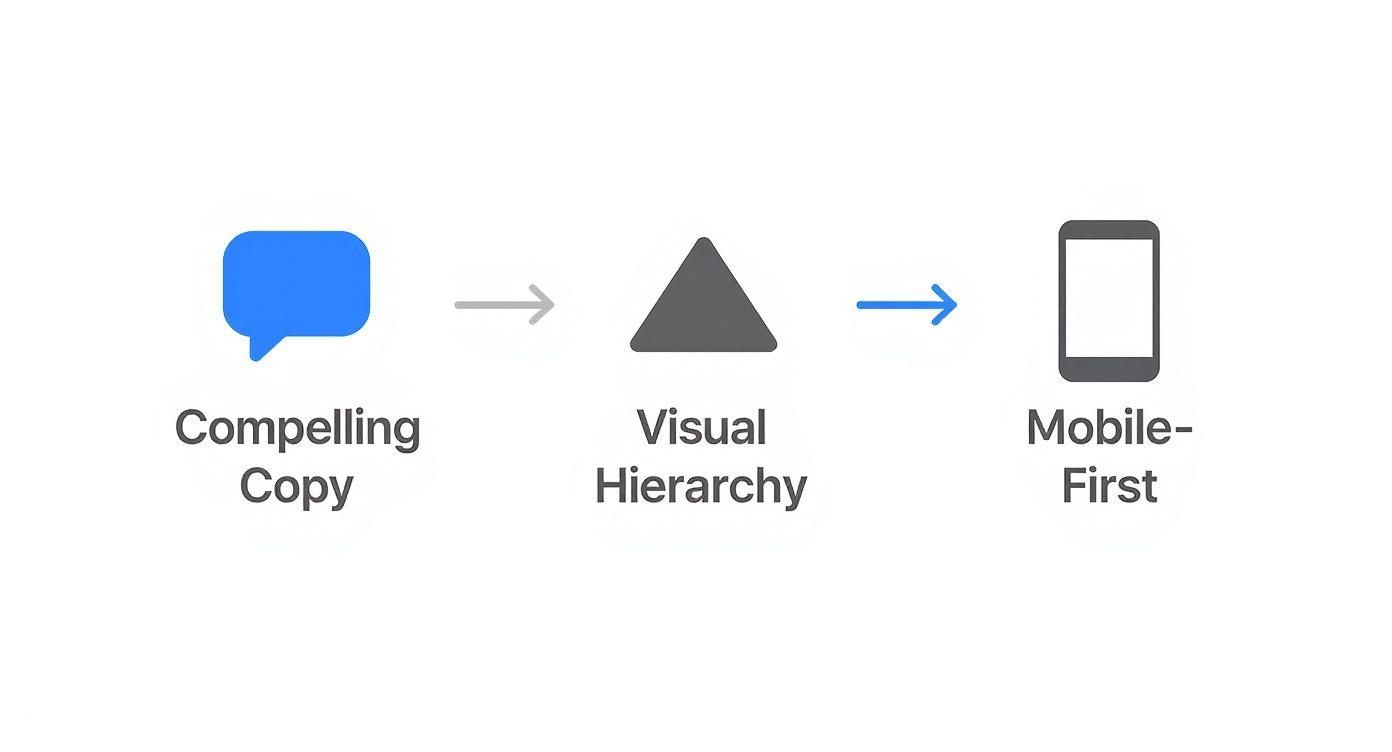
As you can see, effective popups are built on a foundation of compelling copy and a clean visual hierarchy, all designed with a mobile-first mindset to capture user attention where it matters most.
By aligning your popup's trigger with the visitor's specific context and behavior, you transform the interaction from a potential interruption into a valuable, timely, and revenue-generating touchpoint.
The data strongly supports this. Research shows that popups triggered by specific URLs convert 152% more visitors than generic ones. Their average conversion rate hits 5.80%, a significant leap from the 2.30% seen with non-targeted popups.
Even a simple adjustment, like waiting to show a popup until a visitor views a second page, can increase the conversion rate to an incredible 28.98%. You can learn more about how timing impacts popup conversions and see the full dataset for yourself.
This is not just about increasing sales; it's about smarter business management. Instead of running a site-wide sale that erodes margins, you can use precise triggers to move specific inventory or reward only your most engaged shoppers. This level of control is what separates a basic popup tool from a strategic platform like Quikly, which is built to turn these behavioral insights into profitable "Moments" in the customer journey.
A powerful popup tool doesn’t operate in a vacuum. Its real potential is unlocked when it functions as a central hub, feeding valuable customer data across your entire marketing ecosystem. For Shopify merchants, this means turning isolated popup interactions into a unified, revenue-generating machine.
The goal is to create a seamless flow of information. When a shopper engages with a behaviorally-triggered popup, that data shouldn't remain siloed. It needs to be instantly passed to the tools you use daily, such as your email and SMS platforms. This creates a cohesive and intelligent customer journey that increases lifetime value.
Imagine this scenario: a customer is about to abandon their cart. An exit-intent popup appears with a unique, one-time discount. They enter their email. That single action should initiate a chain reaction that does far more than just capture a lead.
This is where a deep integration with platforms like Klaviyo or your preferred SMS tool becomes critical. The moment that email is submitted, a series of automated actions can be triggered.
By connecting your popup tool directly to your email and SMS platforms, you transform a single interaction into a long-term, multi-channel conversation. This level of sophisticated automation is what separates basic apps from a strategic marketing stack.
This synchronized approach ensures every touchpoint is connected, making your marketing feel more personal and less disjointed. For merchants looking to build a robust system, it's worth exploring the best Shopify marketing apps that offer these deep integration capabilities.
This integration philosophy extends beyond just email and SMS. Data from your popups can inform paid ad targeting, loyalty programs, and even customer service interactions. To take it a step further, it's also worth learning how to maximize conversion with well-designed Shopify landing pages to ensure the entire journey is optimized from start to finish.
It’s all about building a smarter, more responsive business where every piece of technology works together to drive profitable growth.
If you're like most store owners, you have questions about popups. Are they annoying? Do they actually work? A well-executed popup strategy is a major lever for revenue, but it's easy to get wrong. Let's address some of the most pressing questions we hear from Shopify merchants.
This is a major concern, and the short answer is: no, not if implemented correctly.
Google penalizes intrusive interstitials that block content immediately upon a user landing on a mobile page. However, a well-timed, thoughtful popup is a different matter entirely. The goal is not to interrupt the user journey but to enhance it.
The secret lies in using smart behavioral triggers. Instead of showing an offer immediately, wait for a user to demonstrate interest. For example, trigger a popup only after they've scrolled 70% down a product page or browsed multiple items. An easily closable exit-intent offer is perceived as a helpful final attempt to provide value, not a frustrating roadblock.
You must look beyond vanity metrics like email captures and focus on ROI. Revenue is what sustains a business.
First, you need to track the conversion value generated by users who interact with your popups versus those who do not. The simplest way is to use unique discount codes within your popups. When those codes appear in your Shopify orders, you have direct attribution.
But don't stop there. Analyze your Average Order Value (AOV). Is a "15% off orders over $75" offer successfully increasing basket size? For a long-term view, track the Customer Lifetime Value (LTV) of the leads you capture. This is where integrating your popup tool with Shopify and an email platform like Klaviyo becomes absolutely essential. It’s a complete mindset shift from "How many emails did I get?" to "How much profitable revenue did this campaign drive?"
Tying every popup interaction to a real business outcome—like attributed revenue or a higher AOV—is how you prove its value. It lets you optimize for profitability, not just for a bigger email list.
This is a critical distinction. A generic countdown timer ("Offer ends in 10 minutes!") can feel inauthentic and manipulative. Modern consumers are savvy and often immune to such tactics.
Psychological urgency is a more sophisticated and honest approach that uses real-time data to create authentic motivation. It is grounded in proven behavioral science.
Here’s what that looks like in practice:
This approach feels different because it's based on reality. It builds trust, is more compelling, and ultimately leads to higher conversions from customers who feel respected, not manipulated.
Ready to turn your popups from simple email collectors into a powerful, psychology-driven revenue engine? See how Quikly uses advanced urgency marketing to create profitable moments in your customer's journey. Learn more and get started.