
<img height="1" width="1" alt="" style="display:none" src="https://www.facebook.com/tr?ev=6026852841840&amp;cd[value]=0.00&amp;cd[currency]=USD&amp;noscript=1">
Skip to content

10 Valentine's Day Marketing Ideas to Drive Revenue and ROI

Urgency Marketing ecommerce marketing shopify marketing

Valentine's Day represents a massive revenue opportunity, yet most e-commerce brands rely on generic discounts and basic countdown timers that barely move the needle. This approach ignores the powerful psychological drivers behind holiday purchasing decisions. In a landscape where the average cart abandonment rate hovers around 70%, leveraging sophisticated urgency is no longer optional. It's essential for protecting profit margins and maximizing return on investment.

This guide moves beyond simple tactics, exploring the behavioral science behind what makes shoppers act now. We'll dissect 10 advanced Valentine's Day marketing ideas, grounded in principles like scarcity, social proof, and anticipation. Each strategy is designed not just to capture emails or boost temporary traffic, but to create high-intent purchase moments that significantly impact your bottom line.

Forget surface-level tips. You will learn how to structure campaigns that tap directly into consumer psychology, transforming passive browsers into active buyers. Each idea includes actionable implementation steps, example creative prompts, and key performance indicators to track, with specific guidance for Shopify store owners. Learn how to transform your marketing from forgettable promotions into a masterclass in behavioral economics, driving measurable revenue growth and creating a memorable brand experience that lasts long after the holiday is over. This is about turning a single-day event into a significant boost for your Q1 performance.

1. Limited-Time Flash Sales with Countdown Timers

A flash sale is a high-impact, short-duration promotion that offers significant discounts (e.g., 25-50% off) for a very limited period, typically between 24 and 72 hours. This strategy taps directly into the psychological principle of scarcity, signaling to consumers that the opportunity is fleeting. When paired with a visible countdown timer, it triggers a sense of urgency and Fear of Missing Out (FOMO), compelling shoppers to make immediate purchase decisions rather than delaying. This is one of the most effective Valentine's Day marketing ideas for capturing both early-bird planners and last-minute gift buyers.
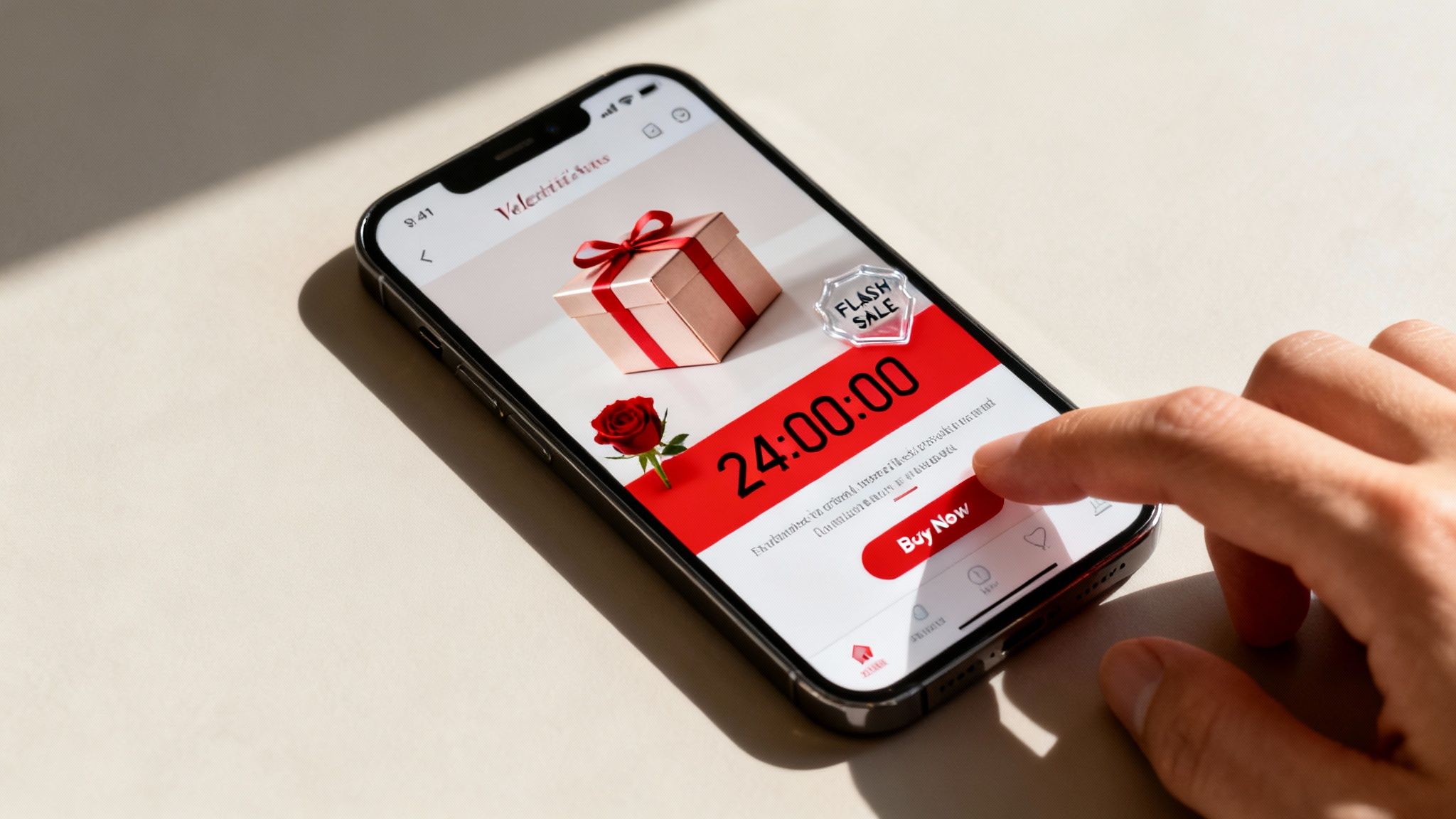
A hand taps a smartphone displaying a Valentine's Day flash sale with a gift box, rose, and countdown.

This tactic moves beyond simple discounts by creating a competitive, time-sensitive shopping event. Major retailers like Sephora and Amazon have perfected this model with their lightning deals, conditioning consumers to act decisively when presented with a great offer that won't last. The goal is to convert hesitant shoppers into buyers by shortening the consideration phase.

Execution Strategy

  • Target Audience: Ideal for last-minute shoppers, discount-seekers, and existing customers who are familiar with your products.
  • Execution Steps:
    1. Select Products: Choose high-margin, popular gift items, or slow-moving inventory you need to clear before the new season. Bundling items like a "Valentine's Day Gift Set" can increase Average Order Value (AOV).
    2. Set Up the Sale: In your Shopify admin, create a discount code or automatic discount for the selected products. Use a Shopify App to add a prominent banner with a countdown timer to your homepage and product pages.
    3. Promote Heavily: Announce the flash sale 24 hours in advance via email (to your Klaviyo segments), SMS, and social media to build anticipation. Send a "go-live" notification and a "last chance" reminder a few hours before it ends.
  • Urgency Tactics (with Quikly): Instead of a generic timer that all users see, use Quikly to create a tiered offer where the fastest responders get the best deals (e.g., first 10 get 50% off, next 50 get 30% off). This gamified, psychology-backed approach heights engagement and drives faster revenue generation than a standard timer.
  • Timing: Launch your main flash sale 48-72 hours before February 14th to capture the peak of last-minute shopping. Consider a smaller, pre-Valentine's sale a week earlier for proactive shoppers.
  • KPIs to Track: Conversion Rate, Average Order Value (AOV), Revenue Generated, and Website Traffic during the sale period.

2. Ranked Offers Strategy (Tiered Reward System)

A ranked offer strategy gamifies the shopping experience by presenting customers with multiple reward tiers that they can unlock by completing specific actions. Instead of a single, static discount, this system creates a journey where engagement deepens as the value of the reward increases. This approach leverages the psychological principle of goal gradient theory, where people are more motivated to complete a task as they get closer to the reward. It's one of the most engaging Valentine's Day marketing ideas for building brand loyalty beyond a one-time purchase.

This method transforms passive browsing into active participation. Brands like Lululemon and Sephora use tiered loyalty programs to make customers feel valued and encourage repeat purchases, moving them up a ladder of exclusivity. For Valentine's Day, this creates a compelling narrative around the gift-giving journey, making the act of shopping itself more memorable and rewarding.

Execution Strategy

  • Target Audience: New and existing customers, loyalty program members, and shoppers motivated by gamification and exclusive rewards.
  • Execution Steps:
    1. Define Tiers & Actions: Create 3-4 distinct tiers with Valentine's-themed names (e.g., Bronze Cupid, Silver Sweetheart, Gold Beloved). Assign an action to each tier, such as signing up for emails (Tier 1), making a purchase over $50 (Tier 2), and sharing the campaign on social media (Tier 3).
    2. Assign Rewards: Ensure the rewards escalate in value. Tier 1 might offer free shipping, Tier 2 a 15% discount, and Tier 3 a free gift with their next purchase.
    3. Implement & Promote: Use a loyalty app or marketing platform to track customer actions and automate reward delivery. Announce the program across your channels, highlighting the top-tier reward to showcase what’s possible. Integrate with your Klaviyo or SMS flows to notify users when they've unlocked a new tier.
  • Urgency Tactics (with Quikly): Use Quikly to power a "fastest-to-the-top" campaign. Announce that the first 100 people to reach the "Gold Beloved" tier will receive a bonus prize, like a limited-edition product. This adds a layer of competition and scarcity, dramatically accelerating engagement and revenue.
  • Timing: Launch this campaign in late January or the first week of February. This gives customers enough time to engage, move through the tiers, and make their final Valentine's Day purchase using their unlocked reward.
  • KPIs to Track: Customer Engagement Rate (actions completed per user), Customer Lifetime Value (CLV), Repeat Purchase Rate, and List Growth.

3. Social Media Sharing Incentives

Social media sharing incentives transform your customer base into a powerful, distributed marketing team. This strategy rewards customers with discounts or bonus gifts when they share your Valentine's Day offers, products, or brand content on their personal social media channels. It leverages the psychological principle of social proof, as recommendations from friends are inherently more trusted than brand advertising. This is one of the most cost-effective Valentine's Day marketing ideas for driving organic reach and acquiring new customers through authentic, user-generated content (UGC).

This tactic moves beyond passive brand mentions by creating a direct value exchange that motivates action. Groundbreaking referral programs from companies like Dropbox and Airbnb demonstrated that incentivizing sharing can fuel exponential growth. For Valentine's Day, this means turning gift-givers into brand advocates, amplifying your message far beyond your existing follower count.

Execution Strategy

  • Target Audience: Ideal for socially active customers, micro-influencers within your audience, and shoppers who are motivated by community and peer recommendations.
  • Execution Steps:
    1. Define the Offer: Determine the incentive for sharing. A simple discount (e.g., "Share for 15% off") is effective, but tiered rewards ("Get 25% off if a friend buys") can drive higher-quality referrals.
    2. Integrate Sharing Tools: Add one-click social sharing buttons to your product pages, order confirmation pages, and email campaigns. Use a Shopify App that can track these shares to automate reward distribution.
    3. Launch the Campaign: Promote the sharing incentive across all channels. Create a unique, memorable hashtag (e.g., #[YourBrand]LovesLove) to track UGC and build a cohesive campaign narrative.
  • Urgency Tactics (with Quikly): Instead of a static reward, use Quikly to create a time-sensitive sharing challenge. Announce that the first 100 customers to share your Valentine's gift guide on Instagram will unlock an exclusive 40% discount. This gamifies the sharing process, triggering competitive excitement and a massive, concentrated burst of social activity.
  • Timing: Launch your sharing campaign in early February to build buzz and social proof well before the last-minute shopping rush. Run a secondary "last chance to share" push 3-4 days before Valentine's Day.
  • KPIs to Track: Social Reach/Impressions, Referral Traffic, User-Generated Content Volume, and Customer Acquisition Cost (CAC) from referred customers.

4. Early Bird Exclusive Offers

An early bird offer rewards customers for purchasing well in advance of a key date, like Valentine's Day. By providing an exclusive discount or a value-add for orders placed before a specific deadline (e.g., February 8th), you incentivize proactive shopping. This strategy taps into the psychological principle of loss aversion; customers are motivated to act now to avoid missing the guaranteed delivery window and the special offer. This is one of the most effective Valentine's Day marketing ideas for managing logistics and securing revenue early.

This tactic shifts demand away from the last-minute rush, giving your fulfillment team crucial breathing room to manage inventory and ensure on-time deliveries. Brands like FTD and 1-800-Flowers leverage this model to smooth out their operational peaks, improving customer satisfaction and reducing logistical costs. The goal is to convert planners into early buyers by rewarding their foresight.

Execution Strategy

  • Target Audience: Proactive planners, gift-givers who prioritize on-time delivery, and customers who have previously purchased seasonal items from your store.
  • Execution Steps:
    1. Define the Offer: Create a compelling incentive, such as 15% off, free shipping, or a small gift with purchase for orders placed before your cutoff date.
    2. Set Up the Discount: In your Shopify admin, create a discount code or an automatic discount that expires on a set date. Use a banner on your site to clearly communicate the "Order by X for Guaranteed Valentine's Delivery" message.
    3. Launch the Campaign: Use Klaviyo to email customer segments, particularly past holiday shoppers, with the early bird offer. Promote it across social media and SMS, emphasizing the benefit of stress-free, guaranteed delivery.
  • Urgency Tactics (with Quikly): Instead of a static deadline, use Quikly to create a campaign that rewards the first wave of early shoppers with the best deals. Announce that the first 100 buyers get the premium offer, creating a competitive rush among your most engaged customers and driving a surge of initial revenue.
  • Timing: Launch your early bird campaign 2-3 weeks before Valentine's Day, with the primary cutoff date set 7-10 days before February 14th to align with standard shipping deadlines.
  • KPIs to Track: Orders Placed Before Deadline, Average Shipping Time, Customer Acquisition Cost (CAC), and overall Campaign Revenue.

5. Spin-to-Win Gamification Campaigns

Gamification introduces game-like elements into non-game contexts to boost engagement and drive specific behaviors. A spin-to-win promotion is an interactive pop-up or landing page where customers "spin" a virtual wheel to win a random prize, such as a discount code or free shipping. This strategy transforms the passive experience of receiving an offer into an active, enjoyable event. By tapping into the psychology of variable rewards, it builds anticipation and creates a memorable brand interaction that significantly increases on-site engagement and lead capture.
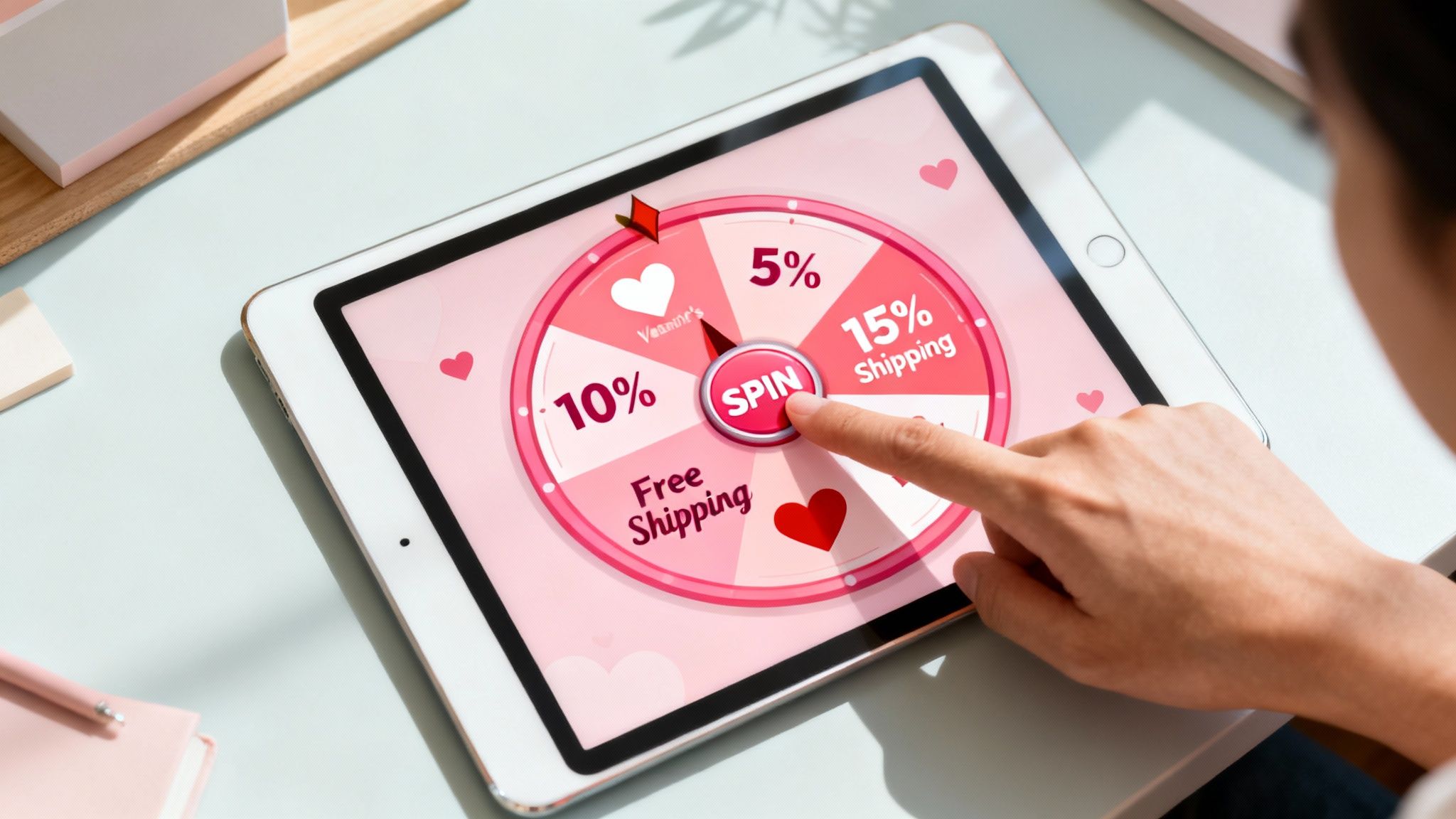
A person's hand taps a 'Spin the Wheel' game on a a tablet, showing Valentine's Day discounts.

This tactic is far more effective than a static pop-up because it encourages active participation. The user feels a sense of control and excitement, making them more invested in the outcome and more likely to use their "won" prize. While many apps focus solely on email capture, the real business impact comes from linking the gamified experience directly to revenue-generating behavior.

Execution Strategy

  • Target Audience: New website visitors, email list subscribers, and engagement-focused shoppers who enjoy interactive experiences. It's particularly effective for acquiring new leads.
  • Execution Steps:
    1. Design the Wheel: Create a visually appealing, Valentine's-themed wheel using brand colors, hearts, and romantic imagery. Define the prize tiers, such as 5% off, 10% off, 15% off, and a grand prize like free shipping.
    2. Set Up the Campaign: Use a Shopify App like Privy or Wheelio to create the spin-to-win pop-up. Configure it to appear after a user has been on the site for a set time (e.g., 15 seconds) or on exit-intent. Gate the spin with an email or SMS opt-in to grow your lists.
    3. Distribute Winnings: Ensure the won discount code is automatically displayed and easily copied. Follow up with an immediate email or text message from your ESP (like Klaviyo) that includes the code, reminding the shopper to use it before it expires.
  • Urgency Tactics (with Quikly): Elevate the standard spin-to-win by integrating it with a Quikly campaign. Announce a limited-time "Jackpot Spin" event where the first 100 participants to spin the wheel are guaranteed to win a higher-tier prize (e.g., 25% off or a free gift). This creates a rush of activity, driving massive traffic and revenue-focused sign-ups in a short window.
  • Timing: Implement the spin-to-win pop-up in late January to capture early shoppers and build your marketing list for the final Valentine's push. Run it throughout the first two weeks of February.
  • KPIs to Track: Email/SMS Sign-up Rate, Pop-up Conversion Rate, Discount Code Usage Rate, and Average Order Value (AOV) from converted shoppers.

6. Live Drop/Limited Quantity Release Strategy

A live drop is a marketing event where you release an exclusive, limited-quantity product at a specific, pre-announced time. This strategy, perfected by brands like Supreme and Nike's SNKRS app, transforms a simple product release into a high-anticipation event. It leverages the psychological principles of scarcity and exclusivity to create a powerful sense of FOMO (Fear of Missing Out), driving massive traffic spikes and immediate sell-outs. This is one of the most powerful Valentine's Day marketing ideas for brands wanting to create significant buzz and sell premium products.

This tactic moves beyond traditional product launches by creating a competitive environment where shoppers feel they must act instantly to secure a rare item. By limiting supply, you increase the perceived value of the product and foster a loyal community of brand enthusiasts who eagerly await each release. This is how luxury and streetwear brands cultivate an air of desirability and command premium prices.

Execution Strategy

  • Target Audience: Brand loyalists, collectors, gift-givers seeking unique items, and trend-focused shoppers.
  • Execution Steps:
    1. Select a Hero Product: Choose a unique, exclusive Valentine's Day item or a limited-edition collaboration that cannot be found elsewhere. This could be a special colorway, an engraved product, or a curated gift set.
    2. Build Anticipation: Announce the drop date and time at least a week in advance across all channels. Use your email list (Klaviyo), SMS, and social media to share sneak peeks and start a countdown.
    3. Launch the Drop: On your Shopify store, make the product live at the exact scheduled time. For Shopify Plus merchants, ensure your storefront is optimized to handle the anticipated traffic surge to avoid site crashes.
  • Urgency Tactics (with Quikly): Instead of just releasing the product, use Quikly to create a "Race to Release" campaign. Announce the drop and have customers opt-in. At a random time, Quikly's platform sends a notification to everyone who opted-in, and the fastest to respond claim the limited products. This gamified "Moment" maximizes engagement and ensures the release is a major event.
  • Timing: Schedule a series of small drops in the two weeks leading up to Valentine's Day (e.g., "7 Days of Love Drops"). This builds momentum, encourages repeat website visits, and creates multiple opportunities for press and social media mentions.
  • KPIs to Track: Sell-Through Rate, Website Traffic at Drop Time, New Customer Acquisition, and Social Media Engagement/Mentions.

7. Bundle Deals and Gift Sets

Creating curated product bundles is a powerful strategy to increase Average Order Value (AOV) while simplifying the gift-giving process for shoppers. This approach involves grouping complementary items into themed gift sets, often offered at a slight discount compared to buying each product individually. This tactic directly addresses consumer decision paralysis by presenting a complete, ready-to-gift solution, boosting perceived value and making the purchase feel both thoughtful and economical. This is one of the most effective Valentine's Day marketing ideas for guiding customers toward higher-value purchases.

A beautifully wrapped gift box with a 'Bundle' tag, a lit candle, and a bouquet of baby's breath on a beige cloth.

This method moves beyond a simple sale by merchandising products as a cohesive experience. Brands like Sephora and Glossier have mastered this by creating beautifully packaged kits that feel exclusive and special. The goal is to remove friction from the shopping journey, making it easy for customers to say "yes" to a pre-made, perfect gift.

Execution Strategy

  • Target Audience: Gift-givers looking for convenient solutions, shoppers aiming for a specific budget, and customers who want to discover complementary products.
  • Execution Steps:
    1. Curate Bundles: Create 3-5 gift sets at various price points (e.g., $50, $100, $150+). To help inspire your product selection and gift set creations for the holiday, consider exploring unique Valentine's Day gift ideas. Name them with romantic themes like "The Cupid's Kiss Kit" or "The Sweetheart Set."
    2. Set Up in Shopify: Use a Shopify App like "Bundles" or create a new product that represents the set, linking the individual SKUs for accurate inventory tracking. Clearly display the total savings.
    3. Promote Strategically: Use email and social media to showcase the bundles as complete gift solutions. Highlight the value and convenience in your messaging, positioning them as "no-stress" Valentine's Day presents.
  • Urgency Tactics (with Quikly): Instead of just offering the bundle, attach a limited-time gift-with-purchase (GWP) to it. Use Quikly to run a campaign where the first 100 bundle purchasers receive an exclusive extra item. This adds another layer of scarcity and encourages immediate action, boosting AOV and protecting profit margins.
  • Timing: Launch your main bundles two to three weeks before February 14th to capture early planners. Introduce a "Last-Chance Bundle" with express shipping options during the final 72 hours.
  • KPIs to Track: Average Order Value (AOV), Bundle Sales as a Percentage of Total Sales, Product Attachment Rate, and Gross Margin on Bundles.

8. Personalized Recommendations and Dynamic Offers

Personalized recommendations and dynamic offers leverage customer data to create highly relevant, individualized shopping experiences. Instead of a one-size-fits-all promotion, this strategy uses browsing history, past purchases, and customer segmentation to present unique product suggestions and tailored discounts. This approach taps into the psychological principle of the "cocktail party effect," where individuals are more likely to pay attention to information that is personally relevant to them. This is one of the most sophisticated Valentine's Day marketing ideas because it makes each customer feel understood and uniquely valued.

This method moves beyond basic segmentation by using machine learning to predict what a customer is most likely to buy and what offer will most effectively persuade them. Pioneers like Amazon and Netflix have demonstrated that this level of personalization significantly increases engagement, loyalty, and revenue. For Valentine's Day, it means showing a customer who previously bought a necklace a matching pair of earrings, not a generic box of chocolates.

Execution Strategy

  • Target Audience: Repeat customers, high-LTV segments, VIPs, and shoppers who have shown specific product interest (e.g., viewed an item multiple times).
  • Execution Steps:
    1. Segment Your Audience: Use your Shopify and Klaviyo data to create detailed segments based on purchase history (e.g., "fine jewelry buyers," "first-time gift givers"), average order value, and browsing behavior.
    2. Craft Dynamic Offers: Create a series of tiered offers. For example, a 25% discount on a specific category for a high-LTV segment, a "free gift with purchase" offer for a segment that has browsed but not purchased, and a standard 10% off for new visitors.
    3. Deploy Personalization: Use a personalization app on Shopify to display dynamic product recommendations on the homepage and product pages. Send hyper-targeted email and SMS campaigns to your specific Klaviyo segments with their unique offers.
  • Urgency Tactics (with Quikly): Elevate personalization by launching a dynamic Quikly campaign where the offer itself is personalized. Segment your audience so that VIPs see a "Claim 40% Off" offer, while a less-engaged segment sees a "Claim 20% Off" offer for the same campaign. This rewards loyalty while still creating universal urgency.
  • Timing: Start sending personalized recommendations in late January. Deploy the most aggressive dynamic offers and abandoned cart sequences 5-7 days before February 14th, when buying intent is highest.
  • KPIs to Track: Conversion Rate by Segment, Average Order Value (AOV), Customer Lifetime Value (CLV), and Email/SMS Click-Through Rates.

9. SMS and Push Notification Urgency Campaigns

SMS and push notifications are direct-to-consumer channels that bypass cluttered email inboxes to deliver time-sensitive messages. With open rates reaching as high as 98%, these channels are exceptionally effective for creating immediate urgency. This strategy leverages the personal and instant nature of mobile alerts to remind customers about expiring offers, flash sales, and shipping deadlines, directly tapping into the principle of loss aversion and prompting immediate action.
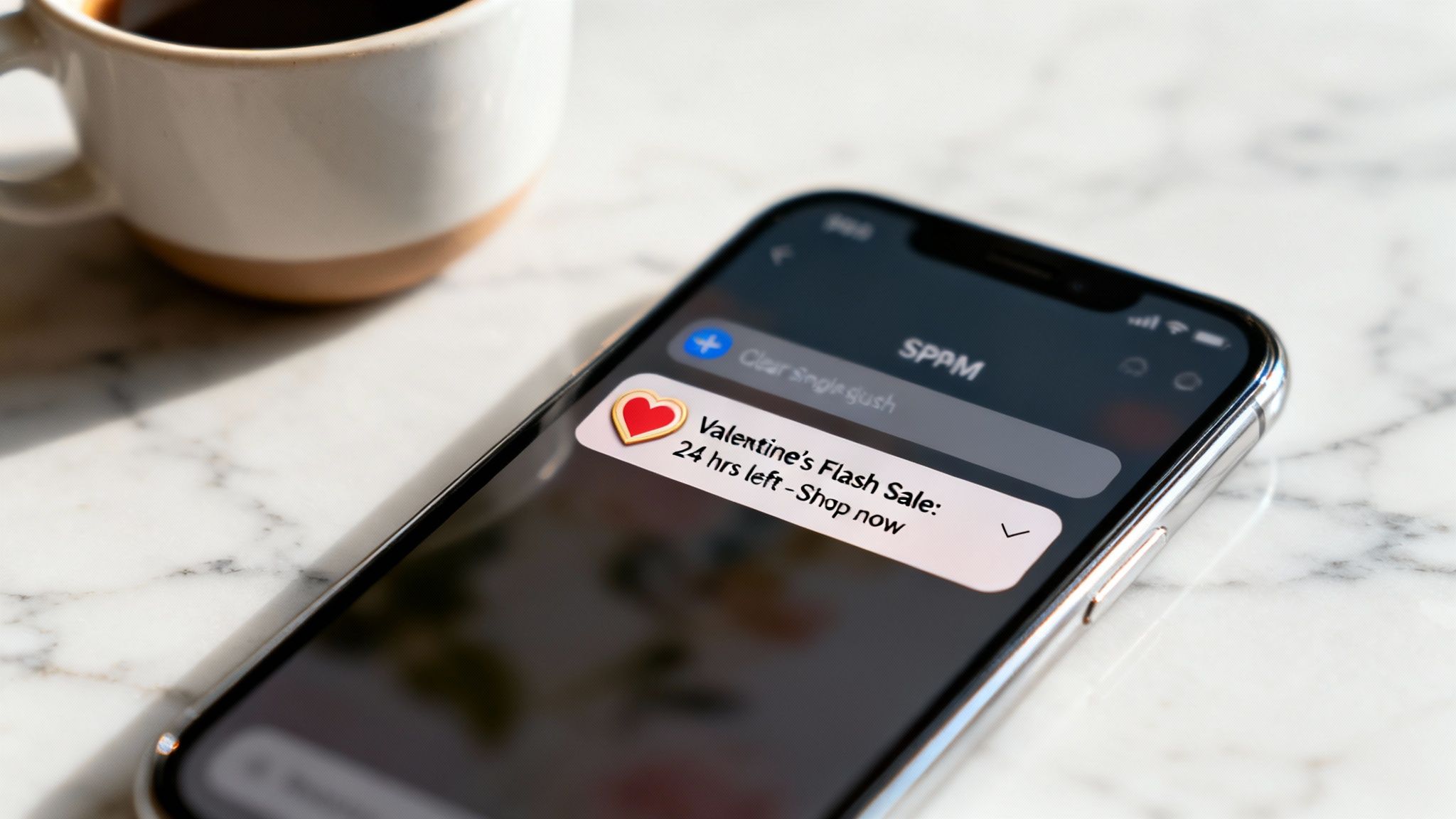
A smartphone displays a Valentine's Flash Sale notification with a heart icon, next to a coffee cup.

This tactic transforms a passive marketing message into an active, real-time engagement. Brands like Foot Locker and Sephora use SMS alerts to announce product drops and flash sales, conditioning their audience to respond quickly to high-priority updates. For Valentine's Day, these notifications are crucial for cutting through the noise and converting shoppers in the final, critical hours. This is one of the most direct Valentine's Day marketing ideas for driving immediate traffic and sales.

Execution Strategy

  • Target Audience: Perfect for last-minute shoppers, mobile-first consumers, and highly-engaged VIP customers who have opted into SMS/push communications.
  • Execution Steps:
    1. Integrate SMS/Push Tools: Connect an app like Klaviyo, Postscript, or Attentive to your Shopify store to manage and segment your subscribers.
    2. Craft Compelling Copy: Write concise, high-impact messages. For SMS, keep it under 160 characters (e.g., "V-Day Flash Sale Ends TONIGHT! 30% off our Love Collection. Don't miss out: [link]").
    3. Schedule Your Campaigns: Plan a sequence of messages. Send a push notification 24 hours before a sale ends and a final SMS alert 2-3 hours before the deadline for maximum impact.
  • Urgency Tactics (with Quikly): Drive even faster action by integrating Quikly's gamified offers into your SMS campaigns. Send a link to a tiered offer where the fastest to click get the best prize (e.g., "First 25 to click get a FREE gift with order!"). This transforms a standard notification into an exciting, competitive "Moment" that boosts click-through rates and revenue.
  • Timing: Send push notifications for "last chance" reminders 24 hours before your shipping cutoff. Deploy your most urgent SMS messages during peak shopping hours (6 PM - 8 PM) in the 24-48 hours leading up to February 14th.
  • KPIs to Track: SMS/Push Click-Through Rate (CTR), Conversion Rate from channel, Revenue per Recipient, and List Growth Rate.

10. Referral and Word-of-Mouth Marketing Programs

A referral program incentivizes existing customers to become brand advocates by rewarding them for bringing in new shoppers. This strategy leverages the powerful psychological principle of social proof, as a recommendation from a trusted friend is far more persuasive than traditional advertising. By offering a dual-sided incentive, such as a discount for both the referrer and the new customer, you create a powerful, self-perpetuating growth engine. This is one of the most cost-effective Valentine's Day marketing ideas for acquiring high-intent customers with a low Customer Acquisition Cost (CAC).

This tactic turns your customer base into an active marketing channel, driving organic growth. Iconic brands like Dropbox and Airbnb demonstrated how a well-structured referral system can lead to exponential user acquisition. For Valentine's Day, this translates to turning happy gift-givers into your most effective sales team, tapping into their personal networks to find others looking for the perfect present.

Execution Strategy

  • Target Audience: Loyal customers, recent purchasers who had a positive experience, and brand advocates active on social media.
  • Execution Steps:
    1. Define Incentives: Choose compelling, dual-sided rewards. A "Give $15, Get $15" discount is a popular and effective model. This provides clear value to both parties.
    2. Set Up the Program: Use a Shopify app like Referral Candy or Smile.io to automate the generation of unique referral links, track conversions, and distribute rewards seamlessly.
    3. Promote Your Program: Announce the Valentine's referral program to your existing customers via an email campaign in Klaviyo, on-site banners, and post-purchase follow-up messages. Make the sharing process frictionless.
  • Urgency Tactics (with Quikly): Supercharge your referral program by integrating it with a time-sensitive campaign. You could offer a "Valentine's Referral Sprint" where referrers who bring in a new customer within a 72-hour window receive an extra bonus reward. Quikly can manage the tracking and instant reward fulfillment for these time-bound referral pushes, creating urgency for advocates to act now.
  • Timing: Launch your referral program in late January to give advocates ample time to share before the Valentine's Day shopping rush. Send a reminder email about the program during the first week of February.
  • KPIs to Track: Referral Rate (percentage of customers who refer others), Conversion Rate from referrals, Customer Acquisition Cost (CAC) for referred customers, and Revenue from the referral channel. To avoid common pitfalls, learn more about the 5 common mistakes most referral programs make.

10 Valentines Day Marketing Strategies Compared

Strategy Implementation complexity Resource requirements Expected outcomes Ideal use cases Key advantages
Limited-Time Flash Sales with Countdown Timers Low–Medium — set timers and end triggers Moderate — dev integration, inventory sync, marketing Short-term revenue spikes; higher conversion rates Last-minute shoppers; peak shopping windows (e.g., week before V-Day) Creates urgency; easy to activate quickly
Ranked Offers Strategy (Tiered Reward System) Medium–High — progression logic and UX High — platform rules, analytics, creative assets Increased engagement, list growth, higher lifetime value Gamified campaigns; list-building and repeat engagement Drives repeat interactions; collects first‑party data
Social Media Sharing Incentives Low–Medium — share tracking and reward flow Moderate — content, seed incentives, social integration Expanded organic reach; more UGC; brand awareness Awareness pushes; low paid‑media budgets Cost-effective amplification; authentic endorsements
Early Bird Exclusive Offers Low — time-based access controls Low–Moderate — logistics planning, messaging Earlier purchases; smoother fulfillment; reduced rush Shipping-sensitive offers; pre-order/delivery guarantees Spreads demand; improves fulfillment efficiency
Spin-to-Win Gamification Campaigns Medium — interactive UI and anti‑abuse controls Moderate–High — development, design, prize costs Higher time-on-site; email capture; conversion lift Engagement-focused campaigns; list growth Fun, memorable UX; strong data capture
Live Drop / Limited Quantity Release Strategy High — precise scheduling and inventory control High — forecasting, notifications, marketing cadence Predictable traffic spikes; strong FOMO; premium pricing Exclusive or limited-edition product launches Genuine scarcity; builds buzz and loyalty
Bundle Deals and Gift Sets Low–Medium — SKU bundling and pricing Moderate — packaging, inventory coordination Increased average order value; simplified buying Gift buyers; shoppers seeking easy solutions Boosts AOV; reduces decision paralysis
Personalized Recommendations & Dynamic Offers High — ML, data integration, testing High — data infrastructure, tooling, privacy controls Higher relevance, conversion rates, and CLV Large catalogs; repeat customers; VIP targeting Relevance-driven conversions; efficient ad spend
SMS & Push Notification Urgency Campaigns Low–Medium — scheduling and compliance Moderate — opt-in lists, messaging platform, per-message cost Immediate responses; very high open rates; timely conversions Final reminders; last‑chance sale pushes Extremely high open rates; direct, timely channel
Referral & Word-of-Mouth Programs Medium — link tracking and reward automation Moderate — incentives, tracking tools, promotion Cost-effective acquisition; high-quality leads Programs that leverage existing customers High-trust acquisition; pay-on-conversion economics

From Ideas to Impact: Implementing Your High-ROI Valentine's Strategy

The transition from a list of promising Valentine's Day marketing ideas to a high-performing, revenue-generating campaign hinges entirely on strategic implementation. The ten strategies we've explored, from limited-time flash sales to personalized dynamic offers, are more than just creative tactics. They are actionable frameworks deeply rooted in the principles of consumer psychology and behavioral economics. The real power isn't in just using a countdown timer; it's in understanding why the anticipation of a deadline triggers action, or why the scarcity of a limited-quantity drop compels an immediate purchase.

Success in the competitive Valentine's Day landscape requires moving beyond generic, one-size-fits-all promotions. It demands a sophisticated approach that respects the shopper's intelligence while ethically leveraging proven psychological triggers. The difference between a basic pop-up capturing an email and an advanced urgency "Moment" is the difference between a fleeting interaction and a profitable, brand-building experience. The goal is not just to secure a single conversion but to increase Average Order Value (AOV), protect profit margins by avoiding deep, across-the-board discounts, and efficiently manage inventory for high-demand products.

Synthesizing Strategy into Action

As you prepare your campaign, it's crucial to connect these ideas into a cohesive customer journey. A single strategy can be effective, but a combination is formidable. Imagine a customer journey that begins with an "Early Bird Exclusive Offer" communicated via your Klaviyo email flow, followed by a "Limited Quantity Live Drop" promoted on social media, and concluding with an abandoned cart sequence powered by SMS urgency alerts. This multi-layered approach creates a continuous sense of excitement and value that basic discount codes simply cannot replicate.

Your key takeaways should be centered on three pillars:

  • Psychology over Promotion: Ground your campaigns in proven concepts like FOMO, scarcity, and social proof. Instead of just announcing a sale, build a narrative around its exclusivity or limited nature. This elevates the perceived value of your offer and your brand.
  • Integration and Automation: The most effective Valentine's Day marketing ideas are those that work seamlessly within your existing tech stack. Your urgency marketing platform must integrate flawlessly with Shopify, your ESP like Klaviyo, and your SMS provider. This automation is what allows enterprise-level Shopify Plus merchants to scale complex, personalized campaigns without manual oversight, ensuring the right message hits the right customer at the right time.
  • Data-Driven Refinement: Every campaign is a learning opportunity. Go beyond tracking simple conversion rates and look at Key Performance Indicators (KPIs) that tell a fuller story: Customer Acquisition Cost (CAC), Lifetime Value (LTV), and profit margin per order. Use these insights to determine which urgency tactics resonate most with your audience, and refine your approach for future holidays.

Your Path Forward: From Planning to Profit

Do not feel obligated to implement all ten ideas at once. The most pragmatic approach is to select two or three strategies that align best with your current business goals, brand voice, and inventory position. If you have excess stock of a particular item, a flash sale or bundle deal is a logical choice. If you're launching a new product, a limited-quantity live drop can generate immense buzz and immediate sales velocity.

By focusing your efforts, you can execute with precision, measure the results accurately, and build a playbook of proven tactics. This strategic approach transforms marketing from an expense into a predictable, high-ROI investment. You are not just running a Valentine's Day sale; you are engineering a customer experience designed for maximum engagement and revenue impact, setting a new standard for how your brand connects with its audience during pivotal retail moments.


Ready to move beyond basic timers and pop-ups? Quikly helps the world's leading brands turn these advanced psychological strategies into automated, revenue-driving campaigns. See how our platform can seamlessly integrate into your Shopify store to create sophisticated urgency "Moments" that captivate customers and grow your bottom line by visiting Quikly.

Share this post

Quikly Content Team
Quikly Content Team

The Quikly Content Team brings together urgency marketing experts, consumer psychologists, and data analysts who've helped power promotional campaigns since 2012. Drawing from our platform's 70M+ consumer interactions and thousands of successful campaigns, we share evidence-based insights that help brands create promotions that convert.