

ecommerce psychology
brand loyalty
best brand experiences
Shopping cart abandonment is what happens when a shopper adds your products to their online cart but vanishes before they ever click "complete purchase." It's a universal headache for Shopify merchants, with the global average rate hovering near a staggering 70%.
But from another perspective, it's also your single biggest untapped revenue opportunity. By understanding the consumer psychology driving this behavior, you can transform this challenge into a significant growth engine for your business.
For most ecommerce brands, a high shopping cart abandonment rate feels like a constant leak in your sales funnel, directly impacting revenue and profit margins.
Viewing it only as a problem, though, means you're missing the real story. Think of it less as a leak and more as a powerful growth lever, hiding in plain sight right there in your store's analytics. The goal isn't just to react to abandonment but to proactively apply behavioral economics principles to understand and influence your customers' decisions.
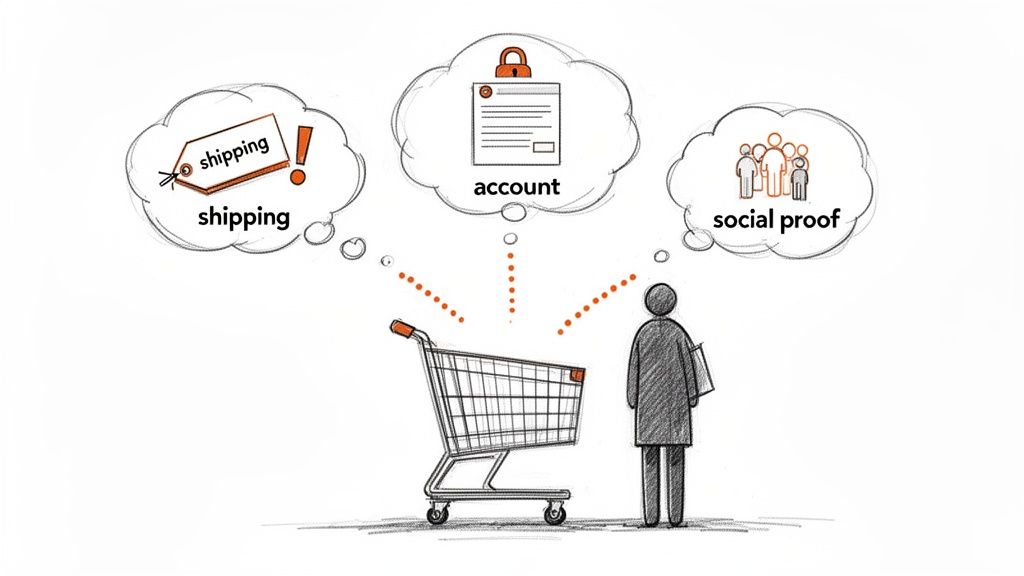
Every abandoned cart tells a story. A story about friction, hesitation, or an expectation that wasn't met. These moments are fueled by powerful psychological triggers. For instance, when a customer sees an unexpected shipping cost, it trips a wire in their brain called loss aversion—a core concept from behavioral economics where the psychological pain of an unforeseen expense feels far greater than the pleasure of owning the item.
Similarly, forcing a user to create an account introduces just enough friction to activate choice paralysis. Research shows that when faced with an overly complex decision, it suddenly becomes easier for a consumer to do nothing at all than to push through the extra steps.
The scale of this challenge is massive, but so is the potential reward for cracking the code. Shopping cart abandonment has been a thorn in the side of ecommerce for nearly two decades, with rates climbing from 59.8% in 2006 to a current global average of 70.19%.
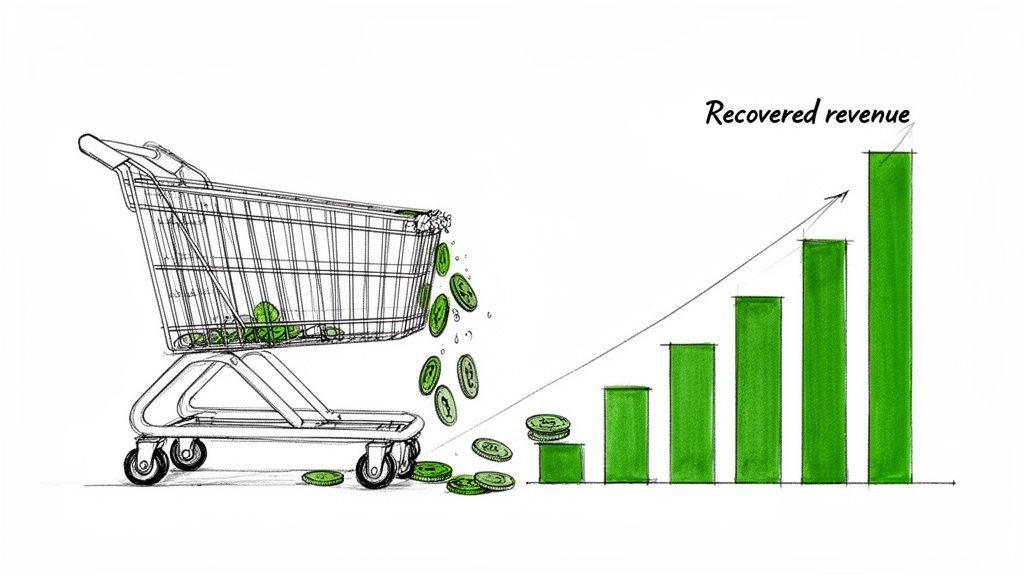
Globally, that translates to an estimated £2.96 trillion in lost sales every year. The good news? Experts estimate that up to £192.4 billion of that is recoverable with smarter, psychology-driven strategies. You can explore the full breakdown of these shopping cart abandonment statistics to really grasp the scope of this opportunity.
To put it in perspective, here are the key numbers every merchant should know.
| Metric | Global Statistic |
|---|---|
| Average Abandonment Rate | 70.19% (Industry Benchmark) |
| Annual Lost Merchandise Value | £2.96 Trillion |
| Mobile Abandonment Rate | 75.1% |
| Recoverable Annual Revenue | £192.4 Billion |
These stats paint a clear picture: the problem is widespread, incredibly costly, and hits even harder on mobile devices where checkout is often clunkier.
The infographic below drives these points home visually.
This data isn't just trivia; it's a clear signal that the friction on mobile is a major contributor to lost sales.
Clawing back this lost revenue requires moving way beyond the basic "You left something in your cart!" email. The top Shopify and Shopify Plus merchants are now deploying advanced strategies rooted in psychology that tackle the real reasons for abandonment right on their site, in the moment. Quikly positions itself as an expert in this urgency marketing science, enhancing banners, popups, and the entire shopper's journey.
By reframing shopping cart abandonment as a critical customer feedback tool, you can transform it from your biggest liability into your most valuable source of growth. Each lost cart is a chance to refine your user experience and strengthen your connection with your customers.
Instead of just chasing down lost sales after the fact, this approach is all about creating a more compelling and frictionless shopping journey from the very beginning. By weaving principles like scarcity, social proof, and anticipation into your banners, pop-ups, and the checkout process itself, you don't just recover carts—you stop them from being abandoned in the first place.
This is the science of turning hesitation into conversion. It's how you unlock the hidden revenue stream already flowing through your Shopify store.
To truly solve shopping cart abandonment, you must analyze why the cart was left behind. Every time a shopper gets a cart full of items and then clicks away, they're reacting to some kind of psychological trigger. Mastering these triggers is how you turn last-second hesitation into a confident purchase and drive immediate ROI.
An abandoned cart is more than just a missed sale. It's the exact moment when the perceived pain of buying something becomes greater than the pleasure of owning it. This is a delicate balance, and when it tips the wrong way, shoppers bail.
Certain moments in the checkout process can spark negative feelings that lead directly to a customer bouncing. These aren't just minor annoyances; they're major psychological hurdles that stop a sale in its tracks.
If you really want to get to the bottom of where these moments happen, a great tool is customer journey mapping. It lets you walk in your customer's shoes and pinpoint exactly where the friction is.
Just knowing what scares customers away isn't enough. The best Shopify stores flip the script. They proactively use positive psychological motivators to build momentum and squash hesitation before it even starts.
You can dig deeper into these principles in our guide to the behavioral science behind shopping behaviors. It's not just about rescuing carts after they've been abandoned; it's about creating an experience that prevents them from being abandoned in the first place.
By dissecting the negative psychological triggers in your checkout, you can replace them with positive motivators that transform the final steps of a purchase from a hurdle into an exciting and rewarding experience. This shift is fundamental to protecting revenue and maximizing profit margins.
Think of these principles as tools you can weave right into your onsite messaging, from banners to popups:
When you strategically place these positive triggers, you aren't trying to manipulate anyone. You are being transparent about value and helping customers get past the natural roadblocks in the buying process. This approach is about much more than just capturing an email for a future drip campaign—it’s about generating real revenue, right now.
Not all urgency tactics are created equal.
Many ecommerce brands reach for the most basic tool: a generic countdown timer on a product page. While these timers can sometimes provide a minor bump in conversions, they often do more harm than good, cheapening your brand and training customers to wait for the next fake discount.
This approach is built on pressure, not psychological value. It feels manipulative because the urgency isn't authentic. Shoppers are savvy; they notice when a timer magically resets on a page refresh, and that erodes trust. In the long run, this strategy trades a meaningful customer relationship for a quick, low-value sale. Contrast this with advanced behavioral triggers which focus on revenue generation over simple email capture seen in many pop-ups.
Advanced urgency marketing ditches the one-size-fits-all model and instead taps into authentic behavioral triggers grounded in proven consumer psychology. The goal isn't to manufacture fake pressure. It's to generate genuine excitement and help customers feel confident about their decision to buy. This is sophisticated psychology, not manipulation.
This smarter method also protects your profit margins by steering clear of deep, unnecessary discounts. It's all about creating compelling "Moments"—like those powered by Quikly—that pull shoppers in and drive high-intent purchases, focusing on immediate revenue and inventory management benefits.
True urgency marketing is the science of ethically motivating action by transparently communicating real-world value and opportunity. It respects the customer's intelligence and enhances their shopping journey, rather than just pressuring them at checkout.
This intelligent approach uses your actual business constraints and opportunities to create powerful psychological motivators. Here are a couple of actionable takeaways.
Instead of offering a flat discount to everyone, a dynamic ranked offer introduces a sense of social competition. It's a surprisingly powerful motivator that taps into our innate desire to achieve and win.
Another powerful strategy is the limited-time product drop, which plays on the psychological principle of anticipation. The excitement of waiting for something can be as potent as acquiring it.
This tactic works especially well for Shopify Plus merchants with a loyal following. By announcing an exclusive product drop ahead of time, you create buzz and open a dedicated window for high-intent buying. It turns a simple transaction into a can't-miss brand event that can drive massive revenue in a short time. This is just one of many advanced Shopify urgency tactics you can use to combat shopping cart abandonment.
When you move beyond basic timers, you start using strategies that don't just recover lost sales. You strengthen your brand, protect your profits, and build a more loyal, engaged customer base.
A rock-solid cart recovery strategy isn't a single magic bullet. It's a full playbook that engages customers on your site and long after they've clicked away. For Shopify and Shopify Plus merchants, this means a step-by-step approach to smooth out every point of friction, turning "I'll think about it" into "I need this now."
The best part? Your recovery plan starts before a cart is even abandoned. It begins with fixing the psychological hurdles that cause people to leave.
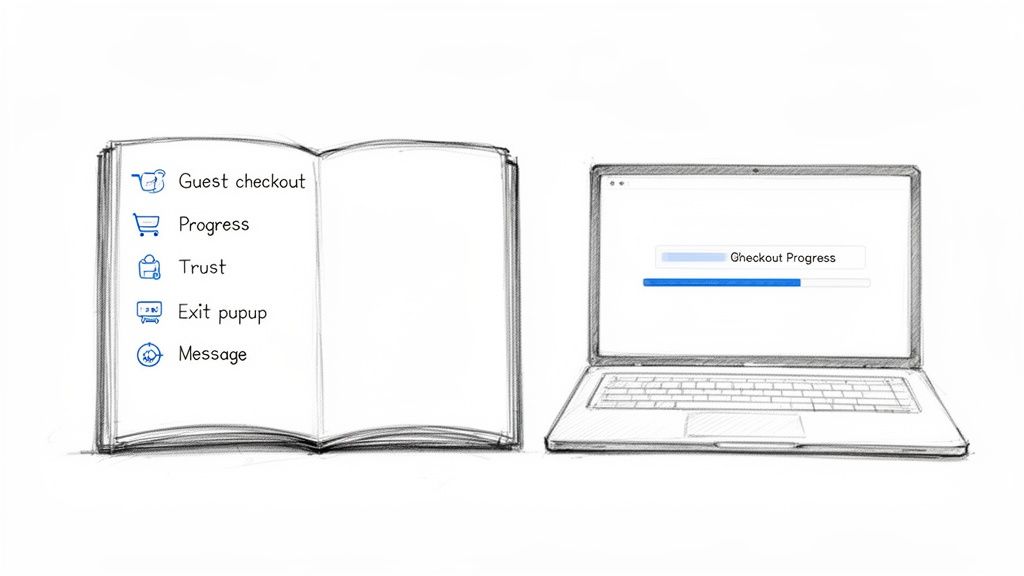
Your first line of defense is making the path to purchase feel effortless and safe. Every element should build momentum and prevent the shopper from overthinking their decision.
These foundational fixes are actionable takeaways you can implement immediately. But the real revenue is recovered when you layer in smarter messaging.
Generic pop-ups begging for an email are a thing of the past. Today's approach uses behavioral triggers to deliver the right message at the perfect moment—a message designed to generate revenue, not just capture a lead.
Consider an exit-intent popup. Instead of a weak "Don't Go!" message, you can trigger a compelling, limited-time offer based on what's in their cart. This turns hesitation into an opportunity for an immediate sale. Quikly's "Moments" are built for this, using sophisticated automation to serve up offers that feel exclusive and genuinely valuable, not desperate.
Even with a flawless website, people will leave. This is where your offsite recovery playbook—powered by email and SMS—kicks in. The goal is to create a seamless sequence that reminds, persuades, and provides a compelling reason to return.
The most effective abandoned cart flows aren't just reminders; they're an extension of your brand's conversation with the customer. Each message should rebuild the value and create a compelling reason to act now.
Hooking up a platform like Klaviyo or an SMS marketing tool to your Shopify store lets you automate this with precision. A high-converting flow usually looks like this:
This sequence strategically ramps up the urgency, tapping into the psychological power of scarcity. By creating a real deadline, you create a powerful motivation to finish the purchase. For more ideas, you can dig into our guide on effective abandoned cart email examples.
A great shopping cart abandonment strategy isn't just about sending a few emails. It's a measurable system that should drive revenue directly back into your business. To see if it's working, you must look past surface-level numbers and focus on metrics that signal real, sustainable growth and protect profit margins.
This is where you shift from simply recovering carts to building a sophisticated revenue engine. The goal isn't just to win back one sale; it's to do it profitably and increase that customer's lifetime value.
Your overall abandonment rate is a good pulse check, but the real insights come from digging deeper. To get actionable data, you need to track core metrics that measure the true financial impact of your recovery campaigns.
Here's what to watch:
Cart Recovery Rate (CRR): This is your ground zero. It’s the percentage of abandoned carts you successfully bring back to life. The formula is simple: (Recovered Carts / Total Abandoned Carts) x 100. If this number is climbing, your tactics are on the right track.
Average Order Value (AOV) of Recovered Carts: This one is all about protecting your profits. Are your recovery efforts bringing back big spenders, or are you just handing out discounts to customers who were only going to buy a low-cost item anyway? Compare the AOV of recovered carts to your site-wide AOV—it will tell you if your offers are attracting the right shoppers.
Total Revenue Uplift: At the end of the day, this is the number that really counts. It's the total extra cash your cart recovery campaigns have generated. Tracking this proves the direct ROI of your strategy and makes it a no-brainer to invest more time and resources into getting it right.
We know from behavioral economics that different psychological triggers work on different people. Scarcity might work for one customer, while social proof might convince another. The only way to know what clicks with your audience is to test everything.
Instead of guessing, you can pit different psychological principles against each other to see what truly drives action—and revenue.
An optimized cart recovery strategy is built on a foundation of continuous experimentation. A/B testing allows you to replace assumptions with data, ensuring every message and offer is scientifically calibrated for maximum financial impact.
For example, you could set up a simple test inside your Klaviyo or SMS flows to compare two different angles:
Test A (Scarcity/FOMO): The subject line and copy emphasize urgency. Something like, "Heads up! Items in your cart are low in stock. Grab them before they're gone."
Test B (Social Proof): This version leans into the wisdom of the crowd. The copy might say, "Great choice! Others are loving this item. Complete your order before it's the one that got away."
By running this test, you're not just finding out which email gets more opens. You’re learning whether your audience is more motivated by the fear of missing out or the comfort of a popular choice.
This same logic applies to your onsite pop-ups and banners. With a tool like Quikly, you could A/B test different "Moments"—maybe a ranked offer versus a limited-time flash sale—to see which one generates more immediate sales.
Ultimately, remember that every abandoned cart you recover is a win for your overall conversion rate. It's how you effectively improve ecommerce conversion rates across your entire store. This constant cycle of testing, analyzing, and tweaking is what turns a simple recovery tactic into a powerful, profit-generating machine.
We’ve spent this guide digging deep into shopping cart abandonment, and if there’s one thing to take away, it’s this: it’s not a problem, it's a profound opportunity. The journey from staring down that staggering 70% average abandonment rate to actually recovering that revenue isn't about quick fixes. It’s paved with a real understanding of consumer psychology.
Think of it this way: every abandoned cart is a conversation that got interrupted, not a door slammed in your face.
By shifting how you see it—from simple recovery to proactive, psychology-based engagement—you change the entire shopping experience. Forget about generic timers that erode trust. Instead, you can build compelling "Moments" that tap into genuine scarcity, social proof, and anticipation. It’s an approach rooted in behavioral economics, turning what used to be friction into genuine connection.
The strategies we've walked through give you a clear path. By fine-tuning your Shopify checkout, building smart recovery flows with tools like Klaviyo, and constantly A/B testing your messaging, you're not just patching leaks. You're building a resilient and incredibly profitable ecommerce engine. This isn't about tricking people; it’s the science of showing your value at the exact moment they’re making a decision.
Every abandoned cart is a data point. It's not a lost sale. It’s a clue telling you exactly where you can make your customer experience better. That mindset shift is what turns your biggest headache into your most powerful catalyst for growth.
Ultimately, your goal is to make the decision to buy feel both easy and exciting. The principles of urgency marketing, when used correctly, do exactly that. They help shoppers get over that natural hesitation, feel good about their choices, and click "buy" with confidence.
You're now armed with these psychological insights and real-world tactics. You're ready to restart those interrupted conversations. You have the tools to reclaim that lost revenue, protect your margins, and build a brand that people are genuinely excited to buy from—again and again.
Let's dive into some of the most common questions Shopify merchants ask about cart abandonment, with real-world answers that go beyond the usual textbook definitions.
While the global average is around 70%, fixating on that number is a mistake. A "good" rate really depends on your industry, price point, and customer base.
For most Shopify stores, getting your abandonment rate below 60% is a significant achievement. If you're in a high-consideration industry, the rate may be higher, while fast-moving consumer goods might see rates in the 50-55% range with proper optimization.
The only benchmark that truly matters is your own. Instead of chasing an industry average, aim for steady, measurable progress. Shaving off even 5-10% from your rate month-over-month is a clear sign your strategy is generating positive ROI.
It’s a simple piece of math that tells a powerful story: what percentage of shoppers who start a checkout don't finish it? While Shopify Analytics does this for you, it's good to know what's happening under the hood.
The formula is: (1 - [Total Number of Completed Transactions / Total Number of Carts Created]) x 100
So, if you had 1,000 carts created last month and 300 of those shoppers actually completed their purchase, your abandonment rate would be 70%. That means for every 10 customers who initiate a purchase, 7 of them walk away.
It absolutely can, but only when it’s done poorly. There's a vast difference between creating genuine value based on behavioral science and faking urgency with deceptive tactics.
Customers are savvy. They know a countdown timer that resets on a page refresh is a cheap trick. That kind of tactic doesn't create urgency; it creates distrust and makes your brand look desperate.
But when urgency is grounded in authentic information—in the actual dynamics of your business—it's not manipulative; it's helpful. It’s about giving shoppers the context they need to make an informed decision. Consider these psychological principles:
Ethical urgency marketing is about creating compelling "Moments" that help the shopper, not just push for a sale. It’s the difference between a one-time trick and a sustainable strategy that builds both revenue and customer trust.
Ready to stop using cheap tricks and start creating real urgency? Quikly goes way beyond basic timers. We use the science of consumer psychology to build compelling moments that drive sales without sacrificing your profit margins.
Find out how our advanced behavioral triggers can help you turn hesitation into action. Visit https://hello.quikly.com to see how it works.