

ecommerce conversion
customer experience strategy
digital customer experiences

Pop-up advertising is often misunderstood. Dismissed as intrusive, many e-commerce brands fail to see them as powerful revenue-generating assets. The reality is, with industry benchmarks showing an average cart abandonment rate near 70% and conversion rates hovering around a mere 2.5%, Shopify merchants can't afford to ignore any tool that can meaningfully impact ROI. This is where the science of high-revenue pop-ups comes into play, transforming a simple email capture form into a sophisticated instrument of consumer psychology.
This article moves beyond basic countdown timers and generic discount offers. We will dissect high-performing pop-up advertising example showcases, grounding each one in principles of behavioral economics like scarcity, FOMO (Fear of Missing Out), and social proof. A critical part of this transformation involves understanding the strategies for achieving a strong return on investment (ROI) in advertising. Our analysis will provide a strategic blueprint for implementing urgency marketing that not only boosts conversions but also protects profit margins and aids in inventory management. You will learn how to transition from basic pop-ups to psychologically-driven campaigns that enhance the entire shopper journey, with actionable tips for immediate implementation.
OptinMonster is a mature onsite conversion optimization suite renowned for its powerful pop-up and lead generation tools. It stands out by offering a comprehensive platform that moves beyond simple email capture, providing ecommerce businesses with a robust toolkit to reduce cart abandonment, boost sales, and segment audiences with precision. Its extensive library of over 700 templates and multiple campaign types, including lightbox pop-ups, full-screen welcome mats, and floating bars, allows for rapid deployment and testing without needing a developer.
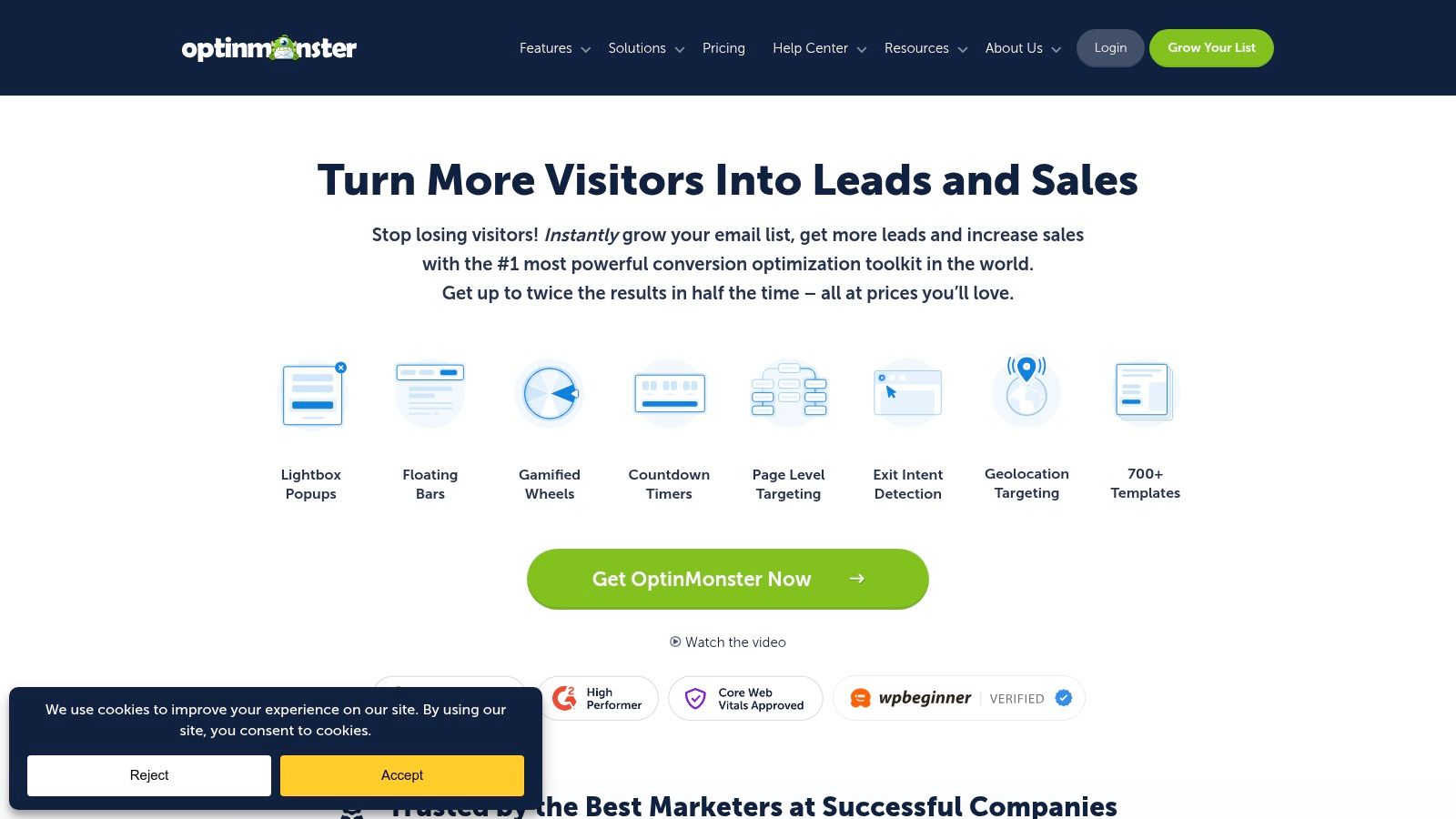
What makes OptinMonster a top-tier pop-up advertising example is its sophisticated targeting and trigger engine. Its signature Exit-Intent® technology is a standout feature, using behavioral psychology to re-engage abandoning visitors at the most critical moment. This trigger is crucial for Shopify merchants aiming to combat the industry's average 70% cart abandonment rate. By presenting a targeted offer just as a user's cursor moves towards the exit, stores can recover otherwise lost revenue. If you want to dive deeper into the mechanics of this powerful tool, you can explore the strategic nuances of exit-intent pop-ups and their impact on conversions.
Actionable Tip: Combine OptinMonster's geolocation targeting with a countdown timer to create a sense of urgency for location-specific promotions. This tactic leverages both the psychological principles of scarcity (time-limited) and relevance (location-specific) to maximize conversion impact.
Website: https://optinmonster.com
Justuno is an intelligent conversion platform specializing in onsite messaging and advanced pop-ups for direct-to-consumer brands. It moves beyond standard email capture by offering deep personalization, AI-powered product recommendations, and sophisticated audience segmentation. Tailored for Shopify Plus merchants and growing DTC brands, Justuno empowers marketers to create highly relevant user experiences with multi-step forms, gamified pop-ups, and targeted banners without extensive developer resources.
What makes Justuno a powerful pop-up advertising example is its emphasis on profile enrichment and automation. The platform’s ability to run quizzes and surveys within pop-ups allows brands to gather zero-party data directly from visitors, which can then be used to create hyper-personalized segments. Its Audience Sync feature connects this onsite behavior directly to advertising platforms like Facebook and Google, ensuring messaging remains consistent across the entire customer journey. This capability is critical for nurturing leads and effectively building a high-quality email list that translates into higher lifetime value.
Actionable Tip: Use Justuno's multi-step forms to reduce friction. Ask for an email on the first screen, then on the second screen, ask for an SMS opt-in or additional preference data. This secures the initial conversion before requesting more information, improving overall capture rates.
Website: https://www.justuno.com
OptiMonk is a powerful and accessible onsite message toolkit, offering a robust suite of pop-up and personalization features. It's particularly attractive for emerging ecommerce brands due to its generous free plan, which provides full-feature access for up to 10,000 monthly pageviews. This allows small stores to leverage sophisticated marketing tactics like urgency timers and advanced targeting without an initial financial commitment, making it an excellent platform for testing and optimization.
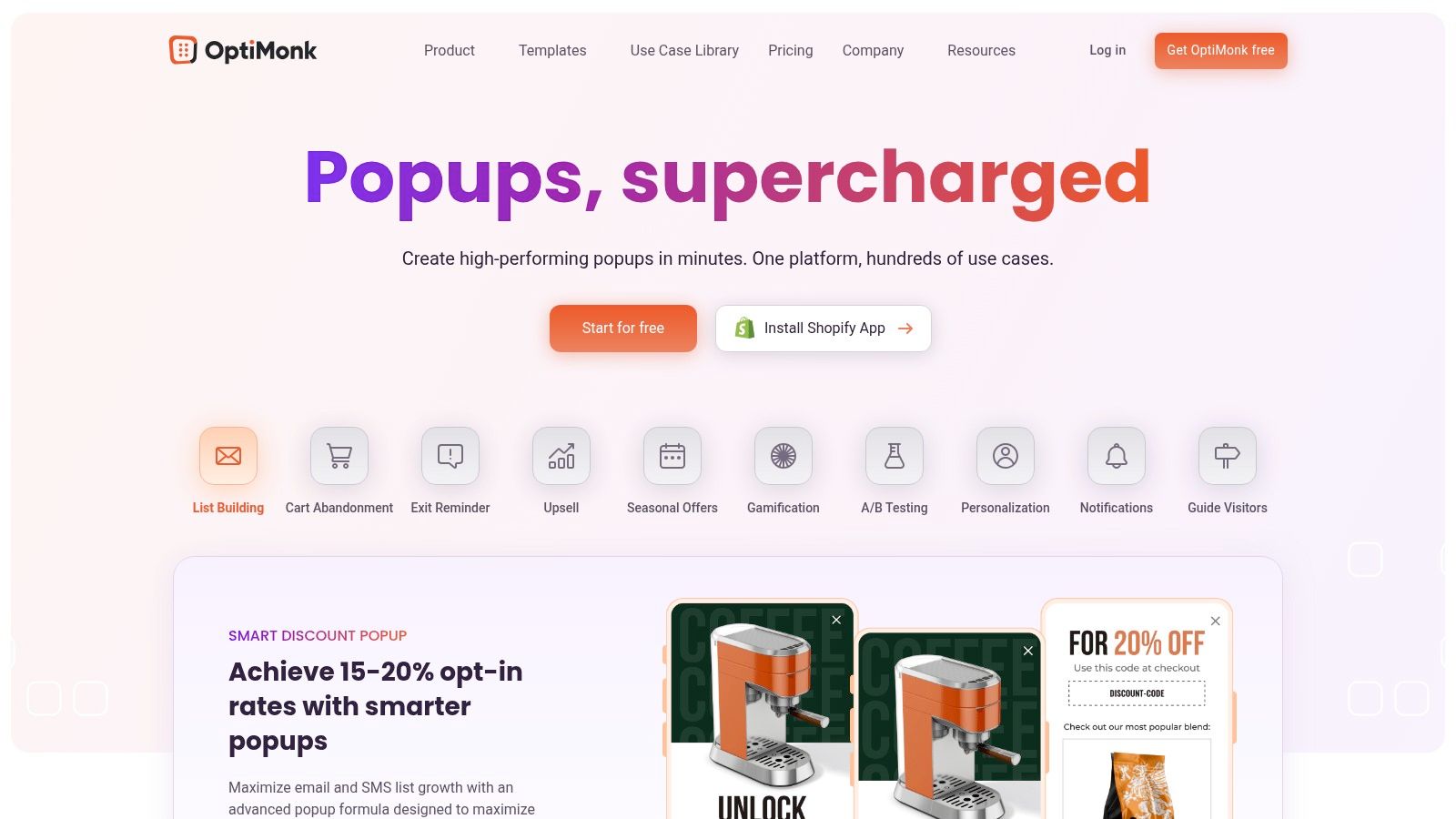
What makes OptiMonk a noteworthy pop-up advertising example is its focus on making advanced personalization accessible. While it includes standard triggers like exit-intent, its strength lies in the depth of its segmentation rules available even on lower-tier plans. For a Shopify store, this means you can display a unique discount pop-up specifically to repeat customers who have spent over a certain amount, or show a free shipping offer only to visitors from a specific marketing campaign. This level of granularity helps protect profit margins by ensuring offers are only shown to the most relevant audience segments.
Actionable Tip: Combine OptiMonk's cart-based targeting with a countdown timer. Trigger a pop-up offering free shipping that expires in 10 minutes, but only for users with over $50 in their cart. This applies the psychological principle of scarcity directly at the point of decision, nudging high-value carts toward conversion.
Website: https://www.optimonk.com
Privy simplifies the marketing stack for Shopify merchants by combining pop-ups, email, and SMS marketing into a single, cohesive platform. It's designed for brands that want to move quickly, building powerful on-site displays and immediately automating the follow-up sequences without juggling multiple tools. Its library includes a variety of campaign types like spin-to-win wheels, cart savers, and multi-step forms, making it easy to launch engaging and interactive promotions.
What makes Privy a compelling pop-up advertising example is its all-in-one approach that directly connects list growth to revenue. Instead of just capturing an email and exporting it to another tool like Klaviyo, you can instantly trigger a welcome series or an abandoned cart text message from the same dashboard. This tight integration is especially valuable for Shopify stores looking to create a seamless customer journey from the initial pop-up interaction to the final purchase, bridging the gap between lead capture and conversion.
Actionable Tip: Use Privy's A/B testing feature on a cart saver pop-up. Test a straightforward discount (e.g., "15% off to complete your order") against a free shipping offer to see which incentive more effectively reduces cart abandonment while protecting your profit margins.
Website: https://www.privy.com
Wisepops is a multi-channel onsite conversion toolkit designed for ambitious marketing teams. It extends beyond standard pop-ups to include embeds, product recommendations, and web push notifications, providing a unified platform for engaging website visitors. The platform is particularly valuable for teams seeking creative inspiration, as it offers a public showcase of real customer campaigns, an extensive template library, and an onsite marketing academy.
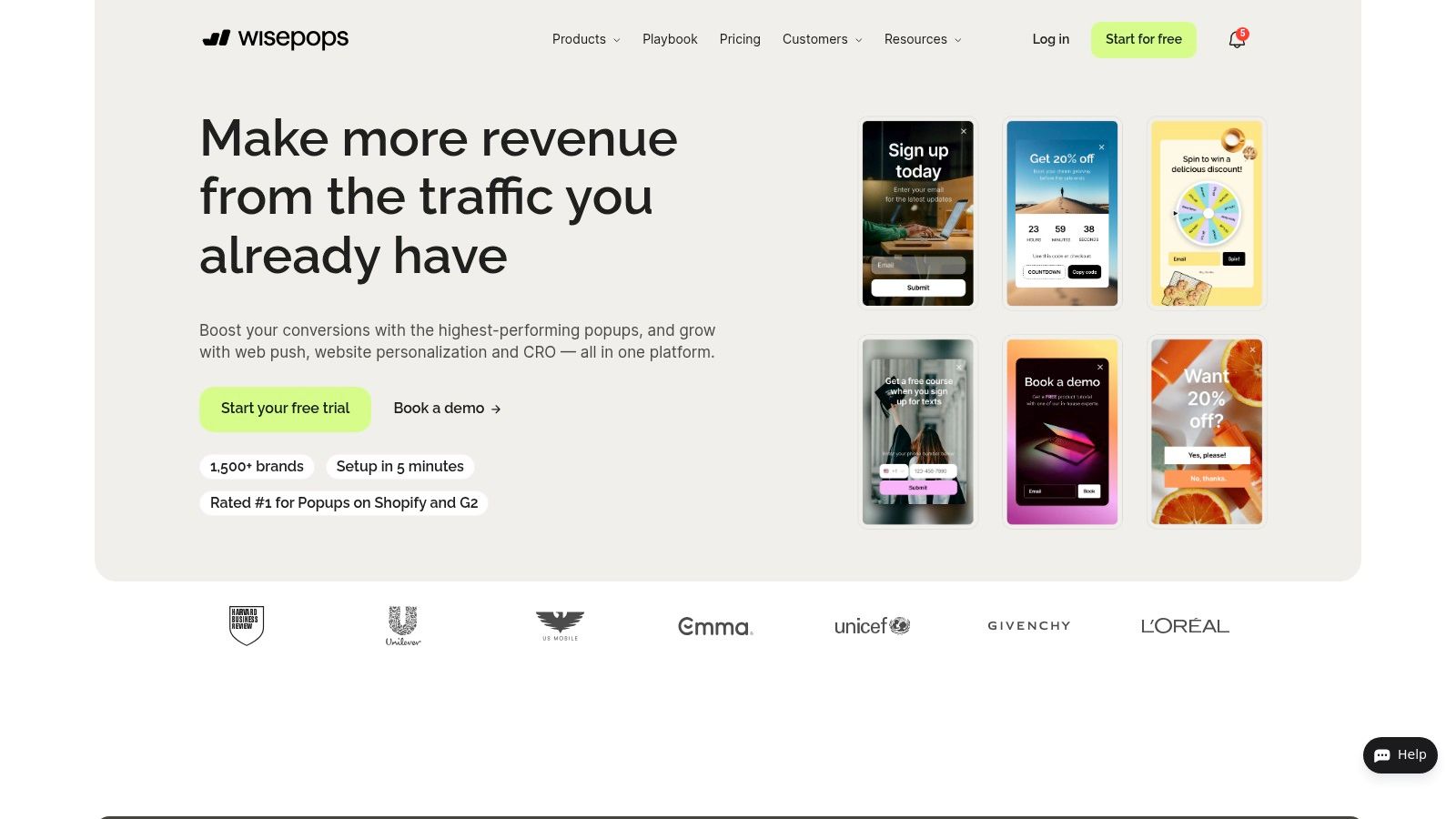
What establishes Wisepops as a strong pop-up advertising example is its emphasis on both functionality and education. The platform doesn't just provide the tools; it actively teaches marketers how to use them effectively through its rich resource hub. For Shopify merchants, this combination is powerful, enabling them to move from theory to implementation quickly. The ability to manage multiple onsite campaigns, from a welcome discount pop-up to a strategic web push notification for a new product drop, all within one dashboard streamlines workflow and ensures a consistent brand experience.
Actionable Tip: Use the 14-day full-feature trial to test the most advanced features without commitment. Set up an A/B test comparing a simple discount pop-up against a more sophisticated one that uses custom properties from your Shopify store, like a customer's past purchase history, to measure the direct impact on revenue.
Website: https://wisepops.com
Sleeknote is a user-friendly platform focused on creating elegant pop-ups and onsite experiences tailored for ecommerce brands. It excels in driving engagement through interactive and urgency-driven campaigns, offering features like gamified pop-ups, product recommendations, and sophisticated multi-step forms. The platform is designed for marketers who want to move beyond simple lead capture and create more compelling, context-aware interactions that guide visitors through the sales funnel without disrupting the user experience.
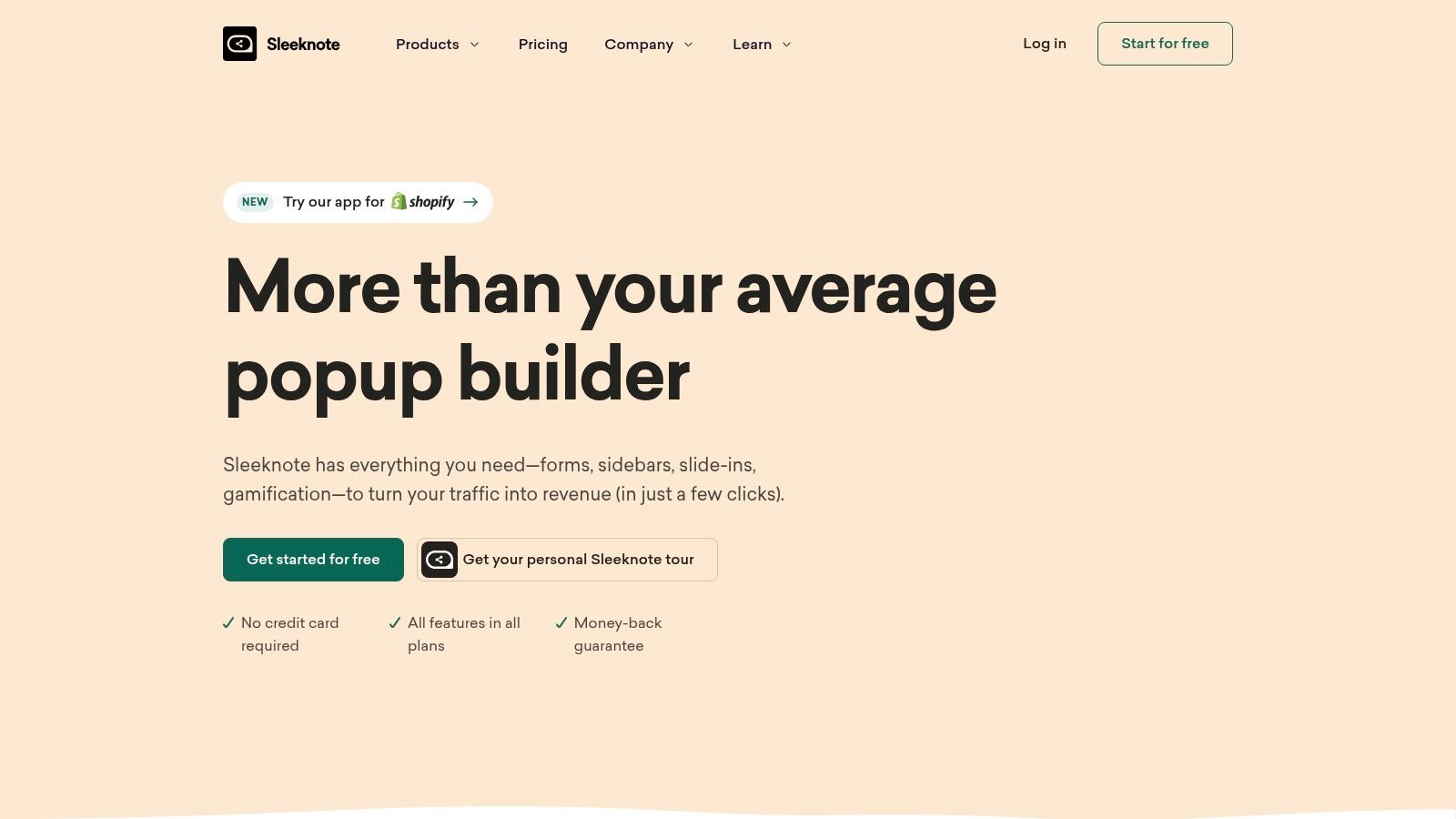
What makes Sleeknote a compelling pop-up advertising example is its emphasis on gamification and multi-step campaigns. Features like spin-to-win wheels and digital scratch cards tap into the psychological principle of variable rewards, creating a sense of anticipation and fun that significantly boosts engagement and email sign-ups. Multi-step forms allow you to collect more information without overwhelming the user, starting with a simple question (like a 'yes' or 'no') before asking for an email, a technique grounded in the commitment and consistency principle.
Actionable Tip: Combine Sleeknote's geo-targeting with a countdown timer for a product launch. You can show a unique "Launching in X Hours" pop-up to visitors in a specific time zone, creating localized urgency and building anticipation for a new release.
Website: https://sleeknote.com
The Shopify App Store itself serves as a dynamic marketplace and a powerful research tool for any merchant looking for the perfect pop-up advertising example. Instead of being a single solution, it's a curated hub listing hundreds of pop-up apps, ranging from simple, free announcement bars to sophisticated, enterprise-level conversion suites. This makes it an ideal starting point for browsing real-world examples, comparing features, reading uncensored merchant reviews, and understanding current pricing models.
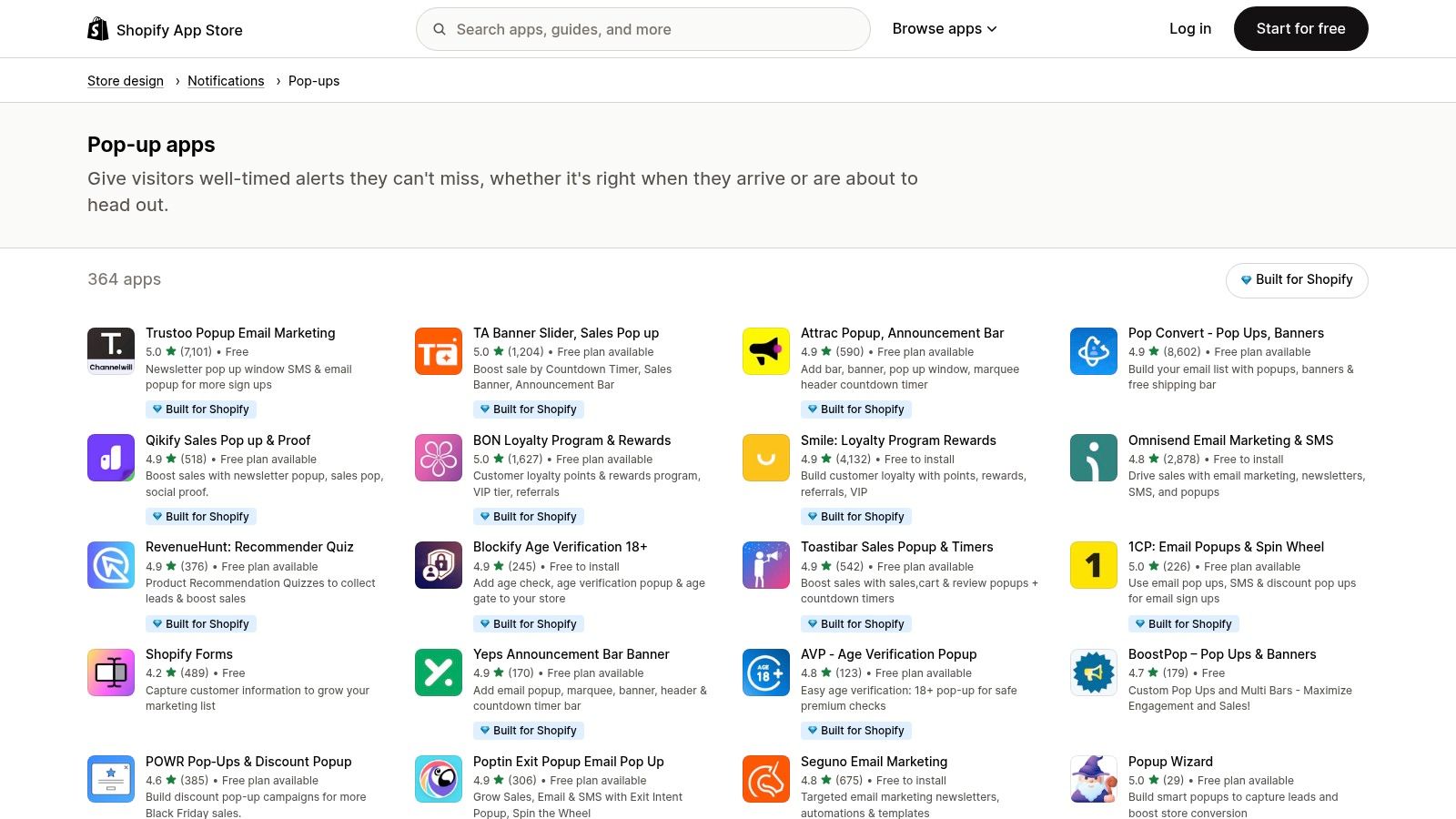
What makes the App Store uniquely valuable is its direct integration with the Shopify ecosystem. Merchants can install apps with a single click, often with free trials, allowing for rapid, low-risk testing directly within their store environment. The "Built for Shopify" badge provides an added layer of trust, indicating that an app meets Shopify’s high standards for performance, security, and user experience. To maximize the effectiveness of pop-up apps found here, consider a comprehensive practical guide to improve ecommerce conversion rates to ensure your underlying strategy is sound.
Actionable Tip: Before committing to a paid app, install two or three different options with free trials. Run them on a duplicate, unpublished theme to test their user interface, trigger logic, and impact on site speed without affecting your live customers. This hands-on comparison is the fastest way to find the perfect fit.
Website: https://apps.shopify.com/categories/store-design-notifications-pop-ups
| Tool | Implementation complexity | Resource requirements | Expected outcomes | Ideal use cases | Key advantages |
|---|---|---|---|---|---|
| OptinMonster | Low–Medium — fast setup with templates; advanced features add complexity | Moderate — impression-based pricing, analytics, ecommerce integrations | Higher conversion from targeted overlays, quick campaign launches, revenue attribution | SMBs and mid-market promotional overlays, urgency and exit-intent campaigns | Large template library, strong targeting/triggers, exit-intent and ecommerce integrations |
| Justuno | Medium–High — deep feature set, learning curve for advanced automation | High — visitor-based pricing, setup for audience sync and AI recommendations | Highly personalized conversions, improved segmentation and retargeting | DTC brands and Shopify Plus merchants needing personalization and automation | Advanced segmentation, audience sync, multistep/gamified pop-ups, enterprise tooling |
| OptiMonk | Low — quick install, native plugins, simple interface | Low–Medium — generous free plan (up to 10k pageviews), pageview pricing for growth | Cost-effective testing and personalization for small stores, fast ROI | Small stores testing pop-ups, urgency timers, onsite personalization without upfront cost | Strong free plan, native Shopify/WordPress apps, responsive support |
| Privy (by Attentive) | Low–Medium — all-in-one setup combining pop-ups with messaging automation | Moderate — pageview-based pop-up pricing, SMS costs may apply | Integrated capture + automated follow-ups, better cart recovery and retention | Shopify merchants wanting built-in email/SMS automation and cart savers | Built-in email & SMS, gamified pop-ups, simple starter pricing |
| Wisepops | Medium — multi-channel toolkit with extra configuration for recommendations and push | Medium–High — pageview caps, enterprise add-ons (SSO, SOC2) can increase cost | Multi-channel onsite engagement and inspiration-driven campaigns | Teams seeking templates, campaign examples, and multi-channel onsite tools | Product recommendations, web push, public campaign showcase and resources |
| Sleeknote | Medium — rule engine and gamification options require setup | Medium — visitor-based pricing; gamification may be add-on cost | Urgency-driven and gamified engagement, multi-step lead capture across domains | Ecommerce urgency campaigns and gamified lead capture with multiple domains | Unlimited campaigns/domains on lower tiers, gamification add-ons, advanced targeting |
| Shopify App Store – Pop-up apps category | Variable — depends on chosen app; installation via Shopify is straightforward | Variable — wide price spectrum, many free trials, billing via Shopify | Rapid testing and comparison of many vendors, fast app installs/uninstalls | Merchants exploring options, comparing vendors, rapid A/B testing on Shopify | Centralized marketplace, merchant reviews, easy install, large selection of apps |
Throughout this guide, we've deconstructed a wide array of pop-up advertising example strategies, moving beyond simple overlays to explore the sophisticated psychology that drives high-value customer action. We have seen how leading brands leverage these moments not just for lead capture, but as powerful revenue accelerators. The common thread connecting the most effective examples is the strategic application of proven behavioral science principles.
The goal is not to pressure or manipulate, but to guide. By thoughtfully integrating concepts like scarcity (limited inventory), social proof (customer activity), loss aversion (expiring offers), and anticipation (upcoming drops), you align your marketing with natural human decision-making processes. This approach ethically helps a customer who is already considering a purchase to overcome indecision, leading to a better shopping experience and a direct impact on your revenue.
The difference between a generic pop-up and a high-performing revenue driver lies in intentionality and testing. Use the insights from the examples we've analyzed to build a more sophisticated strategy. Here are your immediate next steps:
The tools we've covered, from OptinMonster to the various Shopify apps, provide a solid foundation for building better pop-ups. However, as your brand scales, the need for more advanced automation and deeper psychological triggers becomes critical. Manually managing dozens of pop-up rules is inefficient and limits your ability to respond to real-time shopper behavior. This is where basic pop-up apps show their limitations, often focusing more on list growth than on driving immediate, profitable revenue.
This is the point where a strategic partner like Quikly becomes essential. Graduating from basic pop-ups to a fully integrated urgency marketing program allows you to deploy sophisticated, multi-channel "Moments" that drive predictable revenue growth. This advanced approach protects your brand equity by avoiding generic, constant discounting and safeguards your profit margins by creating genuine, time-bound purchase incentives. By embracing the science of urgency, you transform pop-ups from a simple list-building tool into a cornerstone of your e-commerce growth engine.
Ready to evolve beyond basic pop-ups and implement scientifically-backed urgency marketing that drives significant revenue? Quikly specializes in creating sophisticated, automated campaigns that leverage deep psychological triggers to motivate buyers without devaluing your brand. Explore how our platform can transform every pop-up advertising example into a powerful, predictable profit center for your Shopify store.