

ecommerce psychology
brand loyalty
best brand experiences
Pop-up ads have a reputation, but when executed with strategic intent, they transform from a mere annoyance into a powerful revenue-generation engine. Most e-commerce brands stop at basic email capture, leaving significant sales opportunities on the table. This collection of pop-up ad examples moves beyond simple list-building to showcase sophisticated, psychology-driven strategies that directly impact your bottom line, from reducing cart abandonment to increasing average order value. We will explore how leading platforms leverage behavioral economics principles like scarcity, social proof, and loss aversion to create high-impact moments that convert.
This is not just a gallery of attractive designs. For each example, we provide a deep strategic analysis, breaking down precisely why it works and offering replicable methods you can deploy on your own Shopify store. You'll find actionable takeaways, A/B testing ideas, and key metrics to track for optimizing performance. We'll also provide quick integration notes for platforms like Quikly, OptinMonster, and others, helping you choose the right tool for your specific goals, whether it's advanced urgency marketing or robust email acquisition. When focusing on email capture, for instance, it's crucial to build a high-quality list. Understanding the benefits of implementing a double opt-in process can be a game-changer for your long-term email marketing ROI by ensuring you attract engaged subscribers.
Our focus is on the practical application of consumer psychology, demonstrating how to elevate a standard pop-up into a sophisticated conversion tool that protects profit margins and drives measurable growth. Each entry includes screenshots and direct links, providing a comprehensive resource for e-commerce marketers and brand owners ready to unlock the full potential of their on-site messaging.
For e-commerce brands looking to move beyond standard pop-ups, Quikly represents a significant strategic upgrade. It's not just a tool for creating pop-up ad examples; it's a sophisticated urgency marketing platform designed to tap directly into consumer psychology. Quikly positions itself as an expert in urgency marketing science, enhancing not just pop-ups but the entire shopper's journey. It transforms the conventional pop-up into a high-impact "Moment," leveraging principles like scarcity, anticipation, and Fear of Missing Out (FOMO) to accelerate purchase decisions and drive substantial revenue growth.
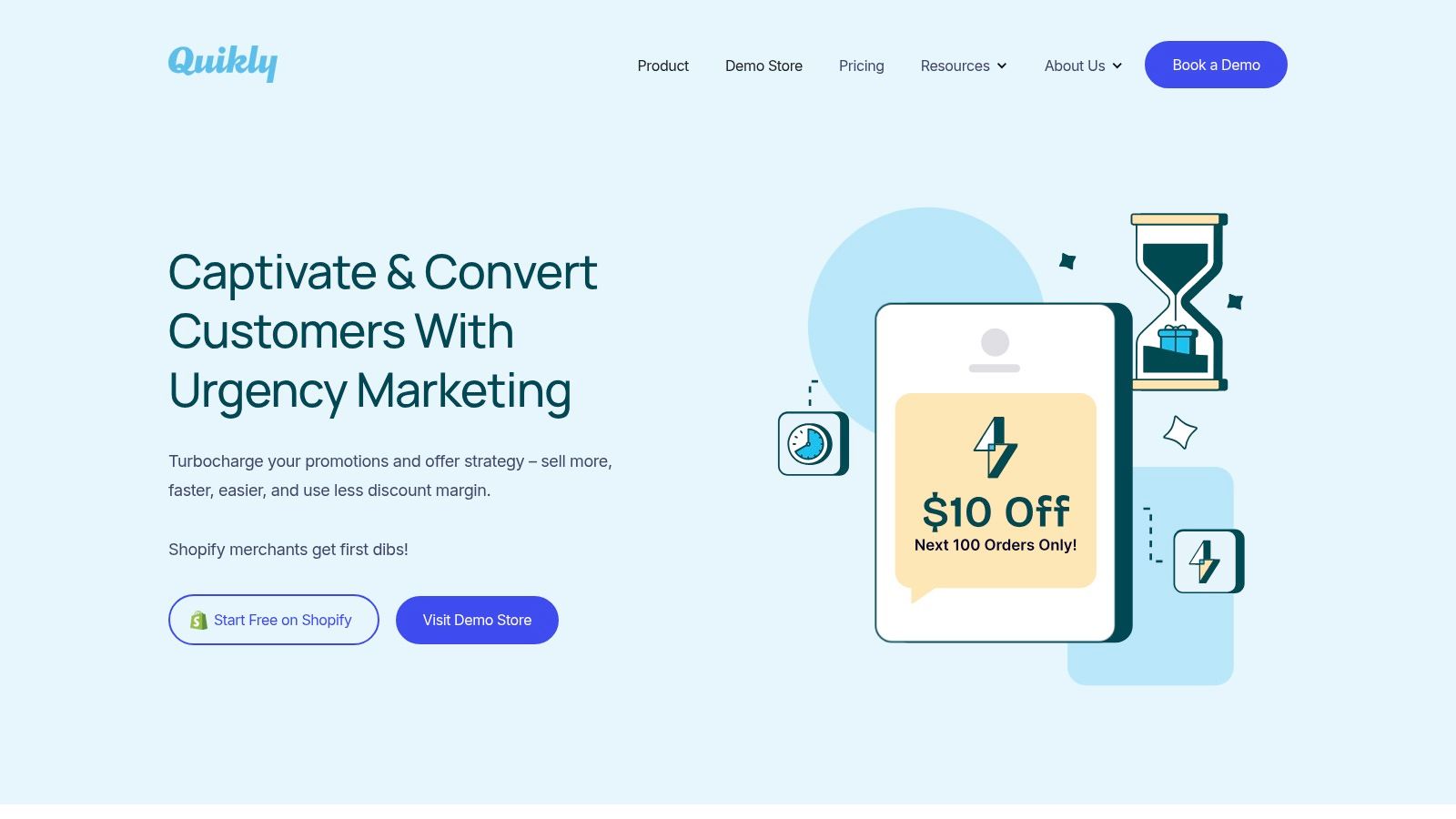
While many tools focus on the basic function of email capture, Quikly’s primary goal is immediate revenue generation and profit margin protection. It achieves this by creating dynamic, time-sensitive campaigns that engage users actively rather than passively. This approach is built on a foundation of behavioral science, turning a simple notification into a compelling, gamified shopping experience. For merchants, particularly on Shopify and Shopify Plus, this translates to selling more products, faster, and managing inventory without resorting to deep discounts that erode profits.
Quikly’s platform is engineered to address the core challenges of modern e-commerce, such as promo fatigue and high cart abandonment rates (which average around 70% industry-wide). It contrasts with basic timer apps by offering a suite of intelligent, psychologically-driven tools that deliver measurable ROI.
Psychology-Driven Urgency: Quikly moves beyond simple countdown timers. It uses advanced behavioral triggers and tactics like limited-time product drops, ranked offers (where faster responders get better deals), and live countdowns tied to specific user actions. This creates genuine urgency based on the psychological principle of anticipation, making participation feel like an exclusive event.
Revenue Focus, Not Just Lead Capture: The platform is optimized for sales velocity and ROI. By creating compelling reasons to buy now, Quikly campaigns directly impact top-line revenue. The reported 32% average revenue lift for participating customers underscores this focus on business impact over simple list growth.
No-Code Implementation for Shopify: A major advantage for agile teams is the fast, code-free setup. Merchants can design, preview, and launch sophisticated campaigns from a library of branded templates in minutes without needing developers or altering theme files, making it ideal for the Shopify ecosystem.
Advanced Personalization & Segmentation: Quikly utilizes a powerful recommendations engine, advanced audience segmentation, and behavioral triggers. This ensures that the right "Moment" is shown to the right shopper at the peak of their purchase intent, maximizing conversion potential and avoiding irrelevant interruptions. It seamlessly integrates with tools like Klaviyo and major SMS platforms to enhance personalization.
Shopify merchants can leverage Quikly for several high-impact scenarios:
Actionable Takeaway: Reframe your pop-up strategy from passive list-building to active revenue generation. Instead of a generic "10% off for your email" offer, use a time-sensitive, limited-quantity pop-up for a specific product category to drive an immediate sale. This leverages scarcity and protects your overall profit margins. Quikly's approach is founded in this behavioral economics model.
Quikly is designed with a strong focus on the Shopify ecosystem, offering a seamless integration experience for stores of all sizes, including Shopify Plus enterprise needs.
Website: https://hello.quikly.com
OptinMonster is a powerful lead generation and conversion optimization toolkit that has established itself as a go-to resource for e-commerce marketers. While it is a platform for building pop-ups, its greatest value for strategic inspiration comes from its extensive library of templates and real-world examples. This makes it a fantastic starting point for any brand looking to understand what high-performing pop-up ads look like in practice before committing to a design.
The platform stands out by offering more than just a software tool; it provides an educational resource. Users can browse galleries filled with hundreds of pop-up ad examples, filtering by goal (like growing an email list or reducing cart abandonment) and type (like fullscreen welcome mats or floating bars). This allows marketers to deconstruct successful campaigns in their niche and replicate proven formulas.
OptinMonster’s strength lies in its sophisticated behavioral targeting. While basic pop-up tools might only trigger on page load, OptinMonster allows for triggers based on a deep understanding of user psychology and intent.
Actionable Takeaway: Implement page-level targeting on your Shopify store. For your top 3 product categories, create a specific pop-up that offers a relevant lead magnet or a small, category-specific discount. For example, on a "Skincare" collection page, trigger a pop-up offering a "Free Guide to Building a Morning Skincare Routine" in exchange for an email. This relevance will significantly outperform a generic site-wide offer.
| Pros | Cons |
|---|---|
| Extensive Template Library: Over 700+ designs provide endless inspiration. | Dated Examples: Some public gallery examples can feel visually old. |
| Advanced Targeting: Granular control over who sees your pop-ups and when. | Impression Caps: Lower-tier plans have impression limits. |
| Shopify Integration: Deep integration for targeting based on cart value. | Learning Curve: The number of features can be overwhelming for beginners. |
Website: https://optinmonster.com/templates/
Pricing: Plans start at $9/month (billed annually) for the Basic plan, scaling up to Growth at $49/month, which includes advanced features like OnSite Retargeting and cart-specific triggers for Shopify.
ConvertFlow positions itself as an all-in-one conversion platform for e-commerce, moving beyond simple pop-ups to create complete marketing funnels. Its core value for marketers seeking pop-up ad examples is its expansive and well-organized template library. This allows brands to rapidly prototype different conversion strategies, from email capture to limited-time offers, without writing any code.
The platform is built for speed and experimentation. You can design, customize, and preview hundreds of templates entirely for free, which significantly lowers the barrier to entry for teams needing to visualize a campaign or get stakeholder approval before committing to a paid plan. This "build-first" approach makes it an excellent tool for brainstorming and deconstructing what makes a high-impact pop-up ad work.
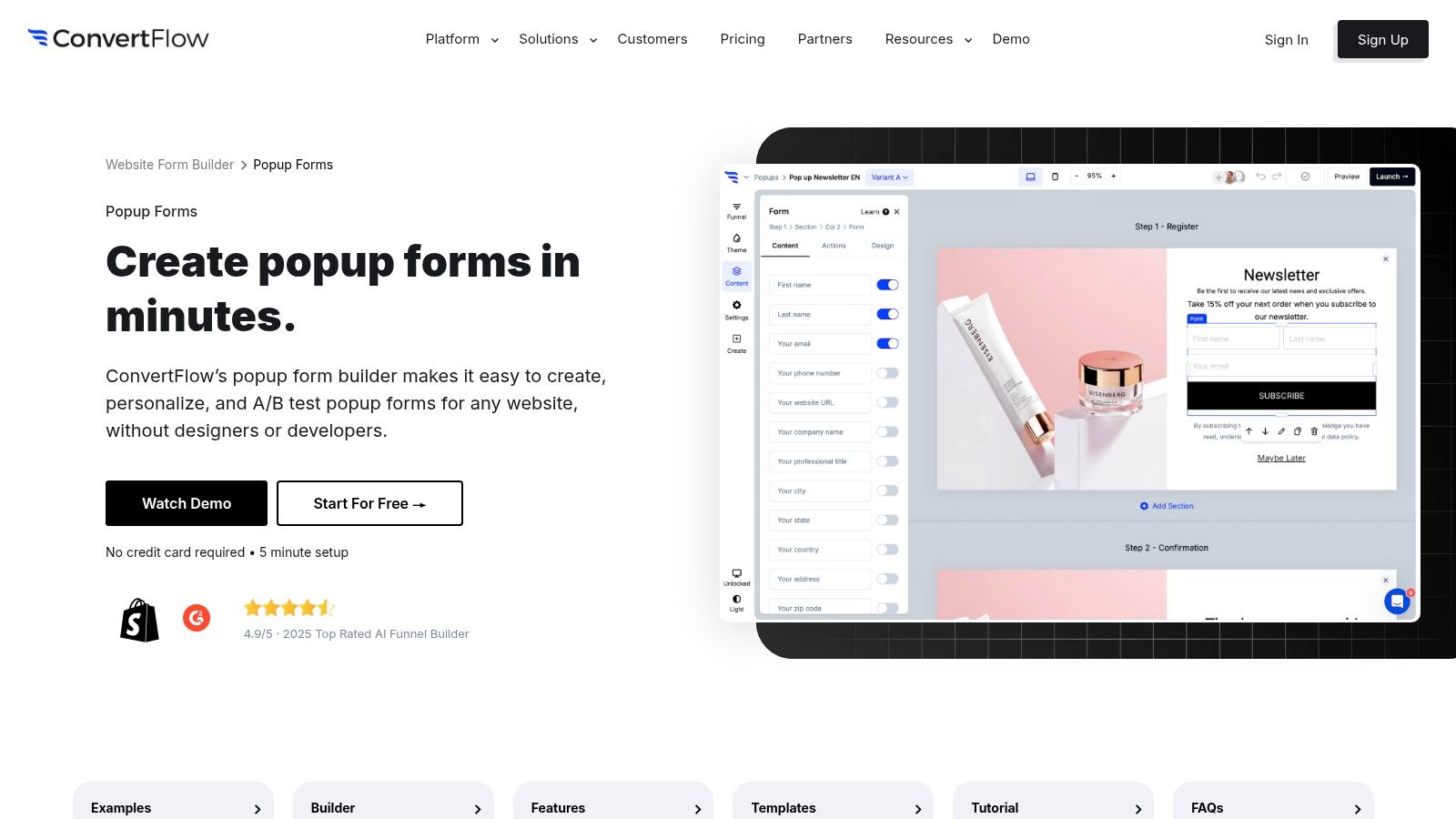
ConvertFlow’s strategic advantage is its funnel-based approach, which encourages marketers to think about the entire customer journey rather than just a single interaction. This is supported by robust personalization and testing capabilities that help optimize every step of the conversion process.
Actionable Takeaway: Test a multi-step pop-up for new visitors. Step 1: "Get 15% Off Your First Order." Once they enter their email, trigger Step 2: "Want free shipping too? Enter your phone number for SMS alerts." This uses the "foot-in-the-door" psychological principle, increasing the likelihood of getting the second opt-in after securing the first.
| Pros | Cons |
|---|---|
| Build and preview for free: Lowers evaluation friction and simplifies concepting. | Traffic-based pricing: Funnel view limits can lead to overages during sales. |
| Broad template inventory: Industry-specific starting points speed up creation. | Advanced features gated: Key personalization is locked behind paid plans. |
| Scales to full funnels: Manages everything from pop-ups to landing pages. | Slight learning curve: More complex than simple, single-purpose pop-up tools. |
Website: https://www.convertflow.com/forms/popup
Pricing: Offers a free plan for up to 2,500 monthly views. Paid plans start with the Marketer plan at $99/month, scaling up based on funnel views and feature access.
Sleeknote is a conversion optimization platform that excels at helping e-commerce brands create aesthetically pleasing and high-performing pop-ups. With a strong focus on practical application, its gallery of pop-up ad examples is curated to solve specific e-commerce challenges, from reducing cart abandonment to promoting live shopping events. This makes it an ideal resource for teams who need modern designs and clear, goal-oriented implementation guides.
The platform provides over 120 customizable templates and a drag-and-drop builder, allowing for rapid deployment without sacrificing brand consistency. Sleeknote’s strength is its user-friendly approach, translating complex marketing goals into actionable pop-up campaigns. Their extensive library of use-case guides and setup tutorials empowers marketers to launch sophisticated, multi-step campaigns with confidence, even without deep technical expertise.
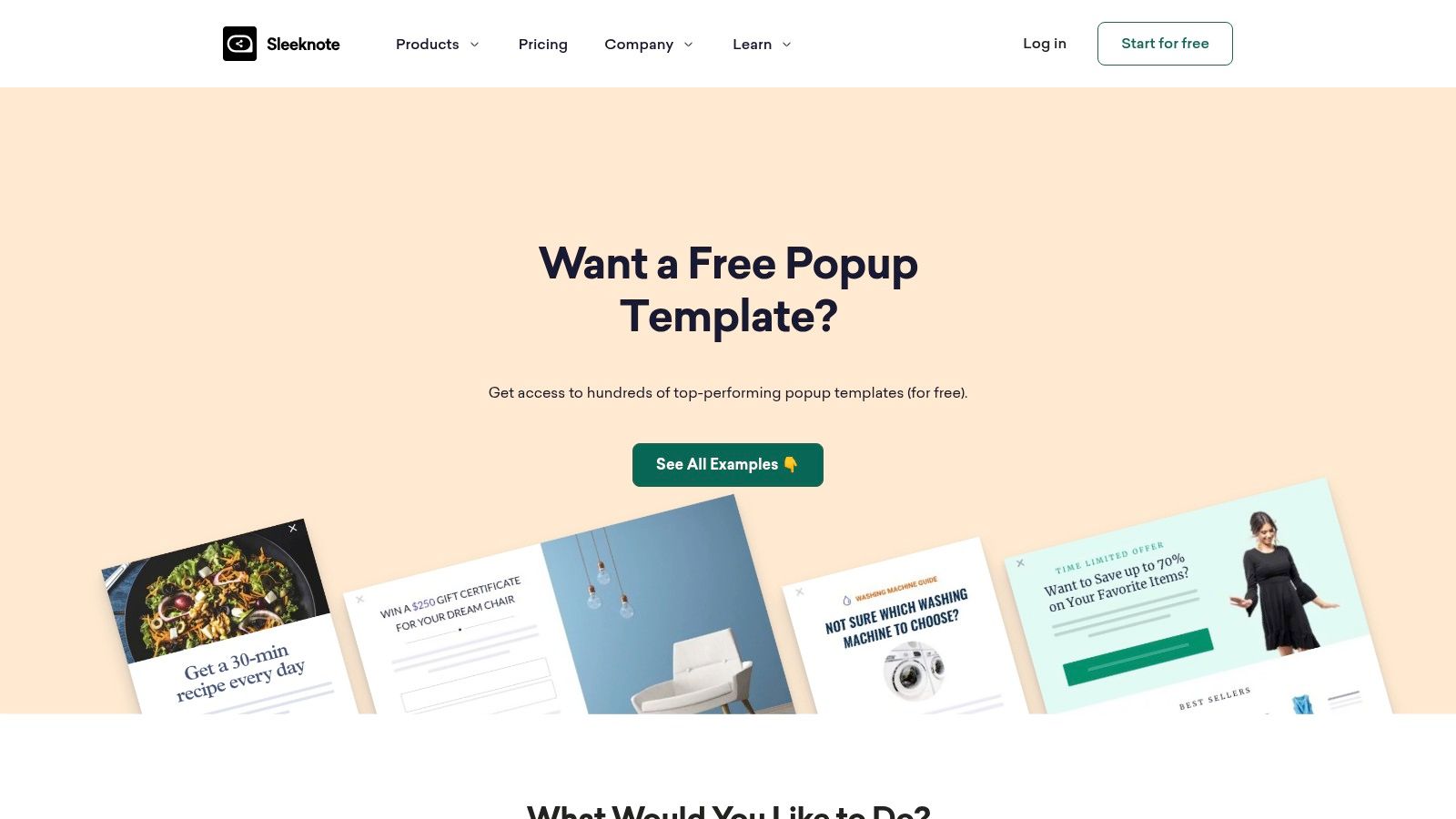
Sleeknote empowers marketers to go beyond simple email capture by natively supporting more interactive and engaging pop-up formats. This focus on user experience helps combat pop-up fatigue and increases engagement by making the interaction feel more like a conversation.
Actionable Takeaway: Implement a "Spin to Win" gamified pop-up using an exit-intent trigger on your Shopify store. Instead of just one prize ("10% off"), offer a variety of outcomes (10% off, 15% off, Free Shipping, $5 Off, Try Again). This leverages the psychological principle of variable rewards, which has been shown in behavioral economics research to be highly engaging and can boost sign-up rates.
| Pros | Cons |
|---|---|
| Clear Use-Case Library: Examples are tied to specific e-commerce goals. | Pricing Model: Session-based pricing can become costly for high-traffic sites. |
| Supports Multistep/Gamified Pop-ups: Natively build engaging pop-ups. | Fewer Third-Party Examples: Public gallery has less variety than larger tools. |
| 7-Day Free Trial: A risk-free way to test the platform and its features. | Focus on Pop-ups: Less of an all-in-one suite compared to broader marketing platforms. |
Website: https://sleeknote.com/popup-examples
Pricing: Plans are based on sessions, starting at $59/month for the Lite plan (25,000 sessions), up to $469/month for the Premium plan (500,000 sessions). All plans include unlimited pop-ups and A/B testing.
Wisepops is a performance-focused onsite marketing platform designed for conversion-driven teams. Its primary value for marketers seeking inspiration lies in its modern template gallery and insightful blog, which showcases contemporary and effective pop-up ad examples. Unlike platforms with dated galleries, Wisepops provides a fresh look into what is currently working in e-commerce, from video pop-ups to gamified campaigns and countdown offers.
This platform empowers marketers to move beyond basic email captures by providing tools and templates for the entire customer journey. Users can explore a gallery filled with ready-made examples tailored for specific goals like upselling products, collecting Net Promoter Score (NPS) feedback, or driving urgency. This makes it a valuable resource for brands looking to implement more sophisticated, revenue-generating pop-up strategies.
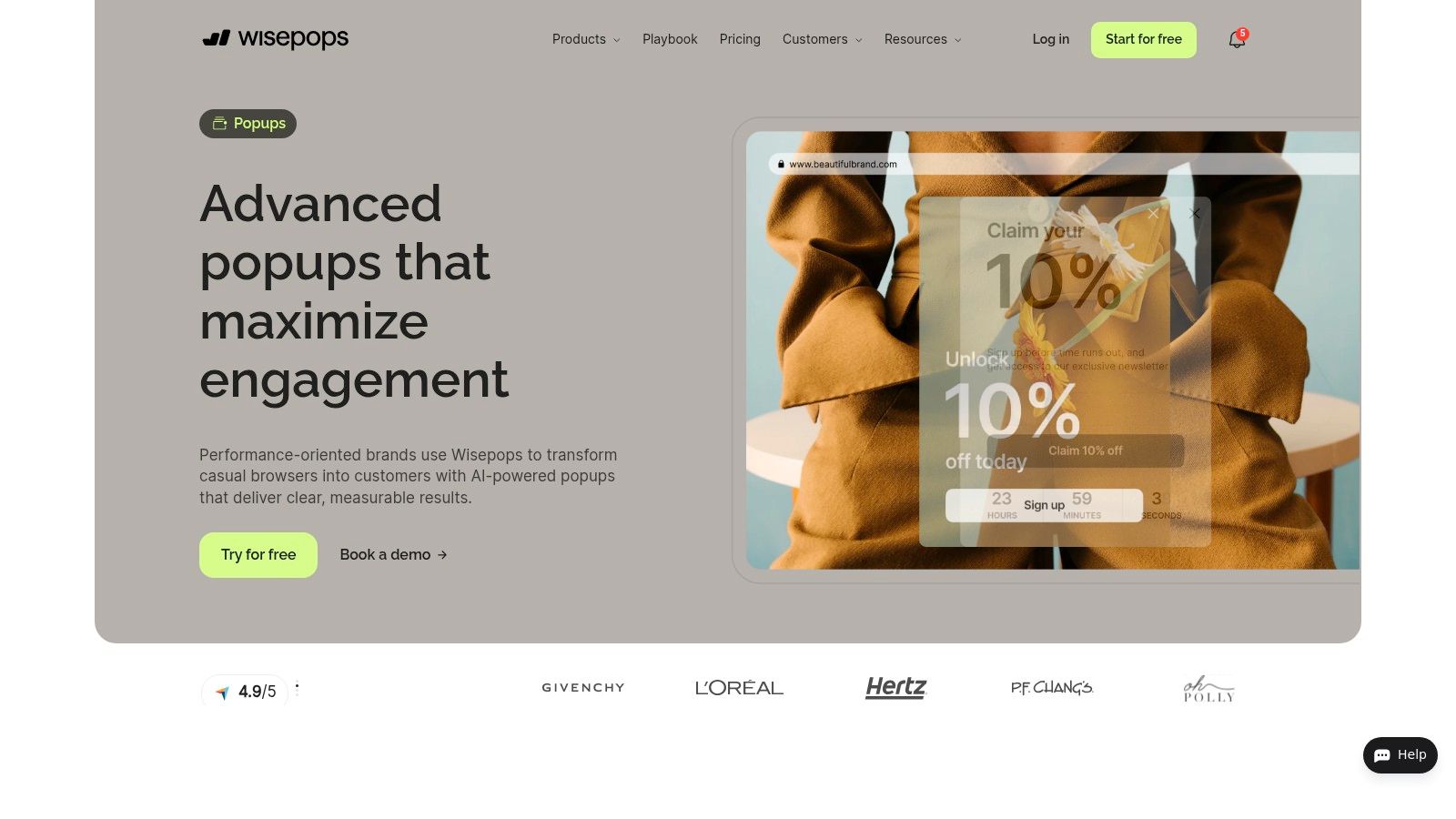
Wisepops excels by combining an intuitive, no-code builder with powerful targeting capabilities that enable precise message delivery. This focus on segmentation and timing allows marketers to create campaigns grounded in user behavior and psychology, ensuring relevance and maximizing impact.
Actionable Takeaway: Use the cart value trigger in your Shopify integration to create an upsell pop-up. Set a trigger for when a customer's cart value is just below your free shipping threshold (e.g., $65 when the threshold is $75). The pop-up can say, "You're only $10 away from free shipping! Add this popular item to your cart." This directly increases Average Order Value (AOV) and boosts revenue.
| Pros | Cons |
|---|---|
| Up-to-Date Gallery: Modern templates and a clean UI for inspiration. | Traffic-Based Pricing: Costs scale with site visitors, which can be a variable. |
| Strong E-commerce Use Cases: Focus on upsells, countdowns, and NPS. | Variable Plan Details: Pricing and features can change and may require sales contact. |
| Helpful Documentation: Extensive resources for quick implementation. | Potential Learning Curve: Advanced segmentation rules can take time to master. |
Website: https://wisepops.com/popups
Pricing: Plans are based on monthly pageviews, starting from a free plan for up to 10,000 pageviews. Paid plans with advanced features like A/B testing and Shopify targeting start at higher traffic tiers.
PageFlows is not a pop-up builder but rather a comprehensive UX and UI pattern library, making it an invaluable strategic tool for competitive intelligence. It offers a massive, searchable database of real-world user flow videos and screenshots from top-tier apps and websites. For marketers looking for pop-up ad examples, PageFlows provides a unique, behind-the-scenes look at how successful brands integrate modals, overlays, and other interruptive patterns into the complete customer journey.
This platform stands out by focusing on the entire user experience, not just the isolated pop-up. Instead of seeing a static design, you can watch a video of the pop-up being triggered in a live environment, from onboarding to checkout. This contextual insight is crucial for understanding the timing, triggers, and flow that make a pop-up feel helpful rather than intrusive, providing a level of research that a simple template gallery cannot match.
The primary strength of PageFlows is its ability to provide high-fidelity, real-world inspiration that goes beyond standard marketing templates. It allows strategists to reverse-engineer the engagement and conversion tactics of market leaders.
Actionable Takeaway: Before your next campaign, use PageFlows to research the pop-up strategies of 3-5 of your direct competitors. Document the triggers they use (e.g., time on page, exit-intent), the offers they make, and the copy they use. Use this competitive intelligence to formulate an A/B test for your own pop-up strategy, starting with a proven concept.
| Pros | Cons |
|---|---|
| High-Density, Real-World Examples: See how top brands actually use pop-ups. | Not a Pop-up Builder: You must use a separate tool to implement designs. |
| Saves Research Time: A huge time-saver for competitive and pattern analysis. | Requires Filtering: E-commerce examples may require digging to find. |
| Focus on UX: Helps design pop-ups that don't disrupt the user journey. | Subscription Cost: It is a paid resource, unlike some public galleries. |
Website: https://pageflows.com/
Pricing: Offers a 3-day free trial. Paid plans for individuals start at $25/month (billed annually), with team plans available for larger organizations.
Envato Elements is a creative asset subscription service that provides marketers and developers with a vast library of downloadable digital assets. Rather than being a pop-up builder itself, it serves as a massive marketplace for high-quality, pre-made pop-up templates, UI kits, and code snippets. This makes it an essential resource for teams that want full creative control and prefer to integrate designs into their own systems rather than using an all-in-one platform.
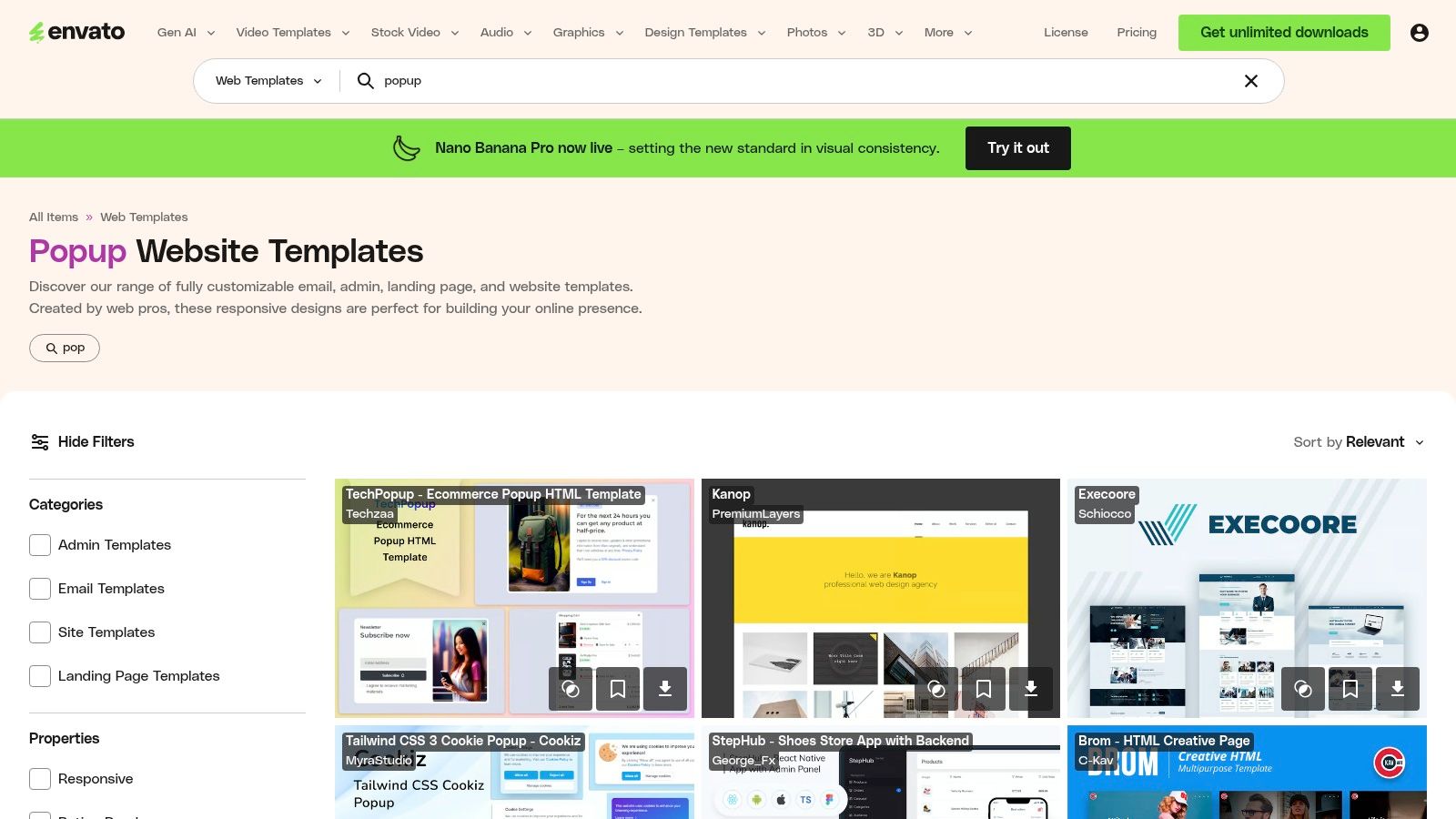
The platform stands out by offering unlimited downloads under a single commercial license, covering everything from WordPress plugins to Figma design files and HTML/CSS templates. For an e-commerce brand with in-house design or development resources, this provides a cost-effective way to source foundational assets for pop-up ad examples. You can find a modern, conversion-focused design and then customize its code or visual elements to perfectly match your brand's aesthetic and campaign goals.
Envato Elements empowers brands to bypass the design limitations of some pop-up builders by starting with professionally crafted assets. This is ideal for executing a unique vision without building from scratch, saving significant development time and cost.
Actionable Takeaway: For Shopify merchants with technical resources, download a well-designed HTML/CSS pop-up template from Envato. Implement it as a custom section in your Shopify theme. This gives you complete control over branding and allows you to integrate directly with Klaviyo's API for more sophisticated segmentation without being limited by a third-party app's visual builder.
| Pros | Cons |
|---|---|
| Extensive Asset Variety: Source templates, code, plugins, and design files. | Implementation Required: Assets must be manually integrated into your site. |
| Cost-Effective Subscription: Unlimited downloads for a flat monthly fee. | Varying Quality: Asset quality and support can differ between authors. |
| Full Creative Control: Templates are fully customizable to match your brand. | Active Subscription Needed: You must maintain a subscription to license new items. |
Website: https://elements.envato.com/web-templates/popup
Pricing: An individual plan costs $16.50/month (billed annually) for unlimited downloads of all creative assets. Team and enterprise plans are also available.
| Product | Implementation complexity | Resource requirements | Expected outcomes | Ideal use cases | Key advantages |
|---|---|---|---|---|---|
| Quikly | Low on Shopify (no‑code); moderate off‑platform | Minimal for typical merchants; enterprise may need professional support | Faster purchase velocity; reported ~+32% revenue lift and strong email/SMS acquisition | Shopify retailers running urgency-driven drops, countdowns and scarcity campaigns | Specialized urgency tactics, fast templated launches, advanced segmentation and recommendations |
| OptinMonster | Low to moderate (templates + visual builder) | Marketer-friendly setup; impression caps on lower plans | Improved lead capture and on-site conversions depending on setup | Marketers wanting a large popup/template library and quick CRO experiments | Extensive template gallery, behavior targeting, A/B testing and impression-based pricing |
| ConvertFlow | Low for design/preview; moderate to publish | Free preview flow; paid plans with traffic-based pricing | End-to-end funnel conversions; good for prototyping and scaling | Teams building multi-step funnels and seeking stakeholder review before launch | Free preview, broad template inventory, multi-site and funnel support |
| Sleeknote | Low (drag-and-drop, mobile editing) | Session/visitor pricing; trial available | Ecommerce growth use cases like cart recovery and list building | Ecommerce teams wanting modern aesthetics and multistep/gamified popups | Curated templates, practical setup guides, native multistep and gamified support |
| Wisepops | Low–moderate (no‑code builder) | Traffic-based plans; pricing often via sales | Conversion-focused outcomes with strong analytics and revenue tracking | Conversion-focused ecommerce teams needing analytics and varied popup types | Updated gallery/UI, strong documentation, revenue attribution and targeting |
| PageFlows | Not an implementation tool (research-only) | Subscription for access; no deployment features | UX and competitive insights; inspiration for safer interruptive patterns | UX researchers and product teams studying real user flows and modals | Massive annotated library of videos/screenshots and powerful search/filtering |
| Envato Elements | Higher — requires manual integration of downloaded assets | Subscription for unlimited downloads; developer/designer time to adapt | Custom visual/code assets enabling tailored popups (outcome depends on implementation) | Teams needing reusable design/code assets, UI kits or WordPress/Elementor components | Broad marketplace of templates, UI kits and code under one commercial license |
Throughout this deep dive into high-performing pop-up ad examples, a clear pattern emerges: the most effective pop-ups are not mere interruptions. They are sophisticated, psychologically-driven interventions timed perfectly within the customer journey to enhance, not detract from, the shopping experience. We've moved beyond simple email capture to explore how urgency, scarcity, and exclusivity can transform a passive browser into an active, engaged buyer.
The examples from industry-leading tools like OptinMonster, ConvertFlow, and Sleeknote demonstrate the power of well-designed overlays. However, the core lesson is that the tool is only as powerful as the strategy behind it. A generic countdown timer pales in comparison to a behaviorally-triggered offer that understands a shopper's specific intent, whether they're about to abandon a cart or are showing interest in a high-value product category. This is the crucial distinction between basic pop-ups and a true urgency marketing framework.
To translate these examples into tangible revenue, it's essential to build a cohesive strategy rather than launching disconnected campaigns. The goal is to create a seamless sense of managed demand across your entire Shopify store, from homepage banners to checkout-intent pop-ups.
Key strategic pillars to implement now:
Selecting the right platform depends entirely on your business maturity and strategic goals.
Ultimately, the best pop-up ad examples are a means to an end: building a more profitable, engaging, and resilient e-commerce business. By applying these psychological principles and leveraging advanced automation, you can transform pop-ups from a necessary tool into your most powerful strategic asset.
Ready to move beyond basic pop-ups and implement a sophisticated urgency marketing strategy? Quikly orchestrates dynamic, revenue-driving "Moments" that leverage deep psychological triggers to motivate purchases without sacrificing brand integrity. See how top Shopify Plus merchants use Quikly to turn fleeting interest into predictable profit.