

ecommerce psychology
brand loyalty
best brand experiences
When you hear the phrase “web site pop up,” you likely picture an intrusive box demanding your email address. For many e-commerce merchants, they're seen as a tool for building a mailing list. But this view overlooks their true potential for driving significant revenue.
A pop-up is more than just a lead capture form. It's a strategic overlay window, a powerful tool designed to guide your customer’s journey and have a direct, measurable impact on your revenue and profit margins.
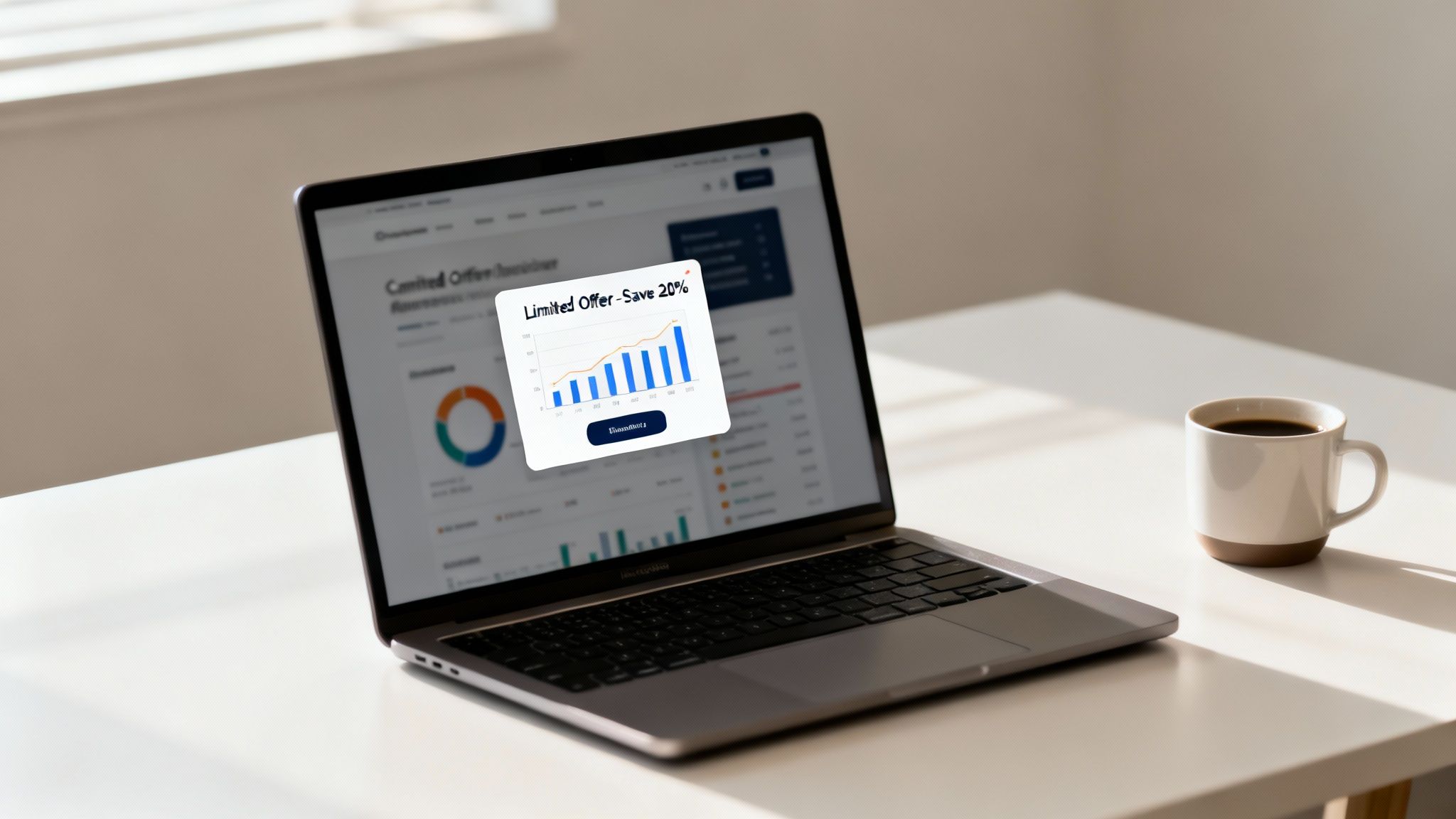
When you shift your focus from basic email capture to revenue generation, pop-ups transform into a core part of your sales and inventory management strategy. The goal is to present the right offer at the perfect moment—not just to make a sale, but to protect your profit margins and move inventory intelligently.
Consider the classic "10% off for your email" offer. It can build a list, but it also trains customers to wait for discounts, eroding margins. A modern pop-up strategy, grounded in behavioral science, is far more sophisticated. It uses advanced behavioral triggers to drive immediate action.
For example, the industry-wide cart abandonment rate is a staggering 70%. An exit-intent pop-up can deploy a compelling, last-minute offer to a shopper who’s about to leave. This isn't just about saving a sale; it's about deploying a targeted incentive to protect your bottom line and recover otherwise lost revenue.
The most effective pop-ups are not manipulative; they are grounded in established consumer psychology. They tap into powerful motivators like scarcity, anticipation, and social proof to build genuine excitement. A well-timed pop-up announcing a flash sale on a limited-quantity item does more than just advertise—it turns passive browsing into an engaging, urgent event. It creates a compelling reason to act now.
To fully grasp how pop-ups drive revenue, it's essential to see where they fit within the broader context of understanding digital marketing funnels. They serve as critical conversion points, nudging customers from consideration to purchase with targeted, psychologically-resonant offers.
The data confirms this potential.
Here's a quick look at what's possible when you move from a basic pop-up to a well-crafted, psychologically-informed strategy. The numbers show a massive gap between average performance and what top-tier campaigns achieve.
| Metric | Average Performance | Top 10% Performance |
|---|---|---|
| Visitor Conversion Rate | 4.65% | 22.02% |
As you can see, the average pop-up converts 4.65% of visitors. However, the top 10% of campaigns, those meticulously tested and optimized with behavioral triggers, achieve a stunning 22.02% conversion rate. That difference highlights the incredible revenue potential hiding in a sophisticated pop-up strategy.
What separates a pop-up that gets instantly closed from one that drives a sale? It’s not just design—it’s psychology.
The most effective pop-ups are carefully timed interventions that tap into the science of human decision-making. By understanding core principles of behavioral economics, you can craft offers that feel genuinely compelling, not manipulative. This is where urgency marketing, expertly applied by Quikly, evolves from a simple email capture tool into a powerful revenue driver.
A high-converting pop-up works with the brain's natural shortcuts and biases. This is about aligning your message with predictable human behaviors to make the shopping journey smoother and more exciting.
The most advanced pop-up strategies are built on behavioral science. Instead of a generic "10% off," they create dynamic moments that spark an immediate desire to act. These triggers are proven to influence purchasing decisions.
Many pop-up apps can place a simple countdown timer on your site, but this is a superficial tactic. It's a static tool in a dynamic, human environment.
True urgency marketing science, as leveraged in Quikly "Moments," applies these psychological triggers in a more sophisticated, automated way. It’s about crafting a unique, personalized experience for a specific shopper at a specific moment.
A basic timer tells a shopper when an offer ends. A psychologically-driven campaign makes them feel the urgency of the moment, connecting the offer directly to their immediate desire and potential loss.
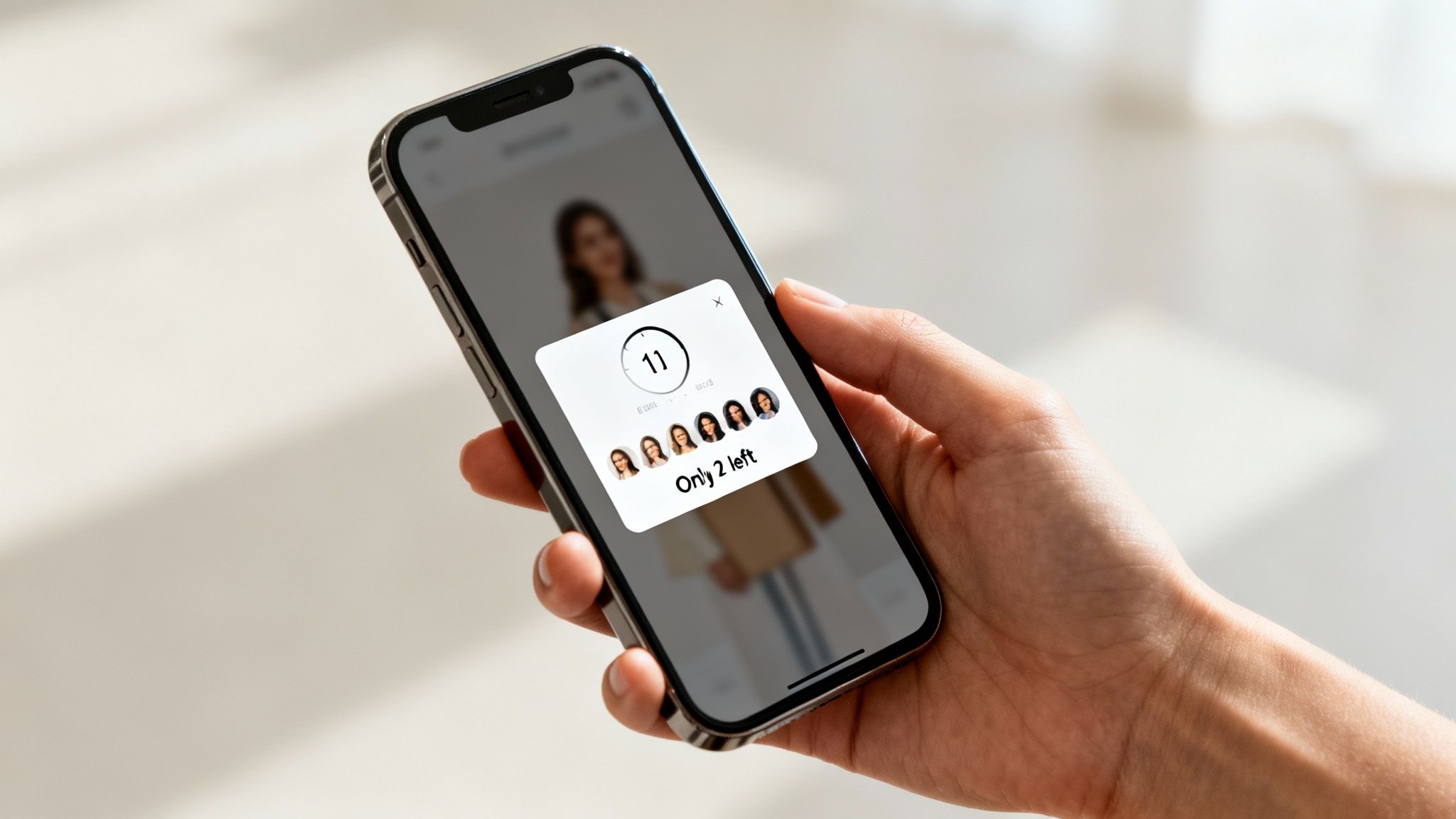
This is a significant leap from a simple discount. For example, instead of just a timer, an advanced system can trigger a pop-up showing how many other people are viewing the same limited-stock item in real-time. This tactic combines scarcity with live social proof, creating a multi-layered psychological nudge far more potent than a simple clock. The result is not just a better conversion rate but a direct boost to average order value and customer lifetime value.
Not all pop-ups are created equal. A generic website pop up focused on email capture is worlds away from a perfectly timed offer designed to secure an immediate sale. The key is understanding the different types and knowing when and how to deploy them to generate revenue.
Think of each pop-up as a specialized tool designed to tap into a different psychological trigger at critical moments of the shopper's journey. Your objective is to choose the right tool for the job—and that job is always to drive a positive financial outcome.
This is the classic pop-up that takes center stage, dimming the background to demand the user's full attention.
Also known as a flyout, the slide-in pop up is a more subtle alternative. It gently glides in from a screen corner, offering information without completely hijacking the browsing experience.
This is a powerful, last-chance effort. The pop-up appears only when a user's cursor movement indicates they are about to leave your site. It’s a final, targeted play to change their mind.
An exit-intent offer is your last line of defense against the industry's average 70% cart abandonment rate. It's not just about capturing an email; it's about saving a sale and recovering otherwise lost revenue.
Its primary function is to re-engage a departing visitor with a compelling reason to stay, such as a last-minute discount, a surprise free shipping offer, or a reminder of the items they're leaving behind.
This is where pop-ups become interactive and enjoyable. Gamified pop-ups, like a "spin-to-win" wheel or a digital scratch-off, transform a simple offer into an engaging game.
To make this actionable, let's map these pop-up types directly to the business goals they serve best. The key is to match the psychological trigger of the pop-up to the specific financial outcome you want to achieve.
| Pop Up Type | Primary Psychological Trigger | Best Use Case for Revenue | Example Implementation |
|---|---|---|---|
| Modal | Immediacy, Focus | Announce a site-wide flash sale to drive immediate purchases | A full-screen overlay appears on landing: "FLASH SALE: 25% Off Everything For The Next 2 Hours!" |
| Slide-in | Nudging, Suggestion | Cross-sell or upsell related items to increase Average Order Value (AOV) | A user adds a coffee maker to their cart, and a slide-in appears: "Don't forget the filters! Add for $5." |
| Exit-Intent | Urgency, Loss Aversion | Recover abandoned carts and convert hesitant shoppers | As a user with items in their cart moves to exit: "Wait! Complete your order now for free shipping." |
| Gamified | Anticipation, Reciprocity | Drive first-time purchases and capture SMS/email for future marketing | A "Spin to Win" wheel for new visitors offering discounts (10%, 15%, free gift) in exchange for an email. |
Ultimately, choosing the right pop-up comes down to understanding your customer's mindset and presenting an offer that feels helpful and timely, not disruptive. By aligning the format with a clear revenue goal, you transform a simple marketing tool into a powerful conversion engine.
A poorly designed pop-up is disruptive, annoying, and the fastest way to make a visitor leave. The most profitable pop-ups are those a customer barely notices until the exact moment it offers something they value.
The difference lies in execution. Effective pop-ups are built on solid User Experience design principles. A great offer is rendered useless if the delivery is clunky or confusing. The goal is to create a seamless interaction that enhances, rather than hinders, the shopping journey.
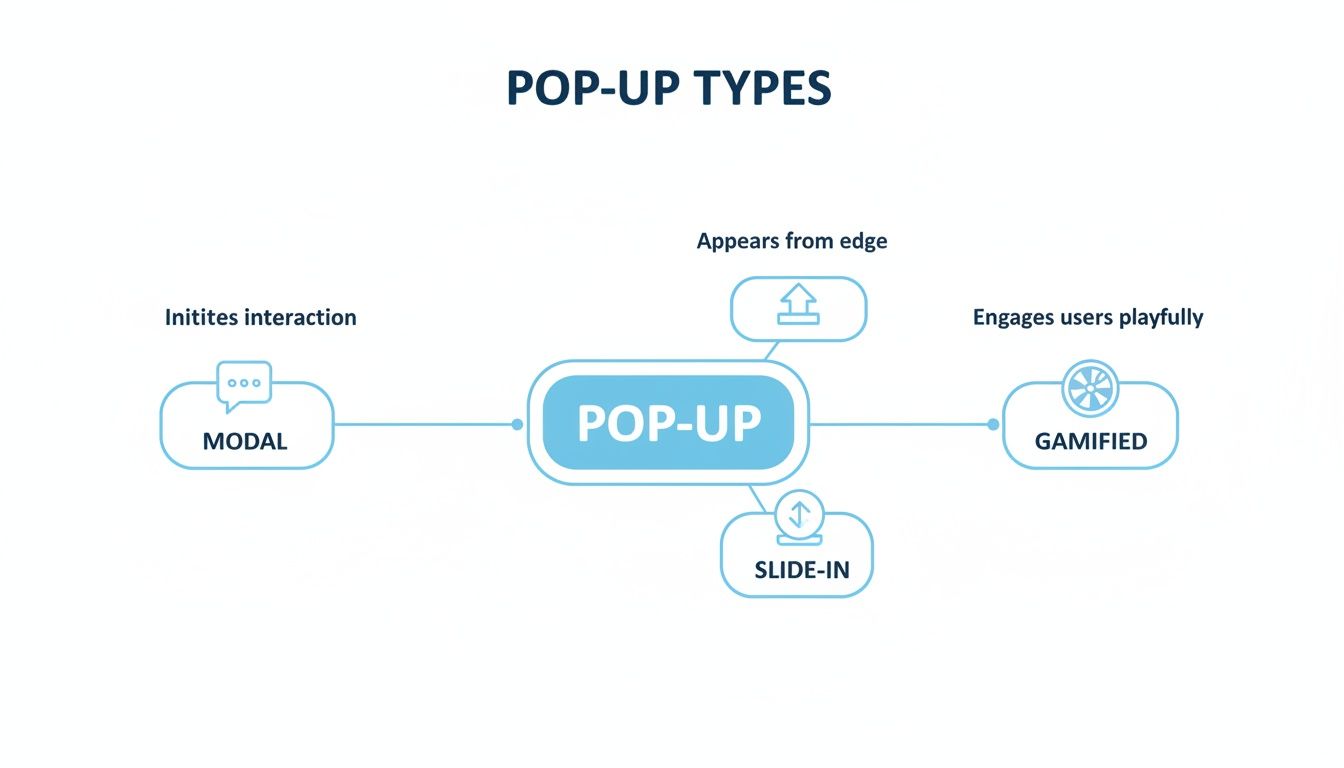
As you can see, each style—from the attention-grabbing Modal to the interactive Gamified wheel—serves a unique strategic purpose. The key is matching the right design to the right moment.
A confused mind always says no. One of the biggest mistakes merchants make is cramming too much into one pop-up. Your message must be understood in a split second, with a single, unmissable call-to-action (CTA).
If your goal is to drive an immediate sale with a limited-time discount, every element—headline, image, button—must support that one objective. Remove all clutter. No secondary links, no social media icons, no competing offers. This laser focus respects your customer’s attention and increases the likelihood they will take the desired action.
From a behavioral psychology perspective, decision fatigue is a real conversion killer. A pop-up with one clear choice ("Get 20% Off Now") is exponentially more powerful than one offering multiple, competing actions.
The majority of e-commerce traffic is on mobile. This means your pop-up must be designed for a small screen first. This includes large, easy-to-tap buttons, readable fonts, and an obvious, accessible close button (X). A pop-up that’s difficult to close on a phone creates immediate frustration and damages brand perception.
Beyond functionality, the pop-up must feel like a natural extension of your brand. Use the same fonts, color palette, and voice as the rest of your Shopify store. This consistency builds trust, making the pop-up feel like an integrated part of the shopping experience rather than a third-party advertisement. When it looks and feels native, shoppers are more receptive to the message.
Turning theory about psychology and design into revenue requires a solid implementation plan. In the fast-paced Shopify ecosystem, a successful pop-up strategy involves more than just installing an app. It's a focused cycle of planning, integrating your tools, and continuous optimization.
First, define a specific business goal. Instead of a vague objective like "get more subscribers," think in terms of tangible business impact. Are you trying to increase your Average Order Value (AOV) by 10%? Do you need to reduce a 70% cart abandonment rate? Or perhaps you need to clear out seasonal inventory. Your goal is the North Star for every pop-up you build and every psychological trigger you employ.
Your marketing tools cannot operate in silos. An effective pop-up strategy must integrate seamlessly with your core marketing platforms to create a unified customer experience. For Shopify and Shopify Plus merchants, this is critical.
This deep integration is precisely what advanced urgency marketing platforms like Quikly are designed for, ensuring the excitement generated in a pop-up is carried through to every other channel. For more details, explore our guide on creating powerful popups for Shopify.
Conversion rate is a useful metric, but it’s only part of the story. To truly understand the ROI of your pop-ups, you must track metrics that tie directly to profit and growth.
Measuring only email sign-ups is like judging a car's performance by its paint color. True success is found in metrics that track revenue, profitability, and customer value.
Keep your focus on these key performance indicators (KPIs):
By continuously A/B testing offers, copy, and designs—while tracking these core financial metrics—you eliminate guesswork and transform your pop-up strategy into a predictable, high-return revenue engine.
Most pop-up apps offer a static solution for a dynamic problem. They show the same generic “10% off for your email” offer to every visitor, focusing on the low-impact goal of email capture instead of the high-impact goal of driving immediate revenue.
A truly effective web site pop up strategy must move beyond these limitations.
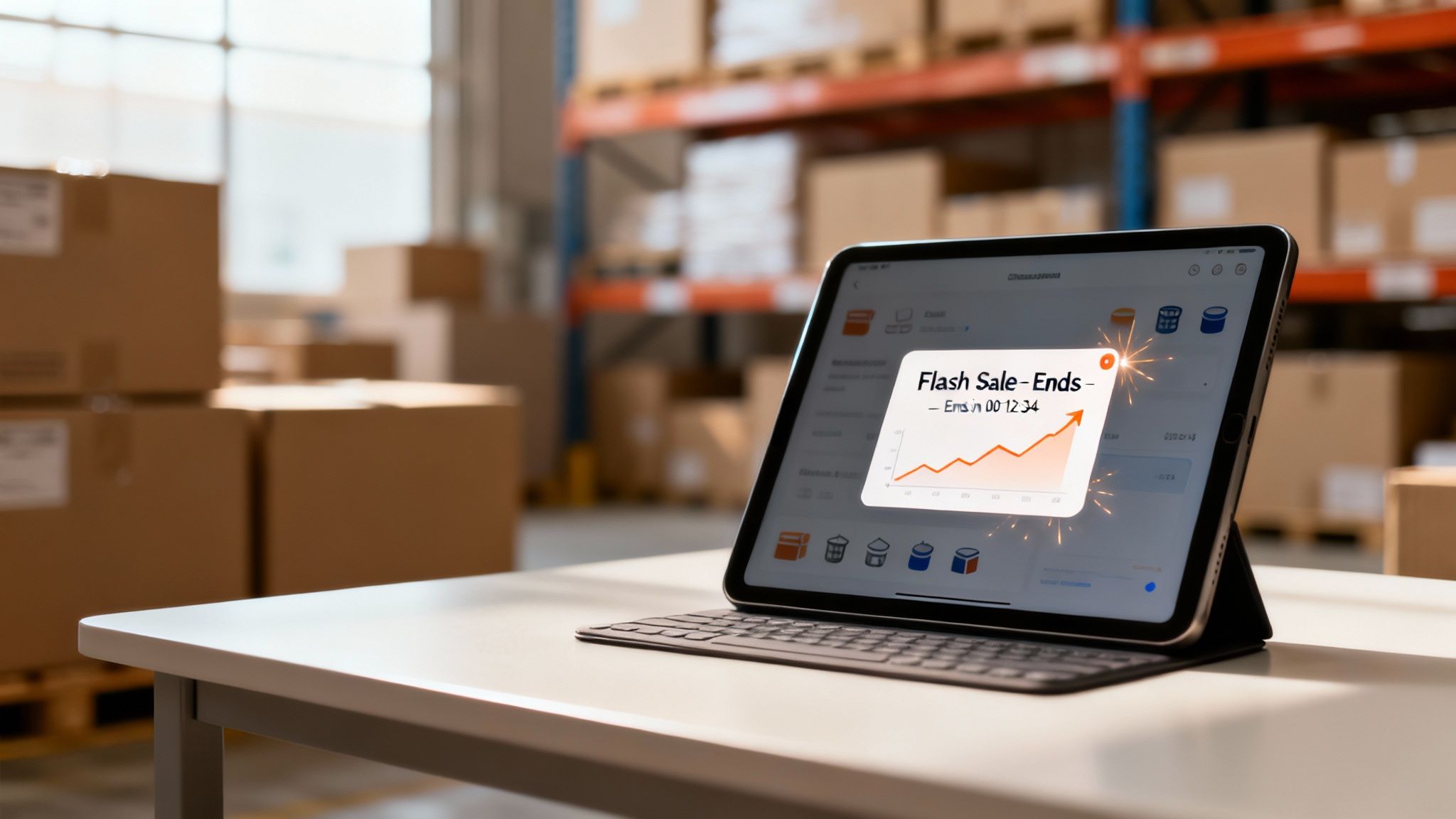
This requires a shift from manual campaign management to intelligent, responsive automation. Instead of setting a simple timer and hoping for the best, an advanced platform reacts to individual shopper behavior in real time, turning a passive browsing session into an engaging, high-energy sales event.
This is where the concept of a Quikly Moment fundamentally changes the game. It’s not just another overlay; it’s a behaviorally-triggered micro-campaign engineered from the ground up to drive a burst of revenue in a short window.
These moments are built around the powerful psychological principles of scarcity and social proof, creating a genuine sense of excitement that feels authentic, not forced.
For instance, instead of a standard exit-intent offer, a Quikly Moment can:
By tying together all the concepts of behavioral economics and targeted engagement, this advanced strategy elevates the pop-up from a simple list-building tool into a sophisticated engine for maximizing revenue, protecting profit margins, and managing inventory with precision.
This is the fundamental difference between legacy pop-up tactics and the science of modern urgency marketing. The goal isn't just to capture an email; it’s to create a compelling, undeniable reason for a customer to buy now.
By focusing squarely on driving immediate financial results, this approach transforms the humble pop-up into one of your most powerful conversion assets.
Let's address some of the most common questions merchants have about using pop-ups. The goal is to provide clear, actionable answers that help you boost revenue while maintaining a positive user experience.
This is a primary concern for many merchants. The short answer is no, provided you implement them correctly.
Google's main issue is with intrusive, full-screen pop-ups that block content immediately upon a user's arrival from search results, especially on mobile. This creates a poor user experience, which Google penalizes.
To remain SEO-friendly, ensure your pop-ups are easy to close, do not obstruct the entire screen on page load, and provide genuine value. Pop-ups triggered by user actions—such as exit-intent or after a period of browsing—are generally considered safe and are among the most effective types.
The key is to shift your mindset from interruption to helpful, timely engagement. This involves moving beyond generic offers to deliver relevance.
While they may look similar, their core purpose and impact on your bottom line are vastly different.
A standard email pop-up is designed for lead capture. Its success is measured by the number of email addresses acquired, typically in exchange for a future discount or newsletter subscription. It's a long-term list-building play.
A revenue-focused pop-up is built to drive a sale right now. Its success is measured in dollars, not sign-ups. Think about a pop-up with a live countdown for a flash sale, or one showing how many people are buying a hot item. These use urgency and social proof to boost conversion rates and average order value within the current visit.
This strategic shift turns the pop-up from a simple list-building tool into a powerful, real-time sales generator.
Ready to stop collecting emails and start driving sales? Quikly is built on the science of urgency marketing, creating dynamic sales events that turn casual browsers into immediate buyers. Discover how Quikly can completely change your e-commerce strategy.