

ecommerce conversion
customer experience strategy
digital customer experiences
For years, the open rate was the gold standard, the North Star for every email campaign. But the game has changed.
Today, getting someone to open your email is less about tracking a vanity metric and more about building genuine, can't-wait-to-see-what's-inside anticipation. The goal isn't just to be seen; it's to make opening your email an intentional choice—a small, satisfying event in your subscriber's day that directly impacts your bottom line.
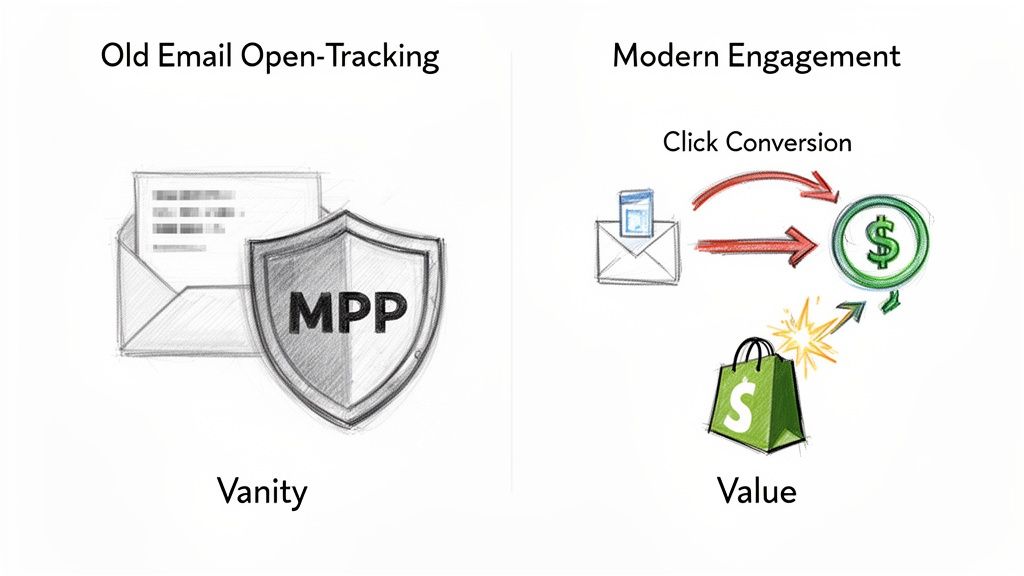
The old way of measuring email success is officially broken. That shiny open rate we all obsessed over? It’s been rendered almost useless by privacy-first shifts, especially Apple's Mail Privacy Protection (MPP). By pre-loading email content behind the scenes, MPP artificially inflates open counts, turning a once-reliable metric into a ghost.
This isn't a small tweak; it's one of the biggest shake-ups in digital marketing performance we've seen. Back in 2022, a healthy average open rate hovered around 48.69%. Fast forward to 2025, and that number is projected to plummet to just 26.9%—a staggering 45% drop in only three years.
For savvy Shopify merchants, this isn't bad news. It's a massive strategic opportunity. It forces us to stop chasing vanity metrics and start focusing on what actually moves the needle: engagement signals that directly tie to revenue and profit.
It's time to pivot. Instead of obsessing over a potentially fake open rate, your energy is better spent on metrics that prove genuine interest and purchase intent. This is where the sharpest e-commerce brands are finding their edge.
Here’s what you should be tracking now:
Of course, email is just one piece of the puzzle. It works best when integrated with other essential ecommerce growth strategies that help you scale your brand.
The modern challenge isn't just getting your email opened; it's about earning the click. This requires a fundamental shift from simply grabbing attention to building tangible value and anticipation from the moment a subscriber sees your name in their inbox.
This shift in focus is critical for any e-commerce brand that wants to thrive in a privacy-first world. The old playbook is obsolete.
This table breaks down how the priorities for e-commerce brands have fundamentally changed.
| Focus Area | Old Approach (Pre-MPP) | New Strategic Approach (Post-MPP) |
|---|---|---|
| Primary KPI | Open Rate | Click-Through Rate (CTR) & Conversion Rate |
| Success Indicator | High open counts (even if passive) | Active engagement (clicks, purchases) |
| Subscriber Value | Measured by list size & open activity | Measured by lifetime value & purchase frequency |
| Content Strategy | Optimized for attention-grabbing opens | Optimized for compelling calls-to-action |
| Goal | Get the email opened | Earn the click and drive revenue |
The takeaway is clear: we’ve moved from a world of passive opens to one that demands active, intentional engagement.
Now, even though we can't track it reliably, getting a subscriber to actually open your email is more crucial than ever. It's the gateway to everything else—the click, the conversion, the revenue.
Improving your true open rate today isn't about gaming a tracking pixel. It's about applying sophisticated consumer psychology.
This guide is your playbook for doing just that. We'll go way beyond basic countdown timers and dive into the behavioral triggers that protect your margins, manage inventory, and drive predictable revenue. You're about to learn why building anticipation is the new cornerstone of a winning email strategy.
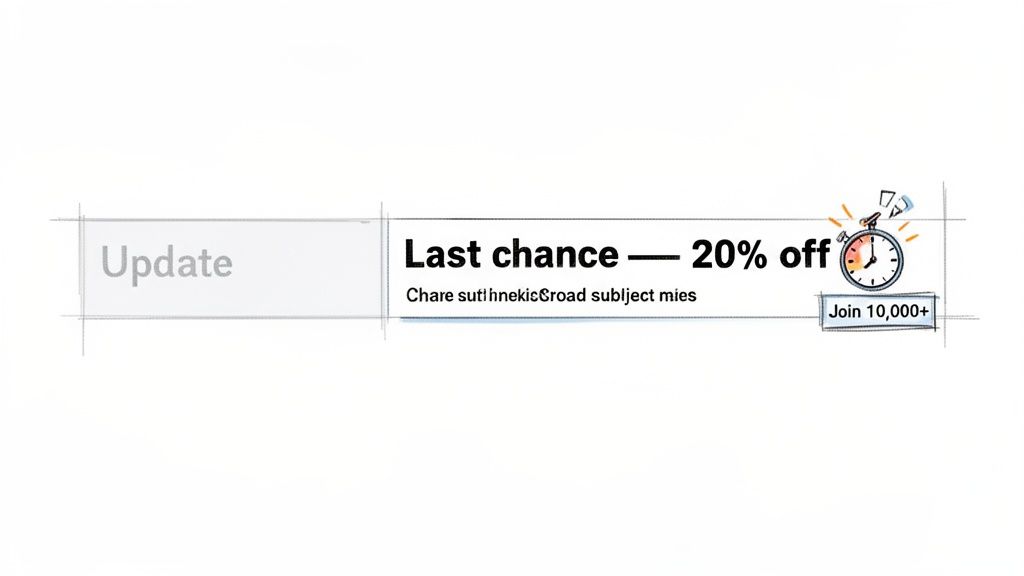
Your subject line is the most important piece of real estate in your entire email. It’s the gatekeeper. It’s the one thing that determines whether your message gets opened or tossed into the digital trash bin, directly impacting your revenue.
In a sea of overflowing inboxes, a passive, uninspired subject line like "New Products Available" is a death sentence. To drive action, you need to dig into the fundamentals of consumer psychology.
This isn’t about manipulation; it's about understanding what makes people act. We’re talking about proven principles from behavioral economics like loss aversion—the concept that the pain of losing something is twice as powerful as the pleasure of gaining it. It’s why a subject line framed as "Your last chance for 20% off" will almost always outperform "Get 20% off today." One creates a sense of dread and urgency, while the other is just another forgettable offer.
The most successful brands don't just announce sales; they create events. They build their entire subject line strategy around scientifically-backed behavioral triggers, moving beyond a simple countdown timer and into campaigns that generate genuine buzz.
Let's break down the core psychological drivers you can use to start improving email open rates right away:
Your goal is to make opening your email feel like an opportunity, not an obligation. Frame your message around what the subscriber stands to gain—or, even better, what they stand to lose. You’ll shift the entire dynamic from a passive announcement to a compelling call to action.
The difference between a subject line that gets ignored and one that drives revenue can be subtle, but it’s profound. It’s about shifting from passive to active, from generic to specific, and from purely informational to deeply emotional.
Take a look at these transformations:
| Weak (Passive & Generic) | Strong (Psychology-Driven & Actionable) | Psychological Principle |
|---|---|---|
| "Our Summer Sale is Here" | "It's now or never: Summer Sale ends tonight" | Loss Aversion & Urgency |
| "New Arrivals This Week" | "Psst... your exclusive first look is inside" | Exclusivity & Curiosity |
| "Check Out Our Best-Sellers" | "What 5,000+ shoppers are raving about..." | Social Proof |
| "Don't Forget Your Items" | "Your cart is about to expire (and so is your offer)" | Urgency & Scarcity |
See the difference? The strong examples create immediate emotional context. They don’t just state a fact; they imply an urgent outcome.
The preheader, that little snippet of preview text next to your subject line, is your secret weapon. So many brands waste this space with "View this email in your browser," and it's a massive missed opportunity.
Think of the preheader as your subject line's wingman. It’s there to complete the thought and provide that final nudge to open.
For example:
Subject Line: A special treat just for you...
Preheader: ...because we think you deserve it. Don't wait, it's for a limited time!
This one-two punch is far more effective than a subject line on its own. If you want to inject even more personality, our guide on funny email subject lines has some creative ideas to help you stand out.
Sending the same email to every single person on your list is a recipe for disaster. It’s the classic “batch and blast” approach, and it’s the fastest way to kill your engagement, annoy your customers, and leave money on the table. This strategy treats everyone the same, completely ignoring their unique behaviors and preferences.
If you’re serious about improving your email open rates, it's time to move beyond one giant list and get smart with hyper-segmentation.
This isn't just about splitting new subscribers from existing customers. We're talking about a sophisticated strategy that uses real customer data to create dynamic audiences. When you do this right, your marketing stops feeling like a generic broadcast and starts feeling like a one-on-one conversation. That personal touch is what gets your emails opened and drives revenue.
If you're a Shopify merchant, you're sitting on a goldmine of customer data. Instead of just lumping everyone together, you can build powerful segments based on how people actually interact with your brand. The trick is to connect your Shopify store data with a capable email service provider, like Klaviyo, which makes this kind of deep, automated segmentation possible and integrates seamlessly with SMS platforms.
You can start by focusing on a few core pillars of behavior-driven segmentation:
When you tailor your messages to these specific groups, the relevance skyrockets. It just makes sense: an email about a new line of running shoes is going to get a much better response from someone who bought running gear last month than from someone who only bought a winter coat.
The real magic happens when you start combining these data points to create more nuanced, high-impact segments. By using Shopify customer tags along with your email platform, you can put this entire process on autopilot.
Here are a few powerful segment examples you could build right now:
| Segment Name | Definition | Campaign Idea |
|---|---|---|
| High-Potential VIPs | Customers with >3 purchases AND have spent >$500 total. | Give them exclusive early access to a new product drop. Frame it as a special reward just for them. |
| At-Risk Customers | Purchased once, but not again in the last 90 days. | Send a simple "We miss you" campaign with a compelling, limited-time offer to bring them back. |
| Category Enthusiasts | Viewed a specific category (e.g., "Dresses") 3+ times in the last 30 days but haven't bought. | Hit them with an email showcasing best-sellers from that exact category, maybe with some social proof. |
| Discount Shoppers | Customers who have only ever purchased using a discount code. | Instead of sitewide sales, target them with campaigns focused on product bundles or other value-adds to protect profit margins. |
These examples underscore a crucial business principle: not all customers are created equal. By focusing your best offers on the segments most likely to respond, you protect your margins and get a much better return on your efforts. For more inspiration, check out our guide on actionable customer segmentation examples.
Getting this granular might seem like a lot of work, but the results speak for themselves. Generic, one-size-fits-all campaigns lead to list fatigue and unsubscribes. Segmented campaigns, on the other hand, feel genuinely helpful and relevant, strengthening your customer relationships with every email you send.
Advanced segmentation is the difference between shouting at a crowd and whispering a secret to a friend. The first is noise; the second creates a powerful, personal connection that drives immediate action.
The data backs this up. For Shopify stores, segmentation isn't just a nice-to-have; it's essential for staying competitive. Campaigns sent to smaller, targeted lists consistently outperform massive email blasts. For instance, single-email automations can hit an impressive 28.52% click-to-open rate, while campaigns sent to smaller lists (under 500 contacts) see rates around 14.72%. It’s clear proof that a targeted, personal approach wins every time.
Ultimately, smart segmentation transforms your email marketing from a guessing game into a predictable revenue driver. When you deliver the right message to the right person at the right time, you’re not just improving open rates—you’re building a more profitable, resilient business.
Your automated email flows are the quiet workhorses of your marketing strategy. I'm talking about the set-it-and-forget-it sequences—especially the welcome series and abandoned cart flows. We tend to pour all our energy into shiny, one-off campaigns, but these automated beasts are often our most profitable assets, silently driving a huge chunk of revenue.
The goal here isn't just to make a few small tweaks. It’s about completely rethinking what these flows are for. We need to move them from being simple notification systems to sophisticated, psychology-driven revenue engines. When you get this right, these flows build real brand affinity, claw back lost sales, and generate predictable income with almost no ongoing effort.
Those first few days after someone subscribes are everything. This is your one shot to make a lasting impression, build a connection, and gently guide them toward that all-important first purchase. A generic "Thanks for signing up" email just isn't going to cut it anymore.
Your welcome series needs to be a multi-step journey that tells your brand's story, provides instant value, and creates a compelling reason to buy now.
The secret is blending brand storytelling with a gentle nudge toward conversion. The first email should be a warm welcome that confirms their subscription and sets the stage for what’s to come. From there, you can introduce your brand’s mission, showcase best-selling products backed by social proof, and finally, drop a well-timed introductory offer.
A powerful welcome series doesn't just sell a product; it sells the customer on the idea of your brand. It makes them feel like an insider from day one, transforming a transactional relationship into a personal one.
This approach pays off—big time. Welcome and abandoned cart emails are consistently the top performers in the email marketing world. Welcome emails see jaw-dropping engagement, with average open rates hitting 68.59%. At the same time, abandoned cart emails are a goldmine, with open rates hovering around 49%. For any brand using urgency in their marketing, these high engagement rates are a massive opportunity to layer in time-sensitive messaging and watch conversions climb.
This simple, three-step process is how you turn raw customer data into personalized emails people actually want to open.
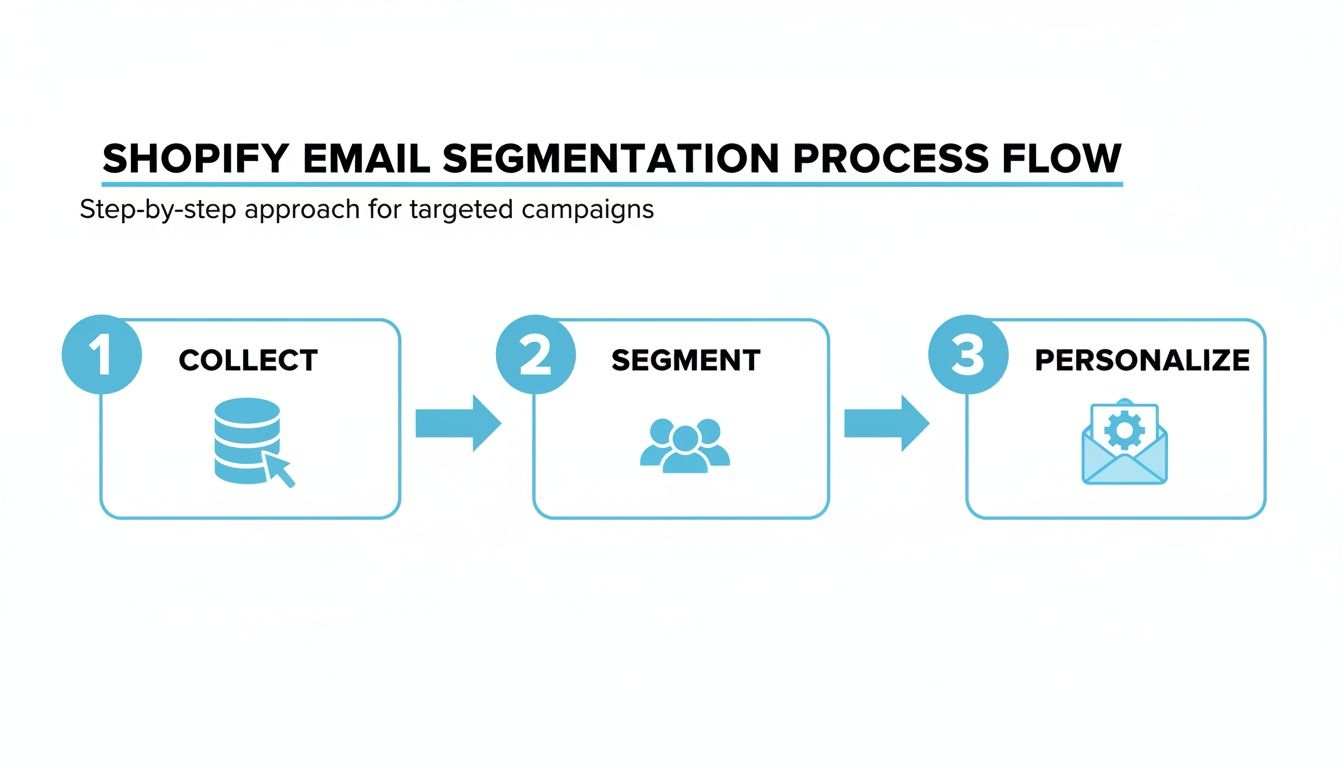
By collecting behavioral data, sorting your audience into meaningful groups, and personalizing your automated flows, you create messages that feel like they were written just for that one shopper.
The average cart abandonment rate is a painful 70%. Think about that. These aren't just lost sales; they're flashing red lights indicating high purchase intent that got derailed. A basic "You left something behind" email is a start, but it leaves so much money on the table. If you want to learn How to Reduce Cart Abandonment and Win Back Sales, optimizing this flow is non-negotiable.
An advanced abandoned cart flow is a masterclass in applied psychology. It's not just a reminder—it's a strategic sequence designed to dismantle hesitation and create a powerful incentive to finish the purchase right now. This is where a platform like Quikly can be a game-changer, turning a passive notification into an active conversion event. Instead of a generic poke, you can embed a dynamic, limited-time offer right in the email, tapping into the powerful psychological trigger of loss aversion.
Here's a look at how a basic abandoned cart email stacks up against a more advanced, psychology-driven flow designed for maximum revenue recovery.
| Element | Basic Approach | Advanced (High-ROI) Approach |
|---|---|---|
| First Email (1 Hour) | "Forgot something?" with a link back to the cart. | "Your cart is waiting (and so is a special offer)." Includes social proof like "over 5,000 shoppers love this item!" |
| Second Email (24 Hours) | A simple restatement of the first email. | "Your items are selling out fast." Introduces scarcity and urgency with a dynamic countdown timer for a limited discount. |
| Third Email (48 Hours) | "Last chance to buy." | "Final notice: Your cart and exclusive offer expire in 3 hours." This email leverages loss aversion by emphasizing the expiring discount. |
This advanced sequence does more than just remind someone; it builds a compelling story of scarcity, social proof, and urgency. By integrating sophisticated automation, like Quikly’s "Moments," you can go way beyond a simple timer. You’re creating a must-act-now event that feels exclusive and important, driving immediate action and seriously boosting your recovery rate.
For more inspiration, check out our deep dive into other abandoned cart email examples to see how top brands are winning back sales.
You can write the most brilliant, persuasive email in the world, with a subject line so good it could sell ice to a penguin, but it’s completely worthless if it never lands in the inbox.
Email deliverability is the unsung hero of a successful marketing program. Too often, merchants only pay attention to it when their open rates suddenly tank. For Shopify stores, thinking of deliverability as just some technical chore is a huge mistake. It’s the very foundation that determines whether your emails make you money or just get lost in the digital void.
Think of it like this: your sender reputation is basically a credit score for your domain. Every single time you hit "send," inbox providers like Gmail and Outlook are judging you. A good reputation gets you the VIP treatment—a direct flight to the primary inbox. A bad one gets you flagged, throttled, or even blacklisted, effectively shutting down one of your most important revenue channels.
A solid sender reputation isn't built overnight. It’s the result of consistent, healthy sending habits. But before you can even get there, three technical protocols are non-negotiable for proving you're a legitimate sender and not some spammer spoofing a domain.
These are the core authentication standards you absolutely must have in place:
Getting these right is table stakes. Without them, you're basically signaling to Gmail and others that you don’t take email security seriously, which makes it incredibly easy for them to just mark your campaigns as suspicious.
Beyond the technical setup, the health of your email list is the single biggest factor influencing your sender reputation. If you’re constantly sending emails to inactive or invalid addresses, you’re sending a massive signal to inbox providers that you aren't paying attention to engagement—a classic spammer move.
This directly poisons your reputation and throttles the delivery of all your emails, even the ones going to your most loyal, ready-to-buy customers.
Neglecting list hygiene is like trying to grow a garden full of weeds. Eventually, the weeds choke out the healthy plants. A bloated, unengaged list actively hurts your ability to reach the subscribers who actually want to hear from you and are ready to buy.
This isn't just about watching your open rates dip; it's about real, tangible lost revenue. A poor reputation means your high-impact abandoned cart flows and welcome series discounts might never even get seen, crippling some of your most profitable automations.
To protect your revenue, you have to be proactive about list health. A quick audit can uncover major issues before they do permanent damage to your sender score. You can start with these steps today.
A sunset policy is simply an automated rule that weeds out unengaged subscribers from your active list. For instance, you can create a segment of everyone who hasn't opened or clicked an email in the last 90 or 120 days.
But don't just delete them right away. First, send them through a final re-engagement or "win-back" campaign. A simple, two-email sequence with a compelling offer can sometimes bring them back from the brink. If they still don’t engage, it's time to say goodbye and suppress them from future sends. Removing these contacts will almost always cause your open rates to jump because you're finally sending to an audience that's actually listening.
Use an email verification service to scrub your list of invalid, misspelled, or fake email addresses. This is especially important if you collect emails through pop-ups or at in-person events where typos are bound to happen.
Doing this quarterly will dramatically reduce your bounce rate, which is a critical metric that inbox providers watch like a hawk. A high bounce rate is a huge red flag that screams "unhealthy list" and will absolutely torpedo your deliverability.
By mastering these deliverability fundamentals, you’ll shift from just sending emails to strategically ensuring they arrive. This protects your sender reputation and maximizes the ROI of every single campaign you run.
When you're deep in the trenches of email marketing, a lot of questions can bubble up, especially for Shopify merchants trying to connect every campaign to actual business results. Let's tackle some of the most common hurdles you'll face when you're working to get more of your emails opened and acted on.
The goal here is simple: give you the insights you need to put these psychology-driven strategies to work and see a real bump in your performance, right away.
This is a tricky one. Defining a "good" open rate isn't as clear-cut as it used to be, mostly thanks to Apple's Mail Privacy Protection (MPP). While you might see industry averages floating around 20-25%, you should really treat that number as a loose benchmark, not a hard measure of success.
For Shopify merchants, the metric that tells a much richer story is the click-to-open rate (CTOR). This number compares your unique clicks to your unique opens, giving you a much sharper picture of how engaging your content really is. A healthy CTOR is typically somewhere in the 10-15% range.
Your real focus shouldn't be on chasing a specific open rate. Instead, aim for steady improvement in the metrics that actually drive revenue, like click-through rates and, ultimately, conversions from your emails.
If you see your open rates take a nosedive out of nowhere, there's a good chance you're landing in the spam folder. Nine times out of ten, this is a deliverability problem tied directly to your sender reputation.
A few usual suspects are often to blame:
Keeping a close eye on these things isn't just a technical chore; it's fundamental to protecting your revenue stream. A bad sender reputation can cripple the performance of all your email campaigns, even your most profitable automated flows.
This is a fantastic question, and the distinction is critical. A basic countdown timer puts a generic clock on an offer, but it often lacks the psychological punch needed to drive real action. True urgency marketing—the science that Quikly is built on—is a whole different ballgame.
It moves far beyond a simple timer by weaving in proven behavioral triggers:
This approach transforms a standard promotion into a compelling, can't-miss event. Unlike a basic pop-up just trying to capture an email, this advanced strategy is designed to generate immediate revenue and move inventory without killing your profit margins. It elevates urgency from a simple tactic to a core part of your revenue strategy.
Ready to turn your email campaigns into high-performing revenue engines? See how Quikly uses the science of urgency marketing to create can't-miss moments that drive immediate action and boost your bottom line. Discover Quikly's solutions.