

ecommerce psychology
brand loyalty
best brand experiences
If you want to grow your e-commerce brand, the formula for driving revenue and protecting profit margins is simple: get customers to buy more often, spend more when they do, and stick around for longer.
This represents a strategic shift from chasing one-off sales to building profitable, long-term relationships. You achieve this through deep personalization, a superior post-purchase experience, and intelligent retention marketing grounded in consumer psychology.
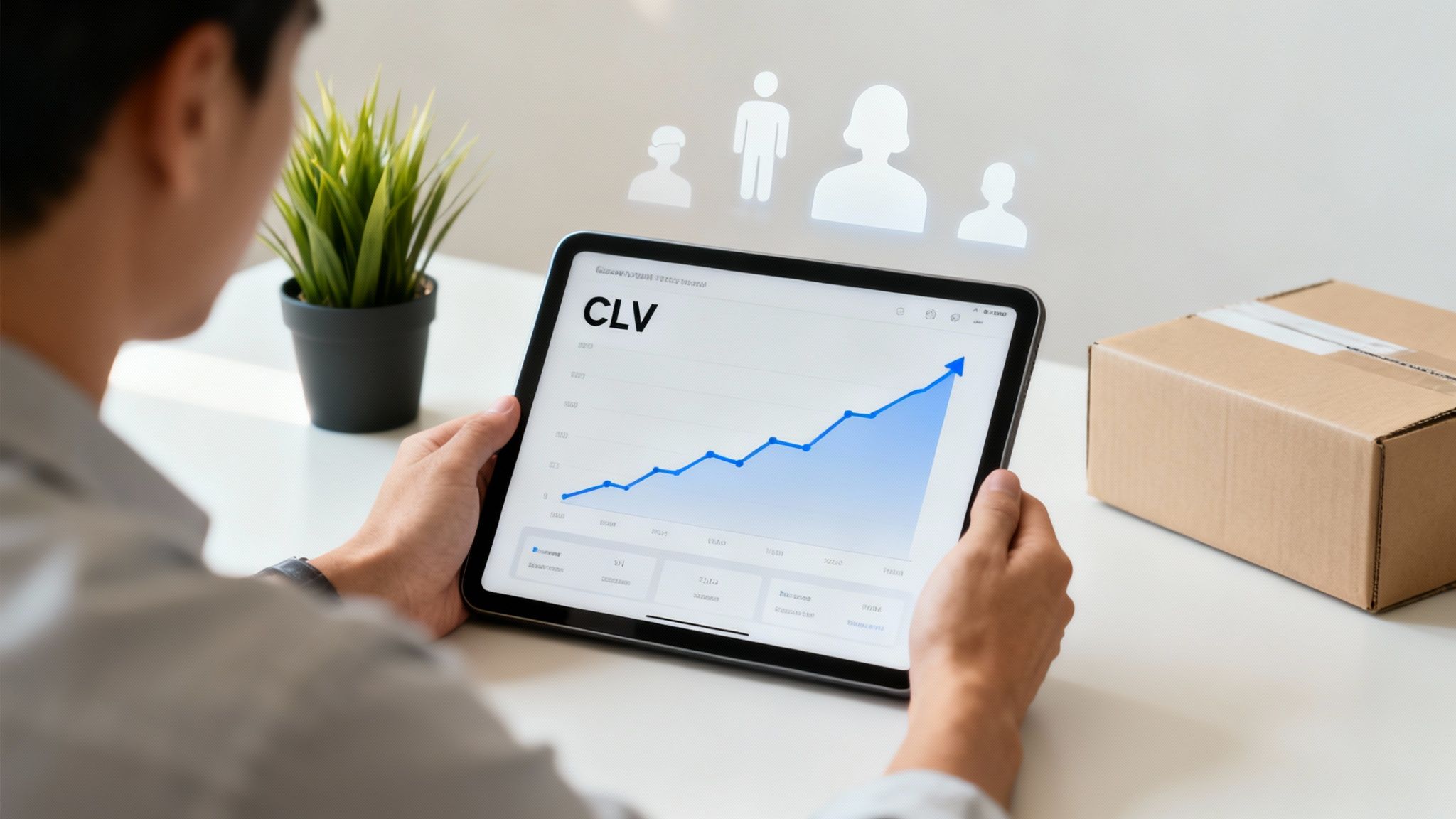
Metrics like conversion rate and traffic are important, but they don't provide the complete financial picture. Customer Lifetime Value (CLV) is the true north star for sustainable growth. It’s the total profit you can realistically expect to generate from a single customer over their entire relationship with your brand.
When you start focusing on CLV, it changes everything.
You stop pouring all your cash into the top of the funnel, desperately trying to acquire new people—a game of diminishing returns with rising ad costs. Instead, you invest in the customers you’ve already won over. This one pivot can completely transform your bottom line and ROI.
A high CLV is more than a vanity metric; it’s a sign of a genuinely healthy, profitable business. Brands that prioritize CLV stop thinking transactionally and start building a resilient engine for revenue.
Here’s why it has such a significant business impact:
When you focus on CLV, the central question shifts from, "How do we make this one sale?" to "How do we build a relationship that leads to many sales?" That long-term view is what separates the good Shopify stores from the great ones.
Ultimately, driving up CLV is all about applied consumer psychology. You have to understand what makes people tick—what fosters loyalty and makes them want to buy from you again. This is where the science of urgency marketing comes into play.
By understanding behavioral economics principles like reciprocity (rewarding loyal customers), anticipation (building excitement for what's next), and social proof (making them feel like part of an exclusive group), you can create powerful marketing moments. These aren't just buzzwords; they're the psychological levers you can pull to increase engagement and repeat purchases.
This guide is your playbook for turning those ideas into real-world tactics. And for a deeper dive, check out these 5 proven tactics to increase customer lifetime value. We'll get into everything from smart segmentation to using sophisticated urgency to create a brand that people can't help but come back to.
Moving from theory to practice is where you really start to see the power of Customer Lifetime Value. It's one thing to think about CLV, but calculating and acting on it is how you unearth hidden revenue streams. For Shopify merchants, the good news is all the data you need is already sitting in your analytics dashboards.
You don't need a PhD in data science to get started. At its core, you're just trying to understand three fundamental levers:
Multiply those three together, and you've got a solid, foundational CLV. Think of this number as your baseline—a benchmark you can work to improve with every strategic move you make. If you want to go deeper on the numbers, check out this a complete guide to calculating CLV that really breaks down the variables.
Figuring out your store-wide CLV is step one. The real magic, though, happens when you start segmenting your customers into distinct groups based on how they shop. This is how you stop shouting into the void and start having targeted, meaningful conversations that drive revenue.
A one-size-fits-all approach to retention just doesn't cut it. A customer who has bought from you ten times in the last year needs a completely different message than someone who bought once six months ago and vanished. Segmentation turns CLV from a historical metric into a predictive tool for driving future sales.
Start thinking about your customer base in tiers. Here are a few essential segments every Shopify store should be using:
By grouping customers this way, you can tailor your marketing with surgical precision. This is the shift from generic email blasts to sophisticated, psychology-driven campaigns that actually get results.
Once you've got your segments dialed in, you can build specific plays designed to resonate with each group's unique behavior and mindset.
For your VIPs:
The name of the game here is retention and advocacy, not aggressive selling. These people already love you. Your job is to make them feel seen and appreciated, which taps right into the psychological principle of reciprocity.
For Promising Newcomers:
Here, the single most important goal is to lock in that second purchase. That post-purchase window is absolutely critical for building habits and showing them why they should stick with your brand.
For At-Risk Customers:
Your mission is simple: win them back. This requires a much stronger, more direct approach that’s grounded in urgency and a clear, can't-miss value proposition.
The moments right after a customer clicks "buy" are pure gold. This isn't just about sending a receipt; it's your first real chance to show them this is a relationship, not just a one-off transaction. A thoughtful post-purchase journey is where you turn one-time buyers into loyal fans who keep coming back.
This is where so many Shopify brands drop the ball. A generic "thanks for your order" email is table stakes—it’s expected and immediately forgotten. A well-designed post-purchase sequence, on the other hand, builds a real foundation for loyalty and directly pumps up the "customer lifespan" part of your CLV.
To create an experience they'll actually remember, you can tap into some proven consumer psychology, especially the "peak-end rule." This behavioral economics principle suggests people judge an experience based on how they felt at its most intense point (the peak) and at its very end. For an online purchase, the unboxing experience and the emails leading up to it are the "end" of that buying journey.
Your job is to make that end memorable and genuinely positive. So, instead of a boring order confirmation, think about designing a sequence that actually builds excitement and delivers real value.
This simple flow shows how you move from just calculating CLV to actually doing something about it through smart, personalized campaigns.
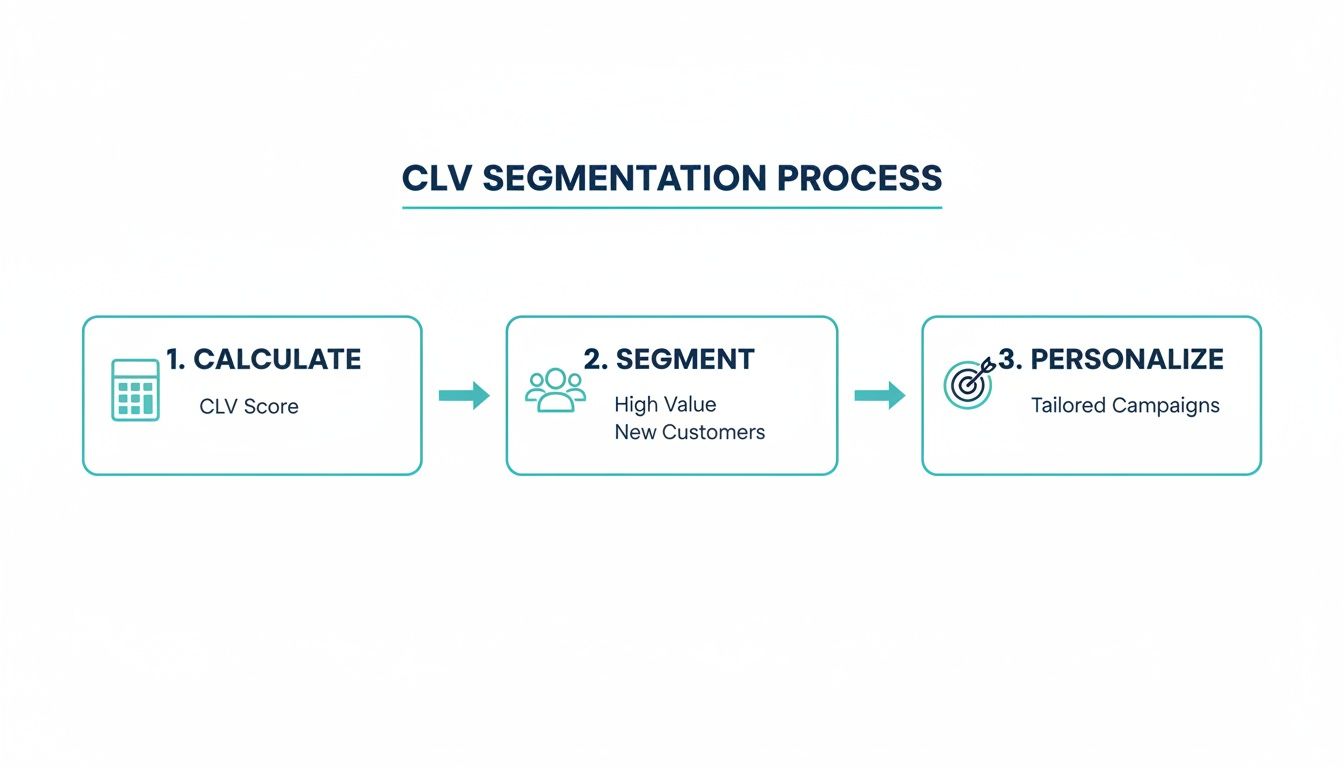
As you can see, using data to segment your customers is the critical bridge between knowing your CLV and actively making it better with targeted post-purchase marketing.
Getting customers to stick around is the bedrock of a killer CLV. Just a 5% increase in retention can boost profits by 25% to 95% in e-commerce. With ad costs going through the roof, focusing on the customers you already have just makes good business sense. It’s a much better ROI.
Once you've delivered that initial hit of value and excitement, you can start strategically introducing urgency to nudge them toward that next purchase. This isn't about being pushy. It’s about giving new customers a compelling, time-sensitive reason to come back while your brand is still fresh in their minds.
This is where you go beyond a simple countdown timer. Real urgency is about creating an event, not just showing a clock ticking down. This is the difference between basic apps and sophisticated psychological triggers.
For Shopify merchants already using tools like Klaviyo or other SMS platforms, this is incredibly easy to set up. You can build automated flows that kick off based on a delivery confirmation or a few days after the product arrives.
Takeaway: Your post-purchase flow isn't just a receipt for a past purchase; it's the opening move for the next one. Think of it as a retention machine first, a notification system second.
Here are a few actionable takeaways to bake sophisticated urgency right into your follow-up:
These aren't your basic retention tactics. By embedding these kinds of psychological triggers directly into your automated post-purchase journey, you create a powerful loop that keeps customers engaged. You're not just increasing how often they buy; you're building the kind of brand affinity that’s essential for powerful customer retention programs. You stop just selling products and start creating experiences customers want to have again and again.
While your post-purchase flows are busy building the foundation for loyalty, you also need a more dynamic way to actively drive repeat sales. This is where the science of urgency comes in—not as a cheap trick, but as a powerful tool grounded in behavioral economics. When used right, it boosts purchase frequency and, you guessed it, your customer lifetime value.
Forget those generic, endlessly resetting countdown timers that erode brand trust. That’s the old way.
Today, sophisticated urgency marketing is all about creating genuine, exciting "Moments" for your customers. These are events that feel exclusive and valuable, compelling them to act now.
Look at how a simple "limited drop" can be framed as a premium, must-have event. It immediately grabs attention.
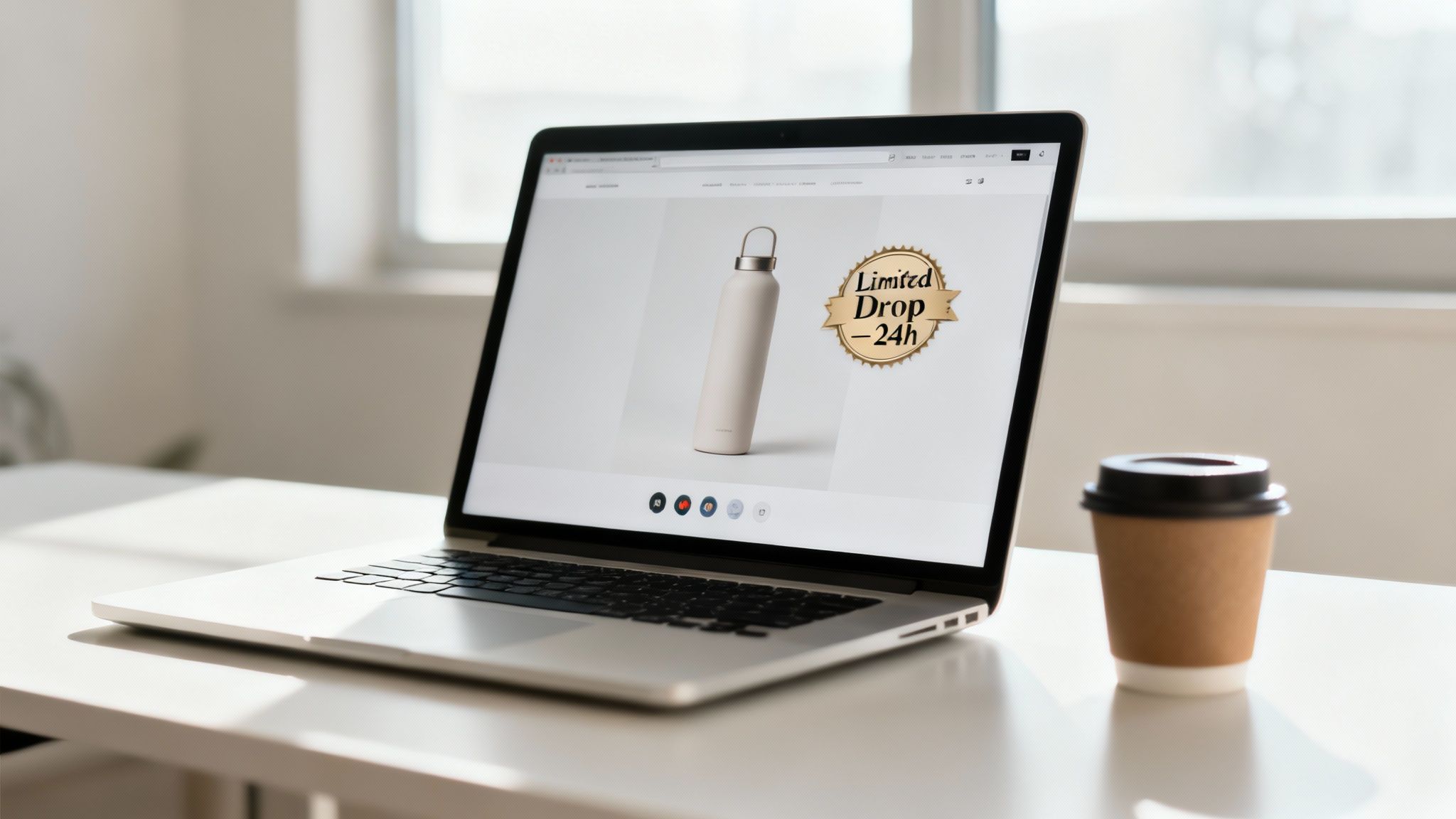
The key here is that the presentation transforms a product into an exclusive opportunity. It shifts the entire conversation from price to access.
Effective urgency isn’t about pressure; it’s about tapping into fundamental human drivers. If you get these psychological principles right, your campaigns will feel like a golden opportunity, not an ultimatum. That’s how you increase CLV without alienating your audience.
By grounding your strategy in these proven concepts, you elevate your marketing from simple pop-ups to engaging, revenue-generating events. You're not just selling a product; you're selling an experience.
The real magic of this approach is its ability to drive sales without resorting to deep, margin-killing discounts. It's about moving inventory, re-engaging customers, and boosting purchase frequency—all while keeping your business profitable.
Imagine running these plays on your Shopify store:
Standard pop-up apps are mostly built for one thing—email capture. Basic timer apps just put a clock on the page. While they have their place, they don't do much for CLV because they lack any real psychological depth or automation. They generate leads, not revenue.
This is where platforms like Quikly come in. As an expert in urgency marketing science, Quikly is designed to create these sophisticated "Moments." The system automates the whole campaign, from notifying your audience via email and SMS (it integrates with tools like Klaviyo) to managing the tiered offers and inventory. This advanced automation enhances banners, pop-ups, and the entire shopper journey.
This is next-generation urgency. It's fully automated, driven by psychology, and built for revenue—not just list building.
You’re not just capturing an email; you're actively conditioning customers to pay attention when your brand communicates. For Shopify Plus merchants managing large-scale campaigns, this level of automation is essential for running complex events without manual headaches.
By mastering these techniques, you can turn your email and SMS lists into powerful, predictable revenue drivers. If you want to go deeper, check out this guide on using urgency psychology to increase email conversions.
Getting customers to buy from you again is a huge piece of the CLV puzzle. But there's another, equally powerful lever you can pull: getting them to spend more each time they check out.
This is all about boosting your Average Order Value (AOV). We're not talking about just throwing more products at people. It's about crafting a smart, unified brand experience that naturally guides customers toward higher-value carts. When you make each transaction more valuable, you see an immediate and direct bump in your overall CLV.
For any Shopify merchant, your product pages and checkout are prime real estate for lifting AOV. The key is to avoid spammy, random pop-ups that cheapen the customer experience. Instead, use behavioral psychology to present offers that feel genuinely helpful, not just pushy.
The best upsells never feel like a sales pitch. They feel like a smart, personalized recommendation that makes the original purchase even better. That's how you build trust and a bigger AOV at the same time.
Truly optimizing your AOV means looking beyond just your website. An omnichannel experience is one where the customer's journey feels completely connected and consistent, no matter where they are—on your mobile app, scrolling through social media, browsing on their desktop, or even visiting a physical pop-up shop.
This consistency is huge for building trust. When a customer feels that seamless connection, they also perceive more value in your brand, making them far more comfortable with larger purchases.
Imagine a customer browsing on their phone during their commute, adding a few items to their cart. Later, they open their laptop, and that cart is synced and ready. A little while after that, they get a targeted SMS offer related to those very items. That's a cohesive, personal journey that drives both loyalty and higher spending.
And this isn't just a gut feeling; the numbers are there to prove it. Research shows that omnichannel shoppers have a massive 30% higher CLV than those who only shop through a single channel. This lift comes from deeper engagement. When customers interact with your brand across multiple touchpoints, they feel more connected. As a result, they stick around longer and spend more. You can dig into more of these findings on customer lifetime value statistics in e-commerce.
To really get the most out of this omnichannel effect, your urgency marketing has to be just as integrated. A flash sale shouldn't just be a lonely email blast. It needs to be a coordinated event, a "Moment" that echoes across every single one of your platforms.
Here’s what that could look like for a Shopify Plus brand:
This kind of coordinated attack ensures your message lands in front of the widest possible audience, meeting them on their preferred channels. It transforms a simple promo into an exciting, can't-miss event that drives both immediate AOV and long-term brand love.
Even with the best strategy in place, you’re bound to run into some questions. When you're in the trenches implementing new tactics to grow customer lifetime value, things come up.
Let's walk through a few of the most common ones I hear from Shopify merchants, grounded in what actually works.
For a growing ecommerce brand, a healthy baseline for your Customer Lifetime Value (CLV) to Customer Acquisition Cost (CAC) ratio is at least 3:1.
This means that for every dollar you spend to acquire a new customer, you should generate at least three dollars back in gross margin from them over their entire relationship with you.
If your ratio is below 3:1, it’s a red flag. It could mean you're overspending on acquisition or, more likely, your retention and repeat purchase strategies aren't effective enough. The top-tier brands, especially those on Shopify Plus, often achieve a 5:1 ratio or even better.
Keeping a close eye on this number helps you find that sweet spot in your marketing budget, balancing the hunt for new customers with the need to keep the old ones coming back. That’s how you build sustainable, profitable growth.
Don't underestimate the power of great customer service. It has a direct and massive impact on CLV, hitting both 'purchase frequency' and 'customer lifespan' right where it counts.
When a customer has a positive, quick, and helpful interaction with your support team, it builds a real emotional connection to your brand. It builds trust. Suddenly, they're far less likely to churn over a small issue. In fact, you can turn a potentially negative experience into a moment that actually builds more loyalty.
Unlocking higher customer lifetime value (CLV) often boils down to superior customer service, which can increase it by a solid 14% while making customers purchase 2.6 times more frequently.
For Shopify stores, this gets really interesting when you connect your support desk to your marketing automation. Imagine resolving a customer's issue and then automatically sending them a unique discount code through a platform like Klaviyo. Just like that, your service team goes from being a cost center to a powerful engine for revenue and retention.
This is a valid concern. The line between effective urgency and harmful manipulation comes down to one thing: authenticity.
Manipulative tactics—fake scarcity, countdown timers that mysteriously reset every time you visit the page—absolutely erode customer trust and cheapen your brand. It's a short-term trick that does long-term damage to your CLV.
But sophisticated urgency is a totally different ballgame. It’s not about tricking people; it’s about applying genuine psychological principles. You're creating real value by offering exclusive access for a limited time or being transparent about true inventory constraints. This is the difference between pressure and persuasion.
The goal isn't to pressure someone into a corner. It's to make them feel smart and rewarded for acting decisively. When urgency is tied to something real—a limited product drop, a tiered offer that rewards the fastest buyers, or a last-chance sale on seasonal gear—it actually makes the shopping experience better.
You’re creating exciting "Moments" instead of just slapping a generic timer on a product page. This approach strengthens brand loyalty and, ultimately, drives your long-term customer lifetime value through the roof. It becomes part of the fun of shopping with you, not a source of anxiety.
Ready to transform your marketing from basic timers to sophisticated, psychology-driven events that boost CLV? Quikly helps Shopify and Shopify Plus brands create exciting "Moments" that drive immediate revenue and build long-term customer loyalty.