

ecommerce conversion
customer experience strategy
digital customer experiences
Slashing prices isn't the only way to boost your ecommerce sales. The real magic happens when you understand the consumer psychology behind why people buy—and more importantly, why a staggering 70% of them ditch their carts before checking out.
It’s about moving past one-off tactics and building a revenue-focused strategy grounded in behavioral economics.
Many brands get stuck hovering around the industry-average conversion rate of just 2.5%. They have traffic, but turning clicks into revenue feels like an uphill battle. Why? Because they’re not looking past surface-level metrics to the underlying science of consumer behavior.
Simply adding a basic countdown timer or a generic email capture pop-up won't drive meaningful revenue growth. Those tools are commodities; they only become powerful when they tap into fundamental human drivers. Once you grasp these psychological principles, you can build a sophisticated strategy that boosts ecommerce sales and protects your profit margins.
The most effective sales strategies feel natural because they align with how our brains are already wired. It’s not about manipulation; it’s about making the shopping experience intuitive and compelling. For a deeper dive, check out our guide on consumer psychology in marketing.
Here are the key psychological triggers you need to master:
By weaving these principles into the entire shopper journey—from banners to popups to email campaigns—you create a cohesive system that drives action. It’s a sophisticated approach that boosts sales without resorting to constant, brand-devaluing discounts.
Now that we've covered the "why," the next sections will show you the "how." We’ll walk through actionable steps for creating urgency, optimizing your funnel, and driving serious revenue growth for your Shopify store. It's time to move beyond the basics and into the science of building campaigns that convert.
Urgency is one of the most powerful tools in behavioral economics, but it's also one of the most misused. Many brands slap a generic countdown timer on a banner and expect sales to pour in. That’s a commodity tactic, not a strategy. This basic approach often falls flat because it lacks the psychological hook needed to inspire action.
Effective urgency is a science. It’s about orchestrating specific "Moments" that tap into core human drivers like Fear of Missing Out (FOMO), scarcity, and anticipation. Done right, you don't just get a temporary lift in conversions; you drive immediate revenue while protecting your profit margins from the race-to-the-bottom discounting prevalent in ecommerce. The goal is to make the shopper feel part of an exclusive event—not like they're being pressured.
A simple timer creates pressure, but it doesn't build desire. That’s the critical difference between a cheap app and a sophisticated urgency marketing strategy. The best tactics are rooted in proven consumer psychology, giving your customer an authentic reason to buy now.
Instead of a one-size-fits-all approach, a smarter strategy builds campaigns around specific behavioral triggers.
The magic happens when you blend these principles. Imagine a limited-edition product drop (scarcity) that you announce a week in advance (anticipation) and is only available for 24 hours (FOMO). That's a powerful trifecta that drives a massive revenue spike.
Turning these psychological principles into automated campaigns on your Shopify store is where you'll see a direct impact on ROI. As an expert in urgency marketing science, Quikly orchestrates these kinds of "Moments," going far beyond what a simple popup or banner app can do.
The focus shifts completely from merely capturing an email to generating immediate, trackable revenue.
A huge challenge for brands is creating this sense of urgency without devaluing their products. For a deep dive into applying these concepts specifically on Shopify without compromising your brand, check out these advanced Shopify urgency tactics.
Instead of quietly adding new products, turn it into a major revenue event. Here’s an actionable workflow for Shopify Plus merchants:
This automated, multi-channel approach creates a controlled sales burst and helps with inventory management by gauging interest ahead of time. You’ve just turned a routine release into a strategic revenue event.
The global ecommerce market is projected to hit $8.1 trillion by 2026. With a global online shopper base approaching 2.77 billion, you cannot afford to use generic, unsophisticated tactics. Smart, psychology-driven urgency is how you capture your piece of this massive market.
Adopting a sophisticated urgency model directly impacts your bottom line in several key ways:
| Business Impact | Basic Timer Approach | Advanced Urgency (e.g., Quikly) |
|---|---|---|
| Profit Margins | Relies on site-wide discounts, which erodes margins. | Protects margins by focusing on exclusivity and limited runs, not just price cuts. |
| Inventory Management | No benefit; can lead to unpredictable stockouts. | Drives fast sell-through of specific SKUs, clearing seasonal inventory on your terms. |
| Brand Perception | Can feel manipulative or cheapen the brand over time. | Enhances brand value by creating exciting, exclusive experiences for customers. |
| Customer Engagement | Passive. The customer sees a timer. | Active. Customers opt-in and participate, building a stronger connection to your brand. |
Ultimately, the goal is to weave urgency into the entire shopper journey. By grounding your campaigns in real behavioral science, Quikly helps you create a powerful, sustainable engine for boosting sales that respects your customer and your bottom line.
A store with high traffic but low sales is a classic sign of a leaky conversion funnel. Getting shoppers in the door is only half the battle. The real work is guiding them smoothly from the first click to checkout.
This isn't about small, incremental bumps in conversion rates. It's a strategic overhaul that directly increases revenue and ROI.
For many merchants, especially those on Shopify Plus, the quickest path to boosting sales is eliminating friction points. These are the small hurdles—confusing navigation, slow-loading images, a clunky checkout—that cause shoppers to leave. With the average cart abandonment rate hovering at a staggering 70%, sealing these leaks can have a massive impact on your bottom line.
A lot of this comes down to psychology. You must maintain momentum at every stage of the funnel.
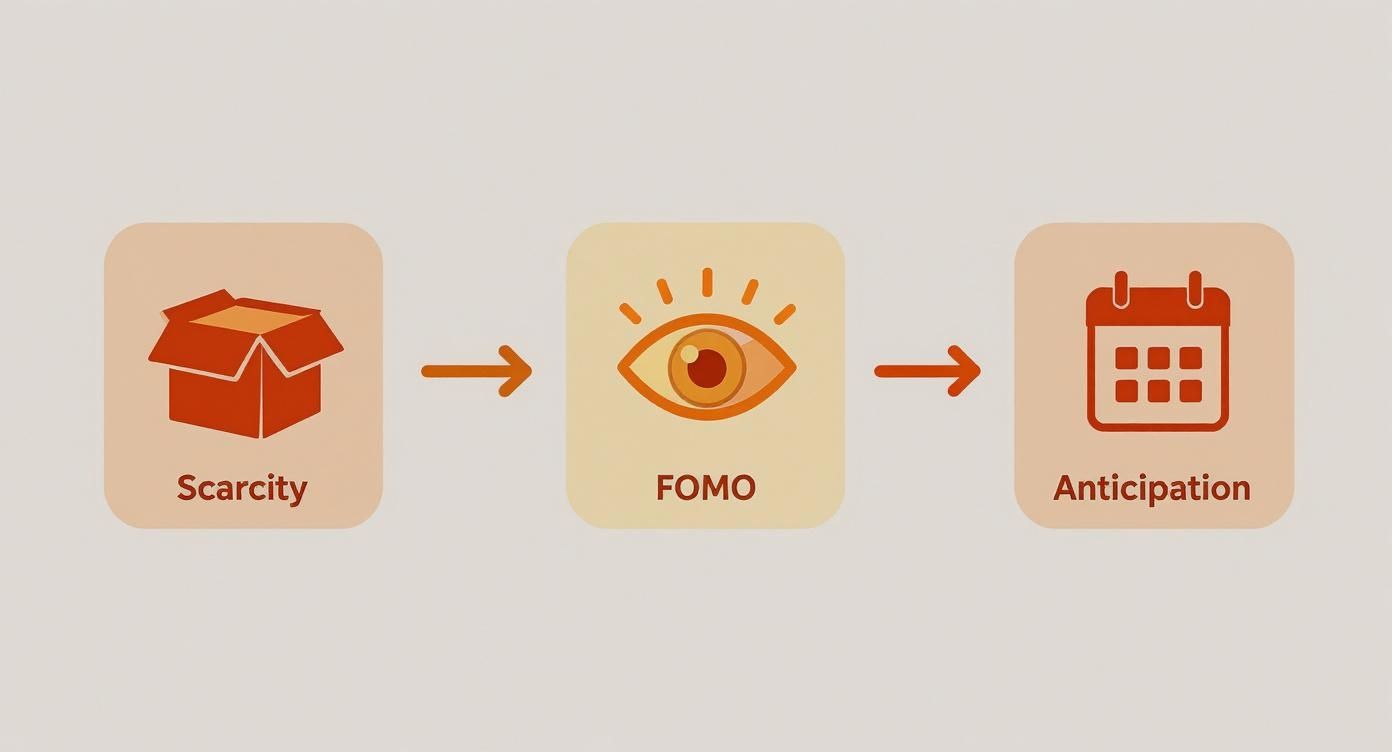
The idea is simple but powerful: scarcity creates a fear of missing out (FOMO), which then builds anticipation for the next opportunity. It’s a loop that keeps customers engaged and ready to act.
Your product page is where the purchase decision is made. This is your digital sales floor, where you must build both trust and desire.
First, your visuals must do the heavy lifting. High-resolution photos from every angle, lifestyle shots showing the product in use, and short videos are essential for overcoming the inability to touch the product physically.
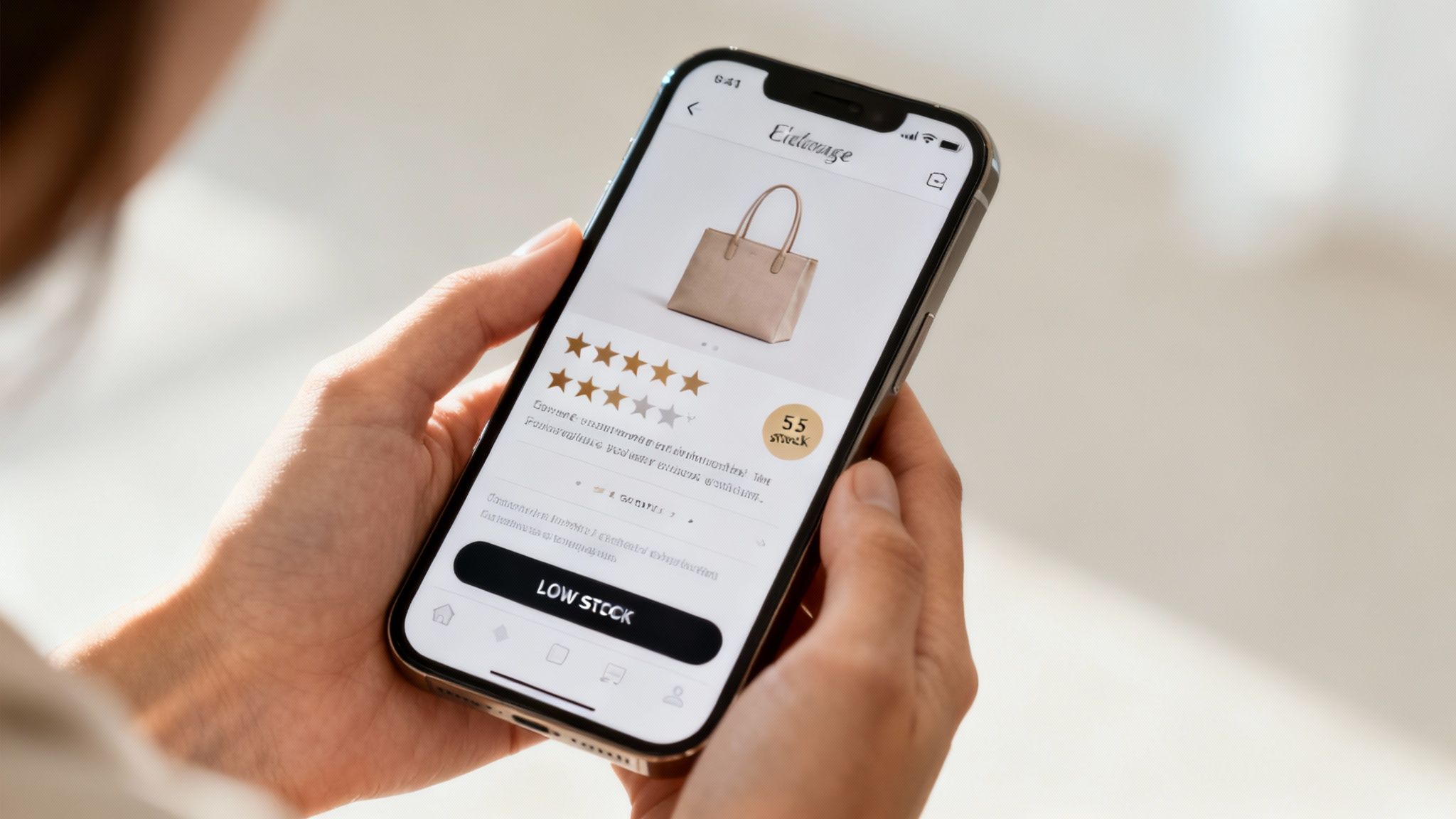
Next, your product descriptions must sell benefits, not just features. How will this product improve the customer's life? Then, weave social proof directly into the page. Customer reviews, star ratings, and testimonials are powerful psychological triggers that signal, "Other people love this, and you will too."
A common mistake is burying social proof at the bottom of the page. Actionable takeaway: place star ratings directly under the product title and sprinkle your most powerful testimonials throughout the description. Make it impossible for a visitor to miss the validation from other happy customers.
The moment a shopper decides to buy, every extra click increases the chance of abandonment. The journey from "Add to Cart" to "Complete Purchase" must be as frictionless as possible.
Start with the add-to-cart experience. Instead of redirecting users to a separate cart page, use a slide-out cart or a subtle pop-up to keep them on the product page. This encourages continued browsing and can help increase your Average Order Value (AOV).
The checkout is the final hurdle. For Shopify Plus merchants, this is a prime area for optimization. Use Shopify Scripts to A/B test different layouts or customize checkout fields.
Here are a few non-negotiable checkout optimizations:
Even with a perfectly tuned funnel, some shoppers will leave. This is where abandoned cart automations become a revenue-generating machine. By integrating your Shopify store with an email and SMS platform like Klaviyo, you can send personalized, time-sensitive reminders.
An effective flow is intelligent. The first email, sent an hour after abandonment, is a gentle nudge. A day later, send another that introduces urgency or highlights a powerful review for the exact item left behind.
This data-driven approach turns a lost opportunity into a recovered sale, boosting your revenue without any additional marketing spend.

It’s easy to get obsessed with new customer acquisition. But sustainable growth comes from maximizing the value of the customers you already have.
The most profitable brands are masters at increasing Average Order Value (AOV) and Customer Lifetime Value (CLV). Shifting focus from one-off sales to building profitable relationships creates a resilient business that isn't reliant on expensive acquisition campaigns.
Encouraging customers to spend more doesn't have to be aggressive. It's often a matter of presentation. This concept from behavioral economics, known as choice architecture, guides customers toward higher-value purchases organically.
For example, instead of showing a single product, frame it as part of a bundle that offers superior value. This leverages a psychological trigger called anchoring. The perceived value of the bundle makes spending more feel like a smart decision, not an upsell.
Actionable takeaways for Shopify stores:
While AOV focuses on a single transaction, CLV is the long game. This metric represents the total revenue a customer will generate over their entire relationship with your brand. Boosting CLV is about turning first-time buyers into loyal advocates.
This is where loyalty programs and personalized communication are critical. When customers feel valued, they have a powerful reason to choose you over a competitor.
A significant mistake brands make is sending generic emails to their entire list. Segmentation is essential. A customer who only buys skincare won't care about a haircare sale. But an email about a new serum feels personal and relevant.
Integrating your Shopify store with a platform like Klaviyo or another SMS tool unlocks powerful segmentation capabilities. You can create automated flows for different customer groups:
To choose the right approach, it helps to compare these strategies. Each tactic relies on a different psychological driver and has a different implementation complexity.
| Tactic | Primary Goal | Psychological Principle | Implementation Complexity |
|---|---|---|---|
| Product Bundling | AOV | Anchoring, Perceived Value | Low |
| Tiered Discounts | AOV | Gamification, Goal Gradient | Medium |
| Post-Purchase Upsells | AOV | Momentum, Scarcity | Medium |
| VIP Loyalty Programs | CLV | Exclusivity, Reciprocity | High |
| Replenishment Reminders | CLV | Habit Formation, Convenience | Medium |
| Personalized Cross-Sells | AOV & CLV | Relevance, Personalization | High |
Ultimately, focusing on both AOV and CLV provides a powerful, two-pronged approach to boost ecommerce sales. You’ll make more money from each transaction today while building a foundation of high-value, loyal customers for future growth.
For a deeper look into specific tactics, you can learn more about how to increase your average order value in our guide.
A perfectly optimized store is like a high-performance engine; it needs high-quality fuel to run. For an ecommerce business, that fuel is a steady stream of qualified traffic.
The goal isn't just more clicks. You need to attract high-intent shoppers who are genuinely interested in your products—the kind of visitors who convert. This means getting smart about your marketing spend to ensure every dollar is an investment in attracting your ideal customer.
Search Engine Optimization (SEO) is the foundation of sustainable, long-term traffic. It's about making your store the definitive answer when a potential customer searches on Google. For Shopify merchants, the biggest wins often come from optimizing product collection pages and creating strategic blog content.
Instead of focusing all your energy on individual product pages, think bigger. Your collection pages (e.g., "Men's Summer Linen Shirts") are goldmines. Optimize their titles, descriptions, and URLs with the keywords people are actually searching for. This captures shoppers who are still exploring options, not just hunting for a specific item.
Your blog is where you solve customer problems. A post like "5 Ways to Style a Linen Shirt for Any Occasion" attracts a broader audience than a product page ever could. It builds your authority and funnels interested readers directly to your product collections.
While SEO is your long game, paid advertising on platforms like Google and Meta (Facebook & Instagram) delivers immediate, laser-focused traffic. The secret is precision. You must dive deep into targeting options to get your products in front of the right audience at the right moment.
A common mistake is sending all paid traffic to the homepage. For maximum ROI, your ad must align perfectly with your landing page. If your ad promises 20% off running shoes, that link must go directly to a page showing those shoes with the discount clearly displayed. That continuity is crucial for conversions.
Attracting the right people also means thinking beyond your local borders. The global scale of online retail is staggering.
Online shopping is projected to make up nearly 24% of all global retail sales by 2026, pushing worldwide online retail sales to an eye-watering $8.1 trillion.
This massive shift in consumer behavior highlights the immense potential waiting in both established and emerging markets for brands willing to expand their reach.
The most effective brands don't rely on a single channel. They make all their channels work in concert. SEO builds a reliable stream of organic traffic, while paid ads can be used to amplify reach during a big sale or product launch.
When determining the right mix of channels, it helps to look at proven strategies for the E-commerce industry.
Ultimately, driving traffic that converts comes down to alignment. You must match your message to your audience and create a seamless path from the first click to the final purchase. Get that right, and you turn your marketing spend into a predictable engine for growth.
When trying to boost sales, the same questions often arise. Let's tackle a few of the most common ones, moving past generic advice to focus on what actually moves the needle.
The key is to ground urgency in genuine value, not an arbitrary countdown timer. This positions urgency marketing as sophisticated psychology, not manipulation. Focus on exclusive product drops, legitimate low-inventory alerts, or early access for loyal customers.
This approach taps into the powerful psychological trigger of scarcity—we desire what is limited. By framing these moments as authentic opportunities, you generate excitement and leverage the Fear of Missing Out (FOMO) on something special. This makes your brand feel more desirable, not less.
While conversion rate is important, the most critical metric for long-term, sustainable growth is Customer Lifetime Value (CLV).
CLV measures the total revenue you can expect from a customer throughout their relationship with your brand. Focusing on CLV forces you to prioritize retention and loyalty, leading to improvements in customer service, loyalty programs, and personalized marketing—the pillars of a resilient business.
This is a classic "leaky bucket" problem, indicating a mismatch between who you're attracting and their on-site experience.
First, analyze your data to find where people are dropping off. Is it on product pages, in the cart, or at checkout? A high bounce rate on a product page, for example, often means your ad's promise doesn't match the landing page experience.
Next, audit your product pages. Are your descriptions compelling? Are your images high-quality? Is social proof like reviews prominently displayed? Then, test your checkout process on both mobile and desktop. Hidden shipping costs are the #1 reason for cart abandonment, so be transparent. Ensure trust signals like security badges are clearly visible.
For a deeper dive into plugging these leaks and improving your store's performance, check out this guide on 7 proven tactics for boosting ecommerce sales.
Ready to transform your marketing with urgency that drives real revenue? As the expert in urgency marketing science, Quikly orchestrates high-impact marketing "Moments" grounded in behavioral science, turning shoppers into buyers and boosting sales without constant discounts.