

ecommerce conversion
customer experience strategy
digital customer experiences
Exit-intent popups are a brand's final, crucial opportunity to engage a visitor at the exact moment they decide to leave. As a user's cursor moves toward the browser's close button, a strategically timed, psychologically-informed offer can reverse that decision, transforming a potential bounce into immediate revenue or a valuable customer relationship.
To understand the revenue-generating power of exit-intent popups, one must look beyond the technology and into the consumer's mind. A visitor leaving a site is often experiencing a specific psychological friction—perhaps they are overwhelmed by choice, hesitant about the price, or simply distracted.
A well-executed popup isn't an interruption; it's a strategic intervention based on proven behavioral science. Consider a shopper who abandons their cart—a behavior exhibited by nearly 70% of online shoppers. This action often triggers the Zeigarnik effect, a psychological principle where the brain remains fixated on incomplete tasks. The exit popup serves as a powerful nudge, prompting them to resolve this mental tension and complete their purchase.
The most effective exit-intent popups leverage fundamental principles of human psychology to compel action. One of the most potent is Loss Aversion, a concept from behavioral economics demonstrating that the pain of losing something is psychologically twice as powerful as the pleasure of gaining something of equal value.
An exit intent popup is more than a marketing tactic; it's a strategic intervention rooted in behavioral science. It engages a customer at a critical moment of hesitation and provides a compelling, data-backed reason to reconsider, turning a lost sale into recovered revenue.
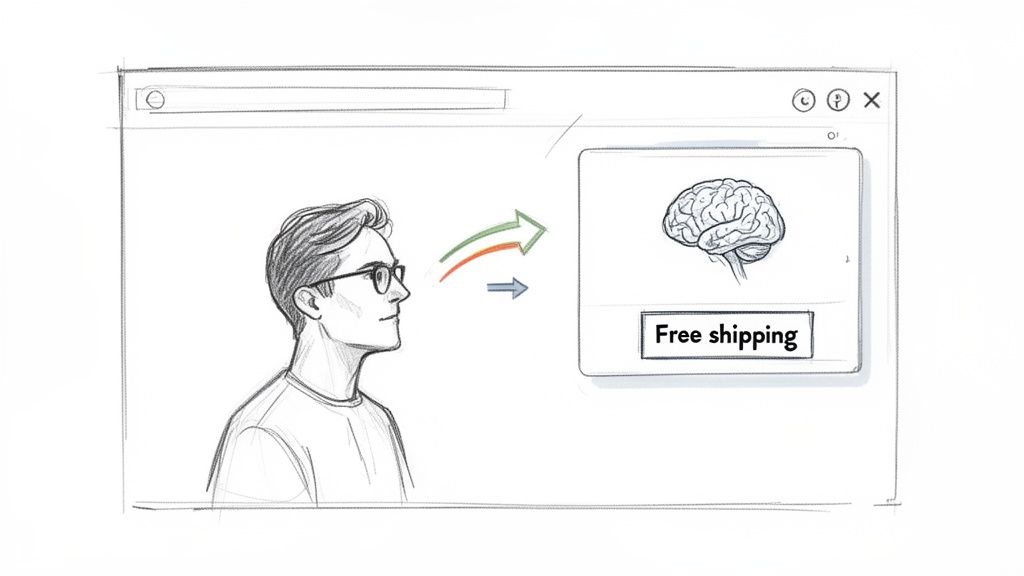
This simple interruption can transform a popup from an annoying ad into a genuinely helpful solution, breaking down the mental barriers that were preventing a purchase.
The business impact of this approach is substantial. The e-commerce industry faces a staggering average cart abandonment rate of around 70%. This represents a massive pool of recoverable revenue.
A well-crafted exit-intent popup can convince 10-15% of those abandoning visitors to complete their purchase. Merchants leveraging Quikly's advanced urgency marketing science have seen their conversion rates climb to an average of 8.07%, far surpassing the industry standard of approximately 2.5%. This is a direct result of moving beyond basic popups and applying sophisticated psychology.
To truly master this, brands must understand the broader context of how to increase ecommerce conversion rate. By grasping the "why" behind consumer psychology, a simple popup evolves into a powerful revenue engine.
An exit-intent popup that drives revenue is not merely an aesthetic element; it is a finely-tuned conversion machine. A brand has only a fraction of a second to capture a visitor's attention before they leave for good. This means every aspect of the design must be rooted in clarity, value, and psychological impact.
Each element must serve a specific purpose. A compelling headline captures attention, a high-contrast call-to-action (CTA) button clarifies the next step, and clean visuals focus the user on the offer. Clutter is the enemy of conversion—excessive text or a busy background will result in an instant dismissal.
This is where sophisticated marketing diverges from the basics. The best popups don't just look good; they embed proven psychological triggers directly into their copy and layout. These are not manipulative tricks but subtle nudges that tap into fundamental human motivations, transforming a simple discount into a compelling reason to stay.
You're moving beyond flashing an offer and are now creating genuine motivation to act.
Here are actionable ways to implement this:
A well-designed popup does more than just present an offer; it changes the visitor's emotional state. By using social proof or anticipation, you shift their mindset from passive browsing to active consideration, dramatically increasing the odds of a conversion.
For Shopify store owners, this level of design sophistication can be the deciding factor between an abandoned cart and a completed sale. The right design makes an offer feel less like an interruption and more like a helpful, last-minute suggestion. Every detail—from the headline to the button color—plays a part in driving ROI.
To see how all these elements come together, check out our guide on the anatomy of an effective web site pop up. When you master these design fundamentals, you create an experience that feels valuable to the customer and delivers an immediate impact to your bottom line.
A generic countdown timer on an exit-intent popup has lost much of its psychological impact. Modern shoppers are desensitized to them. While a simple timer can create a baseline level of urgency, it is often insufficient to cut through the digital noise and motivate a hesitant buyer.
To truly protect revenue and drive immediate action, brands must adopt more sophisticated strategies grounded in behavioral economics—leveraging principles like scarcity, social proof, and competition. Instead of merely telling customers a deal is ending, the goal is to create an environment where they feel a genuine, internal motivation to act now.
One of the most powerful advanced strategies is the ranked offer. This approach reframes a discount by turning it into a competitive event.
For example, imagine a popup that presents a tiered reward structure:
Suddenly, the offer's value is not just limited by time; it's limited by the actions of other shoppers. This taps directly into our competitive nature and the psychological power of scarcity. It transforms a solitary shopping decision into a shared, dynamic experience, making the top-tier discount feel like a prize to be won, not just a coupon to be redeemed.
Of course, even the most sophisticated offer requires a solid design foundation to succeed.
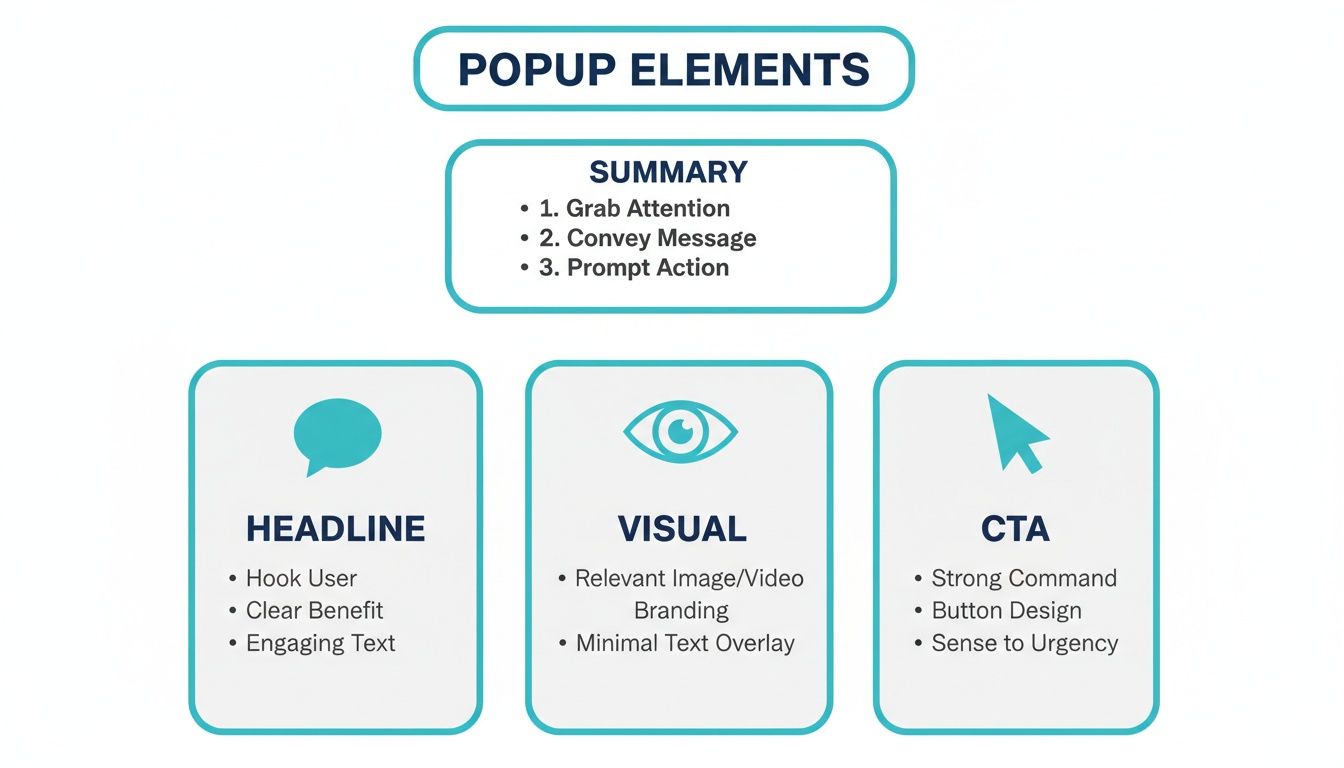
Without a compelling headline, a clear visual, and a strong call-to-action, even the most brilliant urgency tactic will fail to convert.
Another tactic that delivers significant ROI is the limited quantity drop. A ticking clock can sometimes feel artificial, but a finite number of available items is concrete and believable. There is a vast psychological difference between "Sale ends in 1 hour" and "Only 25 left at this price!"
This approach creates a tangible sense of scarcity that a timer cannot replicate. It also serves as a powerful tool for inventory management, allowing brands to clear out seasonal products or move excess stock without resorting to site-wide sales that erode profit margins. The scarcity is real, which makes the call to action exponentially stronger.
When you ground your exit-intent popups in proven behavioral science, you stop just grabbing attention and start creating genuine demand. The goal is to make the customer feel smart for acting fast, not pressured into a quick decision.
To illustrate the business impact, let's compare how these advanced tactics stack up against the standard approach.
| Tactic | Primary Goal | Psychological Principle | Typical ROI |
|---|---|---|---|
| Standard Timers | Create basic time sensitivity. | Urgency | Moderate |
| Limited Quantity | Create tangible product scarcity. | Scarcity | High |
| Ranked Offers | Drive immediate action through rivalry. | Competition & Scarcity | Very High |
| Social Proof | Build trust via peer activity. | Social Proof | High |
As you can see, moving beyond simple timers unlocks more powerful psychological triggers, which often translates to a much stronger impact on your bottom line.
For Shopify merchants, these tactics become even more potent when integrated with the rest of the marketing stack. Consider this scenario: a visitor sees your ranked offer popup, hesitates, and leaves. The opportunity is not lost.
By weaving your exit-intent strategy into your email and SMS marketing, you build a powerful, automated system for revenue recovery. It transforms a potential dead-end into an ongoing, profitable conversation. To see exactly how this works, explore our complete guide on Shopify urgency tactics.
The critical difference between an exit-intent popup that drives revenue and one that is instantly dismissed is relevance.
A generic, one-size-fits-all offer feels intrusive. In contrast, a smart, timely offer based on a shopper's actual on-site behavior feels like a helpful, personalized suggestion. This is where advanced targeting elevates a basic popup into a sophisticated profit-protection tool.
Instead of displaying the same 10% discount to every departing visitor, you can segment your audience with surgical precision. This enables you to deploy offers that are not only more effective but also protect your profit margins by reserving the most generous incentives for the most valuable interactions.
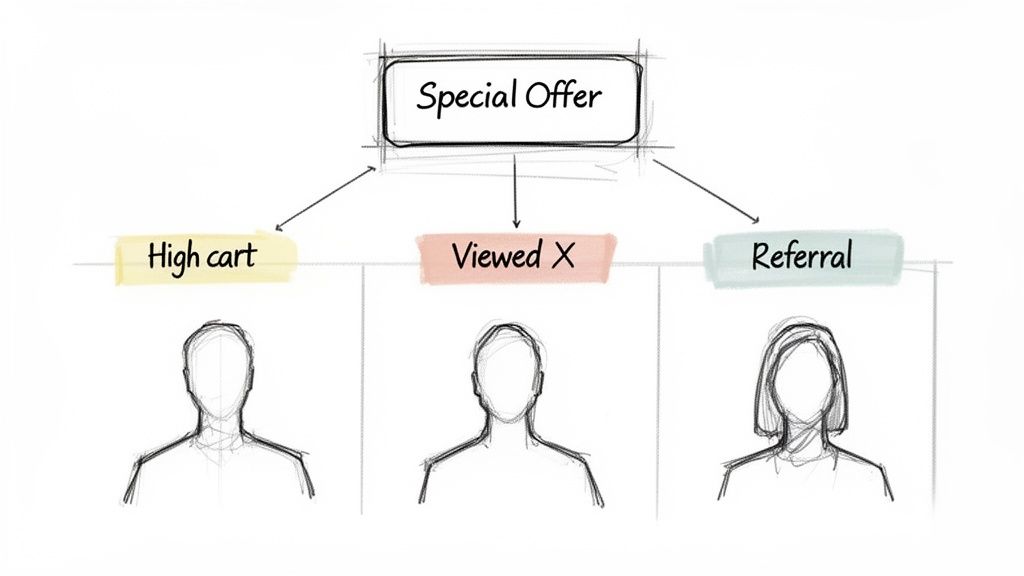
For Shopify merchants, the ability to create targeting rules based on specific visitor behavior is a powerful advantage. These are not guesses; they are calculated responses to clear user signals.
Here are high-impact targeting strategies you can implement immediately:
The objective is to make the offer feel like a personalized conversation. It should directly address the likely reason for their departure—whether it's hesitation over shipping costs, indecision about a product, or searching for a better deal.
For enterprise merchants on Shopify Plus, segmentation can be taken to an even more granular level. It is possible to create rules based on customer lifetime value (CLV), purchase history, or specific customer tags imported from a CRM or loyalty platform.
Imagine displaying a unique "VIP" offer exclusively to customers who have spent over $1,000 in the past year. This level of personalization not only drives immediate revenue but also significantly strengthens long-term customer loyalty.
This granular control transforms exit-intent popups from blunt instruments into precision tools. The impact is well-documented. Industry studies consistently show that well-targeted exit-intent popups can rescue 10-15% of abandoning visitors. For a store with 100,000 monthly visitors, that represents up to 15,000 potential sales recovered. You can explore more data and strategies to boost your conversions to understand the full potential.
Ultimately, advanced targeting transforms your popups from a simple email capture tool into a sophisticated revenue recovery engine. It is about delivering the perfect message to the right person at the exact moment of hesitation—ensuring your marketing efforts directly impact the bottom line.
The distinction between a good marketer and a great one lies in their command of data. When implementing exit-intent popups, it is easy to become distracted by vanity metrics like impressions or open rates. However, the true measure of success is the tangible impact on your business's financial health—specifically, the revenue you recover and the profit margins you protect.
The guiding question should shift from, "How many people saw my popup?" to, "How much incremental revenue did this popup recover?" and "How did this campaign impact our Average Order Value (AOV) and profit margin?" This mindset transforms your strategy from a simple engagement tactic into a sophisticated revenue recovery machine.
To accurately assess performance, you must track the right Key Performance Indicators (KPIs). These metrics provide a clear picture of your exit-intent strategy's effectiveness and illuminate opportunities for improvement.
A well-optimized exit intent popup doesn’t just stop a visitor from leaving; it transforms their final moments on your site into a profitable, value-driven interaction that directly boosts your revenue and protects your margins.
Optimization is a continuous process. The key to maximizing profitability from your popups is rigorous A/B testing—comparing two versions of a popup to determine which one performs better against your primary KPIs.
Focus your tests on high-impact variables that tap into shopper psychology, rather than minor cosmetic changes.
To achieve maximum impact, your exit-intent strategy must be part of a holistic approach. It is vital to integrate these tactics within broader essential conversion rate optimization best practices, ensuring every element on your site works in concert. By systematically testing and refining your approach, you can transform your exit-intent popups from a simple tool into a powerful and predictable revenue engine.
Implementing an exit-intent popup strategy often raises several important questions. Here are answers to the most common concerns from store owners.
This is a primary and valid concern. The definitive answer is no, properly implemented exit-intent popups will not harm your SEO.
Google's penalties target intrusive interstitials, particularly full-page ads that obscure content immediately upon a user's arrival on a mobile site. Exit-intent technology is fundamentally different. It activates only when a user demonstrates clear intent to leave, meaning they have already had an opportunity to engage with your content.
To ensure a positive user experience, adhere to these best practices: make the popup easy to close, provide a genuinely valuable offer, and avoid showing it to the same visitor repeatedly. A well-designed popup can actually enhance the user experience by resolving a point of friction for a hesitant shopper.
There is no single "best" offer; effectiveness depends on your brand, profit margins, and the visitor's context and intent.
However, certain offers consistently perform well:
The key is to test rigorously. Implement an A/B testing plan to discover which offers resonate most strongly with your specific audience segments.
The ultimate goal is to match the offer to the user's intent. A high-value cart might warrant a shipping incentive, while a first-time browser might be more receptive to an educational download. Context is everything.
This is a critical distinction. A standard email popup has a single primary function: to grow your email list. It is a passive lead capture tool. While list-building is important, it does not directly drive a sale in the immediate moment.
An advanced, Quikly-powered popup is engineered from the ground up to be a revenue generation tool.
It elevates the basic popup by integrating powerful principles of consumer psychology. This includes features like ranked offers where rewards decrease as more people claim them, real-time limited-quantity alerts, and dynamic social proof—all within the popup experience. This fundamentally shifts a shopper's mindset from "I'll think about it" to "I need to act now." It is no longer just a lead capture form; it’s an active, conversion-driving component of your sales funnel, designed to generate immediate ROI.
Ready to transform your exit intent popups from simple forms into powerful revenue drivers? Quikly provides the tools to implement advanced urgency marketing, grounded in consumer psychology, to convert departing visitors into loyal customers.
Learn how Quikly can boost your Shopify store’s profitability