

ecommerce psychology
brand loyalty
best brand experiences
Ever notice how some brands just get it? Their online stores feel less like a transaction and more like a guided experience, effortlessly leading you from "just browsing" to "add to cart." It’s not magic. It’s a mastery of the core elements of conversion—a dynamic system that blends consumer psychology, user experience, and a powerful value proposition. This is what separates brands struggling with the industry average 2.5% conversion rate from those driving predictable revenue and protecting their profit margins.
This guide will deconstruct this system, demonstrating how sophisticated urgency marketing, grounded in the science of consumer behavior, can significantly impact your ROI.
To break through the 2.5% ceiling, you must view your store as a cohesive conversion system, not just a collection of pages. This system is designed to guide customers from discovery to purchase with minimal friction. It's not about a single tactic; it's about making multiple components, rooted in behavioral economics, work in harmony.
This guide will break down the key pieces of that system, focusing on how smart urgency—driven by psychological principles like scarcity and Fear of Missing Out (FOMO)—can be the catalyst that amplifies the effectiveness of all other elements.
Think of your e-commerce site as a high-performance engine. You can't just add a massive turbo and expect to win a race if the brakes are bad and the tires are bald. Conversion optimization works the same way. A brilliant value proposition can't fix a clunky user experience, and even the most compelling urgency trigger won't work if customers don't trust your brand. Every element supports the others.
This map illustrates how the core pillars—Psychology, User Experience (UX), and Urgency—all feed into a central, high-functioning Conversion System.
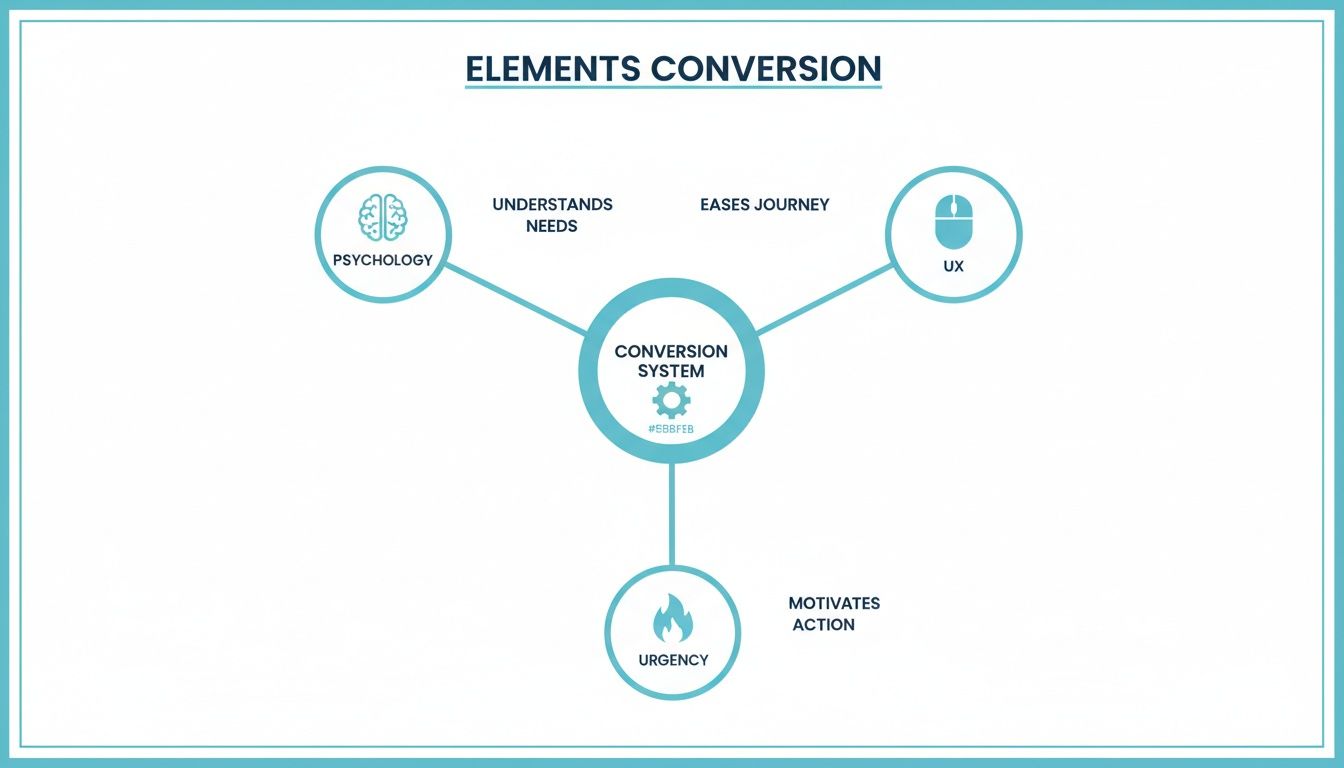
The key insight is that these are not separate disciplines; they are interconnected gears. A change in one area directly impacts the performance of the others, which is why a unified, psychologically-informed strategy is essential for maximizing revenue.
Before we dive deep into each component, let's get a high-level view of the key elements we'll be exploring.
| The 7 Key Elements of E-commerce Conversion | ||
|---|---|---|
| Element | Core Psychological Principle | Primary Business Impact |
| Value Proposition | Clarity & Perceived Benefit | Differentiates from competitors and justifies price. |
| Urgency & Scarcity | Fear of Missing Out (FOMO) / Loss Aversion | Accelerates purchase decisions and protects profit margins. |
| Calls to Action (CTAs) | Action-Oriented Guidance | Directs user behavior toward the desired revenue-generating outcome. |
| Social Proof & Trust | Safety in Numbers / Authority Bias | Reduces purchase anxiety and builds brand credibility. |
| UX & Page Performance | Cognitive Ease & Low Friction | Increases user satisfaction and reduces bounce rates. |
| Product & Pricing | Perceived Value & Anchoring | Aligns product offering with customer expectations and willingness to pay. |
| Checkout & Flow | Goal Gradient Effect / Commitment & Consistency | Minimizes friction at the final step to reduce cart abandonment (around 70% industry-wide). |
Understanding how these pieces fit together is the first step toward building a more effective—and profitable—e-commerce experience.
Mastering these elements is about more than increasing a number on an analytics dashboard; it's about protecting your profit margins and optimizing inventory management. For instance, instead of resorting to steep, site-wide discounts that erode your bottom line, a well-timed urgency campaign grounded in scarcity can move the same inventory at a much healthier margin, directly boosting ROI.
Mastering the elements of conversion transforms marketing from a cost center into a predictable revenue engine. It’s the difference between hoping for sales and engineering them based on proven consumer behavior.
For merchants on platforms like Shopify Plus, this means leveraging advanced apps and integrations to automate these principles. It’s about connecting your email and SMS tools, like Klaviyo, to build seamless, psychologically-driven journeys that feel both personal and impossible to ignore. For a broader look at applying these fundamentals, check out these valuable small business website design tips to boost conversions.
If a strong value proposition makes a customer want your product, urgency and scarcity make them feel they need to buy it now. These are not marketing tricks; they are powerful conversion drivers rooted in fundamental principles of consumer psychology. One of the most potent is loss aversion—a concept from behavioral economics showing that the pain of losing something feels about twice as powerful as the pleasure of gaining it.
A shopper might wait for a sale, but the thought of missing out on a limited-edition item activates FOMO and loss aversion. This psychological trigger flips a switch, turning a passive browser into an active buyer and driving immediate revenue.

The key is creating genuine, event-driven urgency that enhances the shopping experience with anticipation and excitement, positioning Quikly as an expert in this marketing science.
Many brands mistakenly believe "urgency" is just a countdown timer on a product page. This basic approach often feels inauthentic, leading to banner blindness and eroding customer trust. A timer that resets on refresh isn't creating urgency; it's creating suspicion. This is the critical difference between manipulative tactics and sophisticated psychology.
Effective urgency marketing transcends this model by creating exclusive, high-value "Moments" that feel genuinely special. This approach transforms a standard promotion into a memorable, revenue-generating experience.
Consider the difference:
By building campaigns around these behavioral triggers, you aren't forcing a purchase; you're inviting customers to participate in an exclusive opportunity.
A major business impact of strategic urgency is profit margin protection. Instead of running a blanket 20% off sale that devalues your brand, a limited-time product drop can move the same inventory at or near full price. This allows you to avoid the race to the bottom on pricing and train your audience to act on excitement.
For Shopify Plus merchants, this is a game-changer for inventory management. A well-planned scarcity campaign can clear seasonal stock or test a new product without the risk of a massive production run.
By framing scarcity as an exclusive opportunity rather than a limitation, brands can increase perceived value and drive immediate sales without resorting to deep discounts that damage long-term profitability.
This is where sophisticated automation is crucial. Platforms like Quikly enable you to design and launch complex, psychology-driven campaigns without manual oversight. You can configure ranked offers where the fastest customers get the best deals or create high-anticipation drops that integrate seamlessly with your Klaviyo and SMS marketing flows. You can explore a bunch of these strategies in our deep dive into scarcity marketing.
Ready to implement these strategies? Shift your thinking from generic timers to engaging events.
An urgency campaign, no matter how compelling, will fail if customers don't trust your brand. This is where social proof becomes a pillar of conversion. It taps into a fundamental human need for validation, answering the crucial question in a shopper's mind: "Do other people like and trust this?"
Social proof works because of a powerful psychological shortcut known as the "wisdom of the crowd." When uncertain, we look to the actions of others to guide our own. In e-commerce, this manifests as reviews, ratings, and user-generated content (UGC), which are powerful risk-reducers for shoppers.
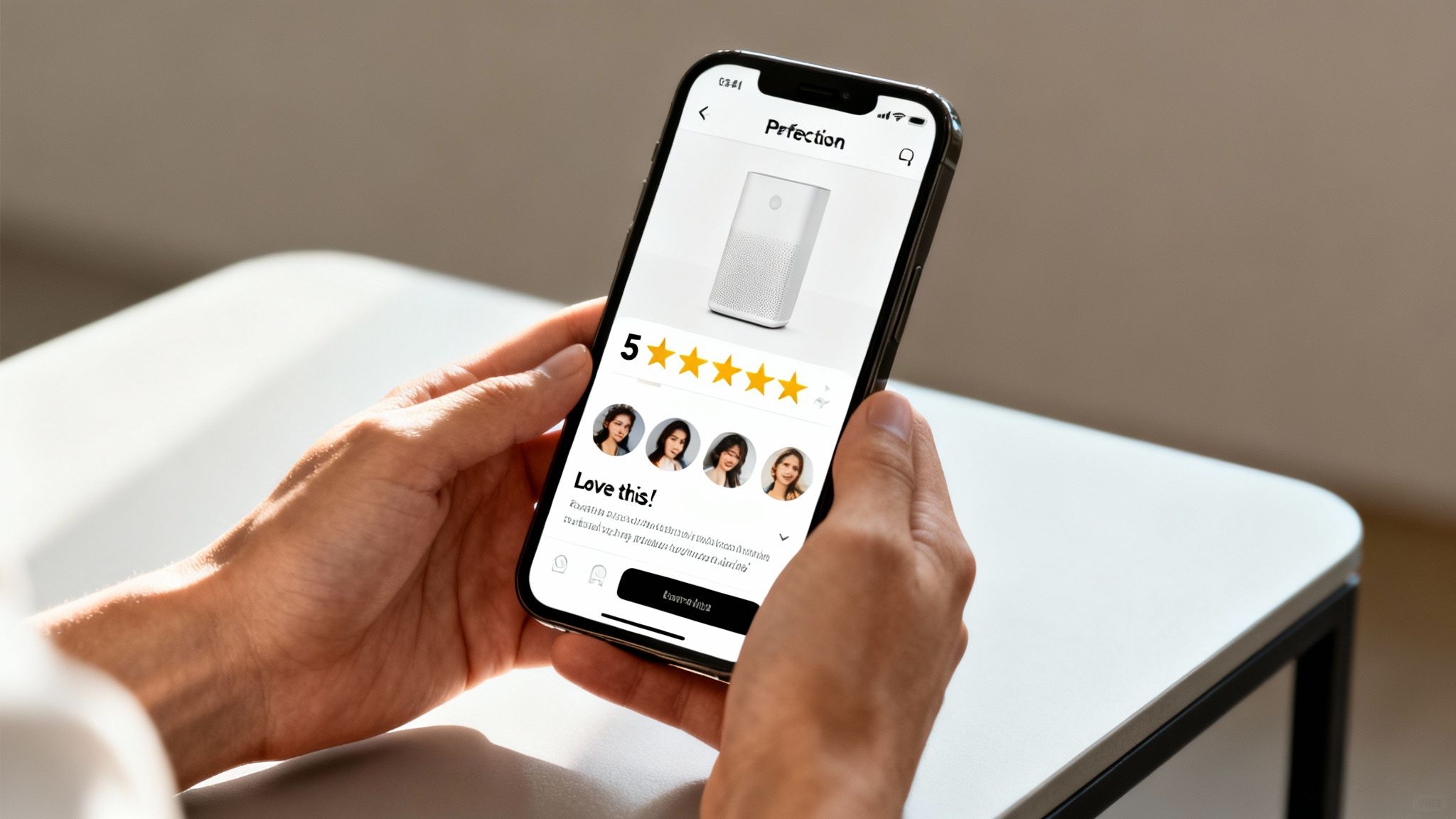
This shift from telling customers your product is great to showing them is paramount. It’s the difference between a salesperson’s claim and seeing dozens of photos of real people using and loving your product. One is a pitch; the other is proof.
While star ratings are a good start, the real conversion impact happens when shoppers actively engage with authentic content from their peers. As a potential customer explores detailed reviews and customer-made videos, purchase anxiety diminishes significantly.
Consumer psychology studies show that when users deeply engage with UGC, conversion rates can increase by as much as 102%. This isn't a static page element; it's an interactive confidence-builder that works its magic at the most critical moments of the buyer's journey.
By weaving authentic customer voices directly into the shopping experience, brands cut down on the perceived risk of buying something online—a huge hurdle for many. Social proof isn't just about testimonials; it's about building a community of trust around your products.
This is why modern brands are moving beyond simple ratings to a richer, more visual world of social proof.
For merchants on Shopify and Shopify Plus, implementing social proof effectively is achievable with the right tools and strategy. The goal is to make customer validation a seamless, natural part of the shopping journey.
Here are a few actionable takeaways:
These tactics turn social proof from a passive element into an active conversion driver. To dig into more advanced strategies for building this kind of credibility, check out our comprehensive guide to social proof.
A clunky user experience (UX) is one of the fastest ways to kill a conversion. A slow, confusing website is the digital equivalent of a store with messy aisles and no staff—customers will leave. Any friction, frustration, or delay is a direct attack on your revenue.
A good UX is built on speed and clarity. When a page takes too long to load or navigation is confusing, you're not just annoying a potential buyer; you're eroding the trust and excitement you worked to build. Every extra second of load time increases the chance of a shopper second-guessing their purchase and bouncing.

This is a massive issue for mobile shoppers. While mobile devices account for a staggering 73% of all e-commerce traffic, their conversion rates lag behind desktop—hovering around 2.49% compared to desktop's 5.06%. That gap represents a huge revenue opportunity for brands that prioritize a mobile-first design. You can explore more e-commerce benchmarks on SpeedCommerce.com.
Integrating urgency into the user journey requires sophistication. The goal is to make these psychological nudges feel like a helpful part of the experience, not an intrusive roadblock. A poorly timed, full-screen popup is the digital equivalent of a pushy salesperson—it creates resistance.
This is where a more advanced approach is necessary. Platforms like Quikly focus on minimally intrusive banners and dynamic "Moments" that enhance the shopping flow. These elements are designed to provide valuable, time-sensitive information without hijacking the user's screen or adding friction.
A great user experience makes the desired action the easiest action. When urgency is integrated thoughtfully, it doesn’t add friction; it clarifies the decision and provides a compelling reason to complete the purchase now.
By designing campaigns that respect the user’s journey, you ensure your urgency tactics amplify conversion signals instead of becoming noise.
For merchants on Shopify, nailing the UX often comes down to theme and app management. Starting with a clean, lightweight theme is critical for fast load times. From there, be disciplined about the apps you install, as each one can add code that slows your site down.
Here are a few practical steps to improve UX and speed on your Shopify store:
Every element on your page should serve one purpose: creating a frictionless path to purchase. For more ideas, check out our guide on building a website that converts.
You can have the slickest user experience and perfectly timed urgency, but a sale won't happen if your store can't answer one simple question from the customer: "What's in it for me?"
This is where your value proposition and call to action (CTA) are critical. The value prop makes the benefit of your product clear and compelling, and the CTA makes the path to getting it easy and desirable.
A strong value proposition is your brand’s promise. It's a direct, clear statement explaining the unique benefit a customer receives, why you’re better than the competition, and how you solve their specific problem.
Without that clarity, all other efforts fall flat. Urgency campaigns fizzle because customers don't understand why they should be in a hurry.
To get this right, you must stop listing product features and start articulating customer outcomes. The goal is to draw a straight line from your product’s attributes to a meaningful benefit in your customer's life.
It's less about "what it is" and more about "what it does for them." This distinction is everything, placing the focus on your customer's success.
A simple framework for your value proposition:
A compelling value proposition isn't just a marketing statement; it’s a core business asset. It justifies your pricing, builds brand loyalty, and provides the psychological foundation upon which all other conversion elements are built.
Once you’ve established why a customer should care, you must tell them exactly what to do next.
The call to action is the pivotal moment where interest converts into action. Yet, many Shopify stores rely on generic buttons like "Buy Now" or "Submit." They function, but they lack the psychological impetus needed to drive a decision.
A great CTA is clear, concise, and action-oriented. More importantly, it reinforces the value proposition by hinting at the positive outcome awaiting them after the click. It should feel like an invitation, not a command.
Notice the difference in focus:
| Standard CTA | Benefit-Driven CTA |
|---|---|
| "Shop Now" | "Explore The New Collection" |
| "Sign Up" | "Get My Free Guide" |
| "Buy Now" | "Start My 30-Day Trial" |
This subtle linguistic shift focuses on the value the user is about to receive, making the click far more appealing.
This is where the elements converge powerfully. Adding a dose of urgency to your CTA can dramatically boost its effectiveness. A standard CTA is a passive suggestion; a CTA supercharged with urgency becomes an immediate, can't-miss opportunity. The fear of missing out (FOMO) turns "maybe later" into "right now."
When Quikly powers a limited-time product drop, for example, the CTA evolves from a basic "Add to Cart" to "Claim My Spot Before It's Gone." The language itself integrates urgency directly into the action, tying it to scarcity and exclusivity.
This transforms the CTA from a simple button into the exciting final step of a time-sensitive event. The business impact is direct: you move more inventory, faster, without slashing your prices and eroding profit margins.
For any Shopify merchant, A/B testing CTA copy within these campaigns is an actionable takeaway. Test phrases like "Get The Deal" against "Unlock My Offer." Integrate these campaigns with your Klaviyo or SMS platform to deliver powerful, urgent CTAs directly to your most engaged customers.
Knowing the individual elements of conversion is one thing; architecting them into a strategy that drives revenue is another. This is where theory becomes action, using smart marketing automation to pull psychological levers that create a cumulative impact.
The goal is to create a seamless journey where value, trust, and urgency work in perfect harmony. This isn't about slapping a timer on a page; it’s about engineering a complete, psychologically-sound customer experience. To achieve this, you need a playbook of real strategies that combine these conversion elements into powerful, memorable "Moments."
Let's translate these concepts into campaigns that Shopify and Shopify Plus merchants can implement immediately. The key is to layer the elements—for example, combining strong social proof with genuine scarcity.
Here are two practical, actionable takeaways:
The best conversion strategies aren't single tactics—they're integrated campaigns. They weave social proof, scarcity, and a clear call to action into a single, compelling story that makes buying feel like an opportunity you just can't miss.
This integrated approach ensures each element amplifies the others, creating a result far greater than the sum of its parts. For any brand selling online, putting effective ecommerce conversion rate optimisation tips into practice is how you connect these strategies to boost sales.
True implementation extends beyond your storefront. The most successful brands connect these campaigns across their entire marketing ecosystem, creating a consistent experience at every touchpoint. This is where integrating with tools like Klaviyo and SMS platforms becomes essential for enterprise-level success.
Imagine launching that ranked offer. You can use email and SMS to build hype for days beforehand. You can segment your audience, sending early-access alerts to VIPs and targeted reminders to shoppers who have shown prior interest.
By automating these communications, platforms like Quikly ensure your urgency-driven campaigns feel personal and timely, not generic. This level of coordination transforms a simple promotion into a multi-channel event that drives immediate revenue and strengthens long-term customer relationships.
While all elements are interconnected, a rock-solid value proposition is the foundation. If a customer doesn't understand why they should care about your product, no amount of urgency or social proof will be effective. That said, urgency is the ultimate catalyst. It takes the interest sparked by your value proposition and converts it into immediate action, bridging the gap between consideration and purchase.
The key is authenticity. Sophisticated urgency is grounded in real value and consumer psychology, not fake pressure. Customers can easily detect inauthentic tactics, which instantly erodes trust. The difference between sophisticated urgency and manipulation is that one adds value to the customer experience, while the other subtracts from it.
The difference between sophisticated urgency and manipulation lies in authenticity. An exciting, limited-time product drop adds value to the customer experience, while a fake, endlessly resetting timer subtracts from it.
Focus on creating exciting events. A "ranked offer" campaign, for instance, rewards your most engaged fans. This approach, powered by a platform like Quikly, makes urgency a positive part of your brand experience, not a cheap trick.
Look beyond the conversion rate percentage. The true measure of success is the impact on your bottom line: revenue and, most importantly, profit margin.
When testing new conversion tactics, track these key metrics:
For example, a strategic urgency campaign that sells items at a higher margin is infinitely more valuable than a generic, sitewide discount that tanks profitability. If you're on Shopify, use your analytics to compare sales data between campaign and non-campaign periods. A/B testing is crucial for isolating the true financial impact of every change.
Ready to turn psychological insights into predictable revenue? Quikly transforms the core elements of conversion into high-impact campaigns that drive sales, protect margins, and excite customers. Discover how our urgency marketing platform can work for your Shopify store. Learn more at Quikly.