

ecommerce conversion
customer experience strategy
digital customer experiences
Thinking about launching an online store is no longer a "someday" project for small businesses—it's an essential strategy for revenue growth. It’s how you take your beloved local shop and open its doors to the entire world, reaching customers well beyond your zip code. This guide is your complete playbook for building a high-impact online store from the ground up, focusing on the ROI and business impact of every decision.
The move from brick-and-mortar shops to digital marketplaces has been massive. What used to be a supplemental sales channel is now the primary standard for retail, creating a new digital "main street" where anyone with a great product and a vision can set up shop. Small businesses are no longer confined by geography; they're competing on a global stage.
This isn't just a trend—it's a fundamental shift in consumer behavior, backed by an explosion in online shopping. Getting started is more accessible and cost-effective than ever, which has allowed millions of entrepreneurs to enter the market and compete effectively against larger brands.
The data tells a compelling story of opportunity. According to a July 2025 ecommerce growth report from tightly.io, a striking 85% of small retail stores now sell online. That's a huge leap from just 45% back in 2023. What's fueling this? Global ecommerce sales are expected to hit $5.8 trillion in July 2025 alone, with 2.7 billion people shopping online. If you want to dive deeper, you can check out their full ecommerce growth round-up to see all the trends.
The picture is crystal clear: the market isn't just growing; it's accelerating. For a small business, this is a golden opportunity to capture a piece of an ever-expanding pie and drive significant revenue growth.
Think about a small, family-owned bookstore. For years, its entire world was the foot traffic on its street. The moment they launched a Shopify store, they suddenly had a direct line to book lovers across the country. Their carefully curated collections, once a local secret, became a national brand.
Their story gets to the heart of it: ecommerce gives small businesses the power to grow in ways that were once completely out of reach. It's not just about selling products online; it's about building a resilient, future-proof business that can adapt to any economic climate.
This jump from a local operation to a global brand is the real promise of ecommerce for small business. It’s all about using technology to pour your passion into something bigger, connect with a massive audience, and build a brand that isn't defined by four walls. The next sections will walk you through exactly how to make that happen.
Picking your ecommerce platform is one of the most critical decisions you'll make when taking your business online. This isn't just a piece of software; it's the digital foundation for your entire store. Your product pages, your checkout process, and your ability to scale—it all rests on this choice. A hasty decision here can lead to significant operational headaches and lost sales down the line.
The key is to find the right fit for your specific business, not just what's popular. Carefully consider your budget, technical comfort level, and long-term business goals. The perfect platform for a local artist selling handmade jewelry is likely the wrong choice for a retailer with a large, complex inventory.
For any local store owner, the decision to sell online is a fork in the road, one that leads directly toward growth and staying relevant.
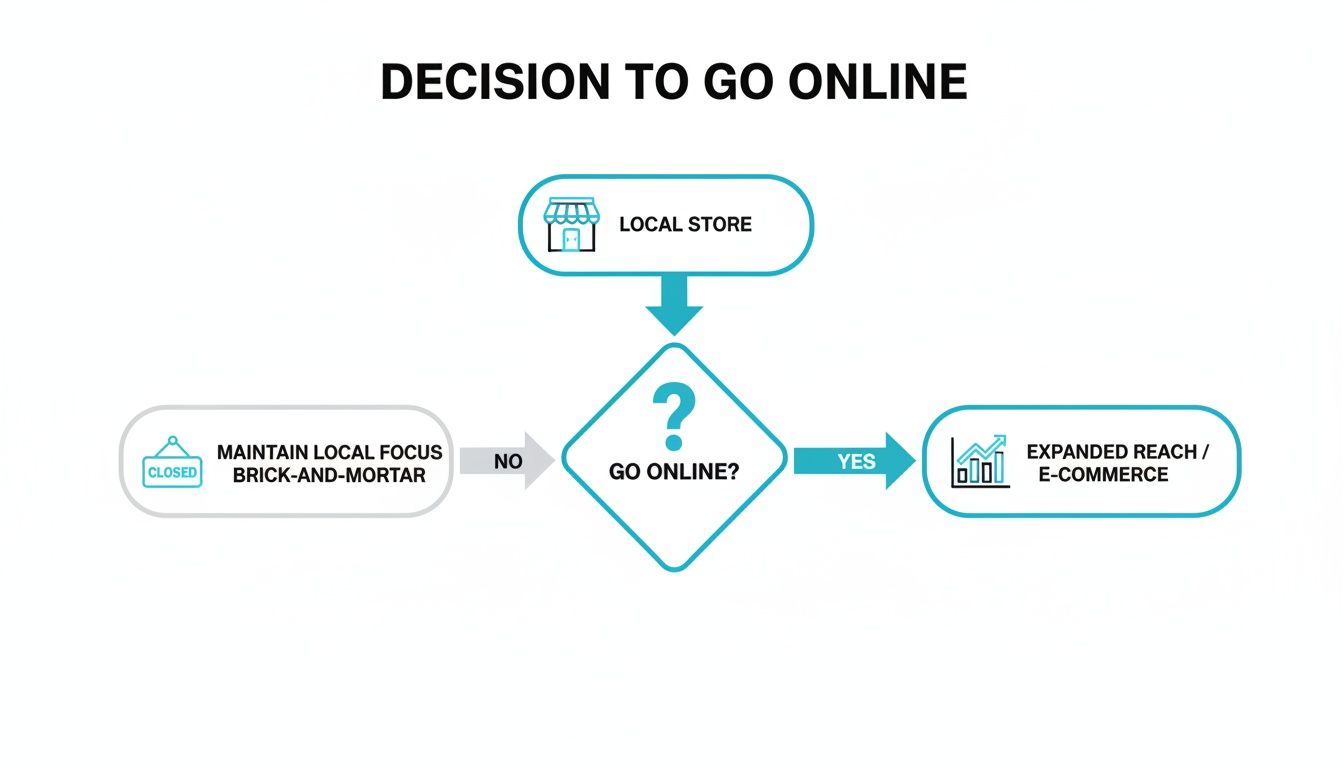
As the flowchart shows, embracing ecommerce isn't just an alternative; it's a direct path to expansion in the modern market.
Your first big decision boils down to this: do you want an all-in-one service, or do you want total control?
Hosted platforms like Shopify or BigCommerce are the all-in-one option. You pay a monthly fee, and they handle the software, hosting, security, and support. They’re built to be user-friendly, letting you get a store up and running fast without needing deep technical knowledge.
On the other hand, open-source platforms like WooCommerce (a plugin for WordPress) are free to download, but you're responsible for everything else—hosting, security, and all updates. This gives you incredible flexibility to build exactly what you want, but it comes with a much steeper learning curve. For most small businesses, a hosted platform is the quickest and safest path to generating revenue.
To help you get a clearer picture, here is a breakdown of the most popular choices. Use this as a quick-start guide to see which platform aligns with your business goals.
| Platform | Best For | Pricing Model | Ease of Use | Key Limitation |
|---|---|---|---|---|
| Shopify | Most businesses, especially those prioritizing ease of use and scalability from startup to Shopify Plus enterprise levels. | Monthly subscription + transaction fees (if not using Shopify Payments). | Very high. Intuitive for beginners. | Transaction fees can add up if you use a third-party payment gateway. |
| BigCommerce | Stores with large or complex product catalogs. | Monthly subscription, with no platform transaction fees. | High. A bit more of a learning curve than Shopify. | The theme editor can feel less intuitive than some competitors. |
| WooCommerce | Businesses that already have a WordPress site and want deep customization. | Free plugin, but you pay for hosting, themes, and extensions. | Moderate to difficult. Requires technical know-how. | You're responsible for all security, maintenance, and updates. |
| Squarespace | Creatives, artists, and service-based businesses that value aesthetics. | Monthly subscription, includes hosting. | Very high. Drag-and-drop design. | Less advanced ecommerce features and a smaller app ecosystem. |
Each of these platforms can get the job done, but the experience of building and running your store will feel completely different depending on which you choose. The "best" one is simply the one that removes the most friction for you.
Picking a platform is a lot like choosing a physical storefront. You have to think about the rent (monthly fees), how much it can grow with you (scalability), and how easily you can change the layout (design flexibility) to give your customers the best possible experience.
For a deeper dive into the pros and cons, this guide on the 7 best ecommerce platforms for small business is a fantastic resource.
A platform’s true power is often found in its app store. This is where you can integrate specialized tools to handle everything from automating your email marketing with Klaviyo to managing sophisticated inventory and SMS campaigns.
On Shopify, for instance, you can find apps that let you run psychology-driven sales events that are worlds beyond a simple countdown timer. So when comparing platforms, don’t just look at the built-in features. Dig into the app marketplace. To see what this means, check out some of the best apps for a Shopify store designed to drive sales and enhance the customer journey. This ability to add new functions is what will allow your ecommerce for small business to adapt and thrive.
So, you’ve picked your platform. Now for the most important part: building a digital storefront that turns curious visitors into paying customers. This isn't about just making something that looks pretty; it’s about crafting a smooth, trustworthy experience that naturally guides people from the moment they land on your site to the final click of the “buy” button.
Every single element of your site—from the product photos to the navigation menu—has a job to do. Getting these fundamentals right is what separates a thriving ecommerce for small business site from one that just sits there. Without a solid foundation, even the most amazing products will have a hard time finding a home.
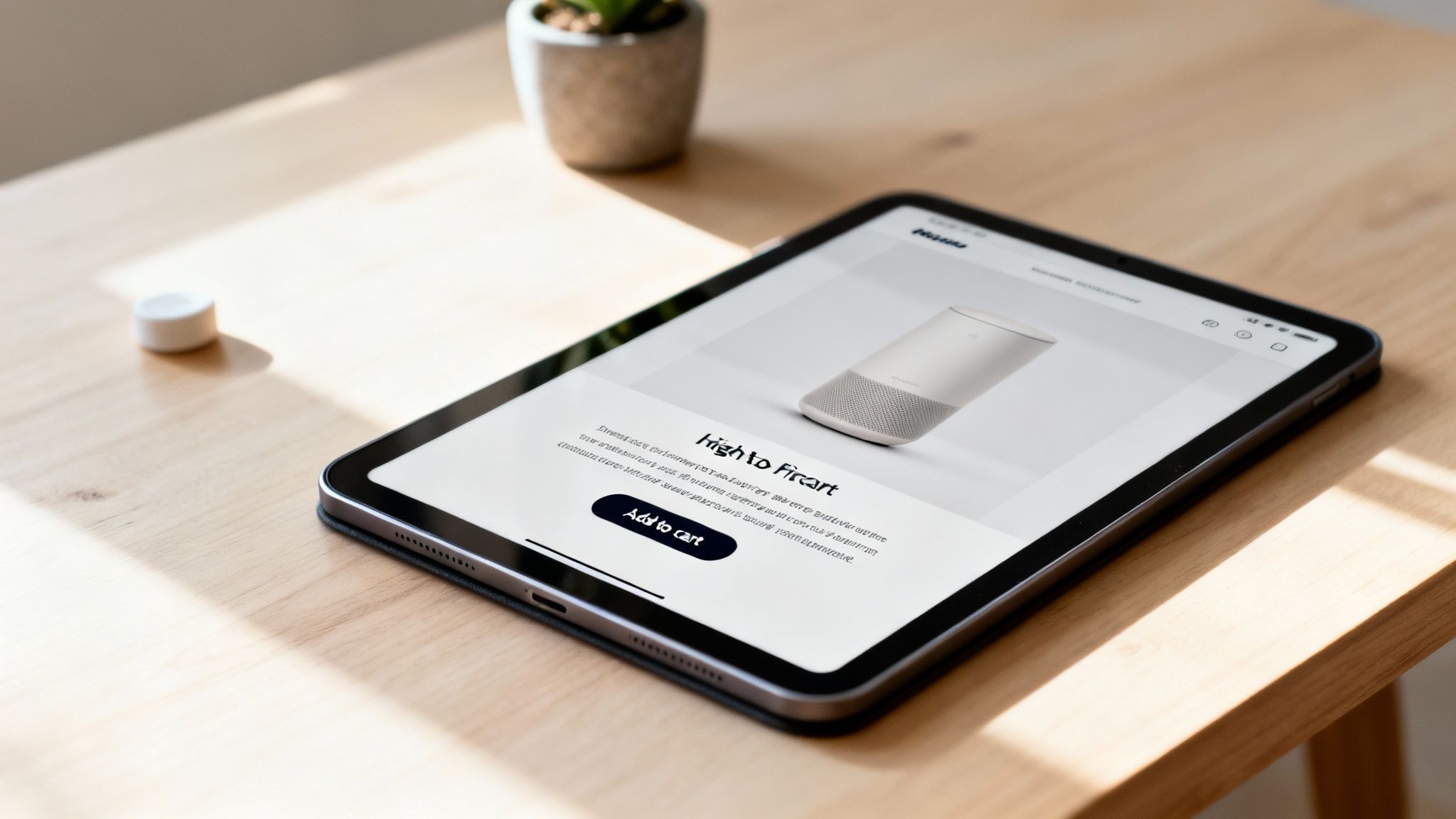
Think of your product page as your digital sales pitch. It has to do more than just list features. It needs to connect with the shopper on a human level, answer their unspoken questions, and give them the confidence to make a purchase.
High-Quality Product Photography: You don't need a fancy studio. Good lighting (natural light from a window is your best friend), a clean background, and a modern smartphone can work wonders. Show your product from every angle, show it in action, and if you can, include a short video. Visuals are everything when a customer can't physically touch the item.
Benefit-Driven Product Descriptions: Don't just list specs; translate them into benefits. Instead of saying "10,000 mAh battery," try "All-day battery life, so you're never scrambling for a charger." Use short, scannable paragraphs and bullet points to make the information easy to digest.
These two elements are the bedrock of a website that converts. They bridge the gap created by not being able to see or handle the product in person.
If people can't find what they're looking for, they can't buy it. Your site’s navigation needs to be simple and crystal clear. Imagine it as the well-lit, clearly labeled aisles in a physical store—it should feel effortless to browse.
Group your products into logical categories and use plain language for your menus (e.g., "Men's Shirts," "Skincare," "Home Decor"). A confusing menu is a one-way ticket to a lost sale. Luckily, platforms like Shopify make this incredibly easy to set up in their theme editor, no coding required.
A study by the Nielsen Norman Group confirmed that users will abandon a site if they can't easily find their way around. Your navigation is their map; a confusing one sends them straight to your competitor.
The checkout is where most online sales fail. A clunky, confusing, or slow process is the number one killer of conversions, especially on mobile, where a huge chunk of your shoppers are. The industry benchmark for cart abandonment is a staggering 70%, much of it happening right here.
Mobile commerce is not a future trend; it's the present reality. By 2025, mobile ecommerce sales are expected to hit $2.51 trillion, representing 59% of all global ecommerce. With 73% of purchases already happening on phones worldwide, a mobile-first mindset isn't optional—it's essential for survival.
Here's how to streamline your checkout:
Platforms like Shopify have invested millions into perfecting their checkout, especially for mobile users. By leveraging these built-in tools, you can offer an experience that feels as seamless as a major retailer's, which has a direct and immediate impact on your bottom line.
Once your store is beautifully designed and ready for customers, the operational work begins. An attractive website means nothing if you can't get the right products to your customers quickly and reliably. This is where inventory and fulfillment come in—the operational heart of your entire ecommerce business.
Getting this part right is what protects your profit margins, prevents stockouts, and keeps customers coming back.
Poor management here is a recipe for disaster. Selling a product you don't actually have (overselling) or running out of your most popular item instantly breaks a customer's trust. Nailing your operations is what separates a professional business from a hobby.
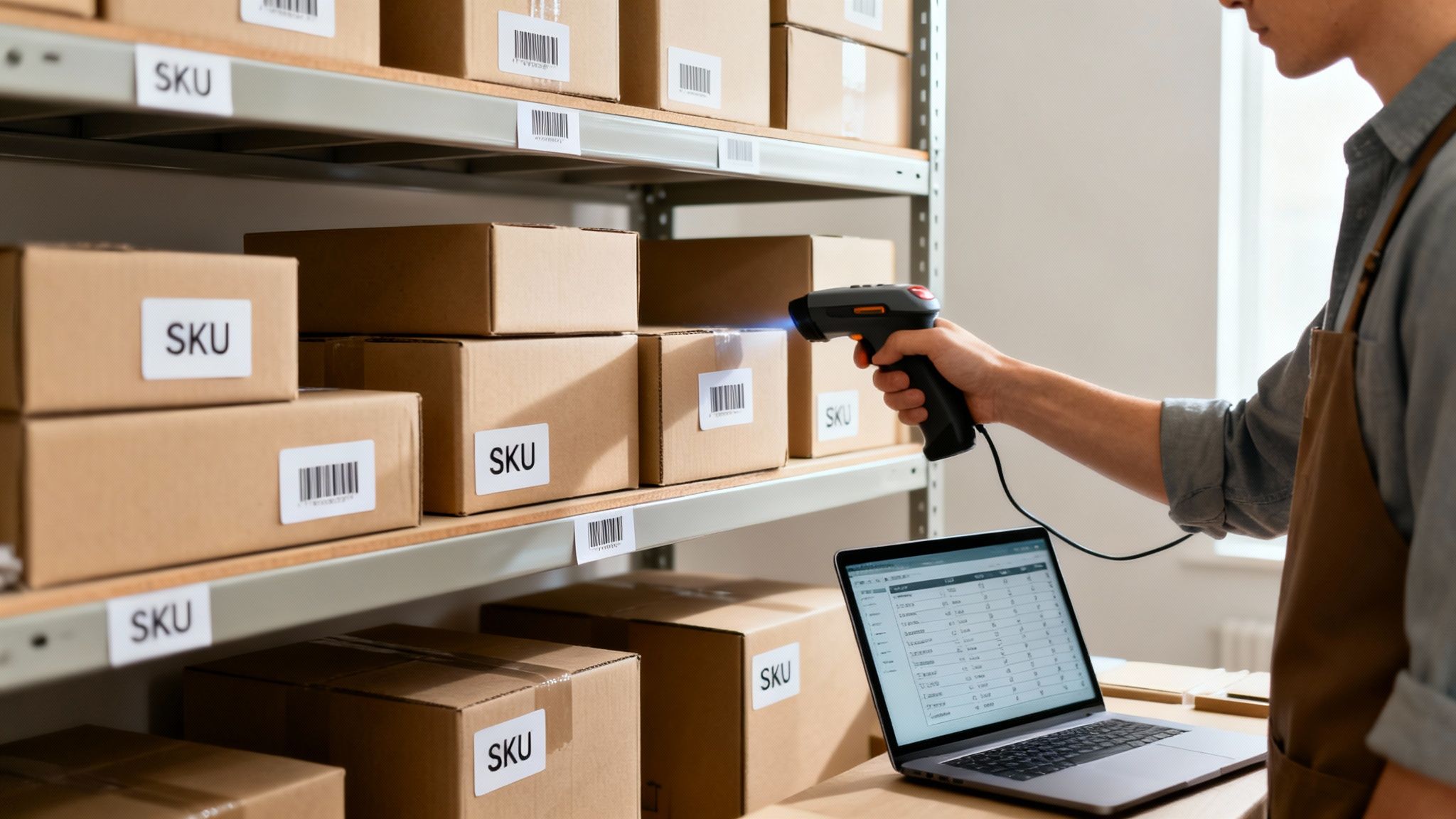
This is what modern inventory tracking looks like. Using technology to maintain accurate, real-time stock levels isn't just for big warehouses; it's fundamental for preventing costly errors that can sink a small business.
At its core, inventory management is about knowing what you have, where it is, and when you need more. The first step is getting organized. Every unique item in your store needs a Stock Keeping Unit (SKU), which is a unique code you create to track it.
Think of an SKU as a product's fingerprint. A t-shirt might have a general product name, but it needs different SKUs for each size and color (e.g., TSHIRT-BLUE-MED vs. TSHIRT-BLUE-LRG). This level of detail is essential for accurate tracking.
The good news? You don't need a complicated system to start. Platforms like Shopify have built-in inventory management tools that automatically update stock levels as sales roll in. When you add a new product, you just enter the quantity on hand, and Shopify does the heavy lifting, even stopping sales when an item sells out to prevent overselling.
An order just came in. Now, how do you get it into the customer's hands? This process is called fulfillment, and you have a few ways to tackle it.
Self-Fulfillment: This is the DIY route. You pick, pack, and ship every order yourself. It gives you maximum control over packaging quality and branding, but it can quickly become a massive time sink as your business grows. It’s the perfect place to start.
Third-Party Logistics (3PL): Here, you outsource storage and shipping to a specialized company like ShipBob or Flexport. You send your inventory to their warehouse, and they handle the entire fulfillment process. It frees you up to focus on growth, but it comes with service fees.
Dropshipping: With this model, you never touch the product. When a customer places an order, you forward it to your supplier, who then ships the product directly to them. This is the lowest-cost way to get started, but it also offers the slimmest profit margins and almost no control over the customer experience.
The right fulfillment strategy is a balancing act between cost, control, and your own time. What works for a brand-new business shipping a few orders a week is completely different from what a growing merchant handling hundreds of daily transactions needs.
Your fulfillment strategy has a direct impact on your bottom line. Shipping costs, boxes, tape, packing materials, and your own time all chip away at your profit margins. Managing these expenses efficiently is key to financial health.
For example, a 3PL can often get much better shipping rates than a small business ever could, which can sometimes offset their fees. But if you’re self-fulfilling, platforms like Shopify can help by offering their own discounted shipping rates with major carriers.
As you grow, these decisions become even more critical. Packing boxes yourself will eventually become a bottleneck, physically limiting how many orders you can ship. Knowing when to make the leap to a 3PL is a huge moment for any growing brand—it lets you meet rising demand without letting service quality slip. Shopify’s app ecosystem is full of seamless integrations with major 3PLs, making that transition much less intimidating.
Getting your online store built is a huge step, but it’s only half the battle. A store without visitors is like a shop on a street nobody walks down. To succeed in ecommerce for small business, you need a steady stream of the right kind of people coming to your site—people who are actively looking for what you sell.
This isn’t about just hoping customers find you. It’s about building a smart, multi-channel marketing plan that gets you noticed, earns trust, and guides potential buyers to your checkout page. Let's break down the core strategies that deliver the best ROI for small businesses.
Search Engine Optimization (SEO) is the art of getting your store to show up at the top of Google's search results. When someone types in "men's classic crewneck t-shirt," you want your product to be one of the first things they see. This is a long-term strategy that brings in free traffic from people who are already in a buying mindset.
For an ecommerce store, this starts with your product pages. Each page needs to be fine-tuned for the specific words a real customer would use.
Platforms like Shopify have many of these SEO tools built right in, so you can easily edit titles, descriptions, and alt text without being a technical expert.
Your email list is one of the most valuable assets your business will ever own. Unlike your social media followers, you have complete control over this list. It’s a direct line to your most loyal customers, and you don’t have to worry about an algorithm change tanking your reach overnight.
You should be focused on building an email list from day one. A simple and effective way to do this is to offer a small incentive—like 10% off a first purchase—in exchange for an email. Tools like Klaviyo integrate directly with Shopify and let you automate welcome emails, send promotions, and even win back customers who abandoned their carts.
Think about this: a mind-boggling 70% of online shopping carts are abandoned before the customer pays. An automated email reminding someone about the items they left behind is one of the most powerful ways to get that sale back.
Another smart move is to use tools like live chat support services. They can answer questions in the moment and grab a visitor's email, stopping cart abandonment before it even happens.
So you've got people on your site. The next hurdle is getting them to actually click "buy." This is where the psychology of urgency marketing comes in. This is not about high-pressure sales tactics; it's about applying proven principles from behavioral economics to overcome hesitation. With the average ecommerce conversion rate sitting around a paltry 2.5%, there's a huge opportunity here.
Modern urgency marketing is far more sophisticated than a basic countdown timer. It's about creating "Moments"—highly anticipated, limited-time events that tap into core human instincts.
This is exactly what we specialize in at Quikly. We help brands build automated, high-impact campaigns that transform the shopper's journey. Instead of a generic popup asking for an email, these "Moments" are engineered to drive revenue directly. They turn passive browsers into active buyers and help you move inventory without slashing prices and hurting your brand. It’s about making sophisticated psychology a core part of your revenue strategy, not just a gimmick.
Running an ecommerce business without tracking your numbers is like driving with your eyes closed. You might be moving, but you have no idea where you're going. To get past the guesswork and start making decisions that actually grow your revenue, you must learn the story your data is telling you. This means focusing on the key performance indicators (KPIs) that truly reflect the health and potential of your store.
It's easy for small business owners to get sidetracked by "vanity metrics" like website visits or social media likes. While they feel good, they don't pay the bills. Actionable insights come from numbers directly tied to your profit margins and long-term survival. The good news is, platforms like Shopify have powerful analytics dashboards that put this critical info right at your fingertips.
Take a look at this screenshot from a typical business dashboard. It shows essentials like Total Sales, Online Store Sessions, and Conversion Rate, giving you a clear, immediate snapshot of business performance.
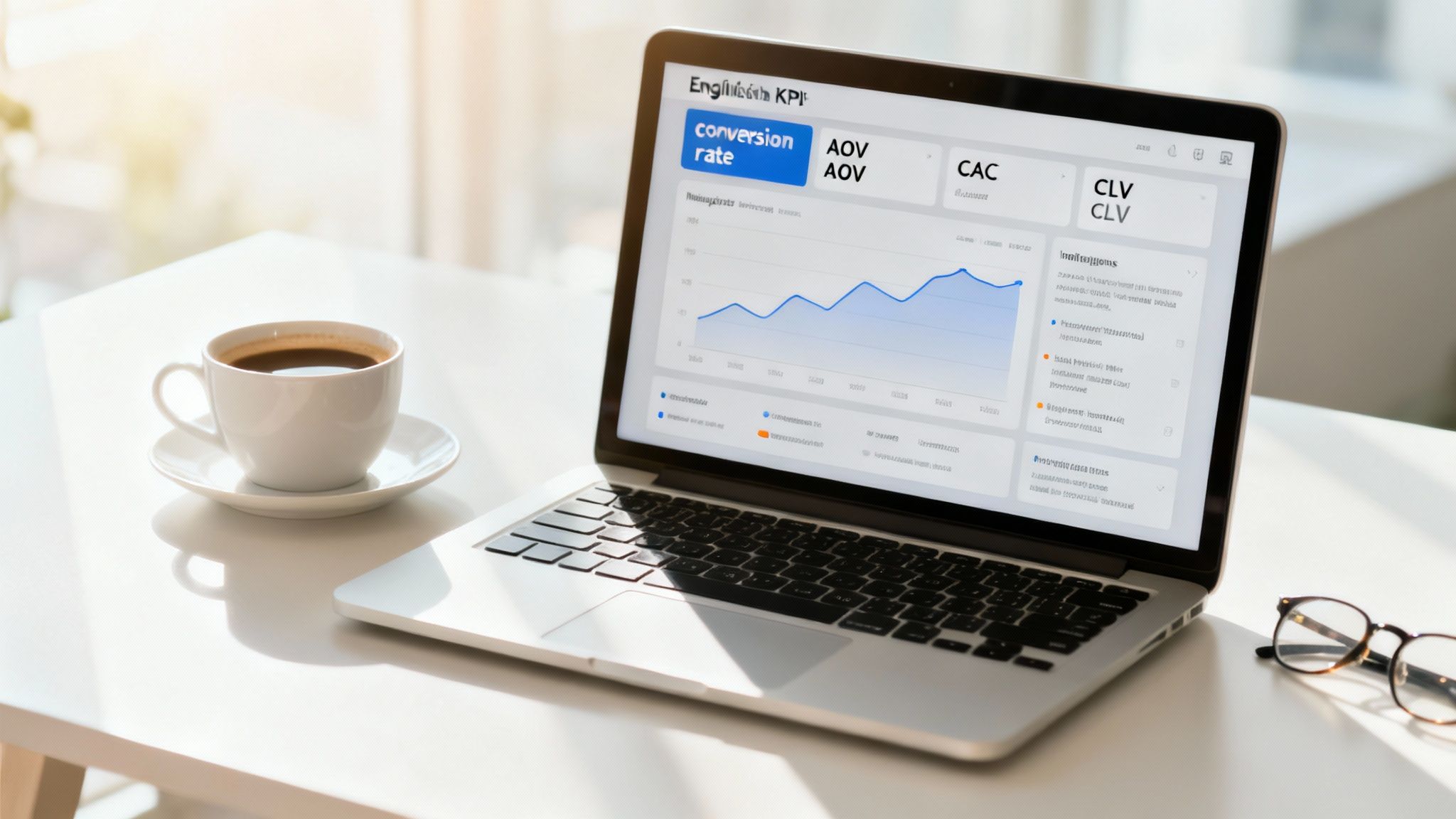
When you know how to read this data, it doesn't just tell you what happened yesterday. It shows you exactly where your biggest opportunities for growth are hiding.
If you want to turn data into real growth strategies for your ecommerce for small business, start by obsessing over these four foundational KPIs. They paint a complete picture of your performance.
Conversion Rate (CR): This is the percentage of visitors who actually buy something. If 100 people land on your site and two make a purchase, your conversion rate is 2%. A stubbornly low number here might indicate a problem with your product pages, pricing, or checkout process.
Average Order Value (AOV): This metric tells you, on average, how much a customer spends in a single order. Finding ways to increase your AOV, perhaps through product bundles or a simple upsell, is one of the fastest ways to increase revenue without needing new traffic.
Tracking AOV is critical. A higher AOV often means you can spend more to acquire a customer while still maintaining healthy profit margins, giving you a significant competitive advantage.
Customer Acquisition Cost (CAC): How much does it cost you to get one new customer? That's your CAC. You find it by taking the total cost of your marketing and sales efforts and dividing it by the number of new customers you brought in. You have to know this number to ensure your ad campaigns are actually profitable.
Customer Lifetime Value (CLV): This is a projection of the total revenue you can expect from a single customer over their entire relationship with you. The ultimate goal? To have a CLV that is significantly higher than your CAC. That's the hallmark of a truly sustainable and profitable business.
Jumping into ecommerce for the first time usually brings up a wave of practical questions. Getting straight answers to these common hurdles is often the key to feeling confident enough to get started. Let’s tackle some of the most frequent questions we hear from founders.
This is the big one. The true cost can swing wildly, but let's break down a realistic starting point. A basic store on a platform like Shopify starts at around $30 per month. On top of that, you’ll need a domain name (about $15 per year), and you'll likely want a few essential apps, which can range from free to $50+ per month. Then, of course, there's your initial inventory.
For a small, focused launch, a starting budget between $500 to $2,000 is a solid ballpark. This gives you enough runway for your platform fees, some simple branding, and your first small batch of products. The key is to start lean and then reinvest your profits back into the business to fuel its growth.
Yes, you absolutely should. Registering as a sole proprietorship or LLC is one of the smartest first moves you can make. It’s all about protecting your personal assets—like your home or car—from any business liabilities. Think of it as building a firewall.
This legal structure also lets you open a dedicated business bank account, which will make tracking your finances clean and simple come tax season. Registration rules change depending on where you live, so always check with your local city and state authorities to get the specifics on licenses and taxes before you make that first sale.
It’s easy to get tripped up when you’re new to the game. Most entrepreneurs stumble over the same few issues. If you can sidestep these common pitfalls, you’ll be way ahead of the curve.
Turn casual browsers into committed buyers with urgency marketing grounded in consumer psychology. Quikly helps Shopify brands create high-impact "Moments" that boost revenue and move inventory without deep discounts. See how it works.