

ecommerce psychology
brand loyalty
best brand experiences
To effectively create urgency in sales, brands must move beyond basic countdown timers and embrace the science of consumer psychology. True urgency is generated by tapping into core behavioral triggers like scarcity, FOMO (Fear of Missing Out), and social proof. This guide explains how to shift shoppers from passive browsing to active buying, making the decision to purchase right now feel like the smartest, most compelling choice. The result isn't just a higher conversion rate; it's a direct and measurable impact on revenue and profit margins.
For a long time, the go-to tactic for creating urgency was slapping a ticking clock on a product page. While timers can work, they often just scratch the surface of a shopper's psychology and fail to deliver significant ROI.
Real urgency marketing is a sophisticated strategy rooted in decades of behavioral economics research. It's the art of creating compelling "Moments"—a term we use at Quikly for next-generation urgency marketing—that make immediate action feel like the most natural, beneficial thing a customer can do.
This isn't about manipulation; it's about aligning your offer with fundamental human drivers. A generic popup timer might capture an email address, but it rarely inspires someone to complete a high-value purchase. A well-orchestrated urgency campaign, on the other hand, can do much more. It can significantly lift revenue, protect your profit margins by reducing the need for constant discounts, and even help you manage inventory more effectively.
The most powerful urgency strategies are all built on a foundation of proven psychological principles. Understanding these concepts is the first step to moving beyond basic tactics and toward a strategy that actually drives revenue.
So, what’s really going on in the shopper’s brain? It usually comes down to a few key triggers.
Scarcity: A core principle of behavioral economics, scarcity dictates that people place a higher value on things they perceive as being in short supply. When a product is framed as rare or limited, its desirability skyrockets. This is why "limited edition" drops or "Only 3 left!" stock alerts are so effective. They trigger a primal fear of loss (loss aversion), pushing someone to buy now to avoid the pain of missing out.
Fear of Missing Out (FOMO): A close cousin of scarcity, FOMO is the anxiety that something exciting is happening and you're not a part of it. In e-commerce, it’s the feeling that other shoppers are snagging a great deal or a must-have product that you’re about to miss. Tactics that show how many other people are looking at an item tap directly into this powerful emotion, a concept explored in consumer psychology studies on social comparison.
Social Proof: As social creatures, we constantly look to the actions and opinions of others to guide our own decisions. When a shopper sees that a product is popular—whether through reviews, testimonials, or real-time purchase notifications—it validates their own interest and builds immediate trust. It cuts through the friction of decision-making and gives them the confidence to click "buy now."
This concept map breaks down how these three pillars—scarcity, FOMO, and social proof—work together to form a truly effective urgency strategy.
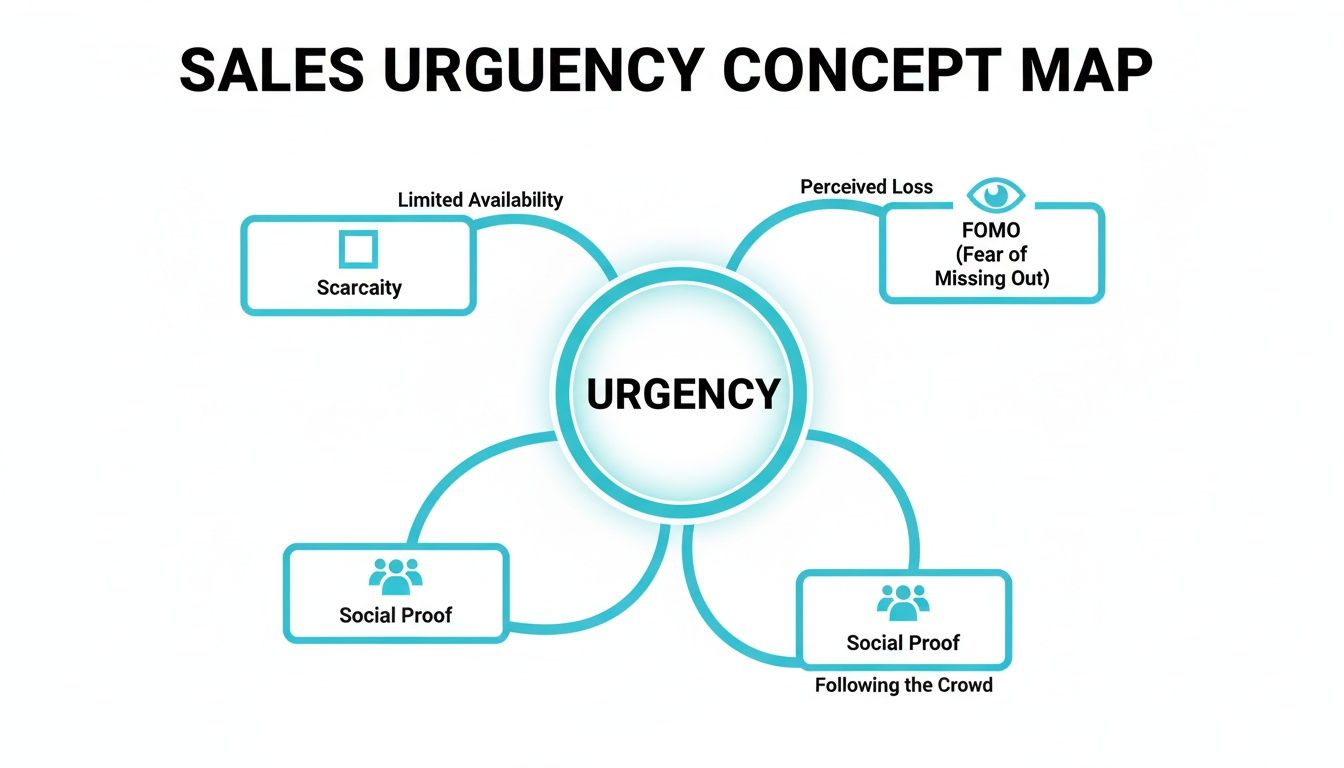
As you can see, the real power comes from the interplay between these fundamental behavioral drivers.
The following table connects these psychological principles directly to the shopper behaviors they influence and the business outcomes you can expect.
| Psychological Principle | Effect on Shopper Behavior | Key Business Outcome |
|---|---|---|
| Scarcity | Creates a perception of higher value and triggers a fear of potential loss. | Higher perceived value allows for premium pricing and protects profit margins. |
| FOMO | Induces anxiety about missing out on a popular item or a great deal others are getting. | Accelerates the purchase decision, shortening the sales cycle and increasing sales velocity. |
| Social Proof | Builds trust and validates the shopper's choice by showing others approve of the product. | Reduces cart abandonment and increases overall conversion rates. |
By weaving these elements into your banners, popups, and the entire shopper's journey, you create a much more compelling and authentic reason for customers to act immediately.
Consider this: the average e-commerce store sees a cart abandonment rate stubbornly stuck around 70% and a conversion rate of just 2.5%. The basic popups and timers we've all seen have barely made a dent in those numbers because they fail to create real, science-backed motivation.
A sophisticated urgency strategy moves beyond simple timers. It automates the deployment of behavioral triggers across the entire shopper journey—from banners and popups to emails and SMS—to create a cohesive and compelling narrative that drives immediate action and revenue.
Instead of a generic, one-size-fits-all approach, modern platforms like Quikly let brands build dynamic "Moments" that feel exclusive and authentic. This is the crucial difference between a tactic that merely collects an email and a strategy that converts customers.
For Shopify Plus merchants, in particular, being able to implement these ideas at scale without slowing down your site is a huge deal. If you want to dig deeper, it’s worth reviewing some advanced Shopify urgency tactics that go beyond the basics. By truly understanding and applying these psychological principles, you can build a powerful system that not only lifts your conversion rates but also strengthens your brand’s bond with its audience.

Seeing something you want is one thing; seeing that it's about to be gone forever is a powerful motivator.
This isn't just a sales trick; it's a core principle of behavioral economics. People inherently place more value on things they see as rare. When you use scarcity correctly, you’re not just creating a temporary sales spike—you're protecting your profit margins and even streamlining your inventory strategy.
The idea is simple: the harder something is to get, the more we want it. It’s a powerful way to bypass the race-to-the-bottom discounting that eats away at your margins. Instead of begging customers to buy with a cheaper price, you’re giving them a compelling reason to buy now: the risk of missing out completely. That simple shift is a game-changer for brand value and ROI.
Case studies have repeatedly shown the power of this principle. Marketing campaigns that lean into scarcity can see conversion rates jump significantly. Even a small tweak, like showing a message that says "Only 3 left," has boosted purchases by an incredible 226% in some A/B tests. That’s the raw power of perceived rarity.
The most believable way to create scarcity is with your actual inventory levels. A countdown timer can feel arbitrary, but a dwindling stock count is a real, tangible constraint that customers instantly understand and trust.
A simple "Low Stock" badge is a start. But the real magic happens when you get more specific.
Actionable Takeaway: Quantity-based scarcity isn't about selling out as fast as possible. It's about giving on-the-fence shoppers a nudge, turning browsers into buyers before they have a chance to abandon their cart.
This is a fundamentally different play than a simple email pop-up. The goal here is driving revenue and moving product, not just collecting leads.
Scarcity is also a secret weapon for inventory management, especially for larger Shopify Plus brands dealing with last season's stock. The typical solution is a deep clearance sale, which can cheapen your brand image.
There's a better way.
Instead of a "50% Off Sale," reframe it as a "Limited Archive Drop" or a "Last Chance Collection." Suddenly, you’re not selling discounted leftovers; you're offering up rare finds. This positions scarcity as sophisticated psychology, not manipulation.
Imagine a fashion brand with a pile of inventory from last season. The old way is to dump it in the sale section. The scarcity-driven way looks like this:
This strategy doesn't just clear out old stock; it often does so with a higher average order value and healthier margins than a standard clearance sale. You’ve turned a logistics headache into a marketing moment that actually makes your brand more desirable.
To really nail these campaigns, check out our deep dive on effective scarcity marketing. When you master scarcity, you stop just creating temporary urgency and start building a smarter, more profitable e-commerce machine.
There’s a massive difference between slapping a generic timer on your site and orchestrating a genuine, time-bound marketing event. Scarcity is about what your customer might lose (the product), but time-sensitivity is all about when they'll lose it (the opportunity). That feeling of time pressure is a classic principle of behavioral economics, and it's incredibly effective at pushing consumers past decision paralysis and into action.
The real goal here isn't just to sell something; it's to create an event. A well-planned flash sale or a limited-time drop turns shopping from a simple transaction into an exciting, can't-miss moment. This is how you generate those big, immediate revenue spikes—it’s a powerful tool for smashing sales targets and clearing out inventory when you want to.
Forget those basic popup timers that feel random and disconnected. A real time-sensitive campaign is a fully integrated marketing push. It's about strategically aligning your inventory, your email and SMS marketing (via platforms like Klaviyo), and your on-site experience to give customers a cohesive, compelling reason to buy right now.
A truly successful flash sale is way more than a discount. It's a carefully planned sequence of events built to create anticipation and drive maximum sales velocity. Just dropping a sale out of the blue is a recipe for a lukewarm response. But a structured approach? That can turn a simple promotion into a major revenue driver.
Here’s a practical way to run a 24-hour flash sale, say, on your Shopify store:
This kind of multi-touchpoint strategy isn't just about creating urgency. It's about guiding your customer along a well-defined path that ends in a purchase.
If you're constantly running sales, you'll eventually create "urgency fatigue." Your customers will just learn to wait for the next discount. To dodge this, you need to frame your campaigns around exclusivity and value, not just a cheaper price tag.
Think about these alternatives instead of a straight percentage-off sale:
These tactics shift the focus from "cheaper" to "more valuable." The urgency comes from the fleeting nature of the extra value, not just a temporary price drop, which is crucial for protecting long-term brand equity and profit margins.
Industry reports consistently show that well-executed flash events can drive revenue uplifts of 30–35% over a typical promotional day. It's a proven formula: combine a clear offer, a firm deadline, and a visual countdown, and you'll see a real increase in both how fast people buy and how much they spend.
To give those revenue spikes an extra kick, build urgency into your abandoned cart sequences. You can dig into some proven strategies for abandoned cart emails to see how it’s done. Weaving in time-sensitive reminders like, "Your cart's special offer expires in 3 hours," helps recapture sales you would have otherwise lost. It’s the perfect complement to your main campaign. Platforms like Quikly can even automate these behavioral "Moments," making sure your message hits at just the right time, without you having to lift a finger.
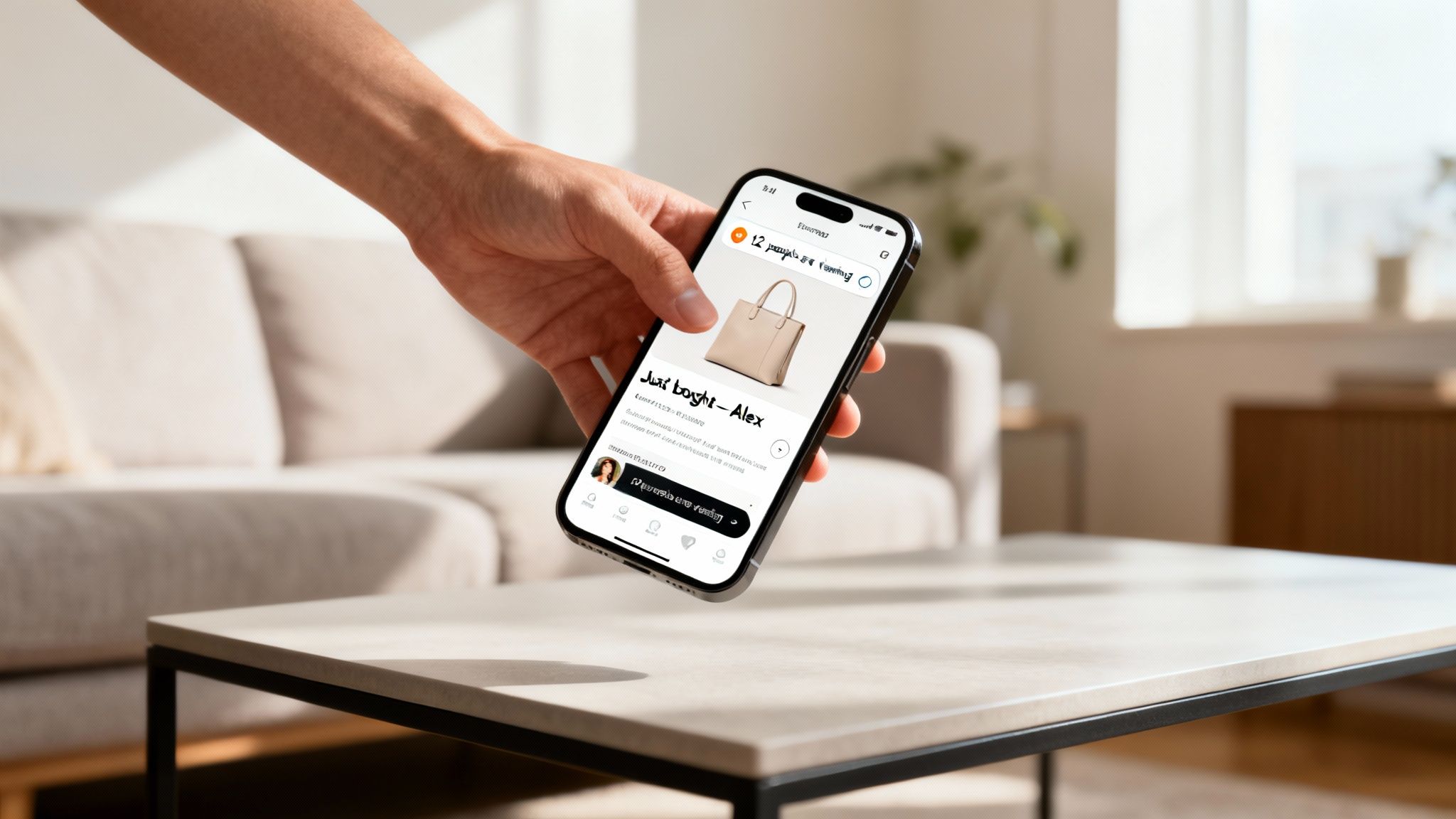
Scarcity and time limits tap into a basic human fear of loss—losing out on a great product or a special deal. But things become even more powerful when you layer in social proof and its close cousin, FOMO.
Suddenly, it’s not just about a potential loss. It’s about the fear of being left behind by everyone else. This combination can flip passive browsing into an active, almost competitive experience that pushes shoppers to make a decision.
Humans are wired to follow the crowd. It’s a psychological principle called informational social influence, and it’s a huge driver of behavior. When a potential customer sees other people are interested in a product, it instantly validates their own taste and builds trust. It’s no longer just you, the brand, telling them an item is great; the actions of their peers are proving it in real-time.
This kind of validation is exactly what’s needed to combat the hesitation that leads to the industry's jaw-dropping 70% average cart abandonment rate.
The goal here is to make your online store feel alive—like a busy, bustling retail shop. A static product page is a lonely experience. A dynamic one, however, creates a sense of community and friendly competition. Instead of just a simple timer ticking down in a vacuum, you can introduce advanced behavioral triggers that showcase real-time shopper activity.
This is where sophisticated platforms go way beyond the basic email capture pop-ups. The objective isn't just to grab a lead; it's to close a sale and drive revenue right now.
Here are a few actionable takeaways to bring this to life:
For enterprise-level merchants, especially those on a platform like Shopify Plus, the challenge is implementing these features at scale without dragging down site performance. Automated systems, like Quikly's "Moments," can manage these behavioral triggers for you, making sure they fire at just the right point in the customer journey without any manual babysitting or site lag.
A dynamic shopping environment turns the isolated act of online browsing into a shared, competitive experience. By showing shoppers they aren't alone, you leverage social influence to create a powerful and authentic reason to complete their purchase now.
While these tactics are rooted in psychology, their real value is measured on your P&L. Creating this kind of competitive energy doesn't just feel exciting for the shopper; it has a direct impact on key business metrics like revenue and margin.
When you clearly demonstrate that a product is in high demand, you often protect your margins. Popular items don't need deep discounts to sell, which preserves their perceived value. On top of that, this active environment speeds up the decision-making process, shortening your sales cycle and boosting inventory turnover.
You can dive deeper by exploring this comprehensive guide to social proof and how its principles apply across your entire marketing strategy.
The real magic happens when you weave these tactics into your entire marketing ecosystem. A shopper might see a "selling fast" banner on your site, then get a follow-up email through Klaviyo that mentions the same product's popularity. A last-chance SMS can then close the loop, creating a cohesive and persuasive story across all channels.
This multi-channel approach makes sure the message of social proof and FOMO is consistent, reinforcing the urgency at every single touchpoint. By automating these sophisticated triggers with Quikly, you can move beyond the limits of a simple timer and build a powerful system for accelerating revenue.
So you've launched an urgency campaign. That's a great start, but it's really only half the battle.
If you don’t have a clear way to measure what’s working, you're just flying blind. An effective urgency strategy isn’t something you just set and forget. It’s a living system that needs constant fine-tuning based on real data to actually move the needle on your bottom line.
This means looking past surface-level metrics, like a temporary spike in your conversion rate. The real success is found in the KPIs that speak directly to the financial health of your business.
To really get a handle on how your urgency campaigns are performing, you need to zero in on a few high-value metrics. These numbers don't just tell you if a campaign worked; they show you how it helped your business grow in a meaningful way.
When you shift your focus to these core business metrics, the conversation changes. It's no longer about just driving clicks; it's about building sustainable, profitable growth. That’s the real difference between a basic timer app and a sophisticated urgency marketing platform like Quikly.
The only way to figure out what truly clicks with your audience is to test, test, and test again. When you have a structured approach to experimentation, you can systematically improve your results, turning what was once guesswork into a predictable science.
When you’re ready to start refining, using techniques like multivariate vs. A/B testing is the way to go. This approach gives you the hard data you need to understand which specific elements are resonating and helps you dial in your messaging for maximum impact.
Here’s a simple framework you can use to start testing your urgency elements:
Test Your Messaging
Try out different copy to see what compels people to act. You could compare:
Test Your Timing
Play around with how long your campaigns run and how often you run them. You might find that a tight 24-hour flash sale creates a much stronger sense of immediacy—and better results—than a 72-hour event. You could also test sending a "last chance" SMS alert three hours before a sale ends versus six hours.
Test Your Offer Structure
Don’t just fall back on the standard percentage-off discount. Experiment with different value propositions to see which one drives the highest AOV while still protecting your margins. For example, pit these against each other:
By constantly analyzing the results from these tests, you'll start to build a playbook of what works for your specific audience. Platforms like Quikly can automate the nuts and bolts of these campaigns, freeing you up to focus on the big-picture strategy and analysis instead of getting bogged down in manual work. This cycle of continuous optimization ensures your efforts to create urgency in sales get more effective—and more profitable—every single time.
When you start digging into sales urgency, a lot of questions come up. It's a powerful tool, but it has to be handled with care. The goal is to build excitement and boost sales by leaning on proven psychology, not by making your customers feel pressured or manipulated.
Let's walk through some of the most common questions we hear from brands who are just getting started.
This is easily the most important question, and the answer comes down to one word: authenticity.
Ethical urgency is always grounded in reality. It’s based on genuine limitations, like actual inventory counts or firm campaign end dates. If you tell a customer there are only 10 items left, it’s because there really are only 10 items left. This positions urgency marketing as sophisticated psychology, not manipulation.
You cross a line the moment things become deceptive. Think fake countdown timers or made-up scarcity claims. That kind of tactic torches customer trust and can seriously damage your brand in the long run. Real urgency marketing respects the customer by giving them transparent, helpful information that empowers them to make a good decision, quickly.
There isn’t a magic number here, but the main goal is to sidestep "urgency fatigue." If everything is always urgent, then nothing is. Your customers will just learn to tune you out.
A good rule of thumb is to tie your big urgency-driven events to your natural retail calendar. Think quarterly sales, a big product launch, or seasonal clearances. These feel like genuine events worth paying attention to.
On the other hand, for automated, everyday urgency—like low-stock alerts or social proof pop-ups showing recent purchases—you can let those run all the time. They feel less like a "SALE!" and more like helpful, real-time info that’s just part of the shopping experience.
The idea is to make your campaigns feel like special moments, not a constant state of emergency. This keeps them effective and protects your margins, because customers won't just sit back and wait for the next inevitable discount.
People often use these terms interchangeably, but they're actually two different psychological triggers. They work together beautifully, but they aren't the same thing.
The real magic happens when you combine them. A campaign that says, "Only 50 units available for the next 48 hours" is the perfect one-two punch. It layers scarcity (the quantity) with urgency (the time), giving customers an incredibly powerful reason to act now. Once you get the hang of blending these two, you can create some truly effective sales moments that feel both exciting and authentic.
Ready to move beyond basic discounts and build a sales strategy with sophisticated, psychology-driven urgency? See how Quikly can help you create compelling marketing moments that accelerate revenue and delight customers. Get started with Quikly today.