

ecommerce conversion
customer experience strategy
digital customer experiences
A truly great conversion optimization strategy is about more than just nudging your conversion rate up a few points. It's a systematic approach to understanding the psychology of your customer journey to drive measurable growth in revenue and profit—not just clicks.
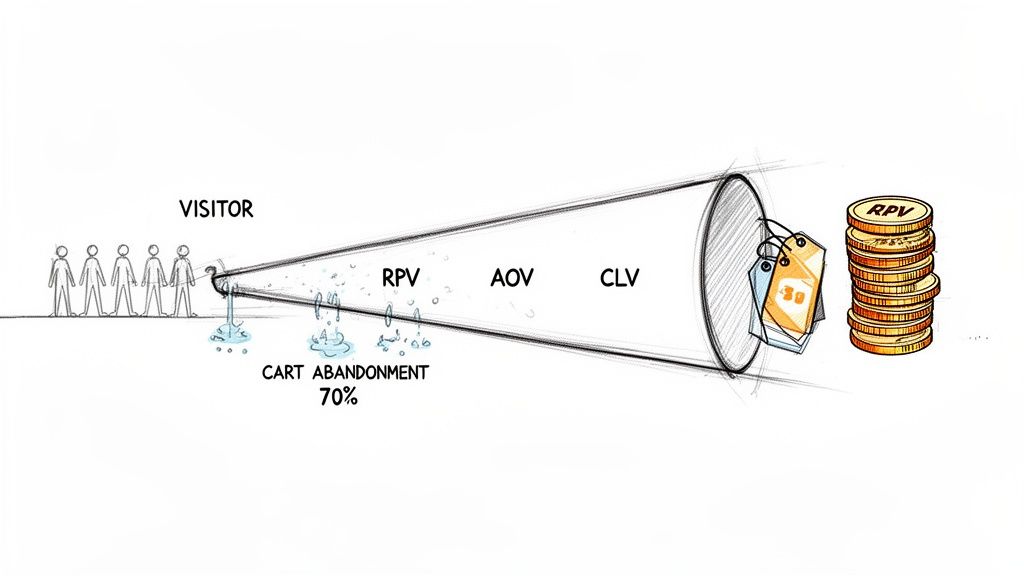
Most brands start by focusing on the basic conversion rate—the percentage of visitors who buy something. It’s a decent starting point, but it barely scratches the surface of what’s actually driving your business.
A sophisticated CRO strategy redefines success. The goal shifts from simply getting more people to buy, to maximizing the revenue impact of every single visitor. For a deeper look at the fundamentals, this guide on building A Winning Conversion Optimization Strategy is a great resource.
It helps to know where you stand. The average e-commerce conversion rate hovers between 1.9% and 3%. Shopify nudges its merchants toward a 2.5% to 3% target. But this number varies widely by niche; sectors like beauty and wellness can see rates as high as 6.8%.
Fixating on that one number can be a trap. If you double your conversion rate but cut your average order value in half, you haven't really won. The real goal is to build a system that grows the entire business, not just one metric.
A smarter strategy zeroes in on metrics that tie directly to your bottom line. These KPIs provide a clearer picture of your funnel’s health and profitability, showing you where you’re leaking revenue, not just losing visitors.
You should be prioritizing metrics like these:
When you set goals around these business-centric KPIs, every A/B test and site tweak is judged on its direct contribution to real growth.
This table breaks down why shifting your focus from standard metrics to more advanced, business-focused KPIs is crucial for your optimization efforts.
| Metric | What It Measures | Why It Matters for ROI |
|---|---|---|
| Conversion Rate (CR) | The percentage of visitors who complete a desired action (e.g., purchase). | A foundational health metric, but can be misleading without context. |
| Revenue Per Visitor (RPV) | The total revenue divided by the total number of visitors. | Offers a complete view of funnel efficiency and financial performance. |
| Average Order Value (AOV) | The average amount spent each time a customer places an order. | Directly impacts immediate revenue; optimizing it is often easier than acquiring new customers. |
| Customer Lifetime Value (CLV) | The total revenue a business can expect from a single customer account. | Shifts focus to long-term profitability, retention, and brand loyalty over one-off sales. |
Focusing on metrics like RPV, AOV, and CLV ensures that your optimization efforts are always tied to what really grows the business: profit.
This shift in focus pays off in tangible ways that go far beyond a simple sales lift. When your CRO strategy is aligned with financial goals, it helps protect your profit margins. You stop relying on deep discounts that erode profitability and instead use psychology-backed tactics to encourage purchases.
Consider the industry-wide cart abandonment rate, which hovers around a staggering 70%. That’s not just a lost sale; it's a massive, untapped revenue opportunity.
By implementing psychology-driven urgency marketing tactics during checkout—like a limited-time offer or a dynamic low-stock message—you can recover a significant portion of those sales without slashing your prices. Suddenly, your optimization efforts become a powerful tool for inventory management and margin protection. If you want to brush up on the basics, our guide on what a conversion rate is and how to calculate it is a great place to start.
Ultimately, a modern CRO strategy is about building a more efficient, profitable, and resilient e-commerce engine. It's time to look beyond the 2.5% benchmark and start optimizing for what truly matters: your bottom line.
To find real growth, you have to get past the what and dig into the why. Your analytics dashboard can tell you what's happening on your Shopify store—which pages get traffic, where people drop off—but a customer journey audit reveals why it's happening. This is where you find the hidden friction points and psychological roadblocks quietly killing your revenue.
This isn't about staring at surface-level metrics. It’s about tracing the actual paths your customers take, from the second they discover your product on their phone—where over 70% of e-commerce traffic originates—to the final click on the “buy” button. When you see your site through their eyes, you start to spot the moments of hesitation, confusion, or decision fatigue costing you sales.
First, gather qualitative data to see your store from a customer's perspective. This is how you pinpoint specific moments of friction that lead to a bounce.
When you put these visual tools together, you’re no longer just looking at numbers; you're observing actual human behavior. This gives you the context you need to understand why a product page with tons of traffic might have a shockingly low add-to-cart rate.
Once you have a feel for how people are behaving, you can start mapping out their most common journeys. For most Shopify stores, the critical paths are clear: homepage to category page, to a product detail page (PDP), and then through the checkout flow.
As you analyze each stage, you’ll start noticing patterns. Maybe you see users hesitating on the PDP and realize your shipping information is vague, creating uncertainty. Or perhaps they’re abandoning their cart the moment an unexpected fee appears—a classic psychological trigger for bailing on a purchase. To really dig in, you need to get comfortable with the whole journey. For a deeper dive, check out a practical guide to customer journey analytics.
Visual data is a game-changer, but you can’t beat direct feedback. Targeted user surveys and exit-intent polls can fill in the gaps that session recordings can't.
Forget generic "How was your experience?" pop-ups. Ask specific, targeted questions at the exact points where people are dropping off:
This direct feedback connects the dots between user behavior and their thought process. The answers often point directly to psychological barriers you can tackle—like a lack of social proof making people wary, or too many choices leading to decision paralysis. Mapping out the 5 stages of the consumer journey is a great framework for understanding what your customers need psychologically at each step.
By auditing your customer journey with a focus on both behavior and psychology, you build a powerful, data-backed foundation for your entire optimization strategy. Every friction point you uncover becomes a potential high-impact test, turning hidden problems into your next big revenue win.
You've audited the customer journey and uncovered the friction points—those moments of hesitation, confusion, or abandonment. Now it's time to shift from analysis to action, turning those insights into structured, high-impact experiments. A smart conversion optimization strategy isn't about throwing random ideas at the wall; it's about designing tests that drive real business results.
At the heart of any good A/B test is a strong hypothesis. A hypothesis isn't just a guess; it's a clear, testable statement that connects a specific change to a predicted outcome, all grounded in a solid psychological reason.
The best way to structure this is the classic: If I do X, then Y will happen because of Z.
Framing it this way forces you to think beyond "let's change the button color." Instead, you're targeting specific user behaviors with solutions rooted in consumer psychology.
This simple workflow is a great way to visualize how you get from a problem to a powerful, data-backed test idea.
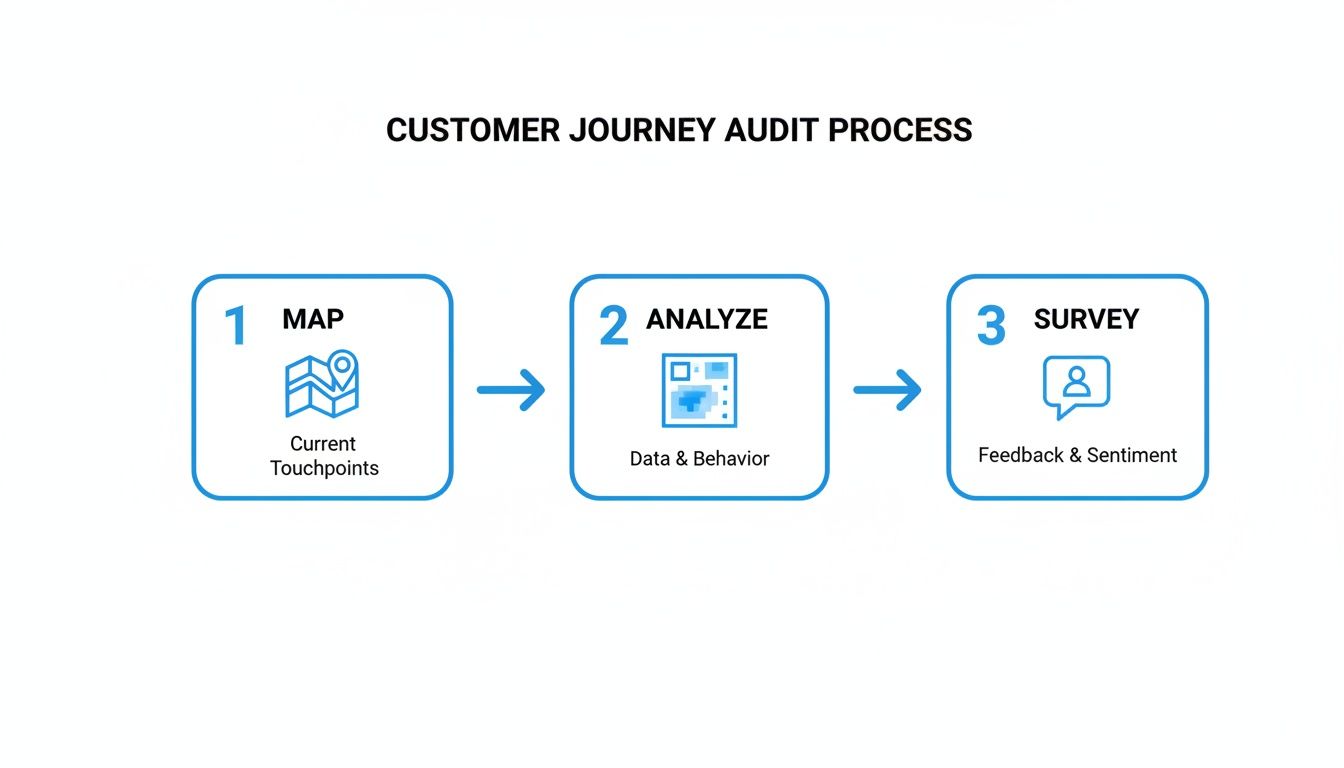
Mapping the journey, digging into analytics and heatmaps, and getting direct customer feedback are the key ingredients for cooking up strong hypotheses that actually have a chance of winning.
Once you have a backlog of solid hypotheses, the next big question is: where do you start? Not all tests are created equal. Some have the potential for massive revenue growth, while others will barely move the needle. You need a system to focus your limited resources on the experiments most likely to hit your bottom line.
A go-to model for many in the industry is the PIE framework. It helps you score each idea against three simple criteria:
By scoring each hypothesis from 1 to 10 across these three areas, you can calculate an average score and objectively rank your test backlog. This simple process keeps your team from getting distracted by shiny, low-impact ideas and laser-focused on what truly moves the needle.
This is where you can really set your strategy apart. Many Shopify stores get stuck testing basic things like static countdown timers or generic "sign up for our newsletter" pop-ups. A more sophisticated approach uses behavioral triggers to deploy urgency at the most psychologically potent moments in the customer journey.
A weak hypothesis sounds something like this: "If we add a countdown timer to the product page, conversions will increase." See the problem? It’s a tactic without a strategy. It's missing the crucial 'because.'
Now, contrast that with a hypothesis grounded in psychology and powered by a platform like Quikly, which is built for creating these sophisticated "Moments" of urgency.
Advanced Hypothesis Example:
If we trigger a limited-availability message (scarcity) for shoppers who have viewed a best-selling product three times, then add-to-cart rates will increase by 15% because the message capitalizes on their demonstrated high intent and leverages the fear of missing out (FOMO).
This is fundamentally different. It's not a blanket, one-size-fits-all tactic; it's a personalized intervention based on actual user behavior. It respects where the shopper is in their journey and introduces urgency when it's most relevant and helpful, not manipulative. This is how you elevate your conversion optimization strategy from a simple testing program into a true revenue-generation engine.
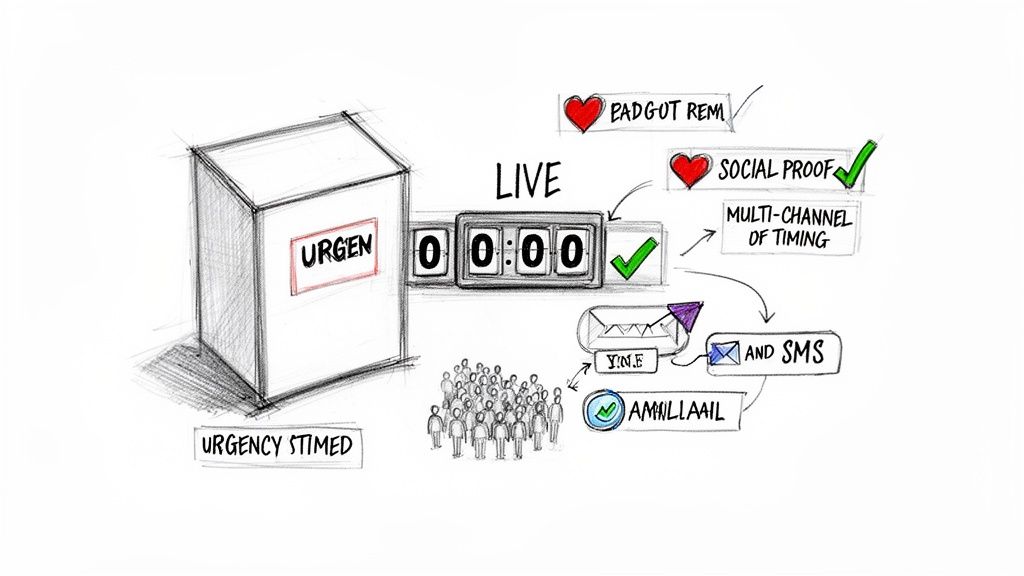
This is where your conversion optimization strategy stops being a spreadsheet and starts generating tangible revenue. We're moving beyond testing button colors and diving into campaigns that tap directly into core consumer psychology. These are the plays that leave generic countdown timers in the dust.
The idea is to build genuine urgency from real-world constraints, helping shoppers break through decision paralysis and click "buy now." It isn't about manipulation; it's a psychologically sound way to nudge customers toward an action they’re already considering.
A truly powerful campaign doesn't just start when the sale goes live—it begins long before. The principle of anticipation is one of the most potent behavioral triggers you can use. By building genuine excitement for an upcoming limited-edition drop or a flash sale, you create pent-up demand that explodes at launch.
This is where you graduate from simple email capture pop-ups. Platforms like Quikly are built for this, creating interactive pre-launch "Moments" that pull people in.
For Shopify Plus merchants, this pre-launch list can be wired directly into tools like Klaviyo or your SMS platform. This lets you build a coordinated communication strategy, sending targeted reminders that build the hype across every channel right up to the second the sale drops.
Once your event or product drop kicks off, the game shifts to scarcity and social proof. This is where most basic apps miss the mark, giving you nothing more than a static timer. An advanced platform lets you create dynamic, behavior-driven experiences that squeeze every last drop of revenue out of the event.
For example, you can set up ranked offers where the fastest people to act get the best deals. This taps into our natural competitive spirit and drives immediate action. During the event, you can show dynamic social proof like "57 people have purchased in the last 10 minutes" to create a buzzing, high-energy vibe that tells shoppers they're making a great decision.
The core difference is the approach. Basic pop-ups and timers are passive. A psychologically-driven "Moment" is an active, engaging event that turns a solitary shopping task into a thrilling, shared experience.
This sophisticated automation also protects your profit margins. Instead of a blanket 20% discount that decimates profits, you can structure tiered offers that reward the quickest buyers while still selling most of your inventory at a much healthier margin. You can dive deeper into these kinds of strategies with our guide to Shopify urgency tactics.
The ROI here is significant. Recent findings show that AI-driven personalization and well-timed tactics can deliver up to a 30% lift in conversion rates. By looking at actual customer behavior and purchase history, these platforms can create campaigns that feel like they were made just for that individual, not sprayed out to the masses.
It’s a massive leap from basic apps that are really just focused on capturing emails. A sophisticated urgency platform is a revenue generation engine. It directly boosts metrics like Revenue Per Visitor (RPV) and helps you move products efficiently to protect your inventory investment.
Here's a quick look at how advanced urgency really stacks up against the basic tools you might be used to.
| Feature | Basic Countdown/Popup Apps | Quikly's Advanced Urgency Platform |
|---|---|---|
| Primary Goal | Email capture or generic urgency | Direct revenue generation and inventory management |
| Psychology Used | Simple urgency (timer) | Anticipation, scarcity, FOMO, social proof, competition |
| Implementation | Static, one-size-fits-all banners and pop-ups | Dynamic, behavior-triggered "Moments" and ranked offers |
| Business Impact | Grows email list, may offer minor conversion lift | Significantly boosts RPV, protects profit margins, clears inventory |
| Management | Manual campaign setup for each event | Automated, multi-channel campaigns integrated with email/SMS |
By folding these advanced tactics into your conversion optimization strategy, you’re not just tweaking your site—you're building a powerful system that converts more visitors, creates a more exciting customer experience, and drives real, sustainable growth for your business.
An experiment is only valuable if you learn something from it. After you’ve run an urgency campaign or any other test, the real work begins: measuring the results, figuring out why it worked (or didn't), and then scaling those wins. This isn't just about picking a winner. It's about building a library of customer insights that creates serious compound growth.
The first rule here is patience. It's a classic mistake to call a test too early just because one variation pulls ahead after a few days. You need to hit statistical significance to get a reliable result, which most platforms define as a 95% confidence level. This just means you can be confident the outcome wasn't a random fluke.
As a rule of thumb, let your tests run for at least two full business cycles—typically two weeks—to smooth out the natural ups and downs in traffic and buying behavior.
When you dig into the data, your goal is to measure the impact on the metrics that actually matter to the business, not just vanity numbers. A winning variation has to drive a real lift in revenue, not just a few extra clicks.
Keep an eye on the numbers that have a direct line to your bottom line:
Focusing on these financial KPIs ensures your optimization efforts are directly tied to growth. A bump in conversion rate is nice, but a simultaneous increase in RPV is what really moves the needle.
The hard data tells you what happened, but the real gold is in the qualitative insights that tell you why. This is where you connect the dots back to your customer's psychology. Did your scarcity test work because of FOMO? Did adding social proof make customers feel less anxious and build trust right before they clicked "buy"?
An A/B test is more than just a competition between two page versions. It's an experiment in consumer psychology. Every result, win or lose, teaches you something valuable about your audience's motivations, fears, and decision-making triggers.
Documenting these insights is non-negotiable. Create an internal knowledge base—even a simple shared doc works—where you log every single experiment.
For each test, make sure you record:
This repository of knowledge becomes your secret weapon. It stops you from running the same failed tests over and over and gives you a constant stream of proven ideas for what to test next.
The final step is to take a winning concept and apply it everywhere it makes sense. If you find out that dynamic social proof messages crush it on your top-selling product pages, don't just leave it there.
Think bigger. How can you scale that psychological principle?
This is how a single successful test fuels a much broader, more impactful strategy. You're not just tweaking pages; you're optimizing the entire customer experience with proven psychological triggers. By analyzing your results with discipline and scaling your wins intelligently, you create a powerful feedback loop that drives sustainable, long-term growth for your Shopify store.
Getting into the nitty-gritty of conversion optimization always brings up a few questions. Let's tackle some of the most common ones.
Forget about picking an arbitrary end date. The real goal of an A/B test isn’t to run it for a set number of days, but to reach statistical significance.
As a solid rule of thumb, you should let an experiment run for at least two full business cycles—that's typically two weeks. This helps smooth out any weird traffic spikes or lulls that happen on certain days of the week.
Your main objective is to gather enough data to hit a 95% confidence level. This is the magic number that tells you the results are legit and not just a random fluke. Most testing tools will handle this calculation for you. One of the biggest mistakes is ending a test the moment one version pulls ahead. Be patient. Good data is worth waiting for and is the foundation of a smart CRO strategy.
It all comes down to authenticity. When urgency feels fake—like those countdown timers that conveniently reset every time you refresh the page—it cheapens your brand and kills trust. A lot of basic timer apps fall into this trap.
But when your strategy is built on real-world constraints, it's a powerful and credible tool. Think about using a platform like Quikly to launch a genuinely limited product drop or a flash sale to move last season's inventory. That's not trickery; it's smart business based on actual scarcity.
This approach taps into behavioral psychology to help customers get over decision paralysis. It's not about manipulation.
By being transparent and using triggers that make sense in the shopper's journey, you actually improve the customer experience. The goal is to create exciting "Moments," not just pushy messages.
Every store is unique, but if you're looking for the biggest impact right out of the gate, start with your Product Detail Page (PDP) and the checkout flow.
The PDP is where the magic happens—it’s where a casual browser decides to become a buyer and clicks "add to cart." Nailing this page with a strong value prop, great photos, social proof like reviews, and a tasteful touch of urgency can make a huge difference.
Once they've added to their cart, your next job is to make the checkout process as smooth as possible. This is where the industry-wide 70% cart abandonment rate becomes a real, painful number. Focus on fixing the biggest friction points:
Zeroing in on these two areas usually delivers the fastest and most meaningful wins for your store’s conversion rate.
Ready to move beyond basic tactics and build a CRO strategy that actually drives revenue? See how Quikly uses the science of urgency to create high-impact campaigns that boost sales while protecting your profit margins.