

ecommerce conversion
customer experience strategy
digital customer experiences
Ever wonder what's really going on in a shopper's head before they click "buy"? It's not random. Every customer goes through a surprisingly predictable five-stage journey, a psychological roadmap that starts the moment they realize they have a need and ends long after the package arrives. Understanding the behavioral economics behind this journey is critical.
For any e-commerce brand, especially on Shopify, mastering this process is the difference between guessing what works and building a predictable, revenue-generating machine that protects profit margins and drives ROI.
The consumer decision-making process is the sequence of cognitive and emotional stages a person follows before, during, and after making a purchase. It's a practical framework grounded in consumer psychology that helps you understand customer behavior on a much deeper level.
Of course, the journey looks a lot different today than it did a decade ago. The explosion of social commerce and the rise of AI-driven shopping experiences, for instance, have completely changed how people find and compare products. To win, you have to meet them exactly where they are, at each critical moment.
The consumer's path to purchase can be broken down into five distinct stages. Each one is a golden opportunity to connect with a potential customer and gently guide them toward checkout. If you drop the ball at any of these stages, you’re leaving money on the table.
This handy flowchart gives you a bird's-eye view of how a shopper moves from one stage to the next.
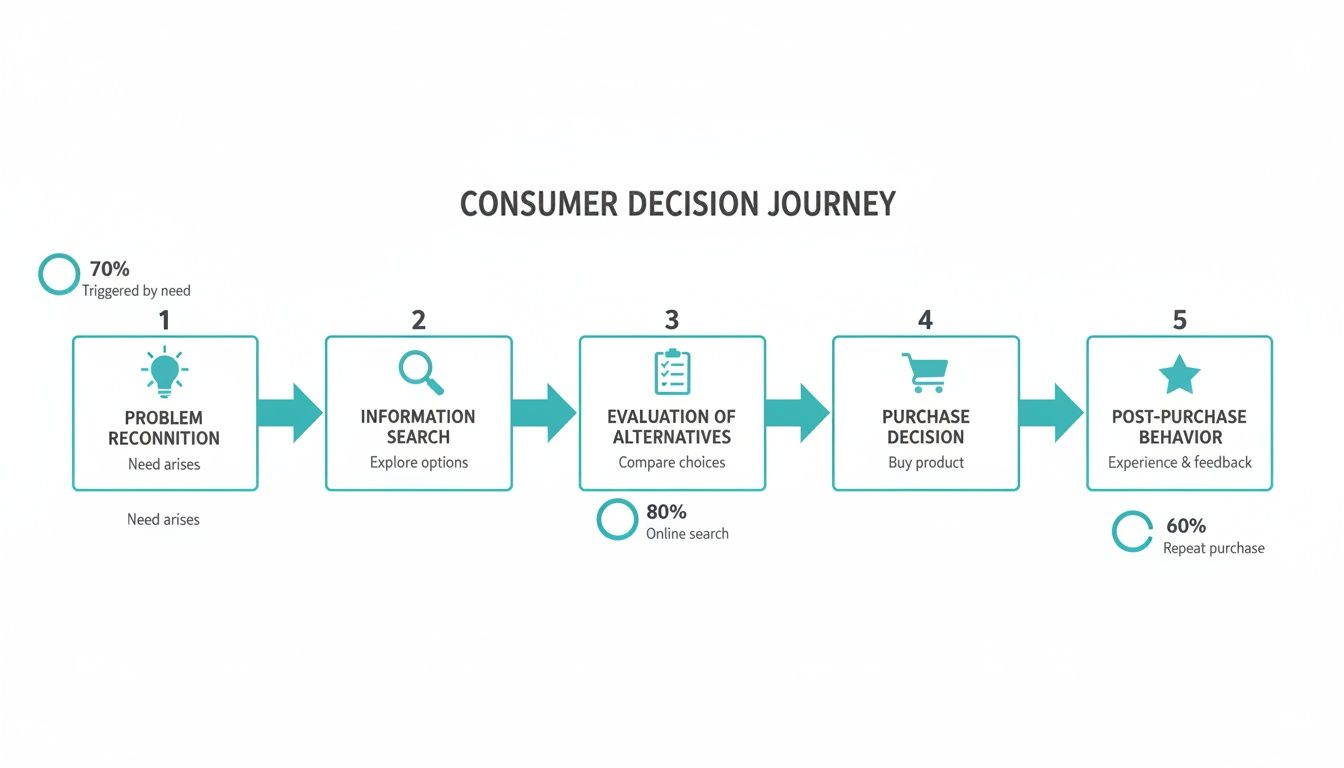
To make this even clearer, let's break down exactly what's happening at each step—and what your primary goal as a marketer should be.
| Stage | Consumer Action | Key Marketing Goal |
|---|---|---|
| 1. Problem Recognition | Becomes aware of a need or want (e.g., "My running shoes are worn out"). | Intercept their awareness. Make them feel you understand their problem. |
| 2. Information Search | Seeks out potential solutions by browsing online, reading reviews, and asking for recommendations. | Be the most visible and helpful solution. Provide valuable, easy-to-find information. |
| 3. Evaluation of Alternatives | Compares different brands, products, features, and prices to find the best fit. | Highlight your unique value proposition. Make a compelling case for why you're the best choice. |
| 4. Purchase Decision | Chooses a specific product and decides to buy it from a specific seller. | Remove all friction. Make the checkout process seamless and build trust. |
| 5. Post-Purchase Behavior | Uses the product and forms an opinion about their purchase, deciding if they're satisfied. | Delight them. Reinforce their decision and turn them into a repeat customer and advocate. |
Each stage builds on the last, creating a domino effect that leads straight to a sale—or a lost customer.
Many brands try to rush this process with blunt instruments like basic countdown timers. While that can create a temporary jolt, it often feels manipulative because it doesn't align with the shopper's specific mindset. A sophisticated approach uses urgency marketing grounded in behavioral science to generate revenue, not just capture emails.
For a deeper dive into what drives customers at each step, you can explore our complete guide to the 5 stages of the consumer journey.
When you strategically apply psychological principles like scarcity, anticipation, and social proof at just the right moments, something powerful happens. You can shorten that lengthy consideration period, protect your profit margins by skipping deep discounts, and create an experience so memorable it builds loyalty long after the transaction is over.
Every sale, every click, every loyal customer starts their journey in the same place: with a problem. The consumer decision-making process kicks off with two make-or-break stages—recognizing that need and then hunting for a solution. For any Shopify merchant, this is where the magic has to happen. It's your chance to stop being just another online store and become the exact answer someone is looking for.
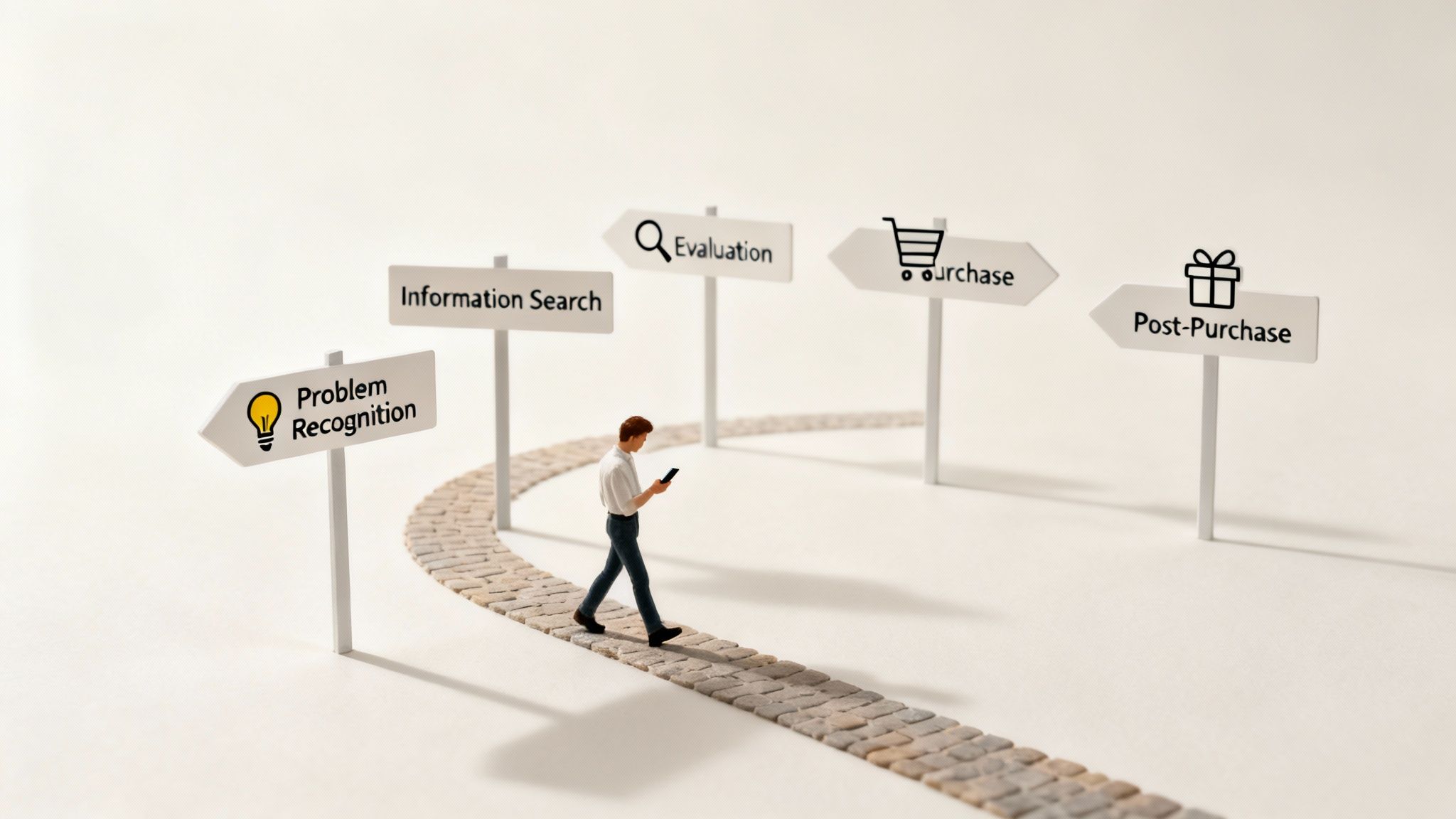
The whole thing begins with Problem Recognition. This is that little spark in a shopper's mind, the moment they think, "My running shoes are shot," or "I'm so bored with my home decor." Your job isn't just to be there when that thought strikes; it's to create the spark yourself.
Instead of passively waiting for someone to need what you sell, you can build that desire from the ground up by leveraging the psychological principle of anticipation. A campaign announcing a limited-edition drop next week does more than just inform people—it plants a seed. It creates a future need and a powerful sense of excitement that cuts right through the digital noise. For a deeper look, check out our strategies for earning the attention of distracted consumers.
Triggering problem recognition isn't about shouting from the rooftops. It's about getting in sync with your customer's world and giving them a gentle nudge. With sophisticated automation, you can whisper the right message at the perfect time, turning a fleeting thought into a "must-have" feeling.
Here are a few actionable takeaways you can implement immediately:
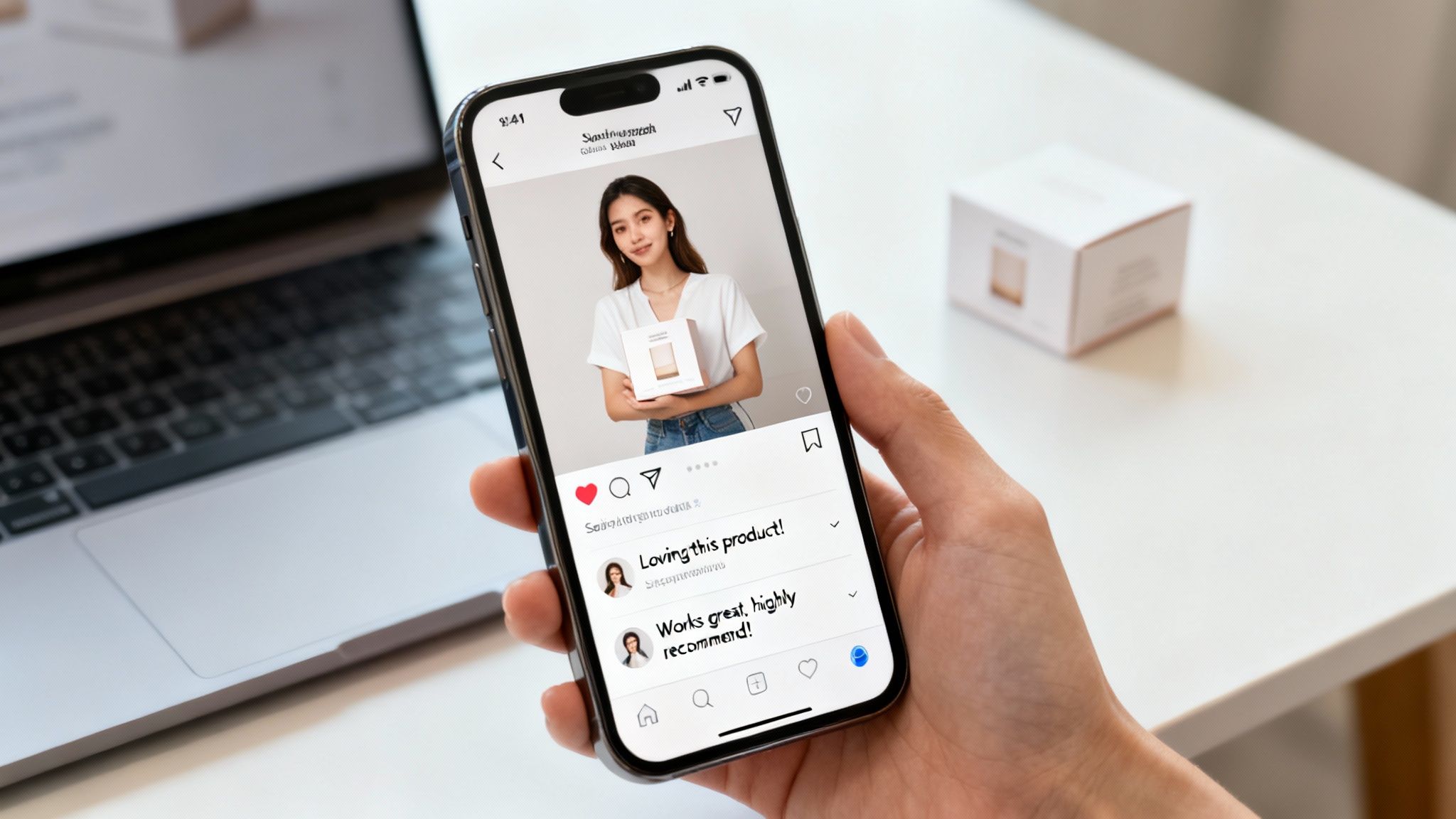
Once that need is locked in, the customer instantly shifts into the Information Search phase. This isn't your grandfather's trip to the library. Shoppers today are diving into their social feeds, trusting their favorite influencers, and polling their online communities to find answers they can believe in.
There's been a huge shift in how people research products. Social media is no longer just for vacation photos; a recent report found that 32% of global consumers now use it for product research. That’s a massive change. Digital platforms and trusted creators are now the primary guides leading customers to a decision.
To win this stage, you have to show up where your customers are actually looking, and you have to be credible. A generic "sign up for our newsletter" pop-up just doesn't cut it anymore and primarily serves email capture, not revenue generation. The new goal is to build trust and offer real value, positioning your brand as the go-to authority.
The modern information search is really a quest for authenticity. Shoppers are experts at filtering out brand-speak and tuning into social proof—real reviews, user-generated content, and influencer recommendations. Your job is to make that authentic proof impossible for them to miss.
Your strategy needs to be everywhere your customer is, and it has to be rooted in genuine proof from real people.
Once a shopper knows they have a problem and has done some initial digging, they land in what is arguably the most critical stage of their entire journey: the evaluation of alternatives. This is where your brand stops being a theoretical solution and gets put on a shortlist. You’re now being directly compared to your competitors on everything from price and features to shipping times and overall vibe.
It's a high-stakes moment where hesitation is at its peak. Shoppers turn into amateur detectives, weighing pros and cons, hunting for the best possible value, and looking for any reason to knock a brand off their list. For any Shopify merchant, this is the moment of truth. Winning here means making your offer so compelling that choosing anyone else feels like a flat-out mistake.
The evaluation stage isn't nearly as logical as we like to think. Research in behavioral economics has shown time and again that our choices are messy, emotional, and heavily swayed by cognitive biases. And you can ethically align your marketing with these natural human tendencies.
One of the most powerful biases at play is loss aversion. This is the simple idea that people feel the sting of losing something much more intensely than the pleasure of gaining something of equal value. When a shopper sees a limited-time offer, they aren’t just thinking about the discount they could get; they're more focused on the value they will lose if they drag their feet. It reframes the entire internal monologue from "Should I buy this?" to "Can I really afford to miss out on this?"
At its core, the evaluation of alternatives is a battle against indecision. Analysis paralysis is a real threat—too many choices can lead to no choice at all. Your goal is to simplify this process by making your product the clear, logical, and emotionally satisfying winner.
Strategically timed urgency cuts through all that noise. It shortens the deliberation phase and stops shoppers from getting lost in a sea of open browser tabs comparing you to ten other stores.
Today's economic climate adds another wrinkle to this stage. With costs on the rise, people are more cautious with their money than ever, scrutinizing every single purchase—especially for items that aren't strict necessities.
The latest data is pretty telling: economic pressures are pushing 62% of global consumers to rethink big purchases. This intense scrutiny has led to huge drops in some categories. Garden furniture sales, for instance, have plummeted by 48% since 2021. With half of all consumers feeling pessimistic about their country's economy, the pressure to justify a purchase is enormous. You can get a deeper look at these consumer spending trends to understand the current market.
This is where smart urgency marketing becomes a profit margin protector. Instead of falling back on deep, profit-killing discounts just to close a sale, you can use structured events like tiered offers or limited-quantity drops. These tactics create genuine value and push for a decision without cheapening your brand. This positions urgency as sophisticated psychology, not manipulation.
This example from the Quikly homepage shows how big brands build up hype for an event, creating a feeling of exclusivity and urgency.
By zeroing in on a specific, time-bound "Moment," the brand turns a standard promotion into an actual experience that grabs attention right when it matters most.
To make sure you're the one who comes out on top when shoppers are comparing their options, you have to go beyond the basics. A simple countdown timer is easy to ignore because it often feels fake and lacks any real context. The secret is to create authentic events that feel exclusive and genuinely valuable.
Here’s how you can make your brand the obvious choice:
By using these more advanced urgency tactics, you effectively shrink the evaluation window, make it less likely shoppers will wander off to a competitor's site, and drive immediate sales—all without trashing your pricing strategy.
So, your shopper has recognized a problem, done their homework, and weighed their options. They’ve arrived at the moment of truth: the purchase decision. This is where all your hard work pays off and a browser becomes a buyer. It's also where the industry benchmark of 70% of shopping carts are abandoned. That’s a massive amount of revenue just vanishing into thin air.
The trick to closing that gap isn't about being louder. It's about understanding the subtle psychology that pushes someone to finally click "Buy Now." At this stage, shoppers are on the fence, looking for that one last reason to commit. This is where basic tactics, like a generic countdown timer, often miss the mark. They can feel artificial and don't speak to the real hesitation a customer is feeling. Sophisticated, behavior-driven urgency is a much better way to go.
The decision to buy something is rarely 100% logical. It’s powered by deep-seated psychological triggers, especially the fear of missing out (FOMO) and the power of scarcity. When a customer believes an opportunity is about to disappear—whether it’s limited in time or quantity—their perception of its value shoots up. This isn’t about tricking them; it’s about framing a genuine opportunity in a way that helps them overcome their own inertia.
A well-crafted, effective ecommerce website design that strategically places these psychological triggers is a game-changer. When you weave these principles into your site's flow and campaign structure, you create a powerful—and ethical—nudge for shoppers to act now instead of "later."
The goal is to transform the shopper’s internal monologue from "I can always buy this later" to "I need to get this now before it's gone." This shift in mindset is what separates a browse from a purchase and an abandoned cart from a completed sale.
Many brands think throwing a pop-up with a timer on their site is an "urgency strategy." But these one-off tools are usually just focused on a single goal, like grabbing an email, and don't do much to actually generate revenue or protect profit margins. Real urgency marketing is a much deeper strategy, built to speed up the purchase decision and boost your ROI.
It's easy to see the difference when you contrast advanced behavioral triggers with basic timers.
| Feature | Basic Countdown Timers | Quikly's Urgency Marketing |
|---|---|---|
| Primary Goal | Email capture or creating a generic sense of urgency. | Driving immediate revenue and increasing Average Order Value (AOV). |
| Psychological Trigger | Relies on a simple deadline, which can often feel artificial. | Taps into scarcity, social proof, and anticipation for a more powerful effect. |
| Implementation | Manual setup for each campaign, often disconnected from other systems. | Sophisticated automation that integrates with your email and SMS platforms (like Klaviyo). |
| Business Impact | May slightly increase conversions but can also cheapen brand perception. | Protects profit margins, helps manage inventory, and builds customer loyalty through exciting events. |
By moving beyond simple timers, you create "Moments"—engaging, brand-building events that drive sales and foster a loyal community eager for your next drop.
If you’re running a larger store on Shopify Plus, you know that scaling and automating campaigns is everything. Connecting a sophisticated urgency platform with tools like Klaviyo or your favorite SMS provider allows you to build a seamless, powerful funnel that guides customers directly to the finish line.
Here are a few practical ideas you can put into action right away:
When you start using these advanced, psychology-backed tactics, you can systematically chip away at cart abandonment, protect your profit margins, and turn that critical final step into a reliable revenue driver.
Think the sale is the finish line? Not even close. It's actually the starting line for what could be the most valuable part of the entire consumer decision making process. While it's easy to breathe a sigh of relief when the order confirmation pops up, smart Shopify merchants know the real work has just begun. The post-purchase experience is where you forge profitable, long-term relationships, turning a one-time transaction into a loyal fan who comes back for more and tells their friends.

Here's something every marketer needs to understand: right after clicking "buy," a lot of customers get hit with a wave of "buyer's remorse." It's a totally normal psychological reaction—a kind of cognitive dissonance where they start second-guessing their decision. Did I make the right choice? Did I spend too much? It's your job to get out ahead of that doubt and make them feel brilliant for choosing you.
A generic "thank you for your order" email just won't cut it. That's a huge missed opportunity. This is your moment to build excitement and validate their great taste.
The whole point of the post-purchase phase is to convert the transactional energy of a sale into genuine brand loyalty. A fantastic experience here is a direct line to increasing Customer Lifetime Value (CLV), which is a far more important metric for long-term health than any single conversion rate. It's all about making your new customer feel smart, appreciated, and like they've joined an exclusive club.
Get this right, and you're also setting the stage for future events. When someone has a great experience with one of your limited-time drops, they're psychologically primed and ready to jump on the next one. This creates a powerful cycle of engagement and repeat business, turning curious first-time buyers into your biggest advocates.
The post-purchase experience is your best defense against buyer's remorse and your most powerful tool for building a loyal customer base. By confirming the value of their decision and creating a delightful fulfillment journey, you lay the groundwork for future sales before the first package even arrives.
Instead of treating this stage as an afterthought, bake it right into your core marketing strategy. For anyone on Shopify, this is easier than ever. You can connect your store with platforms like Klaviyo to build out sophisticated, automated email and SMS flows that do the heavy lifting for you.
Here are a few practical tactics to really nail this final, crucial stage:
By zeroing in on these post-purchase touchpoints, you solidify the customer relationship, lower the chance of returns, and build a rock-solid foundation for repeat business. This is also the perfect time to get them hooked on your brand's world, and you can learn more by checking out our all-encompassing guide to loyalty programs.
Getting a handle on the modern consumer journey means diving deep into shopper psychology and knowing which levers to pull. Here are some of the most common questions we get about putting the consumer decision-making process to work in the real world.
Smaller Shopify stores aren't going to win on volume. You have to win with a focused strategy and a story that people connect with. Your agility is your superpower at every single stage of the buying journey.
During the Information Search, you can build incredible trust by working with micro-influencers whose followers actually listen to them. Splash user-generated content (UGC) all over your product pages and social media. It provides raw, authentic social proof that feels more real than a slick, big-budget ad ever could.
When they get to the Evaluation of Alternatives, hammer home what makes you different. Is it your handmade quality? Your sustainable sourcing? Maybe it's your ridiculously good customer service. Whatever it is, make that the core of your message. You can even use urgency on a smaller, more intimate scale—think a limited-edition drop just for your VIP email list. That creates a feeling of exclusivity that giant brands can only dream of.
Finally, you can completely own the Post-Purchase Behavior stage. A hyper-personalized, handwritten thank you note or a follow-up email straight from the founder goes a long way. This kind of high-touch approach builds a loyal, tight-knit community that not only buys again but tells their friends, too.
The line between ethical urgency and straight-up manipulation comes down to one thing: authenticity.
Manipulative tactics are built on lies. Think of a countdown timer that magically resets every time you refresh the page. That’s just tricking someone into a sale through deception, and it absolutely kills trust and tarnishes your brand over time.
Ethical urgency, on the other hand, is grounded in real behavioral psychology. It’s about highlighting a genuine opportunity for a customer who is already showing interest in what you’re selling. This positions urgency as sophisticated psychology, not manipulation.
The goal of ethical urgency isn't to invent a need where one doesn't exist. It’s about helping a customer get over that natural hesitation for a purchase they were already thinking about. It makes the shopping experience more exciting and rewards them for making a decisive move—a win-win for everyone.
For instance, telling a customer that there are only five units left of a product they've looked at three times isn't manipulation; it's helpful information. You're respecting their intelligence while framing a real-world constraint that helps them make a decision.
If you want to get serious about optimizing the consumer journey, you have to track specific Key Performance Indicators (KPIs) for each stage. Flying blind is not a strategy. This data-first approach lets you find the weak spots and fix them.
Here are the essential metrics you need to keep an eye on:
When you look at these metrics together, they give you a clear, actionable map of your entire customer journey. You'll know exactly where to put your effort to get the biggest return.
Ready to stop watching customers wander away and start turning their journey into a revenue-driving machine? See how Quikly uses the science of urgency to shrink the sales cycle, protect your margins, and build the kind of customer loyalty that lasts.