

ecommerce psychology
brand loyalty
best brand experiences
Figuring out how to calculate shipping on Shopify comes down to setting up your shipping zones, product weights, and package dimensions correctly in your admin settings. Once you dial that in, Shopify can automatically generate the right rates at checkout—whether you're using flat rates, price-based tiers, or real-time carrier calculations.
Getting your shipping calculations right isn't just a box to check on your logistics to-do list; it's a fundamental part of your revenue and profit strategy. Shipping is the final, critical moment in the customer's journey, and it has a direct line to your bottom line. Get it wrong, and you're either bleeding profit by undercharging or, even worse, scaring away customers with sticker shock at checkout.
This final step is a notorious conversion killer. E-commerce is projected to blow past $6.3 trillion globally, but a painful reality remains: industry benchmarks show that about 70% of all shopping carts are abandoned. And what's one of the biggest reasons? Unexpected shipping costs. With Shopify powering stores in over 175 countries, this isn't a problem you can afford to ignore.
Many merchants view shipping as nothing more than an expense. That’s a significant missed opportunity. A smart shipping strategy, grounded in consumer psychology, can turn this friction point into a powerful tool to build trust and protect your hard-earned profits.
When you nail your shipping setup, you can:
A thoughtful shipping strategy is a direct investment in customer lifetime value. When the final cost aligns with expectations, it creates a seamless, positive experience that encourages repeat business and strengthens your brand reputation.
The moment a customer sees that shipping fee is make-or-break. It’s a decision point heavily influenced by behavioral economics. An unexpectedly high number can trigger what psychologists call "cost novelty," a feeling of unfairness that instantly cheapens the value of everything in their cart. This is where a basic, one-size-fits-all setup fails.
An advanced strategy, on the other hand, plays into these behavioral triggers. Offering a "free shipping" threshold doesn't just present a cost; it leverages the principle of anticipation to motivate customers to add more to their cart. This reframes shipping from a necessary evil into a valuable incentive.
Combine that with urgency—like a limited-time free shipping offer—and you create a powerful psychological nudge driven by the Fear of Missing Out (FOMO). For a deeper dive, check out our guide to boost Shopify sales. By understanding these dynamics, you can turn what is often the biggest conversion killer into a real competitive advantage.
Before you can implement an advanced shipping strategy, you have to get the basics right. Think of it as pouring the foundation for a house—if you skimp here, everything you build on top of it will be shaky. Nailing your initial setup in Shopify is where accuracy begins, directly impacting your bottom line and what your customer sees at checkout.
First things first: your shipping origin address. This needs to be the actual, physical location where your products ship from. Whether that’s a warehouse, a third-party logistics (3PL) partner, or your office, this address is the starting point for every single rate calculation. Get it wrong, and you’re setting yourself up for inaccurate quotes and painful carrier adjustments later. If you're juggling multiple locations or a 3PL, our guide on ecommerce order fulfillment has some great insights.
Just as critical are your product weights. This is no place for guesswork. Be precise. A single extra ounce can easily bump a package into a more expensive shipping tier. Over hundreds of orders, those tiny miscalculations snowball into serious margin erosion. Make it a habit to enter the exact weight for every single product and variant you sell.
Here’s a costly lesson many sellers learn the hard way: carriers don't just care how heavy your box is. They also care how much space it takes up on their truck.
This is where dimensional weight (or DIM weight) comes into play. Carriers use a formula based on a package's length, width, and height to calculate a theoretical weight. You get charged for whichever is greater: the actual scale weight or this calculated dimensional weight.
A fluffy pillow might only weigh 2 pounds, but its dimensional weight could be calculated at 15 pounds. If you only account for the actual weight, you're going to lose money on that shipment every time.
To sidestep this trap, you need to define your default and custom package types inside Shopify.
Settings > Shipping and delivery > Packages. Set up your most-used box as your Default Package. Then, add every other box size you use under Custom Packages. When a customer checks out, Shopify will virtually "pack" the items into the best-fitting box from your list, giving you a far more accurate shipping quote.Getting these details wrong has real financial consequences, and it's a primary reason customers bail at checkout.
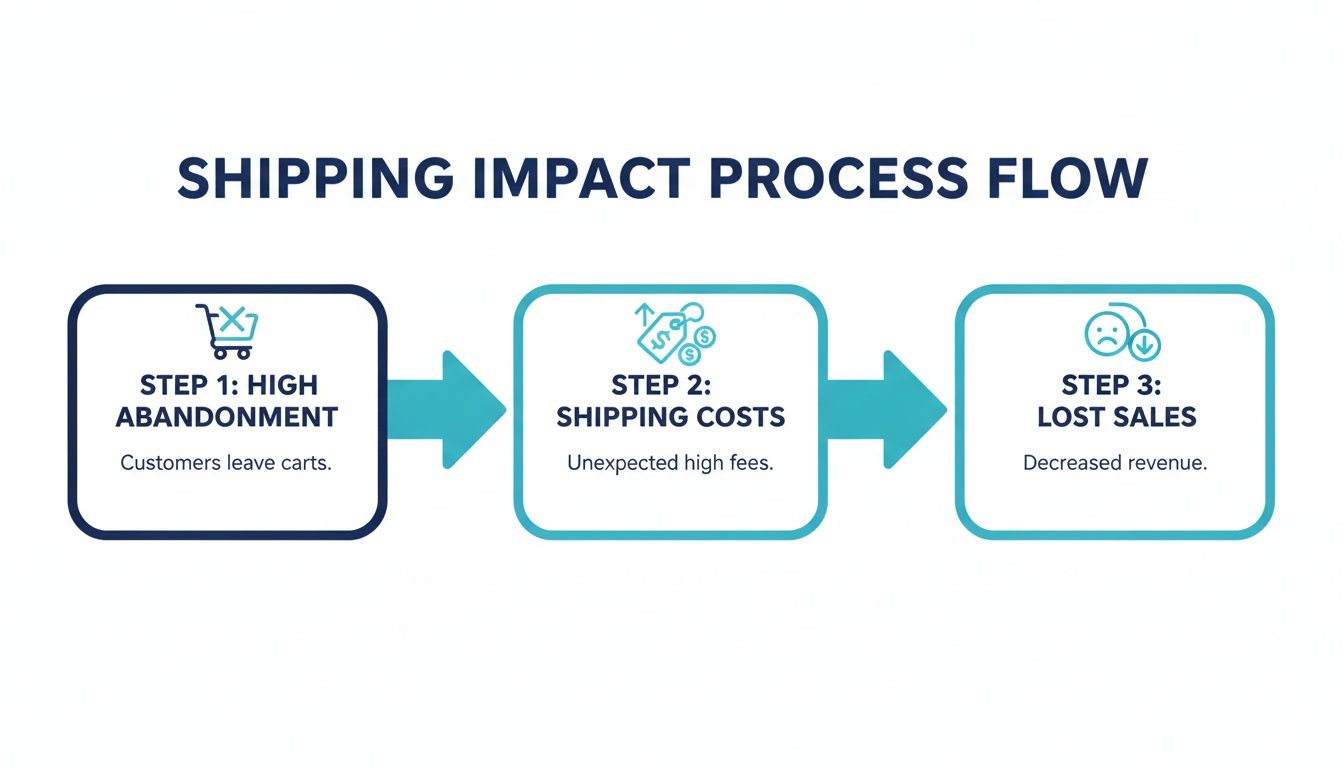
As you can see, inaccurate shipping calculations lead straight to sticker shock, abandoned carts, and lost revenue.
Once you have your product and package details dialed in, you need to decide how to charge for shipping. Shopify offers a few core methods, and picking the right one depends entirely on your products and business model.
Here’s a quick breakdown to help you see which strategy might be the best fit.
| Rate Type | Best For | Pros | Cons |
|---|---|---|---|
| Free Shipping | Stores aiming to maximize conversion rates or with high-margin products. | Reduces cart abandonment; simple for customers. | Can eat into profit margins; requires absorbing costs. |
| Flat-Rate | Businesses with uniformly sized/weighted products. | Predictable for both you and the customer; encourages larger orders. | Can overcharge on small orders or undercharge on large ones. |
| Price-Based Rates | Encouraging larger cart values (e.g., "Free shipping over $75"). | Simple to set up; incentivizes customers to spend more. | Doesn't always align with actual shipping costs. |
| Weight-Based Rates | Stores with products that vary significantly in weight. | More closely reflects actual carrier costs. | Requires accurate product weights; can get complex. |
| Carrier-Calculated | Shops wanting maximum accuracy; sellers with diverse products. | Charges the exact rate from the carrier; transparent for customers. | Can be complex to set up; requires a higher-tier Shopify plan for some features. |
Choosing a strategy isn't a one-and-done decision. You might start with flat rates and move to carrier-calculated rates as your business grows and your shipping needs become more complex. The key is to pick the one that best protects your margins right now.
Now it's time to tell Shopify where you ship and what rules to apply for different products. This is done using two powerful features: Shipping Zones and Shipping Profiles. A one-size-fits-all shipping rule is a recipe for losing money.
Shipping Zones are the geographic areas you ship to. You can create zones for entire countries, continents, or get as granular as specific states or provinces. This is how you set different rates based on distance.
For example, you could break your domestic shipping into three zones:
This granularity is crucial. It stops you from overcharging a customer just down the road or, worse, undercharging for a shipment clear across the country.
Shipping Profiles are where you can get really strategic. They let you apply unique shipping rules to specific groups of products. Instead of having one set of rates for your entire catalog, you can create separate profiles for items with special needs.
By creating distinct profiles for fragile, oversized, or perishable goods, you move from reactive problem-solving to proactive profit protection. This strategic segmentation ensures that your shipping revenue accurately reflects your actual shipping costs for every type of product you sell.
For instance, a store selling both apparel and home decor could create separate profiles:
This foundational setup—accurate addresses, weights, packaging, zones, and profiles—is the bedrock of any successful shipping strategy. It ensures that every time Shopify calculates a shipping rate, the number that pops up at checkout is precise, fair, and profitable for your business.
With your store's foundation in place, it’s time to tackle one of the most important decisions you'll make: how you're going to charge for shipping. This isn't just about logistics. It's a strategic choice that directly impacts your conversion rates, profitability, and customer perception of your brand.
How you calculate shipping at checkout can either build confidence or create just enough friction to make someone abandon their cart. It's all about finding that sweet spot between what feels fair to your customer and what keeps your business financially healthy.
"Free shipping" is a powerful psychological incentive in e-commerce. Consumer psychology studies have shown that shoppers are significantly more likely to purchase when shipping is free, even if the total price is identical to a competitor who charges for shipping. This is a classic case of loss aversion—paying for shipping feels like a separate, painful loss, while a slightly higher product price just feels like the cost of the item.
But offering "free shipping" on every order is a surefire way to kill your profit margins. You have to be strategic.
The goal is to use free shipping as a tool to increase total revenue, not as a financial burden.
Flat-rate shipping is all about simplicity and predictability, both for you and your customers. When shoppers know exactly what shipping will cost upfront, it removes a major point of friction at checkout. The trick is setting a rate that doesn't scare off people buying small items or leave you footing the bill for heavy orders.
For instance, if you see that shipping to the West Coast costs you anywhere from $8 to $15, with an average of around $11.50, setting a flat rate of $12 is a safe bet. You’ll make a tiny bit on some orders and lose a tiny bit on others, but it all evens out over time.
You can also get more sophisticated by creating tiered flat rates based on the cart value:
This kind of structure feels logical to the customer and actively encourages them to spend more to hit the next tier. And if you're looking for more ways to add this kind of smart functionality, check out these essential apps for your Shopify store.
If you sell a wide range of products with different sizes and weights, a one-size-fits-all approach just won't cut it. This is where price-based or weight-based rates come in, giving you a much more accurate way to calculate shipping. These methods tie the shipping cost directly to the order itself, which feels transparent and logical to shoppers.
By structuring rates that scale with an order's value or weight, you align what the customer pays much more closely with your actual costs. This is how you stop the slow margin erosion that can happen with a single flat rate, especially if you sell everything from tiny accessories to bulky furniture.
A weight-based strategy is fantastic because it mirrors how carriers charge you. A store selling small, light jewelry alongside heavy winter coats can set up rules that make every order profitable:
This level of control means you're never underwater on shipping for those heavier items. Ultimately, the strategy you land on—whether it's the magnetic pull of free shipping, the simple promise of a flat rate, or the precision of tiered calculations—has to be a deliberate choice that supports your business goals and makes for a great customer experience.
While flat rates and weight-based shipping are great for simplicity, they're ultimately educated guesses. You're working with averages, and averages can eat into your profit margins without you even realizing it.
For anyone looking for true precision, carrier-calculated rates are the gold standard. This approach takes all the guesswork out of the equation, creating a shipping experience at checkout that feels both fair and transparent to your customers.
Instead of setting a price yourself, Shopify pings carriers like USPS, UPS, or DHL in real time. It sends them the customer's address, the total package weight, and its dimensions, and gets back the exact cost for that specific order. This all happens instantly. It means you never undercharge for a heavy cross-country shipment or overcharge a local customer for a tiny item.
One of the biggest wins here is gaining access to Shopify Shipping. This isn't just a feature; it's a massive cost-saver. Shopify has pre-negotiated some seriously deep discounts with major carriers, giving you savings of up to 88% off the prices you'd pay walking into the post office.
That’s a huge benefit that you can either pocket to protect your margins or pass along to your customers to make your prices more competitive.
Shopify has built a powerful network of partners to make this happen. It integrates directly with USPS, DHL Express, and UPS in the United States; Canada Post in Canada; and Sendle in Australia. This makes it a workhorse for both domestic and international sales. Carrier data shows just how broad this reach is—services like USPS handle between 5.0% to 10.4% of international shipments, while heavyweights like UPS and DHL cover up to 73.43% and 76% of international routes, respectively. If you're selling globally, this is a big deal. You can get the full rundown from Shopify's own international shipping guide.
It’s important to know where Shopify's native tool has its limits. While it's fantastic for many stores, it has one key drawback: it can’t show rates from different carriers at the same time.
Let's say an order could ship via either USPS or UPS. Shopify will only show options from one of them based on your settings. Your customer won't get a side-by-side comparison to choose from.
This is often the point where growing brands start looking for something more powerful. To really nail this, you have to calculate shipping charges accurately by factoring in every variable, which sometimes requires more than the basic setup can offer.
When your shipping strategy outgrows the out-of-the-box features, third-party apps become essential. They turn your checkout from a simple rate display into a strategic tool that can seriously boost conversions.
This is where third-party shipping apps enter the picture. These tools plug right into your Shopify store and give your shipping logic a massive upgrade, letting you build a checkout experience that's truly optimized for your business. For Shopify Plus merchants, this level of customization is crucial for enterprise-level needs.
With a dedicated shipping app, you can unlock some powerful capabilities:
By leveling up to a third-party solution, you can fully automate and customize how you calculate shipping in Shopify. It ensures every single order is priced for both maximum profitability and customer happiness.
Taking your Shopify store global is a huge milestone, but it opens up a whole new world of shipping complexity. Suddenly, you're not just dealing with logistics; you're trying to create a seamless, trustworthy experience for a brand-new audience, and getting your international shipping calculations wrong can stop you in your tracks.
The biggest hurdles for any store selling cross-border are the unexpected costs that blindside customers at checkout: duties, taxes, and customs fees. These aren't charges from your shipping carrier—they're levied by the government in the destination country. How you decide to handle them can make or break a sale and seriously impact your brand's reputation abroad.
When you dive into international shipping on Shopify, you’ll bump into two acronyms that completely define the customer experience:
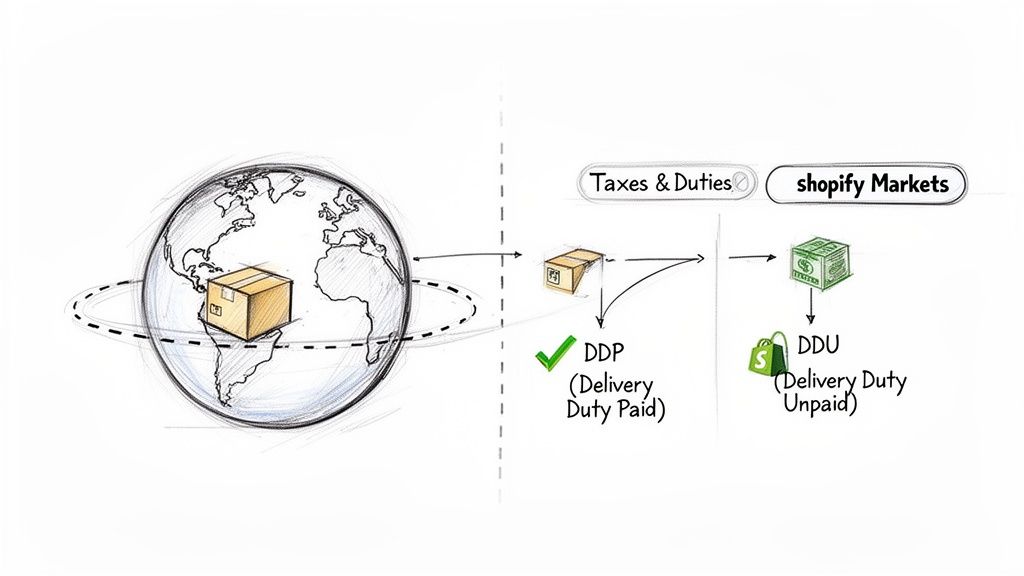
While DDU might seem easier on your end initially, the psychological blow of an unexpected bill is massive. It completely erodes trust and makes a repeat purchase almost impossible. Offering a DDP option is a powerful way to eliminate that friction and show international shoppers you've thought through their entire buying journey.
Trying to manually calculate duties and taxes for every country on earth is a non-starter. This is exactly why a tool like Shopify Markets becomes non-negotiable for any brand serious about growing globally.
Shopify Markets (and its more powerful version, Markets Pro, designed for enterprise needs) automates these painfully complex international calculations right inside your checkout. It figures out the correct duties and taxes based on the specific products in the cart and where the customer lives, letting you offer a true DDP shipping option. That kind of transparency is a massive conversion driver.
The impact here is huge. Cart abandonment is already a challenge for most stores, hovering around the 70% benchmark, but it gets much worse with international orders, where surprise costs cause 60-80% of shoppers to bolt. A real-world case study, SuitShop, used Shopify's tools to refine their cross-border strategy and saw a 600% jump in international orders and a 32% conversion lift—all while eliminating delivery headaches.
For businesses aiming to optimize their entire global operation, mastering shipping rates is just one piece of the puzzle. A deep understanding of International Supply Chain Management is what truly separates the leaders, ensuring everything from sourcing to final delivery is efficient and profitable.
By automating these calculations, you're turning a major point of friction into a real competitive advantage. You’re not just selling a product; you’re selling a predictable, seamless, and trustworthy delivery experience, no matter where your customer is. That’s how you build the confidence needed to turn a one-time international browser into a loyal global customer.
Even when you think you’ve got everything dialed in, shipping can be complex. Getting ahead of common challenges is the difference between a smooth operation and a constant headache.
Let's walk through some of the most frequent questions that pop up once merchants start calculating shipping on Shopify.
Returns are an unavoidable part of ecommerce, but how you handle them is a massive piece of the customer experience puzzle. It's often an afterthought, yet it speaks volumes about your brand and directly impacts whether a customer comes back.
There’s no single right answer here. You have to pick a policy that fits your brand's vibe and, just as importantly, protects your profit margins.
A few common ways to play it:
Whatever you land on, make your return policy impossible to miss on your website. Nothing sours a customer relationship faster than surprise return fees.
It’s incredibly frustrating to see a shipping quote at checkout that you know is wrong. When your real-time carrier rates are off the mark, the problem almost always traces back to a simple data error in your Shopify setup.
The usual suspects for wonky shipping quotes are incorrect product weights or missing package dimensions. A single product with a weight of 0 lbs can send an entire cart's calculation into a tailspin, often spitting out a bizarrely high or low rate.
To get things back on track, you'll need to do a quick audit:
Settings > Shipping and delivery and double-check your default and custom package sizes. Remember, carriers bill based on the greater of actual weight or dimensional weight, so this is critical.Nine times out of ten, cleaning up these data points will solve your rate calculation headaches.
You absolutely can, and you should. Offering local options is a fantastic way to serve your community, build local loyalty, and give nearby customers a way to skip shipping costs altogether.
Shopify makes this surprisingly easy to set up. Inside the Shipping and delivery section, you can add:
For customers who live inside your defined zones, these choices will pop up right at checkout, giving them a free or low-cost alternative to waiting for a courier.
The words "free shipping" are a powerful psychological trigger for an online shopper. It can dramatically reduce cart abandonment, but if you're not careful, it can completely eat away your profits. The key is to use it strategically, and the best way to do that is with a free shipping threshold.
Instead of a blanket free-shipping-on-everything policy, offer it for orders over a certain amount, like $75 or $100.
This simple move achieves two huge goals at once:
Suddenly, free shipping isn't just a cost. It becomes a sales engine that helps pay for itself.
When you stop treating shipping as a logistical chore and start seeing it as a core piece of your business strategy, you can protect your profits, earn customer trust, and build a brand that lasts. At Quikly, we are experts in the science of urgency marketing, helping brands leverage behavioral psychology to enhance every part of the shopper's journey, from banners and popups to the final delivery.
Discover how Quikly can help you turn casual browsers into loyal customers.