

ecommerce conversion
customer experience strategy
digital customer experiences
A customer just clicked "buy" on your website. That's a win. But what happens next is where brand loyalty is truly forged—or broken. This entire behind-the-scenes process of getting a product from a warehouse shelf into your customer's hands is ecommerce order fulfillment.
Think of it as the logistical engine that powers your brand's promise. It encompasses everything from receiving and storing inventory to picking, packing, and shipping orders. Get it right, and you protect profit margins and earn repeat customers. Get it wrong, and you risk your reputation.
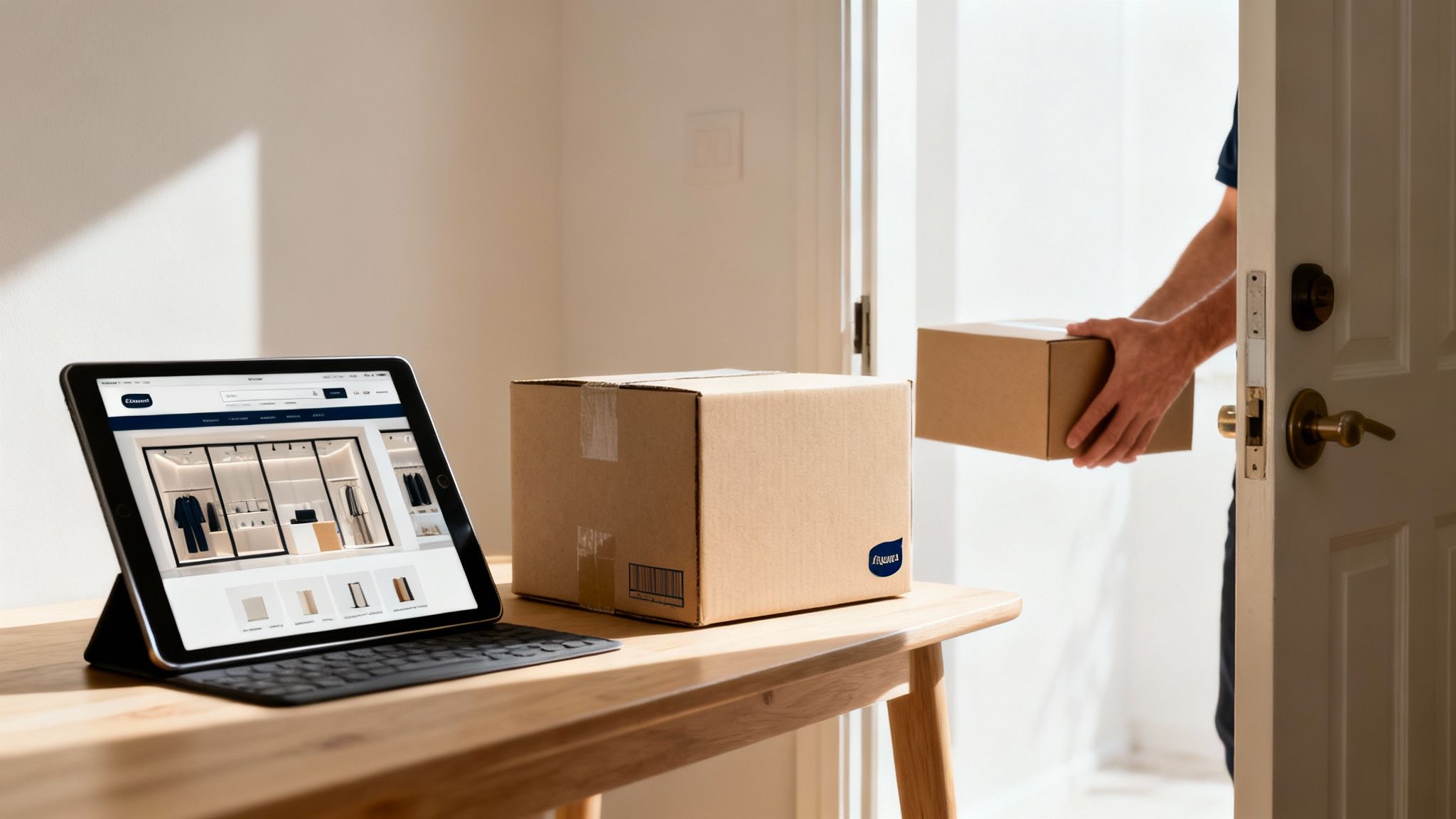
At its core, ecommerce order fulfillment is the operational execution of the promise you make at checkout. It's a critical component of your business strategy that directly impacts customer satisfaction, profit margins, and lifetime value. In today's competitive landscape, a flawless fulfillment process is a non-negotiable requirement for growth.
The sheer scale of this industry highlights its importance. The global e-commerce fulfillment service market was valued at an estimated $123.7 billion in 2024 and is projected to reach an astounding $272 billion by 2030. This explosive growth underscores how vital a smooth, efficient logistics operation is for any online brand aiming to scale profitably.
Whether you're a startup packing boxes in a garage or a global enterprise managing multiple warehouses, every fulfillment process consists of four key stages. Optimizing each one creates a ripple effect of efficiency that reduces costs and delights customers. The entire operation relies on a robust ecommerce integration for order management to ensure a seamless flow from one stage to the next.
Here is a breakdown of an order's journey from click to doorstep.
| The Four Core Stages of Ecommerce Order Fulfillment |
| :--- | :--- | :--- |
| Stage | Key Activities | Business Impact |
| 1. Receiving & Storage | Products arrive, are inspected, counted, and logged into your inventory system. They're then stored strategically for quick access. | An organized warehouse minimizes receiving time, prevents lost inventory, and directly speeds up the entire fulfillment process. |
| 2. Order Processing & Picking | When an order is received, a "pick list" is generated. Staff then locate and retrieve the correct items from the shelves. | This stage is where accuracy is paramount. A single picking error leads to costly returns, negative reviews, and customer churn. |
| 3. Packing & Quality Control | Picked items are checked for accuracy before being securely packed. This is also your last chance to add branded touches and marketing materials. | Proper packing prevents transit damage and creates a memorable unboxing experience, reinforcing brand value. |
| 4. Shipping & Delivery | The packed box is labeled, handed to a carrier, and tracking information is sent to the customer, closing the communication loop. | Reliable shipping and proactive communication build trust. This is the final handoff where your brand's promise is delivered. |
Mastering these four stages isn't just about operational excellence; it's about building a fulfillment machine that becomes a true competitive advantage.
A well-oiled fulfillment machine does more than just move boxes; it delivers on the brand promise made at checkout. It turns a one-time transaction into a relationship by building trust through reliability and speed, directly impacting customer lifetime value.
When you master these fundamentals, you’re not just shipping products—you’re building a brand that customers can depend on, order after order.
Selecting the right ecommerce fulfillment model is a pivotal decision for a brand. This isn't just about logistics; it's a strategic choice that impacts capital expenditure, profit margins, customer experience, and your ability to scale.
The path you choose determines your operational focus. Are you spending your days packing boxes, or are you strategizing your next product launch? Let's analyze the three primary models—self-fulfillment, third-party logistics (3PL), and dropshipping—to identify the best fit for your business.
Also known as in-house fulfillment, this is the starting point for most brands. You manage everything: storing inventory, picking and packing orders, and arranging shipping. This model provides maximum control over the customer experience, allowing for custom-branded packaging and personalized touches.
However, this control comes at the cost of your time and focus. Every hour spent packing boxes is an hour not spent on marketing, product development, or customer acquisition. A tipping point often occurs around 10-20 orders per day, where self-fulfillment becomes a bottleneck that actively hinders growth.
Outsourcing to a third-party logistics (3PL) provider means partnering with a specialist in warehousing, picking, packing, and shipping. You send your inventory to their fulfillment centers, and your ecommerce platform automatically transmits orders to the 3PL for processing.
This model is engineered for scalability. Partnering with a 3PL offers significant strategic advantages:
Partnering with a 3PL isn't just outsourcing a task; it's like acquiring a massive, scalable infrastructure overnight. It’s a strategic move that lets you deliver a world-class customer experience without sinking a fortune into your own warehouses and staff.
Dropshipping operates on a different framework entirely. In this model, you don't hold any inventory. When a customer places an order, you forward it to your supplier, who then ships the product directly to the customer. Your profit is the margin between your retail price and the supplier's wholesale cost.
This approach offers exceptional capital efficiency, making it ideal for testing new product ideas or for entrepreneurs with limited startup funds. The primary tradeoff is a significant loss of control over product quality, shipping speed, and inventory availability. Profit margins also tend to be much thinner due to the lack of bulk purchasing power.
To determine the optimal model, you must evaluate each option based on your business's current stage and future goals. This table outlines the key differences in cost, control, and scalability.
| Comparing Fulfillment Models Self-Fulfillment vs 3PL vs Dropshipping |
| :--- | :--- | :--- | :--- |
| Feature | Self-Fulfillment | 3PL Fulfillment | Dropshipping |
| Upfront Cost | Moderate to High (rent, staff, supplies) | Low to Moderate (setup fees, inventory) | Very Low (no inventory purchase) |
| Control | Complete control over branding & quality | High, but managed through a partner | Low; dependent on supplier |
| Scalability | Low; limited by your space & team | High; scales with order volume | Moderate; depends on supplier capacity |
| Shipping Costs | Highest; standard consumer rates | Lowest; access to discounted rates | Moderate; set by the supplier |
| Best For | Startups, niche brands with low volume | Growing brands focused on scaling | New businesses, product testing |
Choosing your fulfillment strategy is a foundational decision. By conducting an honest assessment of these options against your current needs and long-term ambitions, you can build a logistical backbone that supports your growth instead of constraining it.
A flawless order fulfillment workflow is the invisible engine driving a great customer experience. It is a precise sequence of events that transforms a digital click into a physical package on a customer's doorstep. Mastering this process is about more than just efficiency; it's about eliminating bottlenecks, reducing costly errors, and demonstrating your brand's commitment to quality.
This is the blueprint for that journey, from inventory arrival to final shipment. Let's break down the actionable steps you can take to enhance speed and accuracy at every stage.
To start, it helps to visualize where your own process fits. This infographic lays out the three core fulfillment models.
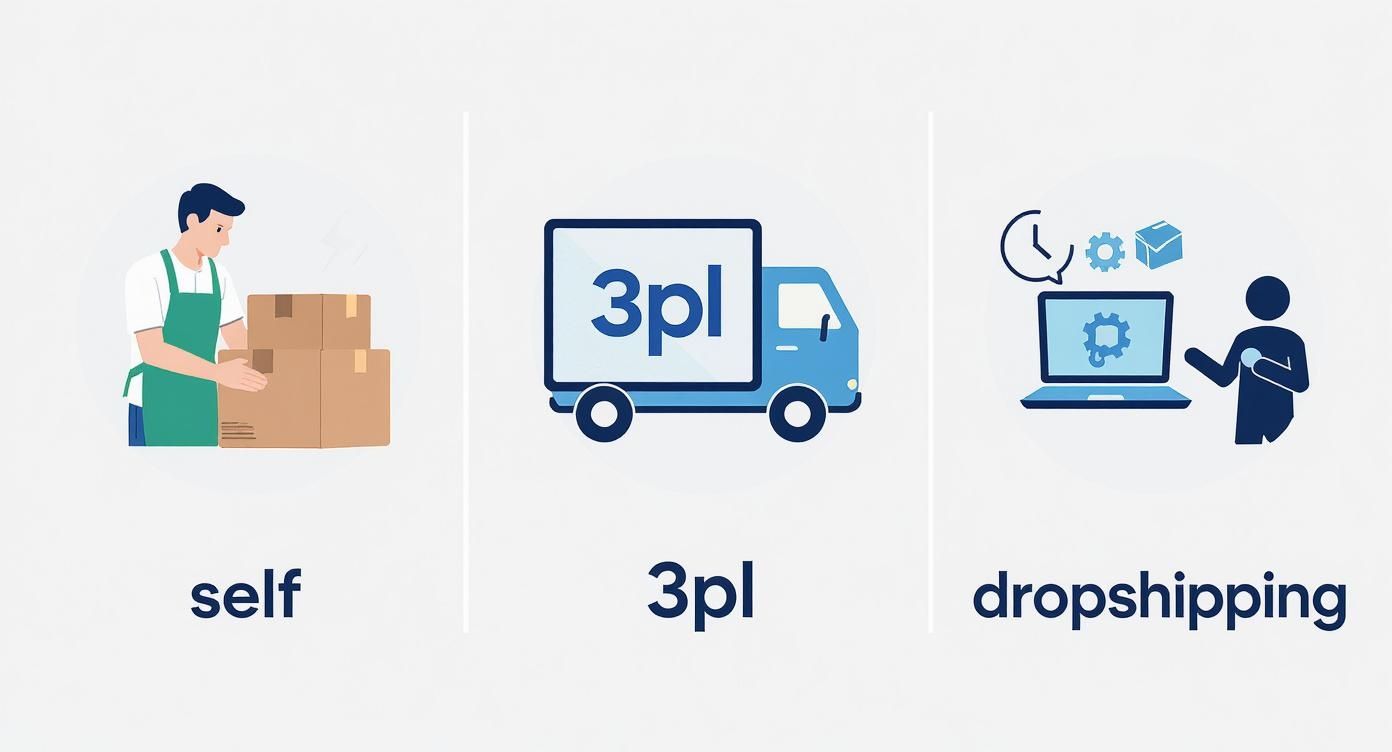
Whether you are handling fulfillment in-house, partnering with a 3PL, or dropshipping, the fundamental steps involved will differ. This image highlights how distinct the operational paths can be depending on your chosen strategy.
The fulfillment clock begins the moment new inventory arrives at your warehouse or 3PL. This initial stage, often termed inbound logistics, is the foundation for the entire process. Any error here will create cascading problems.
A streamlined receiving process directly impacts inventory availability. When an item sells out, an efficient inbound workflow enables rapid restocking. From there, brands can leverage the definitive guide to back-in-stock alerts to capture demand and recover potential lost revenue.
The moment a customer completes a purchase, the order data is transmitted to your Order Management System (OMS) or Warehouse Management System (WMS), initiating the picking process. Here, speed and accuracy are paramount.
The picking process is the most labor-intensive component of fulfillment, accounting for over 50% of all warehouse operating costs. Optimizing this single step offers the largest opportunity to protect your profit margins.
Businesses employ different picking strategies based on their order volume and product mix:
For many Shopify Plus merchants, this process is heavily automated. An online order can trigger a picklist on a warehouse scanner in seconds, guiding the picker along the most efficient path to retrieve all items.
Once all items for an order are collected, they arrive at a packing station. This is your final opportunity to make a physical impression on the customer.
The packing team performs a final quality check, selects the appropriately sized box to avoid dimensional weight surcharges, and adds any marketing inserts. After the box is sealed and labeled, it is sorted by carrier and prepared for pickup.
Finally, the system automatically sends tracking information to the customer, closing the loop on a successful ecommerce order fulfillment workflow.
Expanding your brand globally is a significant milestone, but it introduces a new level of logistical complexity. Scaling your fulfillment for international markets requires a strategic shift from a single-warehouse model to a global distribution network. The primary goal is to position your products closer to your customers, a move that dramatically reduces shipping costs and delivery times. These are not minor benefits; they are two of the most powerful levers for improving conversion rates and fostering customer loyalty.
Successful international expansion is about more than acquiring new customers. It involves delivering a localized experience that feels as seamless as ordering from a domestic brand. This means navigating complex customs regulations, managing cross-border compliance, and protecting your margins from high international shipping fees. Without a robust strategy, global growth can quickly become a logistical and financial challenge.
The most effective strategy for global scaling is distributed inventory. The concept is simple, but its impact is massive. Instead of shipping every international order from a central hub, you strategically store products in fulfillment centers located within or near your key target markets. This model transforms your fulfillment operation from a cost center into a competitive advantage.
Consider this: shipping a package from Los Angeles to London is slow and expensive. Shipping the same package from a warehouse in the UK, however, is fast and affordable. By distributing your inventory, you can:
This is a proven growth strategy. ShipBob's 2025 State of Fulfillment Report revealed that 36% of ecommerce brands plan to expand into new countries this year. For example, luxury brand Aroma360 reduced delivery times to EU customers from 25 days to just 3 by utilizing a UK-based fulfillment center—an 88% reduction in transit time. You can explore more data-backed insights on global fulfillment strategies from ShipBob.com.
For most brands, building an international network of warehouses from scratch is not feasible. This is where partnering with a global third-party logistics (3PL) provider becomes a game-changing decision. A reputable global 3PL offers immediate access to an established international infrastructure without the colossal capital investment.
A global 3PL isn't just a shipping vendor; they are your strategic partner for international market entry. They provide the physical infrastructure, local expertise, and technological integration needed to navigate customs, compliance, and customer expectations in any region.
When you select the right partner, they manage the immense complexity of cross-border commerce on your behalf. They act as your team on the ground, handling everything from customs documentation and duty calculations to localized returns. This frees you to focus on marketing and brand building in new markets.
For enterprise-level brands, platforms like Shopify Plus are designed to handle this complexity. Shopify Plus enables merchants to manage inventory across multiple warehouse locations seamlessly. When an order is placed from a specific country, the system can automatically route it to the nearest fulfillment center, ensuring the fastest and most cost-effective processing.
This native functionality is incredibly powerful. You can configure custom shipping rules and display accurate, real-time delivery estimates at checkout based on the customer's location and the nearest inventory source.
When you integrate this with your global 3PL’s technology and platforms like Klaviyo or other SMS tools, you create a fully automated and localized post-purchase experience. A customer in Germany receives shipping updates in German from a local carrier, creating a familiar and trusted buying journey. This level of sophistication transforms a daunting international operation into a smooth, scalable, and profitable extension of your brand.
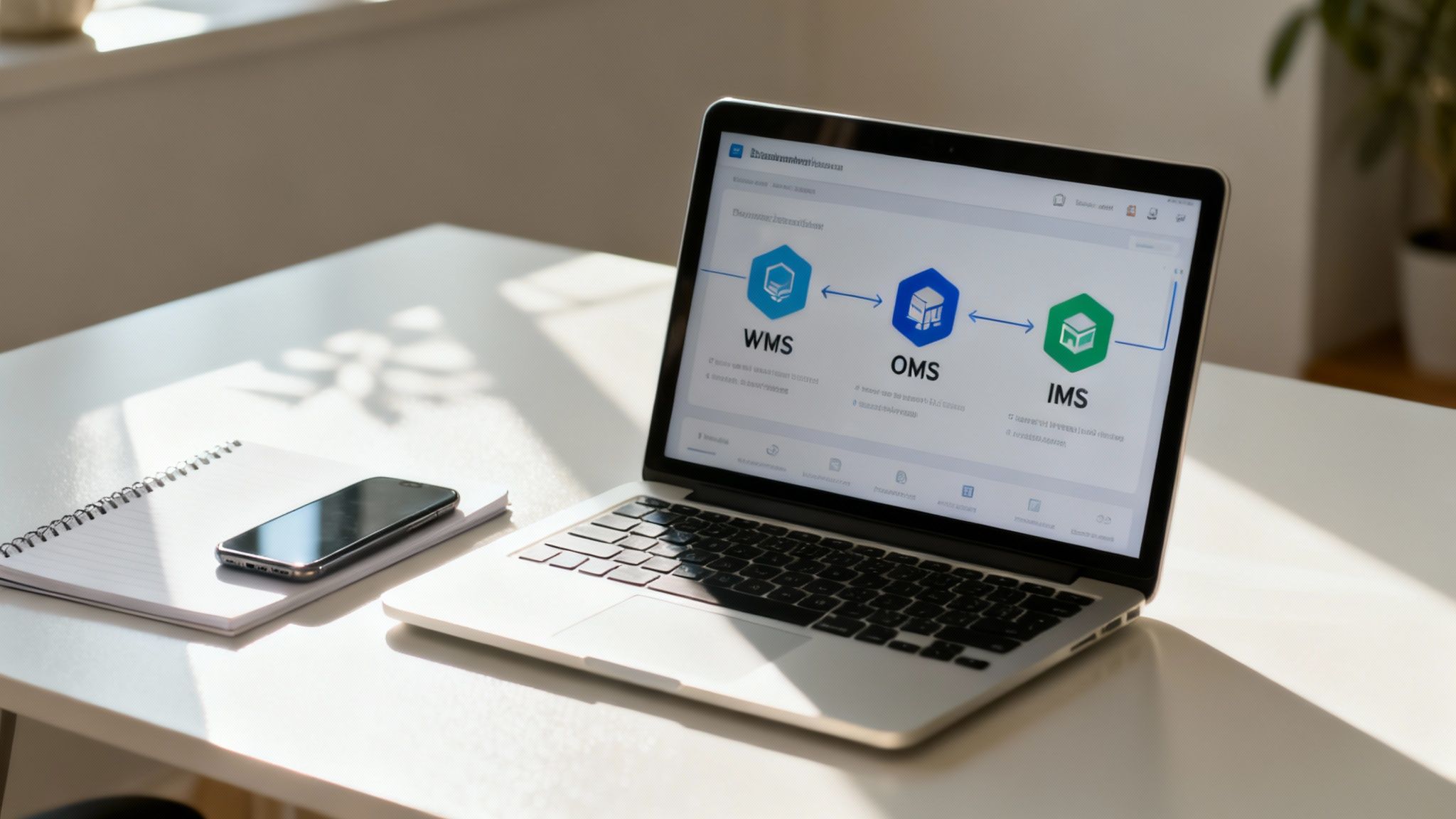
Running a modern ecommerce operation requires working smarter, not just harder, with an integrated technology stack. This ecosystem of software acts as the central nervous system for your entire fulfillment operation, automating manual tasks, synchronizing data, and providing the insights needed for profitable growth.
For any brand looking to scale, the right technology is not a luxury—it is the engine.
At the core of this stack is a trio of powerful systems. Each serves a distinct function, but their true power is realized when they are integrated, creating a single source of truth from the moment a customer clicks "buy" to the second a package arrives at their door.
Understanding the role of each system clarifies how information flows through your business. Together, they create a powerful, automated workflow.
The real value is unlocked when these systems communicate seamlessly.
When a customer places an order on your Shopify store, the OMS captures it and immediately instructs the IMS to reserve the product. The IMS then alerts the WMS, which automatically generates a picklist for the warehouse team. This uninterrupted flow of information is the foundation of efficient ecommerce order fulfillment.
This connectivity extends beyond the warehouse. By linking your WMS to communication tools like Klaviyo or other SMS platforms, you can trigger real-time, automated shipping notifications. The moment a package is scanned as "shipped" by the WMS, a branded email or text message with tracking information can be sent to the customer.
An integrated technology stack transforms fulfillment from a series of manual tasks into an automated, data-driven operation. This not only creates a superior customer journey by reducing support tickets but also provides the crucial data needed for accurate demand forecasting and inventory planning.
This level of automation directly protects your profit margins. For instance, brands can reduce human error by automating order screening for complex shipping rules, a far more efficient method than manual review.
With a solid tech foundation, merchants can explore other valuable tools and find the best apps for a Shopify store to further optimize their operations and marketing. A robust tech stack makes everything else possible.
You cannot improve what you do not measure. In ecommerce order fulfillment, relying on intuition is a surefire way to erode profit margins. The only way to gain an accurate understanding of your operation's health is by tracking the right Key Performance Indicators (KPIs).
This is not about chasing vanity metrics. It's about translating abstract goals—like "shipping faster" or "reducing errors"—into quantifiable data that you can act upon. Monitoring the right KPIs helps you identify hidden inefficiencies, control costs, and make informed decisions that drive sustainable growth.
While dozens of metrics exist, only a handful truly define your fulfillment performance. Mastering these provides a clear, high-level view of what is working and, more importantly, what is not.
Order Accuracy Rate: This is your most critical metric. It measures the percentage of orders shipped without any errors—no wrong items, incorrect quantities, or damages. A dip in this number is a major red flag for your picking and packing process. A low rate not only leads to costly returns but also erodes customer trust. The industry benchmark to aim for is 99.5% or higher.
On-Time Shipping Rate: This KPI measures how consistently you ship orders by the promised date. It directly reflects your warehouse efficiency and significantly influences customer perception of your brand's reliability.
Cost Per Order (CPO): This metric focuses on the bottom line. It calculates the total cost to fulfill an order (including labor, packaging, and shipping labels) divided by the total number of orders shipped. If you don't know your CPO, you cannot accurately determine the profitability of each sale.
Inventory Turnover: This KPI measures how quickly you sell through your entire stock. A high turnover rate is generally a positive sign, indicating strong sales and effective inventory management. A low rate may suggest you are overstocked on slow-moving products.
Monitoring KPIs is only half the battle. The true value comes from using this data to drive improvements. For instance, if you observe a decline in your Order Accuracy Rate, it's time to analyze your picking process. This might lead to implementing barcode scanners to minimize human error.
By consistently tracking these KPIs, you create a feedback loop for continuous improvement. The data doesn't just report on the past; it provides a roadmap for a more efficient and profitable future, allowing you to proactively address issues before they impact customers.
If your Cost Per Order begins to rise, it signals a need to renegotiate rates with your shipping carriers or explore more cost-effective packaging solutions. This analytical approach transforms your ecommerce order fulfillment from a cost center into a strategic component of your business.
As you navigate the complexities of ecommerce fulfillment, several practical questions inevitably arise. Let's address some of the most common challenges that brands face when establishing or refining their fulfillment strategy.
The decision to transition to a third-party logistics (3PL) partner is a critical strategic inflection point. The primary indicator is when your current operations begin to constrain your growth.
This often occurs when your daily order volume consistently exceeds 10-20+ orders, turning your workspace into a chaotic shipping hub. Another clear sign is when you are physically running out of space for inventory.
The breaking point often arrives when you realize you're spending more time printing labels and packing boxes than you are on marketing, sales, and product innovation. When that happens, the operational grind isn't just costing you time—it's costing you the very opportunities you need to scale.
Furthermore, if you cannot realistically offer the affordable, 2-day shipping that customers now expect, it is a significant competitive disadvantage. This is a clear signal to leverage a 3PL's network and discounted carrier rates to remain competitive.
Order fulfillment is one of your most powerful yet often overlooked tools for building customer loyalty. It is not merely a cost center; it is a tangible, physical interaction with your brand. A fast, accurate, and transparent delivery experience builds immense trust and significantly increases the likelihood of a repeat purchase.
Conversely, a single negative experience can permanently damage the customer relationship. A delayed package, a damaged item, or an incorrect product can instantly shatter the brand perception you have worked hard to create. The post-purchase journey is where you deliver on the promise made at checkout.
Simple actions, such as proactive shipping updates via text or email, can transform a logistical process into a positive, reassuring interaction. This keeps customers satisfied, dramatically increases their lifetime value, and reduces costly "Where is my order?" support inquiries.
Although the terms are often used interchangeably, their functions are fundamentally different. A warehouse is designed for long-term, static storage. Its primary purpose is to securely hold inventory.
A fulfillment center, in contrast, is a dynamic environment optimized for speed and throughput. Every aspect—from the layout and technology to the workflows—is engineered to process and ship online orders as quickly and accurately as possible. It is a hub of constant activity, including receiving, picking, packing, and shipping.
An easy way to differentiate them is to think of a warehouse as a library for products, while a fulfillment center is an airport hub, constantly coordinating movement to get everything to its final destination.
Driving urgency is a key component of a successful ecommerce strategy, and your fulfillment process needs to be ready to support those high-velocity sales moments. Quikly helps you create powerful, psychology-backed campaigns that convert browsers into buyers, and a streamlined fulfillment operation ensures you can deliver on that excitement. Learn how to align your marketing and logistics by exploring our solutions at https://hello.quikly.com.