

ecommerce conversion
customer experience strategy
digital customer experiences
While broad research suggests weekdays between 3 PM and 7 PM are prime time for engagement, the real best time to send a promotional email isn’t found in a generic report. It's unique to your audience, tied directly to their habits, and grounded in the science of consumer psychology.
Anyone can send an email. The strategy that drives significant revenue and protects profit margins is timing it to land exactly when your customer is psychologically primed to buy.
Determining the perfect moment to hit "send" is about much more than chasing a high open rate. It’s a strategic decision that directly impacts your bottom line, influencing everything from conversion rates and ROI to inventory management.
A perfectly timed email doesn’t just get seen; it arrives when a customer is psychologically primed to make a purchase decision.
This is the core of sophisticated urgency marketing. Instead of just adding a basic countdown timer to create artificial pressure, you’re aligning your promotion with natural human behavior. When an offer arrives at the right moment, it feels like a helpful nudge, not an aggressive sales pitch. This subtle shift, rooted in behavioral science, builds trust and makes a full-price purchase more likely, protecting your margins.
Consider the industry's staggering 70% cart abandonment rate. Many of these carts are abandoned simply because the timing was off. The customer was distracted by a meeting, browsing on their commute, or wasn't in a buying mindset.
By identifying when your audience is most relaxed and receptive, you dramatically increase the probability that your message will spark immediate action. This isn't just about small tweaks to conversion rates; it's about maximizing your revenue per recipient (RPR)—a much more powerful metric for sustainable growth.
A well-timed email campaign transforms a simple notification into a revenue-generating event. It leverages principles of behavioral economics by meeting customers at the peak of their purchase intent, turning a casual browse into a decisive sale.
Recent analysis shows clear patterns in inbox engagement. For starters, weekdays are the undisputed champions, with over 80% of campaigns being sent Monday through Friday.
While Thursdays and Fridays are popular, Monday often takes the crown for the highest total open rate, hitting 47.3%. Across the board, those peak engagement windows tend to fall between 3 PM and 7 PM.
Of course, timing is just one piece of the puzzle. A truly successful approach depends on solid email marketing strategies for small businesses. This guide will give you the framework to start uncovering your brand’s own unique send window.
To get started, here's a quick look at the generally accepted best times based on broad industry data.
| Day of the Week | Optimal Time Window (Local Time) | Primary Audience & Rationale |
|---|---|---|
| Tuesday | 10:00 AM - 11:00 AM | B2B & Office Workers: Catches professionals after they've cleared their morning backlog and are settling into their workday. |
| Thursday | 3:00 PM - 4:00 PM | General B2C: Taps into the end-of-week mindset as people start planning for the weekend and are more open to shopping. |
| Friday | 10:00 AM | Retail & Entertainment: Aligns with payday for many and captures attention right before weekend activities begin. |
| Saturday | 8:00 PM - 9:00 PM | E-commerce & Hobbyists: Reaches people during their downtime at home, browsing on tablets or phones after the day's events. |
| Sunday | 8:00 PM - 10:00 PM | All Audiences: The "Sunday scaries" often lead to online browsing and shopping as a way to unwind before the week starts. |
Remember, think of this table as your starting hypothesis, not the final word. The real business impact comes when you start testing and let your own audience's data reveal what works.
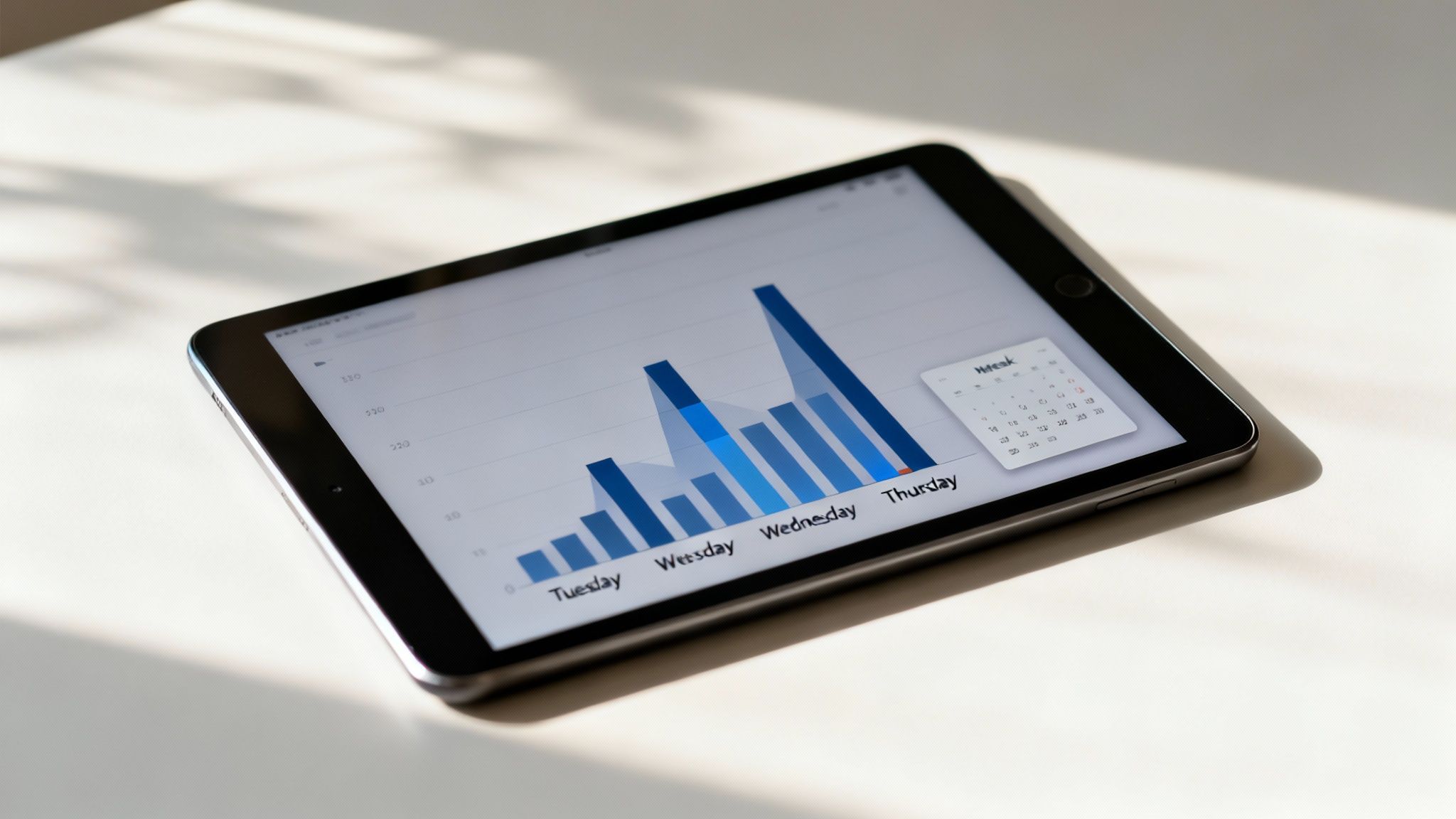
We've covered the basics, but what happens when you analyze the data from billions of emails? A clear, actionable pattern emerges: the middle of the work week is the undisputed champion for grabbing your audience's attention and driving sales.
Tuesday, Wednesday, and Thursday consistently outperform the rest of the week. But it's not a three-way tie; each day has a distinct psychological impact. Understanding this rhythm is how you move from picking a "good" day to strategically timing your promotions for when your customers are most focused and ready to act.
The data tells a compelling story. Mondays are for catching up, leaving little cognitive space for your promotion. By Friday, attention is fragmented as people plan for the weekend. The real revenue opportunity is in the middle.
Here’s how that window typically plays out:
The difference between opens and revenue is critical. A high open rate on Tuesday signals interest, but a high conversion rate on Thursday shows actual purchase intent. Real ROI comes from hitting that moment of maximum intent, not just grabbing a glance.
If you zoom in even further, the data shows that the morning-to-early-afternoon window on Tuesdays and Thursdays is when performance really peaks. In an extensive review, Mailshake ranks the days with Tuesday at #1 and Thursday at #2. The big email platforms agree, with analyses showing Tuesday open rates hitting nearly 20%, with Wednesday trailing close behind.
Crucially, studies that focus specifically on revenue often crown Thursday as the top day for actual sales, proving there's a direct line between timing and your bottom line. You can dig into a detailed synthesis of these findings on peak email marketing times.
Think of these data-backed insights as your starting point. This is the powerful, reliable foundation you can use to start building a tailored testing strategy and uncover your brand's own unique, revenue-maximizing window.
Great timing is about understanding your customer's mindset, not just their schedule. While data tells you when people are opening emails, consumer psychology explains why they do it. When you align promotional emails with your audience's mental state, you move beyond simple open rates to driving real revenue.
This is the distinction between a basic email capture pop-up and a sophisticated urgency marketing strategy built for conversion. A generic countdown timer just creates pressure. But timing your offer to sync up with a customer's natural desire to buy creates a smooth journey that feels genuinely helpful, not manipulative. It’s a critical shift from gimmick to marketing science.
Consider the different roles your customers play throughout the day. The person scrolling through their inbox at 10 AM on a Tuesday has a completely different mindset from the one browsing at 8 PM on a Thursday.
The 10 AM Productivity Peak: Mid-morning, people are usually focused on getting things done. This is the perfect window for B2B offers or larger purchases that require a logical decision. An email landing at this time must be scannable and present the value proposition instantly.
The 4 PM Wind-Down Window: As the workday wraps up, a powerful psychological trigger kicks in: anticipation. People start thinking about the weekend, and their minds open up to B2C offers tied to relaxation, self-care, and personal passions.
Behavioral economics tells us that our willingness to spend on "wants" versus "needs" changes dramatically based on our emotional state. An email that arrives during a moment of relaxation and positive anticipation is far more likely to convert than one that interrupts a moment of high stress.
A customer’s mood and receptiveness to a sale can change by the hour, which is why a one-size-fits-all approach to urgency fails. It’s one of the main reasons consumers are tuning out marketing emails—the timing feels wrong. A "flash sale" alert that hits during a busy morning meeting isn't just ignored; it’s an annoyance.
But send that same offer during an evening scroll session, and it becomes an exciting find. This is where Quikly’s expertise in urgency science shines. We focus on creating promotional "Moments" that sync up with these natural rhythms. Instead of forcing a sense of urgency, this method taps into the shopper's existing psychological state.
By coordinating a limited-time drop with a peak engagement window like a Thursday evening, you're not creating excitement—you're amplifying it. This dramatically boosts participation and drives a much higher ROI, ensuring your message doesn't just get seen, it gets acted on.
Generic advice is a starting point, not a strategy. The idea of a single "best time to send promotional emails" that works for every brand is a myth. A SaaS company targeting busy professionals has a completely different window of opportunity than a Shopify fashion brand selling to weekend shoppers.
To see real revenue growth, you must get specific. The rules of engagement change dramatically based on who you're talking to and what you're selling.
For B2B brands, success is almost always tied to the traditional 9-to-5. An email sent at 10 AM on a Tuesday lands right when decision-makers are at their desks, focused on business solutions and ready to tackle problems. Their mindset is locked on professional needs, making it the perfect moment to evaluate your offer.
For retail and eCommerce, the game is completely different. The most profitable moments often occur in the hours outside of work.
Picture the modern shopper: relaxing on the couch, scrolling on their phone while the TV is on. This "second screen" browsing is a golden opportunity. It’s a low-pressure moment when they're receptive to discovering something new.
A promotional email that hits their inbox at 8 PM on a Thursday taps directly into this mood. They're already thinking about the weekend and are more open to treating themselves. In this context, your email shifts from being an interruption to a welcome distraction.
Generic timers and pop-ups fail because they ignore context. A "limited-time" offer that hits a busy professional's inbox at 9 AM is an annoyance. That same offer landing on a shopper's phone at 8 PM is an exciting discovery. Smart marketing aligns with the customer's real life, not just making noise.
Even within your own audience, you can't treat everyone the same. Digging into your segments reveals the need for different timing strategies. Not every subscriber is on the same page, and your send schedule needs to reflect that.
The data backs this up, especially for B2C. Research from thousands of campaigns consistently shows that late afternoon to early evening on Thursdays (4-7 PM local time) is a prime slot for maximizing revenue. You can dive into more insights showing that 4 PM is often the peak for actual orders per email, with fashion retailers seeing huge success on Thursday evenings.
To truly nail your timing, you have to look at the unique psychology of your audience. A weekend hobbyist thinks and buys differently than a mid-week office worker. Here’s a quick breakdown of how timing strategies can differ based on who you're trying to reach.
| Segment | Primary Day(s) | Primary Time Window (Local Time) | Psychological Rationale |
|---|---|---|---|
| B2B Professionals | Tuesday, Wednesday | 9 AM - 11 AM | Aligns with the focused, problem-solving mindset at the start of the workday before meeting fatigue sets in. |
| eCommerce (General) | Thursday, Friday | 4 PM - 8 PM | Captures the "second screen" shopper unwinding after work and planning their weekend purchases. |
| Fashion & Apparel | Thursday Evening | 7 PM - 9 PM | Taps into pre-weekend excitement and social planning, when shoppers are looking for new outfits. |
| Restaurants/Food | Friday | 3 PM - 5 PM | Intercepts customers as they are making their weekend dining and takeout plans. |
| Hobby & DIY | Saturday, Sunday | 9 AM - 12 PM | Catches people during their downtime when they are actively engaged in or planning for their hobbies. |
| Travel & Hospitality | Monday, Tuesday | 10 AM - 1 PM | Reaches people when they are back at work, often daydreaming or planning their next getaway. |
This table isn't a set of rigid rules, but a guide to help you think more like your customer. By segmenting your audience and timing your messages to their specific mindset, you build campaigns that feel relevant and drive real results.
Stop guessing. While industry benchmarks are a useful starting point, the only way to find the real sweet spot for your brand is to build your own data-driven testing framework. This is how you move from broad assumptions to decisions that directly grow your ROI and revenue per recipient.
This is about a clear, repeatable methodology. Instead of just chasing vanity metrics like open rates, this process hones in on what truly matters to your bottom line: revenue and conversions.
This isn't a one-size-fits-all game. As you can see below, timing really depends on the business model.
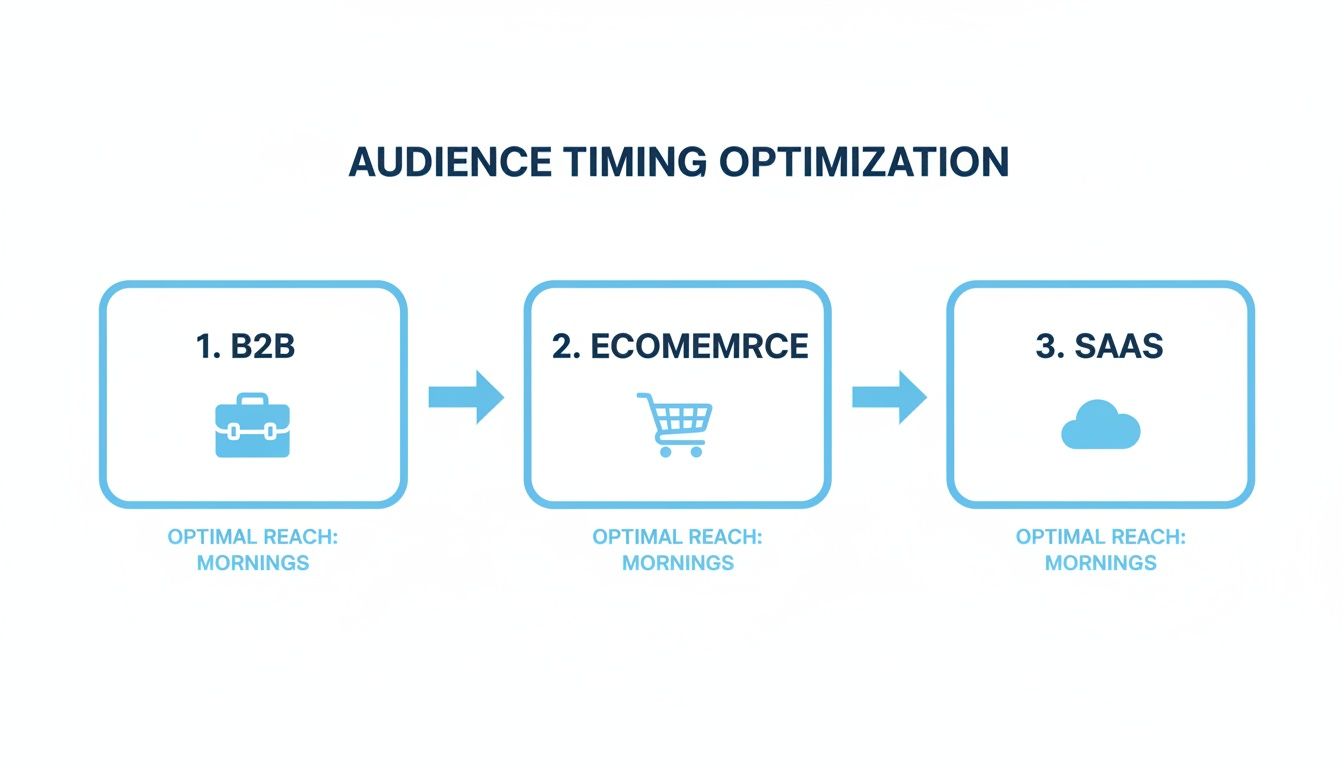
While there are general principles that hold true, peak times for B2B, eCommerce, and SaaS are all a bit different. Each one requires a tailored approach based on how their specific audiences behave.
Before you can test anything, you need a control. Grab one of the industry standards we’ve talked about—like Tuesday at 10 AM or Thursday at 4 PM—and use that as your starting hypothesis. This isn’t the finish line; it’s just the starting block for your optimization race.
Next, you must work with clean data. That means segmenting your audience. An unsegmented list is like a noisy room—it’s impossible to hear what any one person is actually saying.
By segmenting your list, you isolate variables. This allows you to confidently attribute performance changes to your timing tests, not just the random behavior of a jumbled-up audience. It’s the difference between guessing and knowing.
To do this right, group your subscribers based on meaningful criteria. You can go way beyond simple demographics with these customer segmentation examples to set up some really powerful groups. For Shopify Plus merchants, this can be integrated directly with your customer data platform for even more granular control.
With your baseline and segments ready, it’s time for some structured A/B testing. Most modern email platforms, especially tools like Klaviyo that integrate seamlessly with Shopify, make this straightforward. The absolute key here is to be methodical: change only one variable at a time. In this case, it's the send time.
Here’s an actionable takeaway you can implement today:
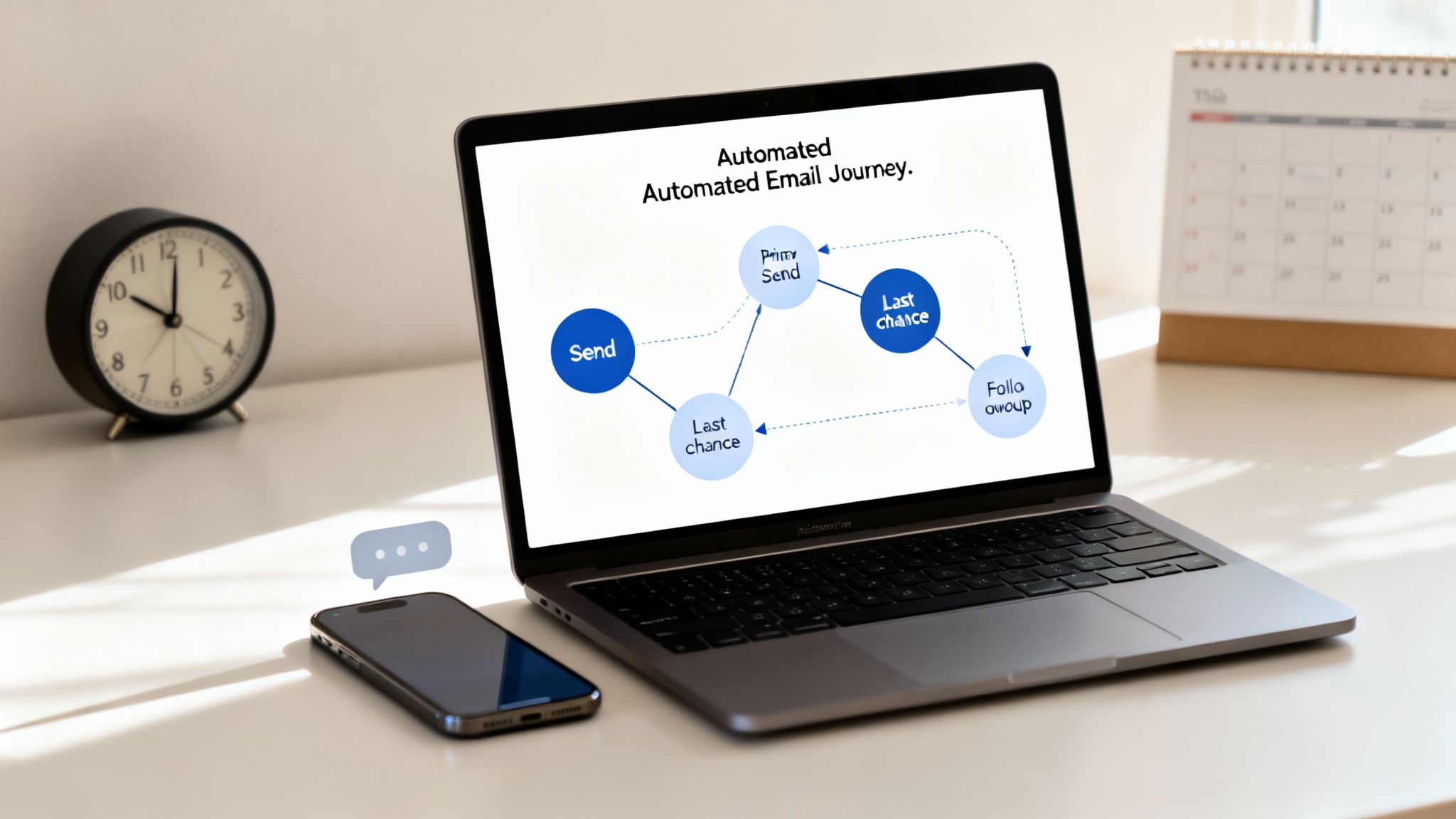
Finding the optimal time to send emails is a huge win. But the real revenue amplification happens when you pair that perfect timing with the science of urgency marketing. This elevates a simple promotional email into a can’t-miss event that drives predictable revenue.
Instead of just blasting a generic discount, you can launch a promotional "Moment" at a time you know your audience is active, like a Thursday afternoon. You're not just sending an email; you're building anticipation right when shoppers are already shifting into a weekend buying mindset. This is a powerful shift from a simple campaign to a genuine experience.
This is where sophisticated platforms pull away from basic timer apps. The significant revenue isn’t just in the initial send; it’s in the automated follow-up. A smart system triggers next steps based on customer behavior, creating a journey that feels personal and responsive. To master this, you need to understand what is email marketing automation is about, because that's what lets you time everything perfectly, at scale.
For instance, a Shopify Plus enterprise could build out a flow that:
This automated, multi-touch approach is the core difference between managing a campaign and running a true urgency marketing engine. It reacts to customer behavior in real time, ensuring every message lands with maximum psychological impact and drives a much higher ROI than manual campaign management.
This entire process is built on a deep understanding of behavioral triggers. By coordinating send times with these proven psychological principles, you create a compelling path from initial interest to final purchase. To dive deeper into these strategies, you can check out our step-by-step guide on using urgency psychology to increase email conversions.
Even after you've nailed down a solid testing plan, specific questions always pop up when you start putting it into practice. Let's walk through some of the most common ones from brands trying to optimize their promotional email schedule.
This is a critical point. For any brand with a national or global audience, sending a single campaign at one set time is a surefire way to leave revenue on the table.
The solution is to use your email platform's "send by time zone" feature. This is a must-have tool found in most modern email service providers, like Klaviyo. It ensures your email lands at the perfect local hour—say, 10 AM—for every subscriber, whether they're in New York or California.
If your platform lacks this, the workaround is to segment your list by major time zones. Schedule separate campaigns for each, starting with the regions that generate the most revenue.
Not in the same way. The timing for your automated flows—like welcome series or cart abandonment emails—is dictated by the customer's action. Here, immediacy is everything.
An abandoned cart email, for example, is most powerful when it hits their inbox within the first hour. You're capitalizing on that moment when purchase intent is still high.
That said, you can still be strategic with timing inside your multi-step flows. For a second cart reminder, A/B test sending it 23 hours later instead of the standard 24. That small shift could be the difference between getting lost in the morning inbox rush and arriving at a quieter, more receptive time in the evening.
Consumer habits change, and your send-time strategy must adapt. This is not a "set it and forget it" task. A good rule of thumb is to conduct a full analysis of your email timing at least once or twice a year.
If you see a noticeable dip in key metrics like your conversion rate or revenue per email, that's a clear signal that your audience's daily routines have shifted. This is your cue to initiate a new round of A/B tests, find the new sweet spot, and get your revenue climbing again.
Ready to turn timing insights into real revenue? With Quikly, you can sync your promotional campaigns with your audience's peak engagement windows, using the science of urgency to create can't-miss events. Discover how to build campaigns that convert by visiting https://hello.quikly.com.