

ecommerce conversion
customer experience strategy
digital customer experiences
The term "pop-up notification" often conjures images of disruptive boxes that interfere with browsing. However, when grounded in the science of consumer psychology, a pop up notification can become one of the most effective tools in your ecommerce arsenal for driving revenue and protecting profit margins.
A pop-up is a targeted message that appears on a shopper’s screen during their journey. While many brands use them simply to capture an email address, their true potential lies in their ability to influence purchasing decisions in real-time. This guide will explore how to transform a basic pop-up from a simple list-building tool into a sophisticated revenue-generation engine.
Consider the average pop-up: a generic, one-size-fits-all offer. It’s the digital equivalent of a store clerk greeting every single person with a flat, "Can I help you?" Most shoppers ignore it.
Now, imagine a more intelligent approach. A shopper is viewing a specific pair of jeans, and just as they check the size, a notification appears: "Heads up, this is a top-seller, and we only have three left in your size." This isn't an interruption; it's a timely, relevant intervention based on the psychological principle of scarcity. This is what turns a basic pop-up into a powerful sales tool.
This strategic approach connects a customer's immediate interest to your bottom line, directly influencing key business metrics like ROI, profit margins, and inventory turnover.
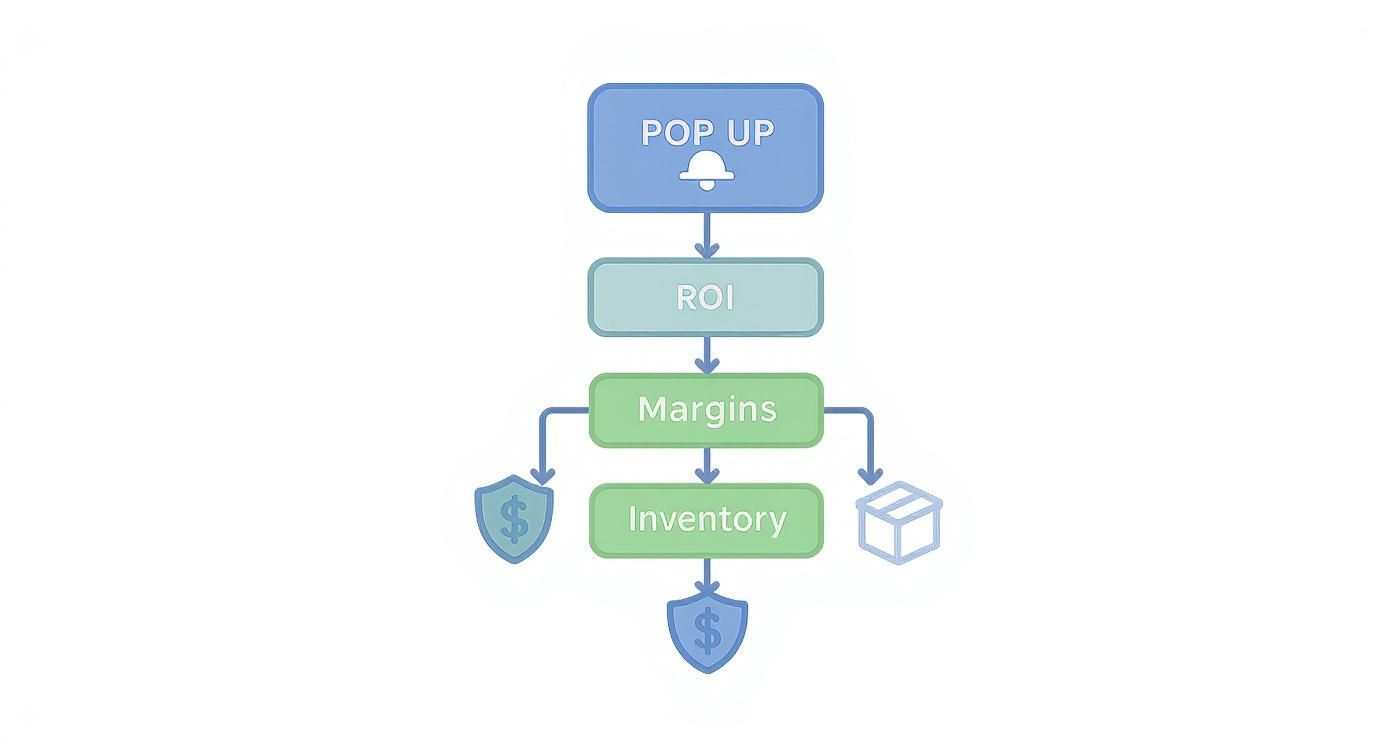
As this illustrates, the objective isn’t vague "engagement." It's about driving measurable financial outcomes by converting a browser’s fleeting interest into a decisive purchase.
The most effective pop-ups don't feel like interruptions; they feel like helpful nudges grounded in an understanding of human behavior. They graduate from simply collecting emails to becoming an integral part of the shopping journey. By tapping into core psychological drivers from behavioral economics, they give customers a compelling reason to act now.
By integrating principles like scarcity and social proof, a pop up notification shifts from a passive information box to an active sales driver, accelerating the customer's decision-making process without resorting to manipulative tactics.
The entire approach centers on enhancing the shopping experience, not hijacking it. This positions urgency marketing as a sophisticated application of psychology, designed to guide rather than pressure.
When executed correctly, the returns are far more tangible than a longer email list. The primary goals become directly tied to financial performance:
This elevates the pop up notification from a simple marketing gadget to an essential tool for any serious marketer, especially on platforms like Shopify Plus where managing high traffic and large inventories is a daily challenge. By using intelligent, behavioral triggers instead of basic countdown timers, brands can create automated "Moments" that feel personal and genuinely useful—turning casual browsers into committed buyers.
What differentiates a pop-up that drives sales from one that gets closed instantly? The answer lies in understanding consumer psychology. The best pop-ups are not random interruptions but carefully timed messages grounded in the science of how we make decisions.
Instead of just displaying an offer, a well-designed pop-up creates a compelling psychological moment for the shopper. It taps into the subconscious question, "Why should I act on this right now?" This is where core principles from behavioral economics can transform a simple notification into a powerful motivator, making it a helpful part of the shopping journey rather than an annoying detour.
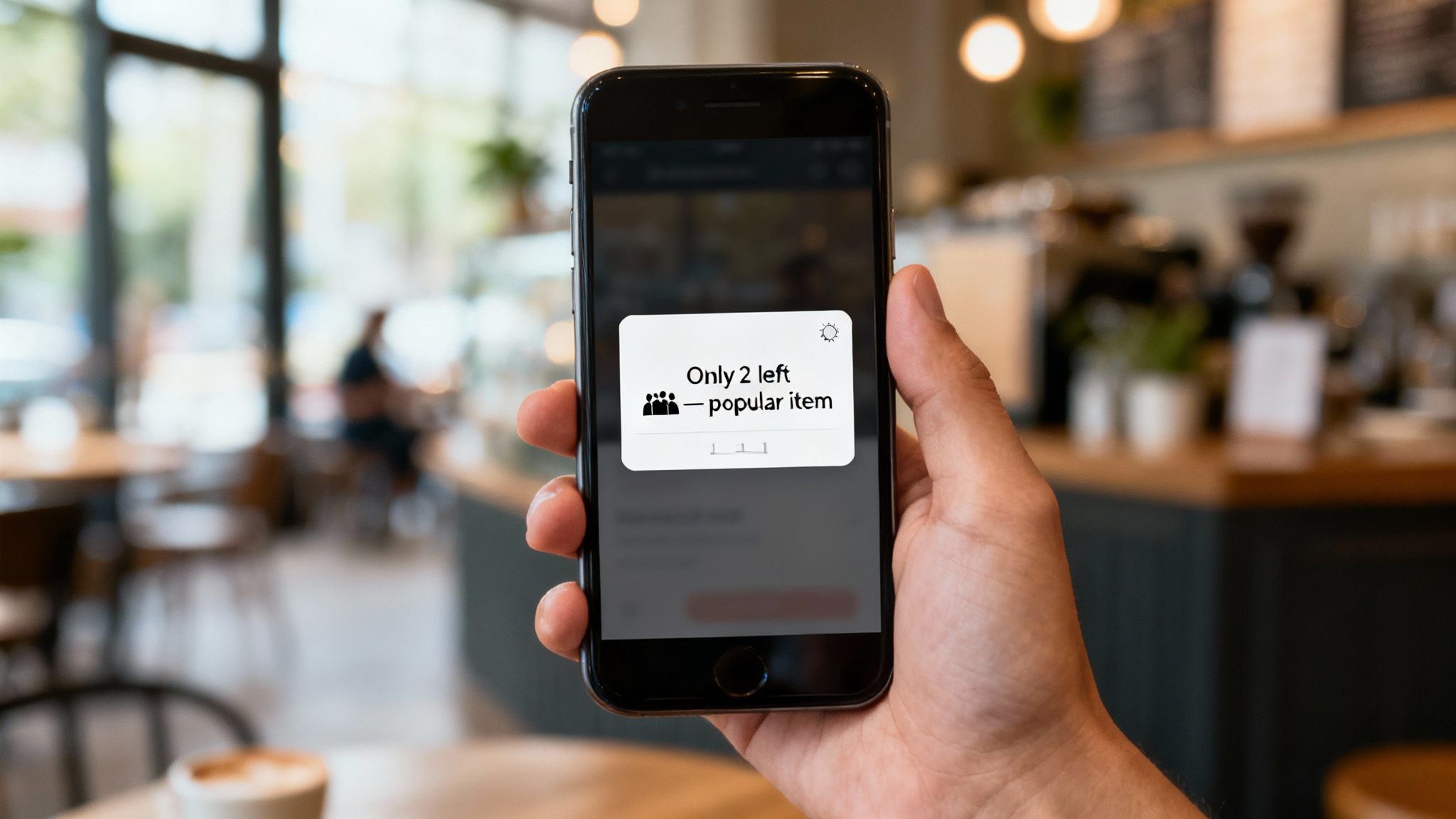
Several key principles from behavioral science consistently drive action. When used ethically, they gently guide customers toward a decision without feeling manipulative.
Actionable Takeaway: Audit your current pop-ups. Can you replace a generic "10% off" offer with a more psychologically compelling message? Try testing a social proof message like "Just bought by a shopper in New York!" or a scarcity alert tied to real inventory levels for a specific product.
Getting the psychology right is critical, but so is execution. Overt or clumsy application can backfire. For example, frequency matters. Research shows that 46% of users will opt out of push notifications if they get just two to five messages a week. Conversely, visually rich notifications can see a 56% higher open rate. You can explore more in this analysis of push notification statistics. This data underscores the need for a smart strategy that prioritizes quality and relevance over sheer volume.
When it comes to pop up notifications, success is often determined more by when you deliver your message than by what you say. An effective pop-up feels intuitive, appearing at the precise moment a customer needs a nudge. This is where modern platforms have evolved beyond simple, manual triggers (like basic exit-intent) into the realm of intelligent automation.
Instead of showing every visitor the same generic message, sophisticated systems use behavioral triggers. These are tied to a user’s real-time actions on your site, making the experience more relevant and effective. This intelligent timing is what separates a pop-up that converts from one that annoys.
Basic pop-up apps often rely on simple, one-size-fits-all rules that require constant manual adjustment. The next generation of urgency marketing, however, is built on automated, context-aware triggers that adapt to each shopper's unique journey.
Some of the most effective intelligent triggers include:
Once you've perfected the timing, the design must be flawless to maintain momentum. Aim for a frictionless experience on both desktop and mobile, with a clear message and an unmissable call-to-action (CTA). If you're seeking a professional touch, you might explore what the best popup design agencies have to offer.
Your pop up notification should always be easy to close and fully accessible. Furthermore, respecting user privacy by adhering to GDPR and CCPA guidelines is not just a legal requirement—it's fundamental to building customer trust. For Shopify merchants, these design details are non-negotiable. You can find more platform-specific tips in our guide on creating high-converting popups for Shopify.
Actionable Takeaway: Implement an A/B test on a key pop-up this week. Test a different headline, CTA button color, or even the timing trigger. For example, on a product page, test a pop-up that appears after 15 seconds vs. one that appears after a 60% scroll. Let the data, not assumptions, guide your design strategy.
Ultimately, a pop-up's power lies in its context. Research shows that pop-ups tied to specific events, like adding an item to a cart, can achieve conversion rates as high as 48.7%. This demonstrates how a relevant message delivered at the perfect moment can dramatically improve performance.
While many brands limit pop-ups to email capture, their real power is in driving immediate sales and protecting profit margins. To move beyond basic list-building, you must treat pop-ups not as passive displays but as active tools for shaping shopper behavior and accelerating the path to purchase. This is how you transform a simple notification into a serious revenue engine.
This is where the science of urgency marketing truly shines. Forget generic timers that count down from a random number. Advanced strategies use dynamic, event-based triggers tied to real business data. This creates an authentic sense of urgency that resonates with customers and compels them to act.
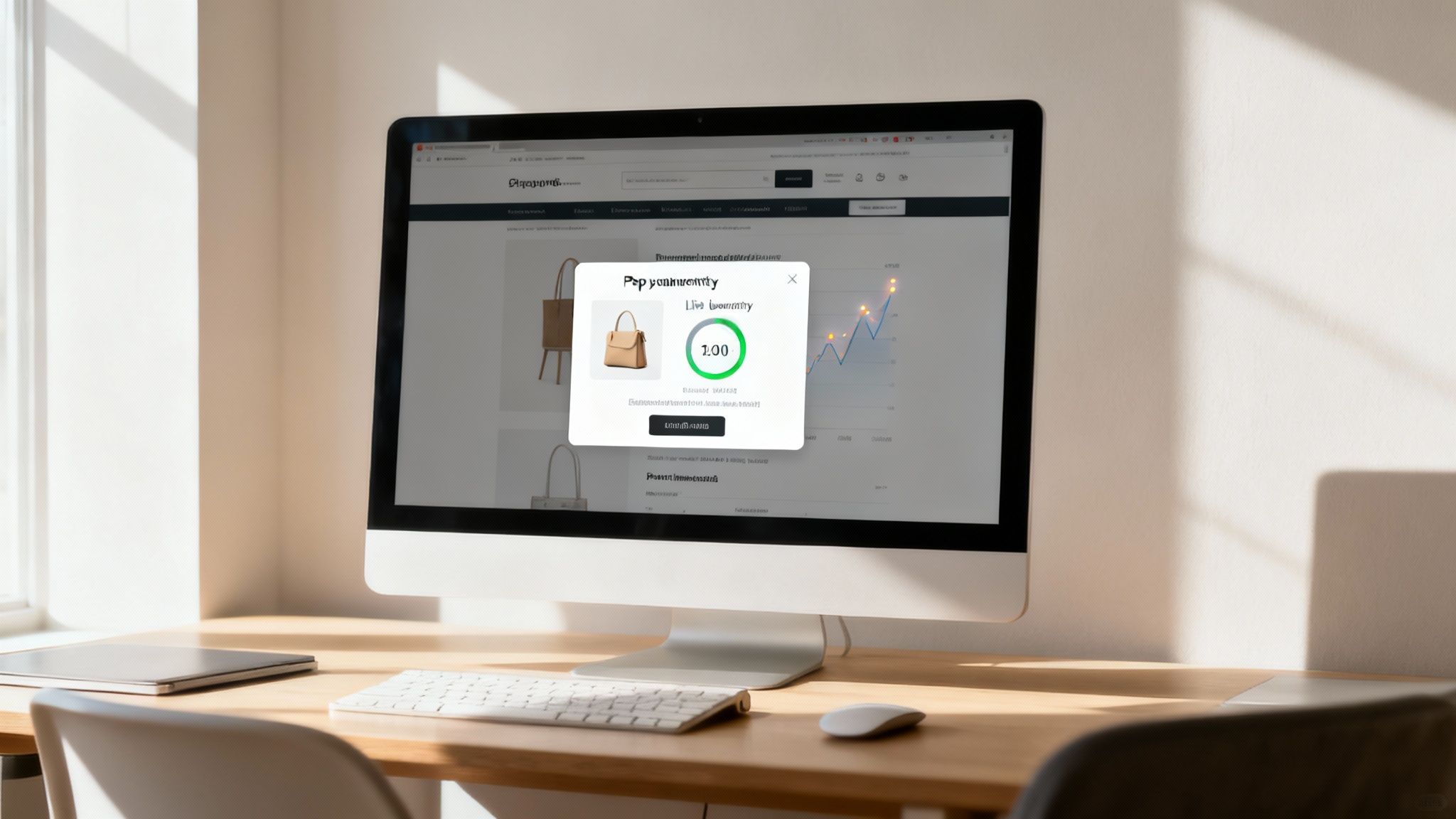
Focusing on revenue means deploying pop-ups at critical moments in the customer journey with clear financial goals. Understanding how these micro-interactions contribute to broader marketing objectives requires a solid grasp of What Is Conversion Rate Optimization. Instead of just requesting an email, use notifications for high-impact activities that directly boost sales.
These strategies are particularly valuable for Shopify Plus merchants. When dealing with large inventories and high traffic, you can automate these targeted promotions, which would be too complex to manage manually.
Actionable Takeaway: Instead of a generic "Welcome" pop-up, create a revenue-focused "Moment." For example, set up a pop-up triggered by cart value: "You're only $15 away from free shipping! Add one more item to qualify." This tactic directly targets an increase in Average Order Value (AOV).
The key differentiator in modern urgency marketing is the shift from static timers to dynamic, event-based triggers. A generic countdown timer that resets for every visitor quickly loses credibility. Shoppers see through the illusion.
In contrast, a notification triggered by real-world conditions is far more powerful. Imagine a pop-up that appears only when a product’s inventory drops below a certain level. That’s not manufactured scarcity; it's real scarcity. It is a potent application of behavioral psychology that makes the message feel authentic and helpful. The same logic applies to other real-time events, such as triggering a special offer just as a visitor is about to leave your site. For those wanting to master this specific tactic, our guide offers deeper insights into effective exit-intent pop-ups.
By connecting your pop-up strategy to real-time data, you transform a simple notification into a sophisticated, persuasive marketing tool that drives measurable ROI.
A pop-up notification should never operate in isolation. Its true power is unleashed only when it is a connected component of your entire marketing ecosystem. By linking data from your pop-ups to your other platforms, you can craft a seamless, personalized customer journey that extends long after the initial website visit.
This integration transforms a pop-up from a one-off tool into a strategic data-gathering machine. The information you collect—who clicked, what they saw, and what they did next—fuels your email and SMS marketing engines, creating a smart, automated feedback loop that boosts returns across every channel.
Consider this scenario: a shopper sees an urgency-driven pop-up for a low-stock item, hesitates, and then leaves your site. In a disconnected system, that lead is lost. But when integrated, that single action can initiate a powerful, automated sequence.
By connecting your pop-up tool to platforms like Klaviyo or Attentive, you can instantly segment that user based on their behavior.
This level of automation is fundamental to creating a fluid customer experience and is a hallmark of the best Shopify marketing apps available today.
This integrated approach makes your pop-up strategy the starting point for smarter, multi-channel conversations. The pop-up becomes the first touchpoint in a much longer—and more profitable—customer relationship, moving your strategy beyond basic email capture and into true revenue growth.
Actionable Takeaway for Shopify Merchants: Check if your current pop-up app offers a direct integration with your ESP (like Klaviyo) or SMS platform. If so, create a new automated flow. For example, build a segment of users who engaged with a scarcity pop-up but didn't buy, and send them a follow-up email 24 hours later titled "Don't Miss Out - Your Item is Almost Gone."
For Shopify Plus merchants, this is not just a "nice-to-have"; it's mission-critical. The ability to automatically segment high-intent shoppers based on their real-time behavior and then nurture them through email and SMS is what separates high-growth brands from the rest.
So, your pop-ups are live. How do you know if they're actually working?
To truly understand the value a pop-up delivers, you must look beyond surface-level metrics like impressions or open rates. While these numbers are interesting, they reveal little about the real business impact. The most successful ecommerce brands focus on key performance indicators (KPIs) that connect directly to the bottom line.
Measuring success boils down to one question: is this pop-up driving profitable growth? It’s time to move past vanity metrics and zero in on the numbers that reflect your company's financial health. This shift changes the conversation from "How many people saw it?" to "How much revenue did it generate?"
To get a clear picture of your pop-up campaign's performance, track these essential, business-focused metrics. They draw a direct line from your notifications to shopper behavior and, ultimately, to your revenue goals.
Actionable Takeaway: Create a simple dashboard to track these four KPIs for your main pop-up campaigns. Review it weekly. If you see a high click-through rate but no impact on AOV or RPV, you know you have a messaging or offer problem, not a visibility problem. This allows you to diagnose and fix issues with precision.
This data-first approach becomes especially critical when using high-impact channels. For instance, certain push notifications can achieve open rates as high as 90%, with an incredible 28% of users who engage going on to make a purchase. You can discover more insights about high-engagement push notification statistics to see just how powerful this can be.
By focusing on these concrete business outcomes, you can stop guessing and start proving the clear financial return of your pop-up notification strategy.
Let's address some common questions that arise when brands begin to think more strategically about using notifications. Moving beyond basic tactics to achieve measurable impact starts here.
They certainly can be—if implemented poorly. A generic, irrelevant pop-up that obstructs content is disruptive and feels like spam.
However, a strategic pop up notification enhances the shopping experience by providing helpful information at the right moment. Imagine a shopper has an item in their cart. Notifying them that it's low in stock isn't an interruption; it's a valuable service. It helps them avoid the disappointment of returning later to find the item sold out, tapping into the powerful psychological principle of scarcity in a way that feels genuinely helpful.
The most effective triggers are tied to shopper behavior, not a simple page-load timer. To see a real return, you must move beyond basic exit-intent pop-ups and leverage advanced behavioral triggers.
Some of the most effective, behavior-based triggers include:
These dynamic triggers create a sense of authentic urgency that feels natural and helpful, a world apart from the manipulative feel of a generic countdown timer.
This is a critical question. It's easy to get distracted by vanity metrics like impressions, but these don't reflect business impact. The true measure of success is tracking metrics that connect directly to your bottom line.
Focus on these business-centric KPIs instead:
By analyzing these figures, you can prove the financial return of your strategy and identify opportunities for optimization.
Ready to turn your pop-ups from simple email collectors into genuine revenue drivers? Quikly helps you build smart urgency marketing campaigns grounded in the proven principles of consumer psychology.