

ecommerce conversion
customer experience strategy
digital customer experiences
Most e-commerce brands view pop-ups as a necessary evil for email capture, often settling for basic countdown timers that barely move the needle. This approach ignores the profound psychological principles that can transform a simple pop-up into a significant revenue driver. With the average cart abandonment rate hovering around 70% and a standard conversion rate at just 2.5%, there is massive revenue left on the table. The difference between a disruptive pop-up and a profitable one lies in understanding consumer psychology: principles like scarcity, FOMO (Fear of Missing Out), and social proof.
This article moves beyond generic templates. We will provide a strategic breakdown of each pop up advertising example, grounding every tactic in behavioral science. For Shopify merchants and digital marketers, understanding the nuances of how to increase website conversions is paramount, and these examples provide a clear roadmap to boosting ROI, not just conversions.
We will explore how to leverage advanced urgency to not only boost sales but also protect profit margins and improve inventory velocity. The goal is to position your brand as a master of sophisticated marketing psychology, not manipulation. Quikly specializes in the science of urgency marketing, enhancing banners, pop-ups, and the entire shopper's journey. These actionable insights are designed for immediate implementation, helping you elevate the customer journey and drive measurable revenue.
Exit-intent technology is a powerful defense against the staggering 70% average cart abandonment rate that plagues e-commerce stores. It detects when a user’s cursor moves towards the browser's close button, triggering a pop-up at the last possible moment. This strategic intervention is a pivotal moment to recover otherwise lost revenue.
This type of pop up advertising example works by interrupting a user's decision to leave. The psychology behind it leverages loss aversion, a behavioral economics principle where the fear of losing a potential gain is a stronger motivator than the pleasure of acquiring it. Instead of a simple "buy or not buy" decision, the pop-up reframes the choice to "claim this exclusive discount or lose it forever."
An effective exit-intent pop-up moves beyond basic email capture; it's a revenue recovery tool. For instance, a Shopify Plus merchant might display a pop-up showing the exact items in the user's cart with a message like, "Wait! Complete your order now and get 15% off." This hyper-personalized approach reminds the shopper of their initial interest and lowers the price barrier, directly addressing a primary cause of abandonment and protecting the sale.
Key Insight: The goal isn't just to capture an email; it's to convert the immediate sale and protect revenue. By presenting a time-sensitive offer directly related to the items in their cart, you create a powerful sense of urgency and value that a generic newsletter sign-up cannot match.
For Shopify store owners, implementing this is straightforward with apps from the Shopify App Store. To maximize ROI:
Time-triggered pop-ups display after a user has spent a set amount of time on a page, typically between 15 and 30 seconds. This delay ensures the visitor has had a chance to engage with the content, indicating genuine interest and making them more receptive to a well-timed offer. This contrasts with basic pop-ups that appear instantly and often feel disruptive.
This type of pop up advertising example is designed to enhance, not interrupt, the user experience. The psychology at play is based on priming and reciprocity. By allowing the user to browse freely first, you build a small amount of goodwill. When the pop-up appears, the user feels less ambushed and more inclined to reciprocate by considering the offer, as their initial interest has already been established.
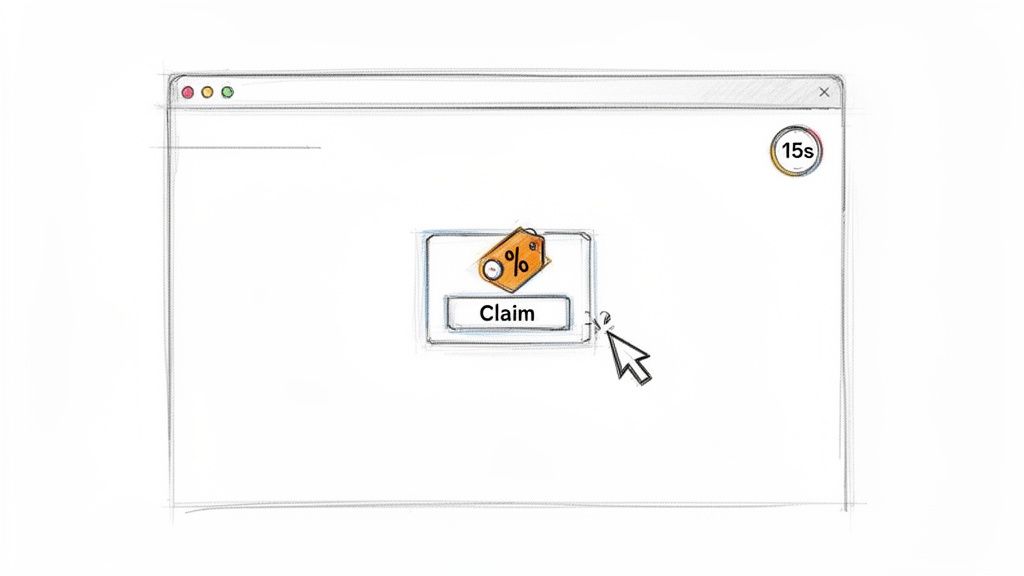
An effective time-triggered pop-up is contextual and value-driven, going far beyond a simple newsletter sign-up. Imagine a user spending 20 seconds on a specific product category page, like "Running Shoes." A pop-up can then appear with a targeted message: "Find Your Perfect Fit! Get 10% off all running shoes for the next 10 minutes." This feels helpful rather than intrusive because it directly relates to the user's current browsing behavior.
Key Insight: The power of a time-delay pop-up lies in its timing. It intercepts users at their peak engagement level, transforming passive browsing into an active purchasing decision by introducing a compelling, relevant, and time-sensitive incentive.
Shopify merchants can easily configure time-delay rules using apps found in the Shopify App Store. To optimize performance and revenue:
Scroll-triggered pop-ups activate only after a user scrolls a specific percentage down a page, typically 25-75%, signaling genuine engagement. This behavior-based trigger ensures the offer is presented to a warmed-up audience, not a casual browser who just landed. It’s a sophisticated trigger that outperforms basic, untargeted pop-ups.
This type of pop up advertising example capitalizes on the psychological principle of reciprocity. By providing valuable content that the user willingly consumes (indicated by their scroll depth), the brand earns the right to present a relevant offer. When the pop-up appears, it feels less like an interruption and more like a timely, helpful suggestion.
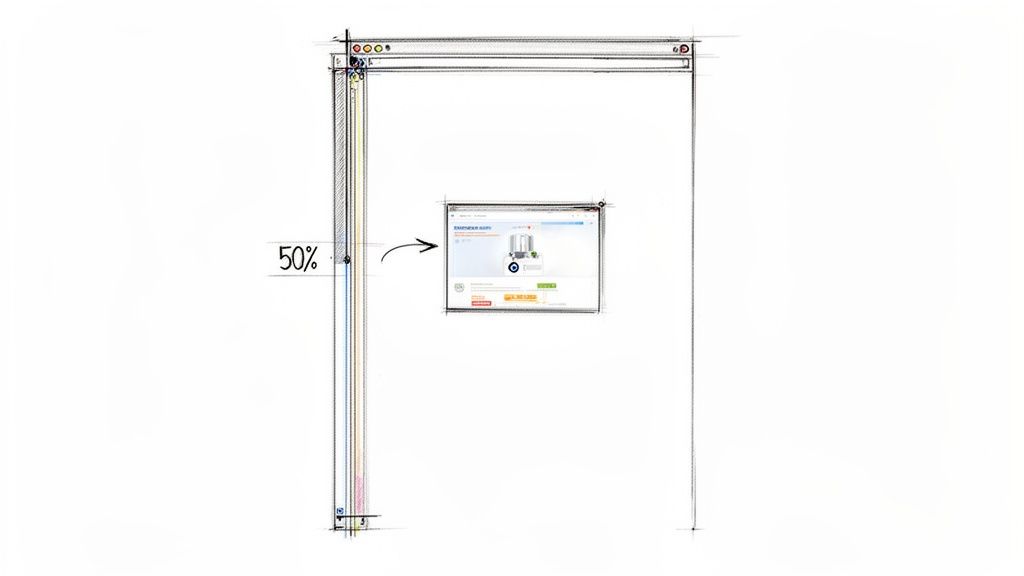
A powerful scroll-triggered pop-up is all about context. On a Shopify product page, a pop-up appearing after a user scrolls past the product description and into the customer reviews section could offer a bundle deal. The message might say, "Love what you're reading? Add our best-selling cleanser and get 20% off your entire order." This tactic aligns the offer with the user's high-intent behavior, striking when their purchase consideration is at its peak.
Key Insight: The power of the scroll trigger lies in its ability to match the offer to the user's demonstrated interest. It's not about interrupting the journey; it's about enhancing it by presenting a hyper-relevant next step when the user is most receptive.
Shopify merchants can use a variety of pop-up apps to set scroll-depth triggers. To maximize revenue and engagement:
While many pop-ups focus on email capture, a modern approach prioritizes revenue generation first. Form-based pop-ups function as a value exchange: a shopper provides their contact information in return for a compelling incentive. This is a foundational strategy for building a first-party data asset, which is critical for long-term customer relationships.
This specific pop up advertising example taps into the psychological principle of reciprocity. By offering a tangible benefit first, such as a 15% discount, brands create a social obligation for the user to reciprocate by providing their email. It transforms a simple data request into a mutually beneficial transaction, making users far more likely to subscribe.
A powerful lead capture form does more than just ask for an email; it initiates a personalized marketing journey that drives revenue. For instance, a beauty brand could use a pop-up that not only offers a discount but also asks the user to select their primary skin concern (e.g., "Dryness," "Acne," "Anti-Aging"). This simple, one-click segmentation allows the brand to immediately place the new subscriber into a tailored welcome series in Klaviyo with relevant product recommendations, drastically increasing the likelihood of a first purchase.
Key Insight: The primary goal is to acquire high-intent leads you can nurture into loyal customers. By gathering a key data point beyond the email, you bypass generic marketing and begin a personalized conversation from the very first interaction, significantly improving email engagement and lifetime value.
Shopify merchants can easily deploy these forms using apps like Klaviyo, Attentive, or dedicated pop-up builders. To optimize performance:
Unlike pop-ups that interrupt the user, click-triggered pop-ups are activated by the user's explicit action, such as clicking a button or link. This permission-based approach respects the user's journey, showing content precisely when their curiosity is highest. It’s a sophisticated behavioral trigger that contrasts sharply with basic, intrusive pop-ups.
This type of pop up advertising example is rooted in the psychological principle of commitment and consistency. When a user takes a small, voluntary step like clicking an "Unlock Offer" button, they are more psychologically primed to follow through with the next step, such as making a purchase. The interaction is initiated by them, which inherently makes the resulting offer seem more valuable and less intrusive.
A click-triggered pop-up excels at delivering highly contextual promotions without disrupting the browsing flow. For example, a Shopify store could place a subtle "View Special Offer" button on a product page. When clicked, the pop-up reveals a limited-time bundle deal. This strategy isolates the offer to only the most engaged shoppers, increasing conversion probability and protecting profit margins from sitewide discounts.
Key Insight: The power of click-triggered pop-ups lies in their opt-in nature. By making the user ask for the deal, you transform the interaction from a pushy sales tactic into a rewarding discovery, significantly boosting the offer's perceived value and relevance.
Implementing this on Shopify can be done through various pop-up apps that support click-triggers. To optimize these for maximum revenue impact:
Entry pop-ups appear almost instantly after a visitor lands on your site. While they can be perceived as aggressive, modern implementations prioritize value exchange, making them a powerful tool for new visitor acquisition. The goal is to make an immediate, compelling offer that frames the entire shopping experience positively.
This type of pop up advertising example capitalizes on the principle of reciprocity. By offering a tangible benefit upfront, like a 15% discount, you create a psychological obligation for the visitor to reciprocate, often by making a purchase or providing their email. It's a proactive strategy that turns a passive browsing session into an engaged, value-driven interaction.
An effective entry pop-up is more than a simple newsletter sign-up; it's a strategic welcome mat that boosts revenue. For example, a Shopify beauty brand could use a welcome pop-up to announce a new product collection and offer an exclusive "First Look" discount. The message, "Be the First to Try Our New Glow Serum! Get 20% Off Your First Order," immediately segments new visitors and aligns their initial engagement with a key business goal: promoting new inventory and protecting margins on older stock.
Key Insight: The primary objective is to convert a new visitor's initial curiosity into a transactional relationship. A valuable, immediate offer prevents bounce rates by giving users a clear reason to stay and explore, directly influencing their propensity to purchase during that first session.
For Shopify merchants, apps can deploy these pop-ups with sophisticated targeting. To maximize effectiveness:
Floating bars, often called sticky bars, broadcast key messages without blocking the user's view. These persistent banners attach to the top or bottom of the screen, remaining visible as users scroll. Unlike intrusive modal pop-ups, they inform rather than interrupt, making them a perfect tool for ongoing promotions like free shipping thresholds or site-wide sales.
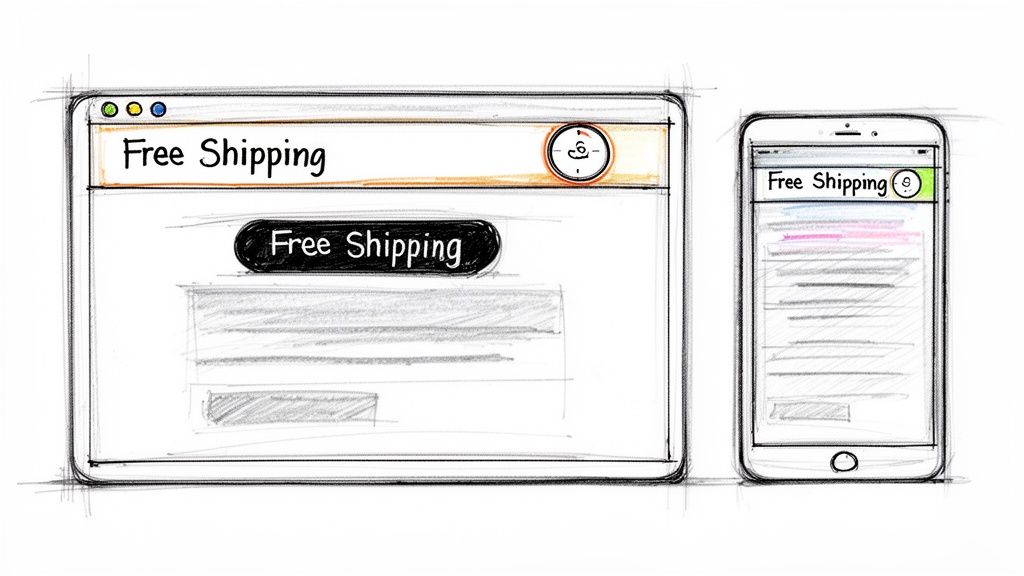
This pop up advertising example capitalizes on the Mere-Exposure Effect, a psychological phenomenon where people develop a preference for things merely because they are familiar with them. By keeping an offer like "Free Shipping on Orders Over $75" constantly in view, you embed the value proposition in the shopper's mind. This subtly encourages them to increase their cart value to meet the threshold, transforming a simple announcement into a powerful Average Order Value (AOV) booster.
An effective floating bar is a masterclass in concise, high-impact communication. It avoids disrupting the user journey while still creating a sense of urgency. For example, a Shopify store running a 48-hour flash sale can use a top-of-page sticky bar with a live countdown timer. The message "Flash Sale Ends In: [Timer]" is always visible, constantly reinforcing scarcity without preventing customers from browsing products. This is far more sophisticated than a basic, static announcement.
Key Insight: The power of a floating bar lies in its persistence, not its interruption. Its goal is to consistently reinforce a single, high-value message, influencing browsing behavior and purchase decisions over the entire session rather than at one specific moment.
Shopify merchants can easily add floating bars using apps or a theme's built-in feature. For maximum effectiveness:
| Pop-up Type | Implementation complexity | Resource requirements | Expected outcomes | Ideal use cases | Key advantages |
|---|---|---|---|---|---|
| Exit-Intent Pop-ups | Medium — cursor-movement detection and session logic (desktop-focused) | Moderate — JavaScript snippet, design, A/B testing | Higher recovery of abandoning visitors; improved cart recovery and email capture | Abandoned cart recovery, last‑moment discounts on desktop | Targets users at highest exit risk; low intrusion since it only appears on exit |
| Time-Triggered Pop-ups | Low — simple timer-based trigger, cross-device | Low — basic JS, timing variants, creative assets | Better engagement than immediate pop-ups; boosts promotions when users are already browsing | Promote offers after user engagement time, flash-sale prompts | Respects browsing time; works on mobile and desktop |
| Scroll-Triggered Pop-ups | Medium — scroll-depth tracking, per-page tuning | Moderate — analytics, per-page settings, responsive design | High engagement from interested visitors; effective for upsells and recommendations | Product pages, long-form content, review sections | Behavior-based targeting; contextual and mobile-friendly |
| Form-Based Pop-ups (Lead Capture) | Medium — form fields, validation, integrations, compliance | Moderate — email platform integration, data storage, consent mechanisms | Direct data collection; builds email lists and personalization data with high long-term ROI | Subscriber acquisition, segmentation, gated content access | Captures first‑party data and drives email marketing growth |
| Click-Triggered Pop-ups | Low — attach to click handlers on specific elements | Low — design for CTAs, per-element analytics | High engagement from intent-driven users; strong contextual conversions | Product CTAs, "View Deal" or "Unlock Offer" buttons, interactive discovery | User-initiated opt-in experience; minimal friction and high relevance |
| Entry Pop-ups (Welcome Pop-ups) | Low — page-load trigger with visitor segmentation options | Low to moderate — design, offer setup, new-visitor targeting | High visibility and opt-ins when offer is compelling; risk of higher bounce if aggressive | New visitor acquisition, welcome discounts, major announcements | Maximum reach and immediate acquisition impact |
The journey through each pop up advertising example in this guide reveals a fundamental truth: the most effective pop-ups are precision-engineered psychological interventions. They have evolved from simple email capture tools into sophisticated, revenue-driving 'Moments' that align perfectly with the shopper's journey. The difference between a pop-up that gets closed and one that converts lies in its ability to tap into core behavioral principles like scarcity, loss aversion, and social proof. Basic countdown timer apps can't replicate this level of sophistication.
By moving beyond generic offers, you can orchestrate high-impact experiences that drive revenue while protecting profit margins. This involves deploying exit-intent offers to recover abandoned carts, using scroll-triggers to engage hesitant shoppers, and leveraging welcome pop-ups to make a powerful first impression. This strategic application of urgency science, powered by sophisticated automation, is what separates leading e-commerce brands from the rest.
Transforming this knowledge into tangible ROI requires a clear, methodical approach. Here are the immediate steps you can take:
Ultimately, mastering the art and science of pop-up advertising is about creating value at every touchpoint. It’s about understanding shopper psychology so deeply that your marketing feels less like an interruption and more like a helpful suggestion. By embracing these advanced strategies, you can convert fleeting interest into decisive action, turning a simple on-site tool into a predictable and powerful engine for profitable growth.
Ready to move beyond basic pop-ups and implement sophisticated urgency science on your Shopify store? Quikly helps brands create high-impact marketing 'Moments' that drive immediate action and measurable revenue. See how our platform can transform your on-site engagement and turn every visitor interaction into a profit opportunity.