

ecommerce psychology
brand loyalty
best brand experiences
Launching a new product is more than just a sequence of tasks; it's a calculated exercise in consumer psychology. The average cart abandonment rate hovers around 70%, with a typical e-commerce conversion rate struggling to reach 2.5%. These industry benchmarks reveal a critical truth: the standard approach to product launches is fundamentally broken for most brands. To succeed, you need a launch product checklist that is grounded in behavioral science, one that systematically builds anticipation, leverages the principle of scarcity, and transforms fleeting interest into immediate, measurable revenue.
This guide moves beyond generic advice and basic pop-ups. We will provide a sophisticated, 10-point framework specifically designed for ambitious e-commerce and Shopify merchants. This checklist is your roadmap for turning a launch from a hopeful guess into a predictable, high-impact revenue event. We'll explore how to integrate advanced urgency marketing tactics, like the automated 'Moments' offered by Quikly, to not only maximize launch-day sales but also protect your profit margins and optimize inventory from day one.
Each step in this checklist is designed to be actionable, focusing on the ROI and business impact of a well-executed strategy. We’ll cover the entire lifecycle, from pre-launch planning and technical setup to launch day operations and post-launch analysis. For a comprehensive guide on the entire process, consider these actionable steps on how to launch a new product effectively. This framework will equip you with the tools to engineer a launch that not only meets but exceeds its financial goals.
Before a single product image is uploaded or an email is drafted, the first step in any successful launch product checklist is defining what victory looks like. Setting clear, measurable goals and Key Performance Indicators (KPIs) transforms your launch from a hopeful guess into a strategic, data-driven operation. This foundational step aligns your team, dictates your marketing tactics, and provides a benchmark to evaluate performance and justify ROI.

Without concrete objectives, you cannot accurately measure the effectiveness of your campaigns or optimize for future growth. Your goals should extend beyond simple revenue targets to include metrics that reflect overall business health and customer engagement. When defining your product launch goals, it is crucial to establish measurable metrics. For a holistic view, you might want to research the top customer service KPIs to track to see how your launch impacts customer satisfaction and loyalty.
Move beyond vanity metrics and focus on numbers that directly impact your bottom line.
Once your goals are set, the next critical item on your launch product checklist is to understand the landscape you are entering. Comprehensive market research and competitive analysis prevent you from launching in a vacuum. This process involves a deep dive into your target audience, market trends, and what your rivals are doing, ensuring your product and marketing strategy are positioned for maximum impact from day one. It is the intelligence-gathering phase that informs everything from pricing to messaging.
This research grounds your strategy in reality, not assumptions. By analyzing customer demographics, psychographics, and existing consumer behavior, you can tailor your messaging to resonate deeply. Simultaneously, examining competitor strategies—especially their use of basic countdown timers versus more sophisticated behavioral triggers—reveals opportunities to differentiate and capture market share. This foundational work is what separates a product that drives revenue from one that sinks without a trace.
Focus your efforts on gathering intelligence that directly informs your launch strategy.
A powerful marketing strategy can drive unprecedented traffic to your store, but it will all be for nothing if the technical foundation crumbles under pressure. Setting up your Shopify store's technical infrastructure is a critical step in your launch product checklist that ensures a smooth, fast, and frictionless customer experience. This process involves verifying that every digital component, from your theme’s responsiveness to your payment gateways, is optimized to handle the anticipated surge in visitors and sales volume.
A technically sound storefront prevents costly launch day disasters like site crashes, broken checkouts, or slow-loading pages, which can decimate conversion rates and damage your brand's reputation. For Shopify Plus merchants, this often involves coordinating with developers to load test servers and confirm infrastructure can scale. For all stores, it means ensuring every plugin and integration, especially advanced urgency marketing tools that integrate with your ESP like Klaviyo, is correctly configured and tested. A well-prepared infrastructure is the invisible backbone of a profitable product launch.
Ensure your digital storefront is primed for peak performance and sales.
With your goals set and market defined, the next critical step in your launch product checklist is to craft the specific marketing experiences that will drive action. Designing compelling urgency campaigns moves beyond simple "buy now" messaging into the realm of behavioral economics, creating an environment where customers feel a genuine, psychological pull to purchase. This involves customizing campaign flows, from countdown timers to competitive ranked offers, to align perfectly with your brand identity and audience triggers.
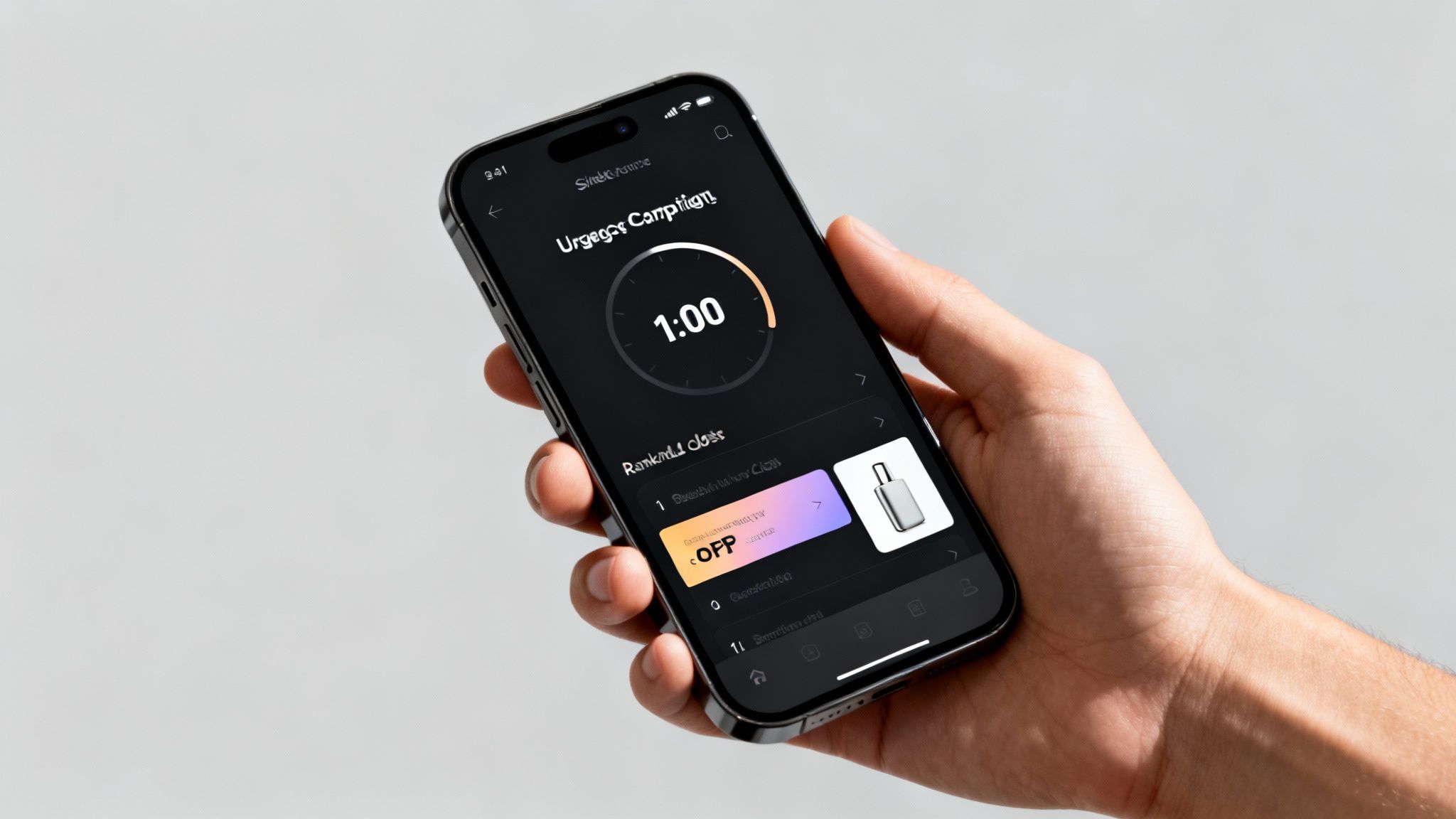
The difference between a generic pop-up focused on email capture and a sophisticated urgency campaign lies in its psychological depth and seamless brand integration. A well-designed campaign doesn't just display a timer; it tells a story of scarcity, exclusivity, or social proof that resonates with shoppers. By exploring various Shopify urgency tactics, you can select the right mechanic that aligns with your product’s appeal and your revenue goals, turning passive interest into immediate profit.
Focus on creating authentic, high-impact experiences that convert without alienating your audience.
A brilliant product and a powerful urgency marketing campaign are only effective if your target audience knows about them. This step in your launch product checklist involves creating an integrated roadmap to communicate your launch across every channel. A comprehensive marketing plan synchronizes messaging and timing across email, SMS, paid advertising, and social media to build anticipation, educate customers on urgency mechanics like drops or ranked offers, and drive a concentrated surge of traffic to your Shopify store during the critical launch window.
This coordinated approach ensures every touchpoint reinforces the core launch message. For example, a D2C brand might use influencer partnerships to announce a limited-time drop powered by Quikly, while email and SMS campaigns provide direct countdown reminders, amplifying the psychological principle of anticipation and triggering FOMO. Without this plan, your launch efforts risk being fragmented and less impactful, resulting in wasted ad spend and a diluted message.
Build a timeline that coordinates every channel to create a cohesive customer experience.
Launching without robust analytics is like flying blind; you can feel the motion but have no idea where you are headed. The sixth step in a comprehensive launch product checklist is to implement comprehensive tracking to measure campaign performance, customer behavior, and ROI. Setting up Google Analytics 4, Shopify Analytics, and specialized tools like Quikly’s reporting dashboard transforms your launch from a series of actions into a source of actionable intelligence.
Proper configuration allows you to attribute revenue directly to specific marketing channels and tactics, from a pre-launch email campaign to a launch-day urgency marketing drop. This data is not just for post-launch analysis; it provides real-time feedback to pivot strategies mid-launch, reallocating ad spend from underperforming channels to high-converting ones. For example, a brand could use Quikly's native analytics to see that countdown timers are outperforming ranked offers by 25%, prompting a shift in promotional creative to maximize revenue impact.
Build a data foundation that reveals the story behind the numbers and drives smarter decisions.
quikly_opt_in event for pre-launch sign-ups or a launch_timer_click event to measure engagement.A product launch is a complex, multi-departmental effort where seamless coordination is the difference between a smooth release and a chaotic scramble. The next essential step in any launch product checklist is to establish a clear command structure. Defining roles, responsibilities, and communication protocols transforms a collection of individual contributors into a unified, high-performance launch team. This organizational foundation prevents dropped balls, eliminates bottlenecks, and ensures rapid, decisive action when it matters most.
Without a designated lead and clear lines of communication, critical tasks can be overlooked, and decisions can be delayed, jeopardizing the entire launch timeline. For instance, Shopify Plus merchants often create dedicated "launch task forces" with representatives from marketing, operations, and customer service. This cross-functional team, led by a single launch manager, ensures all moving parts are perfectly synchronized from pre-launch through post-launch analysis.
Build a resilient team structure that can handle the pressures of launch day and beyond.
When introducing innovative sales mechanics like flash sales or ranked offers, a critical component of your launch product checklist is educating your audience. A well-designed customer education and onboarding plan demystifies the process, turning potential confusion into confident participation. By proactively explaining how your launch works, you reduce friction, build trust, and empower customers to engage, significantly boosting conversion rates and customer satisfaction.
Without clear instructions, even the most exciting urgency-driven campaign can lead to frustration and abandonment. Your plan should address common questions and skepticism head-on, ensuring every potential buyer understands the rules of engagement. This process is not just about providing information; it's about managing expectations and building the anticipation that drives successful, high-velocity sales events.
Make your educational materials as accessible and engaging as the launch itself.
Even the most brilliant marketing strategy can be derailed by a technical glitch or operational chaos on launch day. This is why a comprehensive testing and quality assurance (QA) phase, paired with a detailed launch day operations plan, is a non-negotiable part of any serious launch product checklist. This step moves your launch from hope to certainty by systematically identifying and fixing bugs, validating performance under stress, and creating a minute-by-minute playbook for your team to follow.
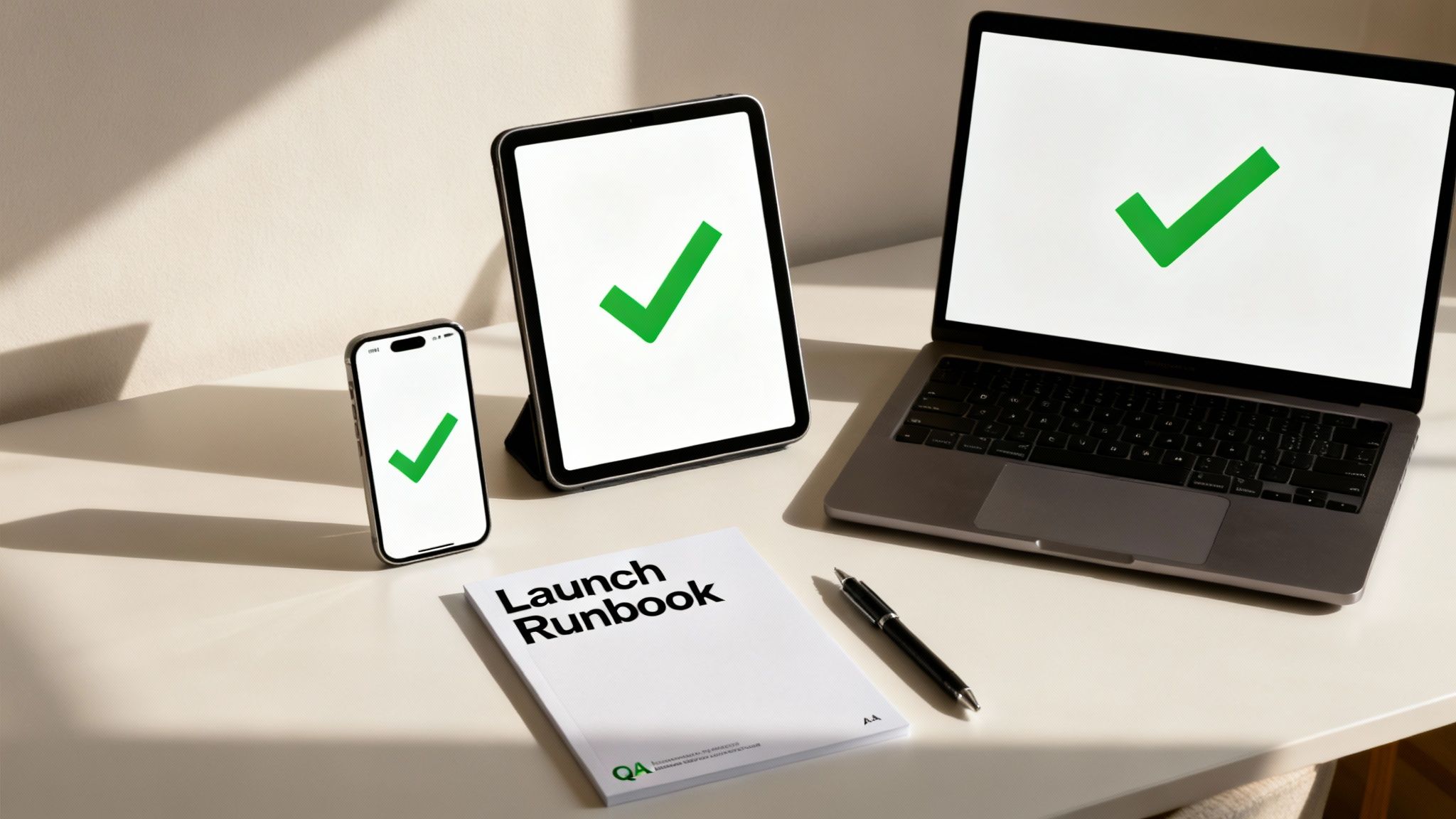
Thorough QA prevents revenue-killing errors like broken checkout flows or incorrect pricing, while a clear operations plan prevents panic and enables rapid, decisive responses to any unexpected issues. For instance, a Shopify Plus merchant might conduct User Acceptance Testing (UAT) with internal stakeholders a week before launch to catch user experience flaws, while simultaneously load-testing the site to ensure it can handle 10x the normal traffic volume anticipated from a high-stakes product drop. This proactive approach protects revenue, brand reputation, and customer trust.
Build a launch plan that anticipates problems and empowers your team to solve them instantly.
The initial launch is not the finish line; it is the starting point for data-driven growth. The most critical, and often most profitable, phase of your launch product checklist begins after the initial rush. This is where you execute a post-launch optimization strategy, using real-world performance data and customer feedback to refine your approach. This continuous improvement cycle turns a successful launch into a sustained, long-term revenue stream by discovering what truly resonates with your audience.
Treating your launch as an iterative process allows you to compound your wins and correct your course based on actual shopper behavior. Instead of relying on assumptions, you can use data to fine-tune everything from your urgency marketing tactics to your email messaging. For instance, a behavioral economics study might reveal that a specific audience segment responds far better to scarcity-driven offers ("Only 50 left!") than to competitive urgency ("Be one of the first!"), allowing you to tailor future campaigns with precision and boost ROI.
Move from a "launch and leave" mentality to a "launch and learn" framework. Focus on experiments that deliver measurable improvements.
| Item | Implementation complexity | Resource requirements | Expected outcomes | Ideal use cases | Key advantages |
|---|---|---|---|---|---|
| Define Your Product Launch Goals and KPIs | Low–Medium (planning & data) | Analytics access, stakeholder time | Clear success metrics; measurable ROI | KPI-driven launches; budget justification | Alignment; data-driven decisions |
| Conduct Market Research and Competitive Analysis | Medium–High (time-intensive) | Research tools, analyst time | Market insights; positioning opportunities | New markets; competitive product launches | Reduced risk; targeted messaging |
| Set Up Your Shopify Store Technical Infrastructure | High (technical setup) | Developers, testing tools, hosting/CDN | Stable, scalable storefront; fewer failures | High-traffic launches; app integrations | Reliability; smooth customer experience |
| Design and Customize Your Urgency Campaigns | Medium (design & testing) | Creative resources, Quikly configuration | Higher conversion rates; increased AOV | Flash sales; limited-time drops | Immediate action; customizable mechanics |
| Develop a Comprehensive Marketing and Communications Plan | High (cross-channel coordination) | Marketing budget, channel teams, agencies | Broad reach; synchronized launch impact | Omnichannel launches; major product releases | Consistent messaging; maximized reach |
| Configure Analytics, Tracking, and Reporting Systems | High (technical & strategic) | Analysts, tagging, analytics platforms | Actionable performance data; attribution | Data-driven optimization; ROI measurement | Objective measurement; rapid iteration |
| Plan and Organize Your Launch Team and Responsibilities | Medium (coordination) | Project managers, PM tools, time | Clear ownership; faster decision-making | Cross-functional product launches | Accountability; efficient operations |
| Create a Customer Education and Onboarding Plan | Medium (content creation) | Content creators, support training, assets | Reduced confusion; higher conversion & trust | New mechanics or novel offers | Trust-building; lower support volume |
| Pre-launch Testing, Quality Assurance, and Launch Day Operations | High (extensive testing) | QA engineers, devices, monitoring, runbooks | Fewer bugs; resilient launch operations | Mission-critical or high-traffic launches | Risk reduction; launch readiness |
| Execute Post-Launch Optimization and Iteration Strategy | Medium (ongoing) | Analysts, CRO tools, testing cadence | Continuous conversion improvements; learnings | Growth phases; evidence-based scaling | Compounding gains; prioritized experiments |
A product launch is far more than a single day on the calendar; it's a critical inflection point that can define your brand’s trajectory for months or even years. The comprehensive launch product checklist we’ve detailed isn't just about ticking boxes. It’s about building a repeatable, scalable engine for growth that transforms a high-stakes event into a predictable and profitable strategic asset for your business. By shifting your mindset from a simple task list to an integrated operational framework, you move beyond hoping for a successful launch and start engineering one.
The real power of this checklist lies in its synthesis of strategy, technology, and psychology. You aren't just setting up a Shopify store; you are building a resilient technical infrastructure capable of handling peak traffic. You aren't just sending emails; you are crafting a narrative that builds anticipation and leverages powerful psychological triggers like scarcity and social proof, principles that underpin consumer psychology.
Mastering your launch process means moving from reactive problem-solving to proactive strategy. Here are the most critical takeaways to internalize:
Ultimately, this launch product checklist provides a blueprint for turning uncertainty into a competitive advantage. It’s about building a system where meticulous pre-launch testing (Item 9) minimizes risk, a clear communication plan (Item 5) maximizes reach, and a focus on the customer journey (Item 8) builds lasting loyalty. By implementing these interconnected steps, you can consistently outperform industry benchmarks, protect your profit margins by avoiding deep, brand-eroding discounts, and establish a powerful market position. Your launch is no longer a gamble; it becomes a well-orchestrated masterpiece of commerce.
Ready to elevate your urgency marketing from basic timers to sophisticated, psychology-driven campaigns? See how Quikly’s platform helps the world's top brands orchestrate record-breaking launches by visiting Quikly to learn how you can turn every product drop into a powerful revenue moment.