

ecommerce conversion
customer experience strategy
digital customer experiences
Writing a high-impact newsletter doesn't start in your draft folder. It starts long before you ever type a single word. It begins with a clear, ROI-focused strategy. This means defining your business goals, understanding the psychology of your audience, and establishing the unique value you will deliver from the very first send.
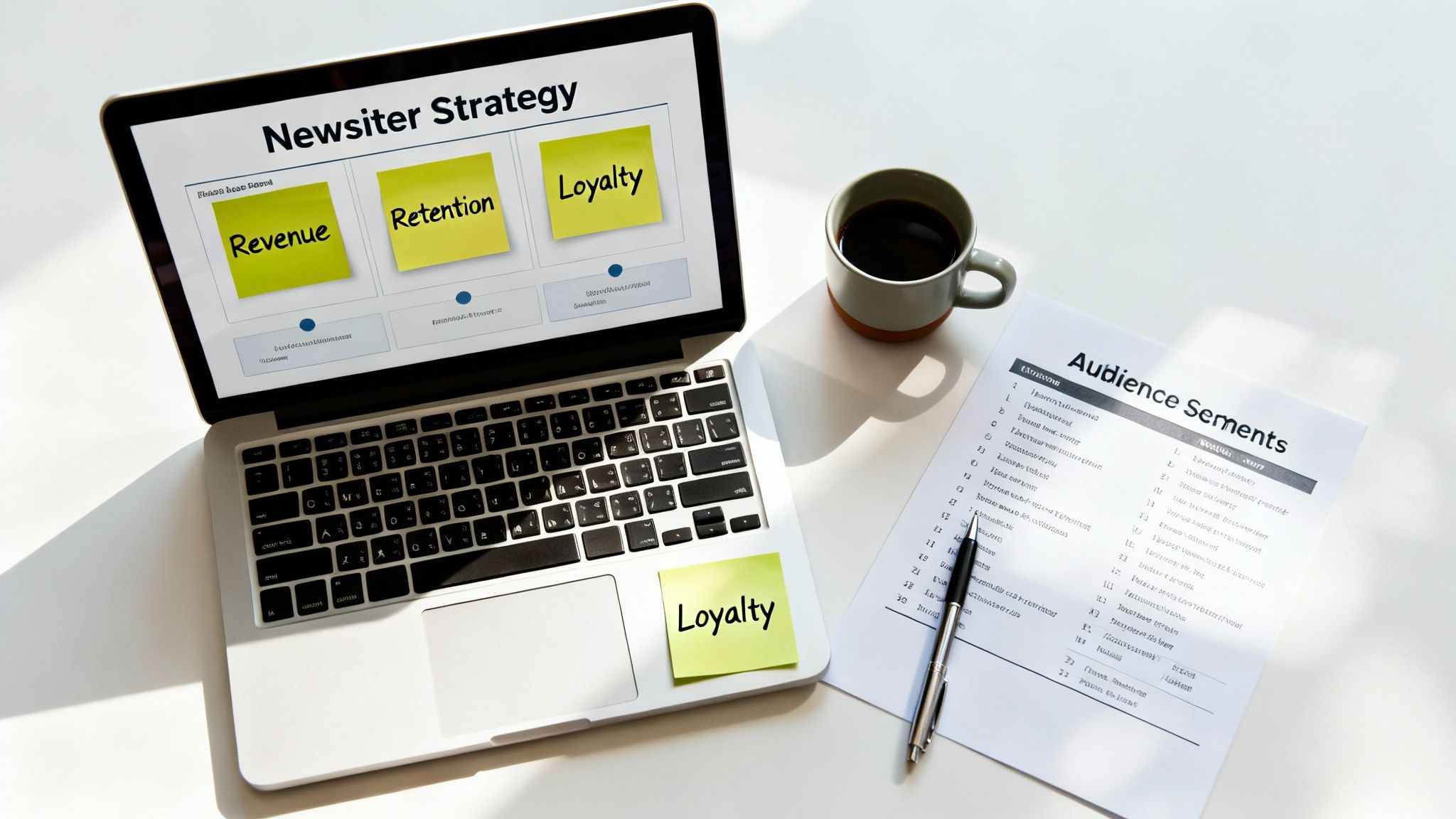
Jumping straight into writing without a plan is a recipe for wasted resources. A truly successful newsletter is a business asset, one built on a solid foundation—not just a collection of random emails. While many brands focus on basic email capture pop-ups, a sophisticated newsletter strategy is designed for revenue generation and long-term customer value.
Newsletters are a proven revenue channel. Industry data shows that for every $1 spent on email marketing, brands can expect an average return of $42. This channel isn't just surviving; it's a vital platform for sustainable, profitable growth.
First, you must answer one critical question: what is the primary financial goal of this newsletter? Vague objectives like "engaging customers" lead to unfocused content and poor performance. You need to tie your newsletter directly to a measurable business outcome.
This single decision will steer your content angles, calls-to-action, and success metrics.
A newsletter without a clear objective is just noise in a crowded inbox. A newsletter with a sharp, ROI-driven goal is a precision tool for business growth.
Once you know your "why," it’s time to define your "who." A one-size-fits-all message doesn't work. The best newsletters feel personal because they speak directly to the specific needs and interests of different customer segments.
Start by creating a simple persona for your ideal subscriber. What are their pain points? What kind of content would solve a problem for them? This keeps your focus on the customer, not just your own agenda.
For Shopify merchants, this is where the strategy becomes powerful. By integrating your store with an ESP like Klaviyo, you can create dynamic segments based on actual customer behavior:
Segmenting your audience allows for hyper-relevant content. This boosts engagement and protects your sender reputation by ensuring you aren’t sending emails people ignore. If you're starting from scratch, our guide on building an email list provides foundational strategies.
Finally, you must define why someone should grant you access to their inbox. What makes your newsletter different from the hundreds of others they could subscribe to? This is your value proposition—your promise to the reader.
Perhaps it's exclusive discounts, expert advice, behind-the-scenes content, or early access to new products. Whatever you choose, make it clear and deliver on that promise consistently.
This is how you tap into the psychological principle of anticipation. You want subscribers to look forward to your emails because they know something valuable is coming. This foundational work transforms your newsletter from a marketing channel into a must-read publication for your best customers.
With your strategy in place, it’s time to write the words that land in your subscribers’ inboxes. The challenge isn’t just getting your newsletter delivered—it’s getting it opened, read, and acted upon. This is where sharp copywriting meets smart consumer psychology.
The opportunity is massive. With the global email user base expected to hit 4.6 billion by 2025 and over 361 billion emails sent daily, the inbox is the most competitive real estate online.
In the U.S. alone, 99% of consumers check their email every day. It’s a direct line to your most engaged audience. Knowing how to write a newsletter that stands out isn't just a skill; it's essential for driving revenue.
Your subject line is the gatekeeper. It has a split second to convince a busy person that your email is worth their time over dozens of others. This isn't about clickbait; it's about making a compelling promise grounded in psychology.
The best subject lines tap into proven psychological triggers:
Actionable Takeaway: A/B test a subject line using a curiosity gap against one that clearly states an urgent offer. Analyze which approach drives a higher open rate for your specific audience segments.
Once they open the email, you have seconds to prove the click was worthwhile. A well-structured newsletter guides the reader's eye and makes the content easy to scan and digest.
The most effective emails follow a simple, powerful framework:
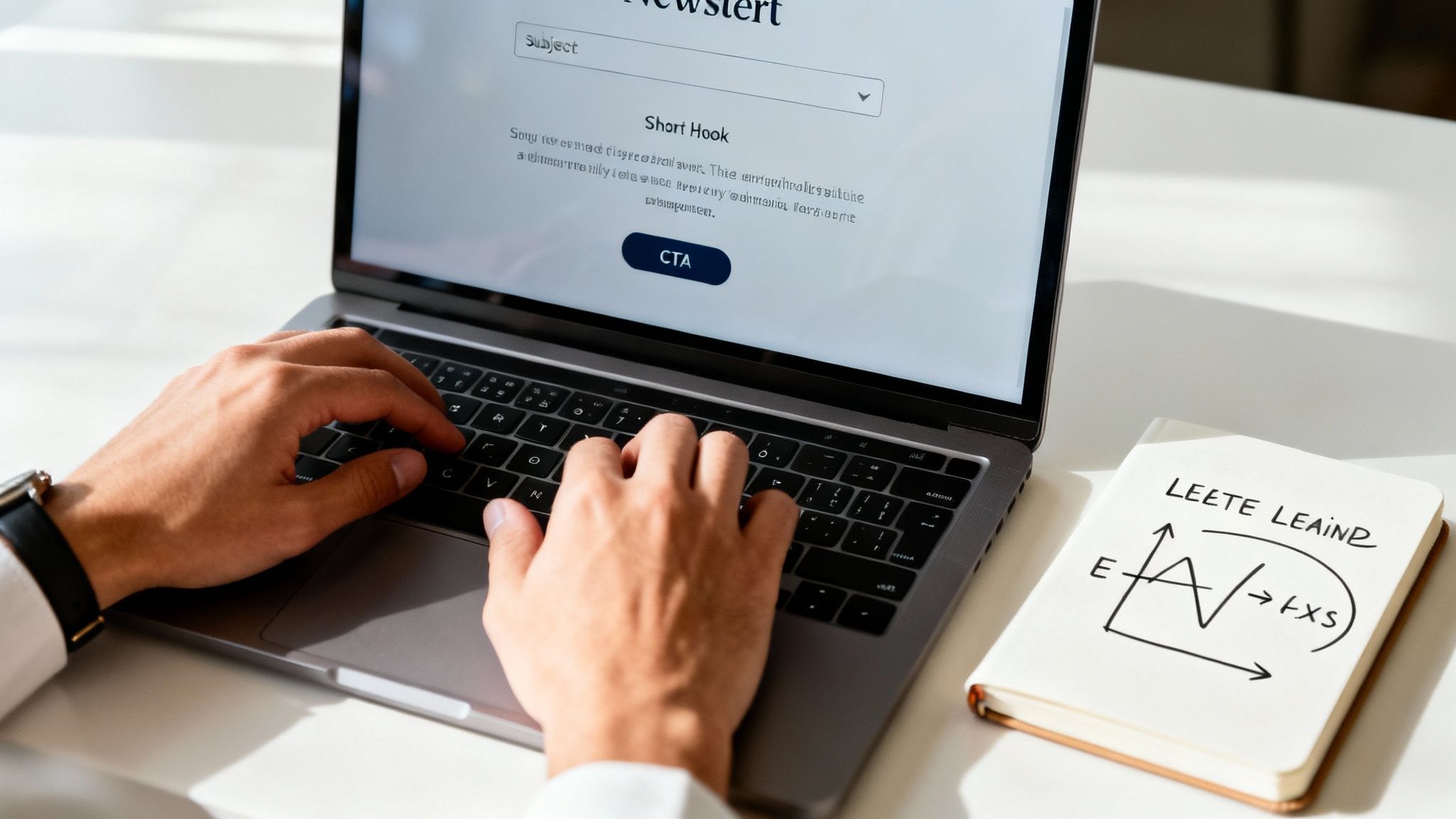
The anatomy of a high-converting newsletter is simple: an irresistible subject line, a hook that grabs attention, core content that provides real value, and a CTA that's impossible to ignore.
How you say something is just as important as what you say. Your brand voice is your business’s personality, and it needs to be consistent in every email. Are you witty and informal? Authoritative and professional?
Your tone, however, can shift with the message. A new product launch might have an excited, anticipatory tone, while an email about a customer service issue should be empathetic and reassuring.
The key is to write like a human, for a human. Drop the corporate jargon. Use the language your customers use. This is how you build a real connection and make your brand feel more approachable and trustworthy. For inspiration, explore these proven newsletter content ideas.
A wall of text is intimidating. Strategic visuals—high-quality images, GIFs, or short video clips—can break up content and make your newsletter more engaging and memorable.
Visuals aren't just for decoration; they have a job to do:
Every element in your newsletter, from the subject line to the final image, should work together to tell a cohesive story. This thoughtful approach turns a newsletter from something that gets read into something that builds relationships and drives real revenue.
A good newsletter informs. A great one persuades.
The real magic happens after a subscriber opens your email. The goal is to inspire them to click, browse, and buy. This requires moving beyond clever copy and tapping into the science of human behavior. Grounding your CTAs in proven psychological principles turns your newsletter into a powerful revenue driver. This isn't about manipulation; it's about ethically using consumer psychology to show subscribers why acting now is in their best interest.
For years, the go-to urgency tactic was a simple countdown timer. While basic timers still have a place, savvy shoppers on platforms like Shopify expect more sophistication. A generic, site-wide timer doesn't create the same impact and can devalue your brand over time.
Advanced urgency marketing is about behavior-driven triggers. Instead of one-size-fits-all clocks, the focus is on creating dynamic, limited-time "Moments" that feel exclusive and personal to each subscriber. This is the difference between a blunt instrument and a surgical tool. Quikly, for instance, specializes in the science of urgency, helping brands enhance their banners, pop-ups, and the entire shopper journey with these sophisticated triggers.
True urgency isn't manipulation; it's motivation. It taps into the innate human desire to avoid missing out (FOMO), framing your offer as a unique event rather than just another sale.
This shift has a massive impact on your bottom line. You can drive a significant revenue spike with targeted, short-lived campaigns without running deep, site-wide discounts that kill your profit margins. It's about protecting brand value while giving customers a compelling reason to purchase.
Leaning into principles from behavioral economics can transform your CTAs, turning psychological insights into measurable revenue.
Here are the big three:
Actionable Takeaway: In your next promotional email, instead of just announcing a sale, frame it around one of these triggers. For example, test a "Low Stock Alert" email against a "24-Hour Flash Sale" email and measure which one generates a higher conversion rate.
If you run a Shopify store, implementing these tactics is straightforward. An ESP like Klaviyo is perfect for segmenting your audience for targeted, urgency-based messages. Imagine sending a low-stock alert only to customers who have viewed that exact item.
For taking this to the next level, a platform like Quikly is built to create sophisticated, time-limited promotional "Moments." Instead of a static discount, you can launch a dynamic offer where the value changes over time or only the first 100 people can claim it. This automated approach adds a layer of excitement that a basic pop-up for email capture cannot match, focusing instead on immediate revenue generation. To dig deeper, check this guide on using urgency and psychology to increase email conversions.
This is how your newsletter becomes a strategic asset. By understanding and applying the science of urgency, you can dramatically increase conversions, recover revenue from abandoned carts (which average 70% across industries), and increase purchase frequency—all while protecting your brand's long-term value.
Writing a killer newsletter is only half the job. A brilliantly crafted message doesn't mean much if it lands in the spam folder or gets ignored. This is where the real work begins. Optimizing isn't guesswork; it's a discipline built on data, technical know-how, and continuous testing. It’s how you ensure every email doesn't just get seen—it drives results.
A newsletter’s success hinges on a strong sender reputation. Internet Service Providers (ISPs) like Gmail monitor how people interact with your emails. The only way to consistently land in the primary inbox is to prove you're a legitimate sender that people want to hear from.
Before you can think about open rates, you have to get the email delivered. This starts with technical authentication protocols. Think of them as your digital passport—they verify to email clients that your messages are genuinely from you.
The two main records you must have in place are:
Setting these up is typically a one-time task in your domain provider’s settings. Platforms like Klaviyo provide clear instructions for Shopify merchants. Skipping this step is one of the fastest ways to get your newsletters flagged as spam.
Beyond that, you need disciplined list hygiene. Regularly removing inactive subscribers feels counterintuitive, but it sends a powerful positive signal to ISPs that you only email engaged contacts, which boosts your overall deliverability.
Once your technicals are solid, you can start optimizing engagement. The most reliable way to learn what your audience prefers is through systematic A/B testing. You send two slightly different versions of an email to small, separate audience segments to see which one performs better.
Focus on variables with the biggest impact:
The golden rule of A/B testing is to only change one variable at a time. If you change both the subject line and the CTA, you won’t know which change made the difference.
Stop guessing what your audience wants and start testing. Data-driven decisions will always outperform assumptions, turning your newsletter from a creative exercise into a predictable revenue channel.
Vanity metrics can be misleading. A high open rate is nice, but it doesn't pay the bills. To understand your newsletter's business impact, you must track the key performance indicators (KPIs) that connect directly to revenue. The average e-commerce conversion rate is only around 2.5%, so every optimization counts.
To get the most out of your performance data, you first need to understand what your audience thinks. You can learn how to measure the quality of your newsletter content by using targeted surveys to get direct feedback.
Then, you can focus your analysis on these core metrics:
This table breaks down the most important newsletter KPIs, what they measure, and how they directly connect to your business's financial health and customer relationships.
| Metric | What It Measures | Direct Business Impact |
|---|---|---|
| Click-Through Rate (CTR) | The percentage of email recipients who clicked on one or more links. | Indicates content relevance and offer appeal. Higher CTRs lead to more traffic and potential sales. |
| Conversion Rate | The percentage of recipients who completed a desired action (e.g., purchase). | Directly measures the email's effectiveness in driving sales. This is your primary ROI indicator. |
| Revenue Per Recipient (RPR) | Total revenue from the campaign divided by the number of recipients. | Provides a clear dollar value for each subscriber on your list for a specific send, helping justify marketing spend. |
| Unsubscribe Rate | The percentage of recipients who opted out of receiving future emails. | Signals content misalignment or sending fatigue. Keeping this low is key for long-term list health. |
| List Growth Rate | The rate at which your email list is growing over time. | Reflects the health of your lead generation efforts and brand appeal. |
By keeping a close eye on these KPIs in a platform like Klaviyo, you can move beyond simple engagement stats. You’ll gain a clear, unfiltered view of how your newsletter contributes to your bottom line. This data is your roadmap, ensuring every email you send is smarter and more profitable than the last.
If you’re still manually sending every newsletter, you’re leaving revenue on the table. One-off campaigns are great for big announcements, but the secret to turning email into a 24/7 revenue engine is sophisticated automation.
By building out email sequences—often called flows—you can create personalized customer journeys that nurture leads, recover lost sales, and build loyalty, all without manual intervention. This isn't about setting up generic, "set it and forget it" emails. Good automation delivers the perfect message at the precise moment a customer is most likely to act. It's how you build an intelligent system that guides subscribers from browsing to their first purchase and beyond.
For any e-commerce brand, especially those on Shopify or Shopify Plus, three automation sequences are non-negotiable. These flows target critical moments in the customer lifecycle, and each has a clear goal tied directly to your ROI.
Automation transforms your email marketing from a series of manual broadcasts into an intelligent, scalable system. It frees up your team to focus on strategy while ensuring no customer touchpoint is ever missed.
This simple flowchart shows the optimization loop for any automated sequence you build. It’s a cycle of authenticating your sends, testing your content, and analyzing what works to constantly improve performance.
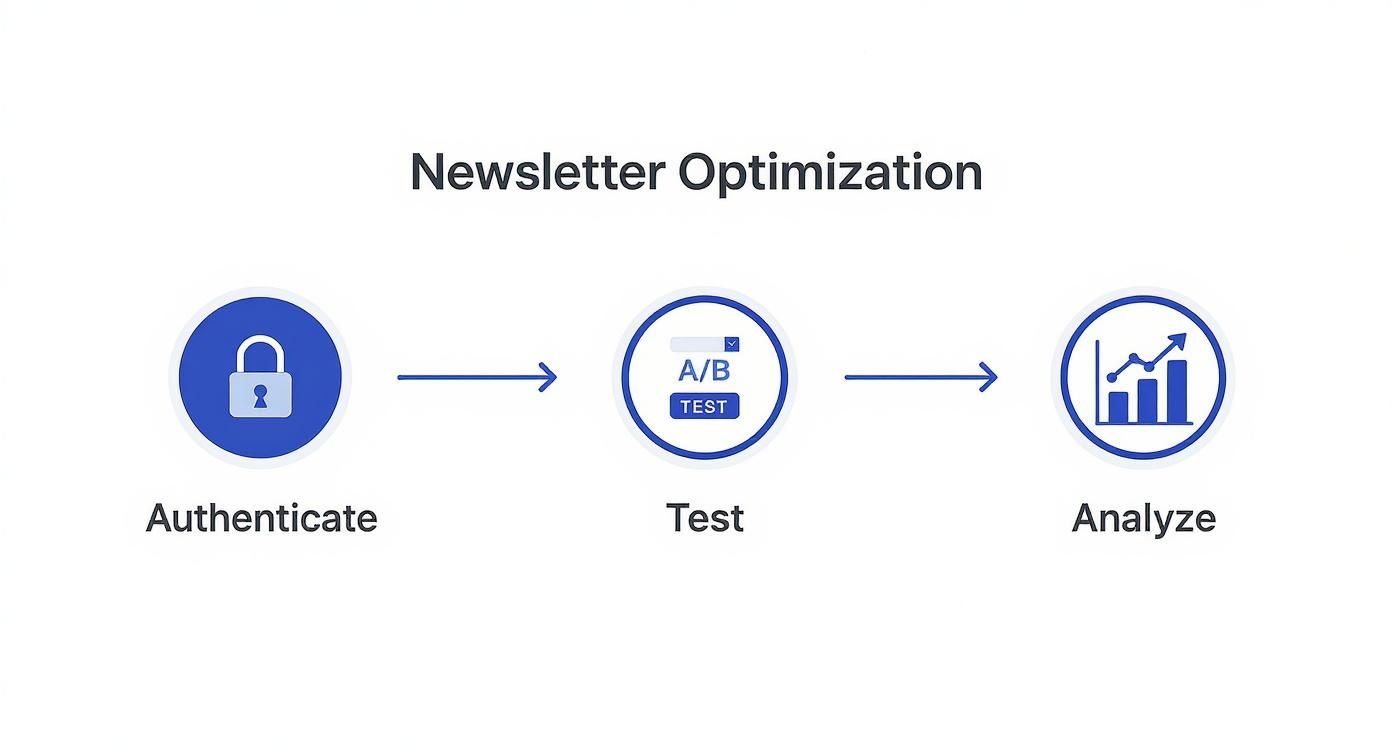
Following this process ensures your automated emails not only get delivered but are continuously refined to squeeze every last drop of value from them.
Let’s get specific with the most critical flow: the abandoned cart sequence. A single "You left something behind!" email is no longer sufficient. A multi-step flow that uses psychology is far more effective.
Email 1 (Sent ~1 hour after abandonment): The Gentle Reminder
The first email should be helpful, not pushy. The customer may have been distracted. Assume good intent.
Email 2 (Sent ~24 hours later): Overcoming Objections & Adding Social Proof
Now, shift from a simple reminder to gentle persuasion. Address common objections like shipping costs and sprinkle in social proof.
Email 3 (Sent ~48 hours later): Introducing Urgency
This is your final attempt to close the deal. Here, you introduce a compelling, time-sensitive reason to act now. This tactic taps into the powerful principle of loss aversion—the psychological insight that the pain of losing something feels twice as intense as the pleasure of gaining it.
Actionable Takeaway: Implement a three-step abandoned cart flow in your ESP. Ensure it integrates with your Shopify store triggers and consider adding an SMS step through platforms like Klaviyo for customers who have opted-in to create a seamless, multi-channel experience that recovers significantly more revenue.
As you implement your email strategy, practical questions will arise. Here are answers to some of the most common hurdles e-commerce marketers face.
There’s no magic number. The right sending cadence depends on your specific audience and the value you provide with each send.
Consistency trumps frequency, every time.
For most e-commerce brands, a good starting point is once a week. This is frequent enough to stay top-of-mind but not so much that you create inbox fatigue. If you have a highly engaged list and are constantly dropping new products or running flash sales, you might test sending twice a week.
The sweet spot is a balance between staying relevant and respecting the inbox. Keep a close eye on your unsubscribe rates and engagement. If you see a spike after increasing your frequency, that's your audience telling you to pull back.
Many studies point to mid-mornings on Tuesdays and Thursdays, but the real "best time" is when your audience is most likely to be checking their email and in a buying mindset.
Think about your customer persona. For a D2C brand, this might be during their lunch break (12-2 PM) or in the evening (8-10 PM) when they are relaxing and scrolling on their phone.
Don't guess. Analyze your email platform’s data. It will show you when your subscribers have opened and clicked in the past. Use that as your baseline, then A/B test different send times to gather your own data. An audience of night owls will behave differently from early-morning shoppers.
First, define "inactive" for your brand. A good rule of thumb is anyone who hasn't opened or clicked an email in 90-120 days. Letting these subscribers sit on your list can damage your sender reputation over time.
The solution is a dedicated re-engagement campaign, often called a "win-back" flow. This is a short, automated series of 2-3 emails designed to get their attention one last time.
Ready to turn your newsletter from a simple update into your most powerful revenue driver? Quikly uses the science of urgency marketing to create high-converting promotional moments that captivate your audience and drive immediate action. See how top Shopify brands are boosting sales without sacrificing margins.