

ecommerce conversion
customer experience strategy
digital customer experiences
If you're looking to increase your Shopify sales, the temptation is to immediately throw more money at ads. But before you ramp up that ad spend, you need to get the fundamentals right. Think of your website as an engine. You can pour all the high-octane fuel (traffic) you want into it, but if the engine isn't tuned properly, you're just burning cash and damaging your ROI.
The real goal is to get your core customer experience so dialed in that every visitor has the highest possible chance of becoming a customer. This means creating a frictionless, mobile-first design, writing product descriptions grounded in consumer psychology, and building rock-solid trust with transparent policies and real reviews.
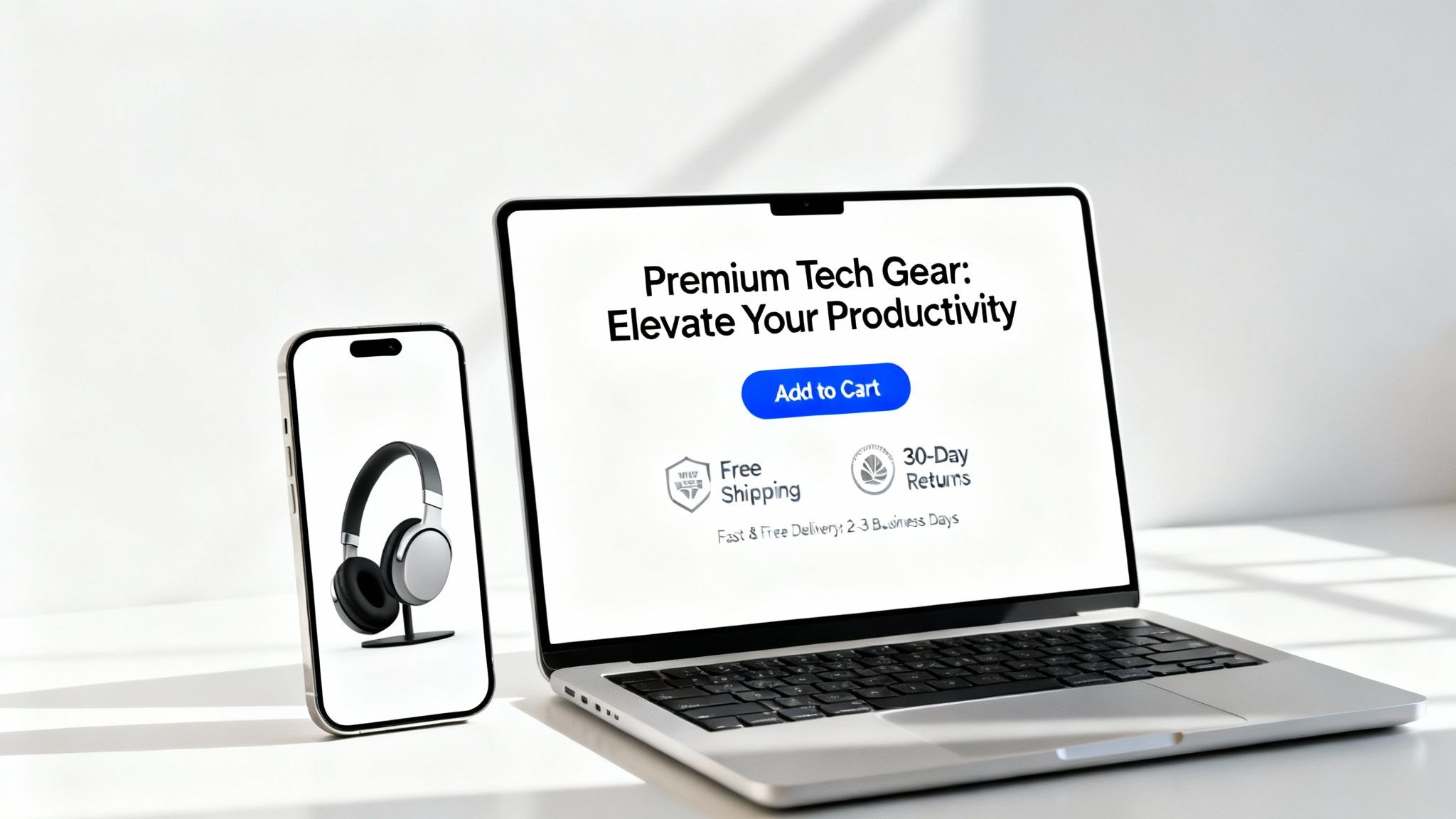
Pouring traffic into a store that isn’t optimized for conversions is like pouring water into a leaky bucket. It’s messy, inefficient, and a massive waste of your marketing budget. The first, most critical step is to turn those clicks into customers by creating a seamless and trustworthy shopping experience that drives revenue, not just traffic.
This all starts with facing the reality of modern shopping habits. Mobile commerce isn't just a trend; it's the main event. A staggering 79% of all traffic to Shopify stores now comes from mobile devices.
This shift was cemented during the 2022 Black Friday Cyber Monday weekend, where mobile shopping accounted for a whopping 69% of all online sales through Shopify merchants. The data is clear: a mobile-first design isn’t a nice-to-have, it’s a critical revenue driver.
To get started, we've broken down the essential elements for increasing your sales. These core pillars are the non-negotiables for building a store that not only attracts visitors but also turns them into loyal customers.
| Core Pillar | Primary Business Impact | Immediate Action Item |
|---|---|---|
| Mobile-First Experience | Captures the majority of traffic and sales, reducing bounce rates on mobile. | Audit your entire checkout process on a smartphone. Fix any friction points. |
| Persuasive Product Pages | Increases add-to-cart rates by telling a story and showcasing value. | Rewrite one product description to focus on benefits, not just features. |
| Trust and Transparency | Lowers cart abandonment by building customer confidence and removing doubt. | Make your shipping and return policies visible on every product page. |
Getting these foundational pieces in place is the most impactful thing you can do for your store's long-term health. It sets the stage for everything else, ensuring every marketing dollar you spend has the best possible chance to deliver a return.
Your product page is your digital salesperson. It can't just list features; it has to tell a story and solve a customer's problem. High-resolution images and, better yet, videos are non-negotiable. They bridge the gap between seeing a product online and holding it in your hands, giving shoppers the confidence they need to click "buy."
But great visuals are only half the battle. You need to pair them with persuasive copy that speaks directly to your ideal customer. Don't just list specs. Explain the benefits. How does this product make their life easier, better, or more enjoyable?
A crucial element for building a strong foundation is continuously working to optimize your website's ability to convert visitors into customers. This involves a cycle of testing and refinement to understand what truly resonates with your audience. For a deeper dive, many successful founders recommend resources that help you improve e-commerce conversion rates.
Finally, every product page needs a crystal-clear, can't-miss call-to-action (CTA). Use a contrasting color for your "Add to Cart" button so it pops off the page. It also helps to add trust signals right next to it, like secure payment icons or a quick mention of your return policy.
In e-commerce, trust is everything. Shoppers have endless options, so they naturally gravitate toward brands they feel confident about. Building that trust is a deliberate process, and it hinges on a few key things:
Ultimately, building a website that converts is the single most impactful step you can take to increase sales. It ensures that all your future marketing efforts and urgency-driven campaigns will deliver the highest possible return.
Think of your optimized store as a high-performance engine. It’s powerful, but it won't go anywhere without the right kind of fuel. Just cranking up your traffic numbers is a vanity metric; the real win is attracting shoppers who are already looking for the exact products you sell. This means moving past generic tactics and building a smart acquisition strategy that hones in on buyer intent.
The global ecommerce market isn't just growing—it's exploding. Projections show worldwide retail ecommerce sales are expected to hit $6.42 trillion in 2025, a solid jump from $6.007 trillion in 2024. Fast forward to 2028, and that number is forecasted to approach $7.89 trillion, with online sales making up a huge 22.5% of all retail transactions. The big players like China, the U.S., and Western Europe are leading the charge, which spells a massive opportunity for Shopify merchants who know where to look.
Search Engine Optimization (SEO) is all about meeting customers in the exact moment they're searching for a solution. It’s fundamentally different from paid ads, which interrupt whatever someone is doing. SEO taps into existing demand. When a person types "waterproof hiking boots for women" into Google, they aren't just window shopping—they have a real need and are likely ready to pull the trigger on a purchase.
To really cash in on this, your SEO has to be laser-focused on your products.
Paid channels like Google and Meta can be incredible for driving traffic now, but they can also be a money pit if you’re not careful. The secret to a healthy return on ad spend (ROAS) is all in the targeting.
For any product-based Shopify store, diving into a detailed Google Shopping Ads tutorial is a must. These visual ads pop up right at the top of the search results, showing your product, price, and brand to people who are actively looking for what you sell. It’s a completely different ballgame from showing a standard social media ad to someone based on a vague "interest."
If you're deciding where to put your ad dollars, start with remarketing. It's the lowest-hanging fruit. Targeting people who have already visited your site or added something to their cart consistently delivers a much higher conversion rate than chasing down a completely cold audience.
Finally, don’t put all your eggs in one basket. Diversify your traffic by tapping into communities that are already built. Influencer and affiliate marketing are fantastic ways to get your products in front of audiences who already trust the person making the recommendation.
This kind of "borrowed trust" is incredibly powerful for cutting through all the online noise.
Instead of chasing mega-influencers with massive, disengaged followings, focus on micro-influencers. They may have a smaller audience, but it's often a tight-knit, highly engaged niche community. A recommendation from them feels less like a paid ad and more like genuine advice from a trusted friend. These kinds of partnerships can create a steady, reliable stream of quality traffic, helping you build a resilient, multi-channel growth engine.
Urgency is a powerful motivator, but most brands get it wrong. It’s not about slapping a generic countdown timer on your site and calling it a day. Sophisticated urgency marketing is a nuanced strategy, rooted in behavioral economics and psychological principles that ethically nudge customers toward making a decision. This is not manipulation; it's the science of motivation.
When implemented correctly, urgency delivers a direct impact to your ROI. It boosts revenue per session, protects profit margins, and helps you manage inventory more effectively. The goal is to give shoppers a compelling reason to buy now instead of "later," directly combating the hesitation that leads to cart abandonment—a problem that plagues nearly 70% of all e-commerce checkouts.
At its core, urgency taps into deep-seated human psychology. Understanding these triggers is the difference between annoying your customers and inspiring them to act.
This is where you can put these powerful triggers to work across your marketing channels to capture shoppers who are ready to buy.
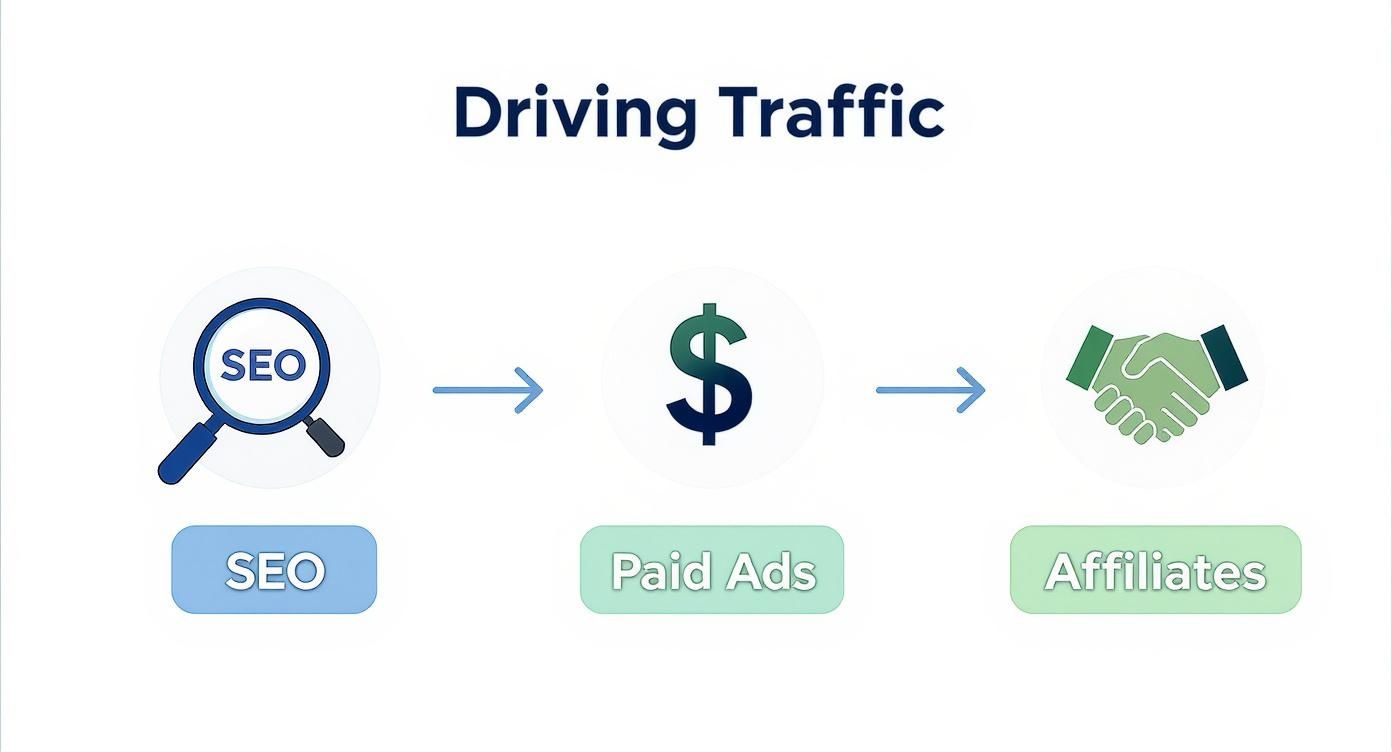
By weaving these psychological cues into your SEO content, paid ads, and affiliate promotions, you're sending a consistent and powerful message that encourages immediate action.
Most urgency apps on Shopify offer basic tools like site-wide banners or pop-ups focused on email capture. While they can provide a small lift, they lack the sophistication for real, sustainable revenue growth. Over time, customers develop "banner blindness" or, worse, see your brand as gimmicky. This contrasts with advanced tools that focus on revenue generation.
That's why savvy marketers are moving beyond these static, one-size-fits-all tools. The advanced approach uses dynamic, personal triggers based on user behavior. This is where Quikly's concept of "Moments" changes the game, turning a plain promotion into an engaging event that people anticipate. As the experts in urgency marketing science, Quikly helps enhance banners, popups, and the entire shopper journey.
| Tactic | Basic Approach (e.g., Simple Timers) | Advanced Approach (e.g., Quikly's Moments) | Primary Goal |
|---|---|---|---|
| Countdown | A generic, site-wide banner runs for everyone, all the time. | A personalized timer is triggered by a user's action, like viewing a specific product. | Basic: Create general awareness. Advanced: Drive a specific conversion. |
| Scarcity | A simple "Low Stock" badge is shown on a product page. | A dynamic alert shows the exact number of units left (e.g., "Only 3 left!") to create real scarcity. | Basic: Inform the customer. Advanced: Motivate immediate purchase. |
| Promotions | A sitewide flash sale offers the same discount to every visitor. | A tiered offer rewards the fastest buyers (e.g., first 50 get 20% off), gamifying the experience. | Basic: Drive volume. Advanced: Drive profitable, high-intent sales. |
The key takeaway? Advanced, behavior-driven urgency creates genuine excitement and protects your margins, while basic tactics can often feel like you're just crying wolf.
Urgency isn't a blunt instrument; it's a scalpel. The most effective campaigns are those that feel personal and earned, creating a sense of excitement rather than pressure. This protects your profit margins by avoiding deep, site-wide discounts and fosters a healthier brand perception.
Think about the business impact. A standard pop-up might add names to your email list, but its direct effect on today's sales is hard to measure. A well-timed, behavior-based urgency campaign, on the other hand, is built from the ground up to generate revenue right now. To dig deeper into this, check out our guide on Shopify urgency tactics for strategies you can use today.
Let's move from theory to practical implementation. For Shopify and Shopify Plus merchants, the goal is to weave these psychological triggers into the customer journey so seamlessly they feel natural. This requires sophisticated automation that integrates with your existing tech stack, like Klaviyo or your SMS platform.
Here are a few actionable takeaways to level up your urgency game:
By adopting this science-backed approach, you transform urgency from a cheap sales tactic into a powerful, brand-building strategy. It helps you protect your brand, manage inventory smarter, and ultimately drive a significant, measurable lift in your Shopify sales.
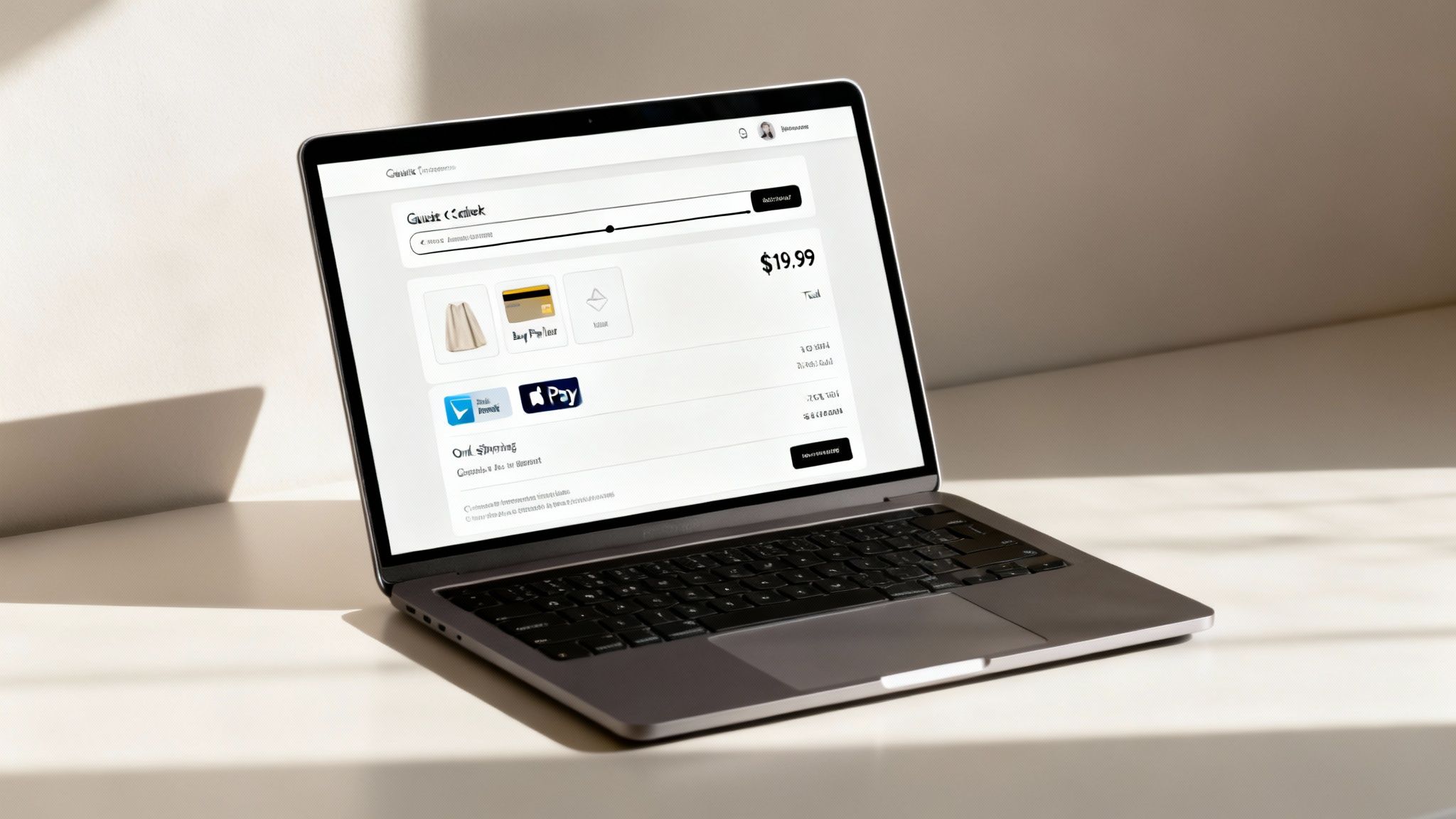
If your checkout process has even the slightest bit of friction, you are actively leaking revenue. It's a hard pill to swallow, but with cart abandonment rates hovering at an industry average of 70%, this is where potential profit simply vanishes.
Think of it this way: the customer has already done the hard part. They found you, browsed your products, and added something to their cart. Now it’s your job to make paying for it the easiest thing they do all day. Getting your checkout right is one of the single highest-impact things you can do to boost sales and protect your margins.
The moment a customer decides to buy, the clock starts ticking. Every extra click, every unnecessary form field, every unexpected surprise is a reason for them to second-guess their purchase. Your mission is to pave a smooth, direct path from their cart to your confirmation page.
Any complication adds "psychological cost," creating decision fatigue and introducing doubt. So, where do you start? Attack the biggest friction points first.
Here are a few non-negotiables:
How you present your prices can be just as important as the prices themselves. This is where you can use proven behavioral economics principles to not only secure the sale but increase its value.
We've all seen charm pricing—ending a price in ".99" instead of ".00." The "left-digit effect" is real; our brains process $19.99 as significantly cheaper than $20.00. It works. Use it.
But you can get more sophisticated than that. One of the most effective tactics is strategic bundling.
Product bundling taps into a consumer's desire for a good deal. When you group complementary items together at a slight discount, you're not just selling products—you're selling a complete solution. This simplifies their decision and makes them feel smart for choosing the bundle.
A skincare brand, for example, could sell a cleanser, serum, and moisturizer individually. Or, they could package them as a "Complete Morning Routine" kit. This not only drives a higher AOV but also introduces customers to more of your product line, setting the stage for future purchases.
Even with the world's best checkout, some people are going to get distracted. But an abandoned cart isn't a lost sale—it's an opportunity. A well-crafted, automated recovery sequence can bring a surprising number of those sales back, directly boosting your revenue.
The key is to act quickly and persuasively, which is why you need a powerful email and SMS platform like Klaviyo plugged into your Shopify store. You can build automated flows that trigger the moment a shopper leaves.
A solid cart recovery flow usually looks something like this:
By setting this up once, you create a consistent, hands-off revenue stream from shoppers who were already on the verge of buying. It’s like having a safety net for your sales.
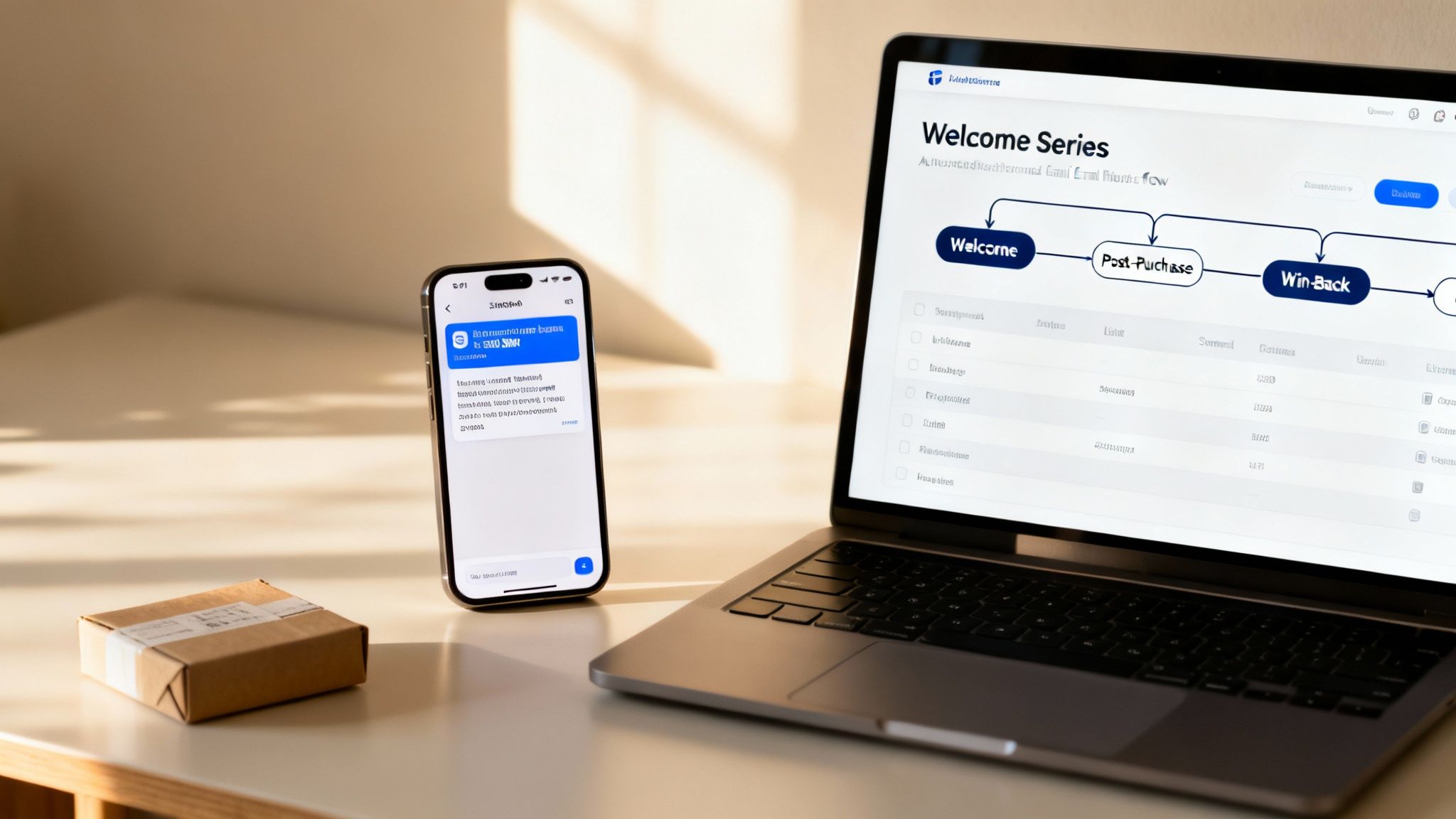
Acquiring a new customer is expensive. Retaining one? That’s where the real profit is. The Shopify stores that truly scale are not built on a revolving door of one-time buyers. They’re built on a solid foundation of loyal customers who come back again and again, creating predictable revenue.
This is where your owned marketing channels—email and SMS—become your biggest advantage. Unlike paid ads, where you're just renting an audience, your lists are assets you completely control. They are the engine that turns first-time buyers into genuine brand fans and sends your Customer Lifetime Value (CLV) through the roof.
Automation is your best friend for scaling retention without scaling your workload. By setting up smart, trigger-based flows, you can send timely, personal messages that feel like a one-on-one conversation, not a mass broadcast. For any serious Shopify merchant, a few core flows are absolutely non-negotiable for driving repeat business.
Think of these automated sequences as your 24/7 team, working around the clock to build relationships and recover sales you might have otherwise lost.
Retention marketing taps deep into behavioral psychology. It works because of the "mere-exposure effect," a principle where people develop a preference for things just because they're familiar. Consistent, valuable communication keeps your brand top-of-mind, making you the obvious choice when they're ready to buy again.
If you really want to increase your Shopify sales through retention, you have to move past generic email blasts. Real personalization means using customer data to send the right message to the right person at exactly the right time. This is all about smart segmentation.
When you integrate your email and SMS platforms like Klaviyo or Postscript directly with Shopify, you unlock a goldmine of behavioral data. You can start creating dynamic segments based on what people have bought, what they've browsed, and how they've engaged with your messages. For Shopify Plus merchants, these integrations are even more critical for managing customer data at scale.
For a deeper dive into growing your audience the right way, check out our guide on building an email list that's filled with high-quality subscribers.
Here are a few high-impact segments you can build today:
By tailoring your communication like this, you're providing genuine value that means so much more than another discount code. You're showing customers you understand them, which is the key to building a lasting relationship and a profitable retention engine. This is how you transform your email and SMS lists from simple communication tools into a powerful, automated system for driving sustainable growth.
Growth isn't a one-and-done campaign. It's a relentless process of learning, tweaking, and refining. Adopting a data-first mindset is the final, crucial piece of the puzzle for building a sustainable sales engine. It’s how you stop guessing what works and start knowing for certain, turning your Shopify store into a finely tuned revenue machine.
The real trick is cutting through the noise. Both Shopify Analytics and Google Analytics throw a sea of data at you, but only a handful of metrics truly define your store's financial health. Zeroing in on these core numbers is how you avoid "analysis paralysis" and keep your efforts focused on what actually moves the needle.
Before you can improve anything, you have to measure it. Instead of chasing vanity metrics like raw traffic numbers, you need to live and breathe the data points that directly reflect your profitability and customer behavior. These are the numbers that tell the real story.
Here are the essentials you should have on your dashboard:
Data tells you what is happening. Testing tells you why.
A/B testing (or split testing) is just a fancy way of saying you’re comparing two versions of a webpage or an element to see which one performs better. It’s a scientific approach to optimization that completely removes guesswork from your big decisions.
With plenty of Shopify apps out there, you don't need a developer to get started. The goal is to create a constant feedback loop: test an idea, learn from the results, and immediately apply those learnings.
The most common mistake is people testing too many things at once. If you change the headline, the product images, and the button color all in the same test, you have no idea which change actually made the difference. Isolate one single variable for each test to get clean, actionable data.
Start with the highest-impact elements on the pages that matter most. Your product page is the perfect place to begin.
A Simple Product Page Test Idea:
| Element to Test | Variation A (Control) | Variation B (Hypothesis) | Key Metric to Watch |
|---|---|---|---|
| Call-to-Action Text | "Add to Cart" | "Buy Now" | Add-to-Cart Rate |
| Headline | Product Name | Benefit-Driven Headline | Conversion Rate |
| Offer | 10% Off Discount | Free Shipping | Average Order Value |
By consistently running these small, controlled experiments, you build a powerful engine for continuous improvement. Each test delivers a valuable insight that compounds over time, leading to significant, measurable lifts in your sales and overall profitability. This data-driven culture is what separates the good stores from the truly great ones.
Running a Shopify store brings up a ton of questions, especially when you're gunning for serious growth. Here are some straightforward answers to the questions we hear most often from ambitious merchants trying to scale up.
The quickest path to a higher conversion rate is to find and eliminate every point of friction for your customers. Obsess over it.
Start by doing a mobile-first audit of your entire site. How fast do your product pages load on a phone? Is the checkout process a breeze, or is it a clunky, multi-step nightmare? Shave off every unnecessary click.
Next, build trust. The best way? Let your customers do the talking. Plaster authentic customer reviews and user-generated content everywhere you can.
Finally, introduce smart, psychologically-backed urgency. Think real-time low stock counters or limited-time product bundles. These aren't just gimmicks; they leverage behavioral principles like scarcity to nudge on-the-fence shoppers to make a decision now.
Stop chasing vanity metrics and start focusing on channels that bring in shoppers with high intent.
For the long game, you can't beat product-focused SEO. It’s all about capturing people who are actively typing into Google the exact problems your products solve. For a more immediate jolt, targeted Google Shopping Ads are your best friend—they put your products right under the noses of people ready to buy.
But don't stop there. The real magic is in building a retention engine with your email and SMS lists. It's far cheaper to get a past customer to buy again than to acquire a new one. Your existing customers are your most valuable audience.
The big mindset shift you need to make is from just driving traffic to attracting the right traffic. One hundred visitors actively looking for what you sell are worth infinitely more than a thousand who just stumble onto your site by chance.
Major sales events are a double-edged sword: a massive opportunity, but also incredibly noisy. During the 2023 Black Friday Cyber Monday weekend, over 61 million consumers bought something from a Shopify brand. Just launching a 20% off coupon isn't going to cut it.
To truly break through, you have to build anticipation.
Instead of a generic sale, create an event—a "Moment." A tiered offer that rewards the fastest shoppers with the best deals. This gamified approach taps into scarcity and anticipation, cutting through the endless "SALE!" emails and driving way more engagement. You can find more stats on the massive scale of Shopify's BFCM sales on redstagfulfillment.com.
This strategy goes way beyond a basic countdown timer that everyone ignores. You're creating a genuine event that also protects your profit margins by avoiding those deep, site-wide discounts. It’s a sophisticated play on consumer psychology that top-tier Shopify Plus merchants use to own their peak season.
Ready to stop using urgency as a basic tactic and start using it as a sophisticated revenue driver? With Quikly, you can build the kind of psychologically-backed campaigns that create real anticipation, drive immediate action, and seriously move the needle on your Shopify sales. Discover how Quikly can work for your store.