

ecommerce psychology
brand loyalty
best brand experiences
It’s a fundamental truth of business: retaining existing customers is significantly more profitable than constantly acquiring new ones.
The core strategy boils down to this: you increase client retention by delivering consistent value and exceptional experiences. Achieving this turns one-time buyers into loyal advocates who drive predictable revenue. This means mastering post-purchase engagement, implementing data-driven personalization, and building a genuine community around your brand.
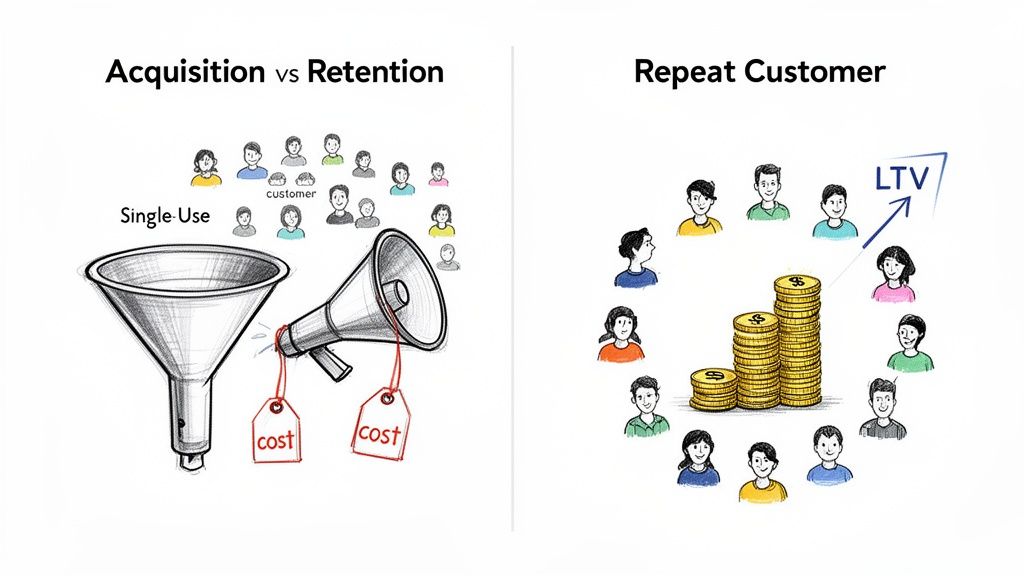
Many ecommerce brands get caught in the acquisition trap, focusing on the immediate rush of a new customer. While top-line growth is important, it can be a costly distraction. The real, sustainable profit engine for your business is your existing customer base.
Shifting focus from chasing new sales to deliberately retaining the customers you’ve already won isn’t just a feel-good strategy; it’s a critical financial imperative that directly impacts your ROI and protects profit margins.
The data is clear: it costs five to seven times more to acquire a new customer than to keep an existing one. That figure encompasses ad spend, marketing efforts, and the resources poured into converting a stranger into a buyer. Prioritizing retention is how you protect your profit margins from being eroded by these ever-rising acquisition costs.
The impact of retention on your bottom line is staggering. Foundational research by Bain & Company revealed that increasing customer retention by just 5% can boost profits anywhere from 25% to 95%.
This is a compounding effect. Loyal customers spend more over time, are more likely to purchase higher-margin products, and become less price-sensitive. They generate predictable, recurring revenue, providing a stable foundation for growth.
That financial stability is invaluable, especially for Shopify Plus merchants managing complex inventory and forecasting. A robust retention strategy transforms unpredictable sales spikes into a reliable revenue stream, simplifying everything from inventory management to cash flow planning.
Beyond the balance sheet, customer retention is rooted in behavioral economics and consumer psychology. A repeat purchase is more than a transaction; it's a vote of confidence driven by powerful psychological triggers.
A retained customer is more than just a repeat sale; they are an annuity. Their value grows through increased spending, referrals, and valuable feedback, directly fueling long-term profitability and brand resilience.
For any online business, diving into proven ecommerce customer retention strategies is the key to building that kind of loyalty and ensuring sustainable growth. When you master how to increase client retention, you stop chasing one-off sales and start building a community of advocates who not only buy from you but actively champion your brand—creating a powerful, cost-effective growth loop that no acquisition-focused model can ever match.
The moment a customer completes a purchase is not the finish line; it’s the starting line for retention. This is your first and best opportunity to convert a one-time buyer into a lifelong advocate, yet it's a moment far too many brands neglect. They revert to transactional mode, sending a generic order confirmation followed by a bland shipping notice.
This approach completely misses a crucial psychological window. The period between purchase and delivery is filled with anticipation and, often, a degree of buyer's remorse. A strategic post-purchase experience transforms that uncertainty into excitement, reaffirming the customer's decision and demonstrating that your brand is about building a relationship, not just processing an order.
That first email after a sale sets the entire tone. A standard "Your order is confirmed" is a significant missed opportunity. This touchpoint should be the beginning of a conversation, designed to build anticipation and deliver immediate value.
Using a tool like Klaviyo for your Shopify store allows you to automate this process with precision. Instead of a basic receipt, integrate these elements:
Nailing this first step begins shifting their mindset from a transactional customer to a valued member of your community.
Shipping is one of the most emotionally charged parts of the ecommerce journey. Industry benchmarks show that customers check their tracking status an average of 3-5 times per order. Each check-in is an opportunity to reinforce your brand.
Stop outsourcing this experience to generic carrier pages like UPS or FedEx—it’s a dead end that pulls customers out of your ecosystem. Instead, use a branded tracking page through a Shopify app like AfterShip or Malomo. You can customize these pages to match your store’s branding, creating a seamless and controlled experience.
Think of a branded tracking page as a dynamic marketing asset, not just a logistical tool. You can showcase related products, display user-generated content, or promote your loyalty program—all while keeping them engaged within your brand's world.
This strategic move reclaims a critical piece of the customer journey. You control the narrative and the environment, reinforcing brand identity and subtly guiding them toward their next purchase.
The unboxing experience is where your digital brand becomes a physical reality. It's the tangible culmination of their purchase, and a memorable unboxing creates a powerful emotional connection that directly influences customer retention.
The package itself is a marketing channel. You don't need a massive budget; small, thoughtful touches can fundamentally alter a customer's perception of your brand's attention to detail.
These details signal that you care. In a world of generic packaging, a thoughtful presentation makes your brand memorable and share-worthy, building the kind of brand affinity that encourages repeat business.
Urgency in marketing has often been misunderstood. Many brands use it as a blunt instrument for acquisition—think of generic "sign up now!" pop-ups that capture an email but do little to build a relationship.
However, when applied with sophistication to your existing customer base, urgency becomes one of the most powerful tools for boosting repeat purchases and fostering long-term loyalty. The key is to evolve beyond basic countdown timers and embrace strategies grounded in behavioral psychology. A simple timer may create fleeting pressure, but it doesn't build an emotional connection. Retention-focused urgency, by contrast, leverages deeper behavioral triggers like scarcity, anticipation, and social proof to re-engage customers and cultivate a desire to return. It’s the difference between a generic sales alert and an exclusive, high-value event.
Standard pop-ups and timers often feel impersonal and can devalue your brand by broadcasting the same generic message to every visitor. This approach fails to recognize a customer's history and loyalty. In contrast, sophisticated urgency marketing is surgical. It leverages customer data to create exclusive "Moments" that feel personal and genuinely valuable. This positions urgency as sophisticated psychology, not manipulation.
Instead of a generic sitewide sale, imagine launching a ranked offer campaign exclusively for your VIP loyalty members. In this model, customers earn better rewards the faster they act, transforming a simple purchase into a competitive and engaging experience. This not only drives revenue but also rewards their loyalty and reinforces their special status. This is how you increase client retention—through meaningful engagement, not just discounts.
The post-purchase journey is the perfect environment to implement this. It’s a prime opportunity to move beyond simple order confirmations and start building anticipation for what’s next.
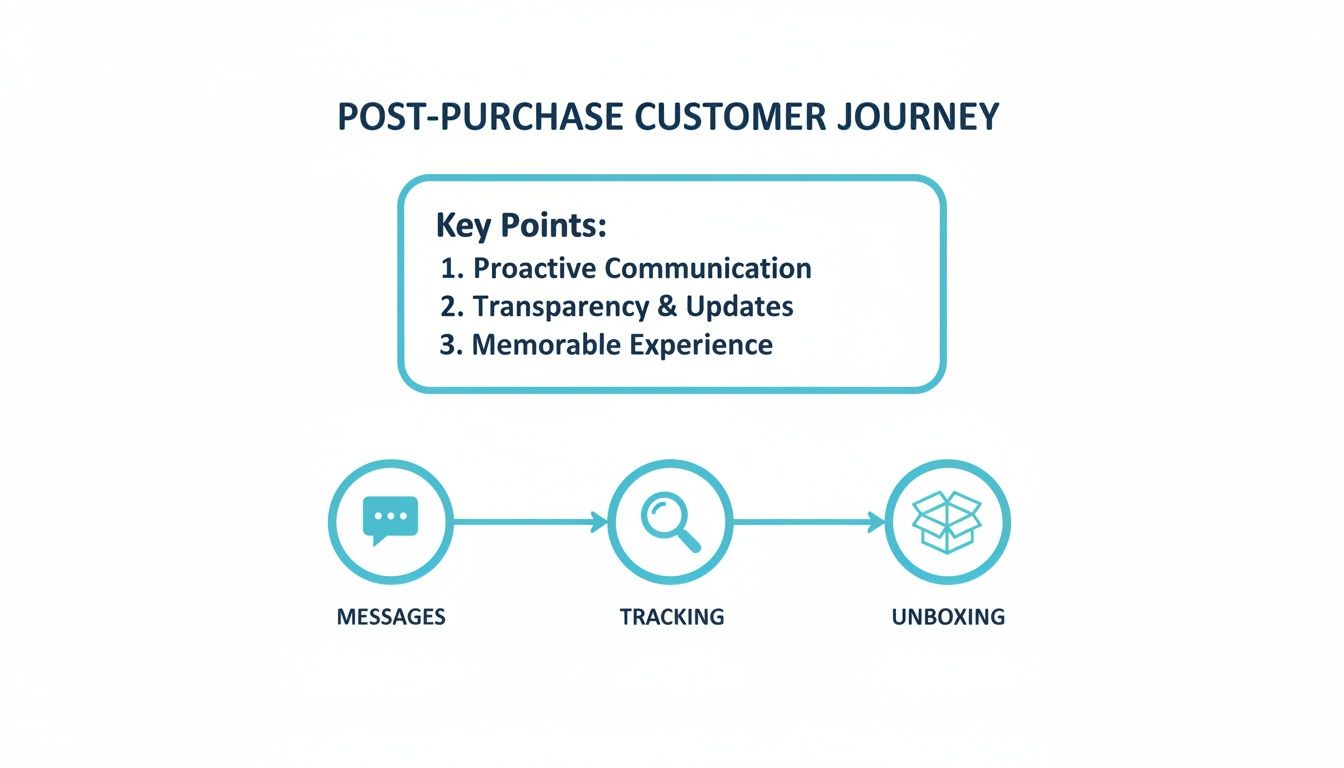
As the infographic illustrates, every touchpoint after the sale is a chance to secure the next purchase by building a compelling, ongoing narrative with your customer.
The true power of a modern urgency platform like Quikly lies in its ability to integrate with your existing tech stack, such as Klaviyo or your preferred SMS platform. This integration enables you to run hyper-targeted campaigns that speak directly to specific customer segments, making each interaction feel exclusive and relevant.
Actionable Takeaway: Implement these segmented campaigns immediately.
True urgency marketing for retention isn't about manipulation; it's about motivation. It uses behavioral science to create compelling reasons for loyal customers to engage again, strengthening their affinity for your brand with every interaction.
These intelligent, segmented campaigns do more than drive short-term revenue; they help protect your profit margins by avoiding deep, sitewide discounts that can devalue your brand.
Considering a 5% increase in retention can boost profits by 25-95%, the ROI of a sophisticated urgency strategy becomes undeniable.
The table below contrasts the limitations of basic tools with the power of advanced behavioral triggers.
| Feature | Basic Countdown Timers | Quikly's Urgency 'Moments' |
|---|---|---|
| Targeting | One-size-fits-all, shown to every visitor. | Hyper-segmented based on behavior and lifecycle stage. |
| Psychology | Relies solely on fear of missing a deadline. | Taps into scarcity, social proof, and anticipation. |
| Experience | Can feel generic and cheapens the brand. | Creates an exclusive, gamified, and rewarding event. |
| Goal | Drive a single conversion or email capture. | Build long-term loyalty and increase Lifetime Value (LTV). |
Ultimately, leveraging urgency as a retention tool is about creating a calendar of compelling events that keeps your brand top-of-mind. It’s a fundamental shift from shouting at everyone to whispering the right message to the right person at exactly the right time.
To dive deeper, explore our guide on using urgency marketing to achieve your loyalty goals.
Many loyalty programs are merely glorified discount clubs, operating on a simple transaction: a customer spends, they get points. While better than nothing, this model misses the larger opportunity to forge a genuine connection that transforms satisfied customers into your most vocal brand champions.
The real goal is not just to reward a purchase, but to build an emotional bond. This requires tapping into fundamental human psychology. An effective program makes customers feel like valued insiders—members of an exclusive group—not just another entry in a database. By designing rewards and experiences that foster a sense of belonging, status, and exclusivity, you build a community people are proud to be a part of.
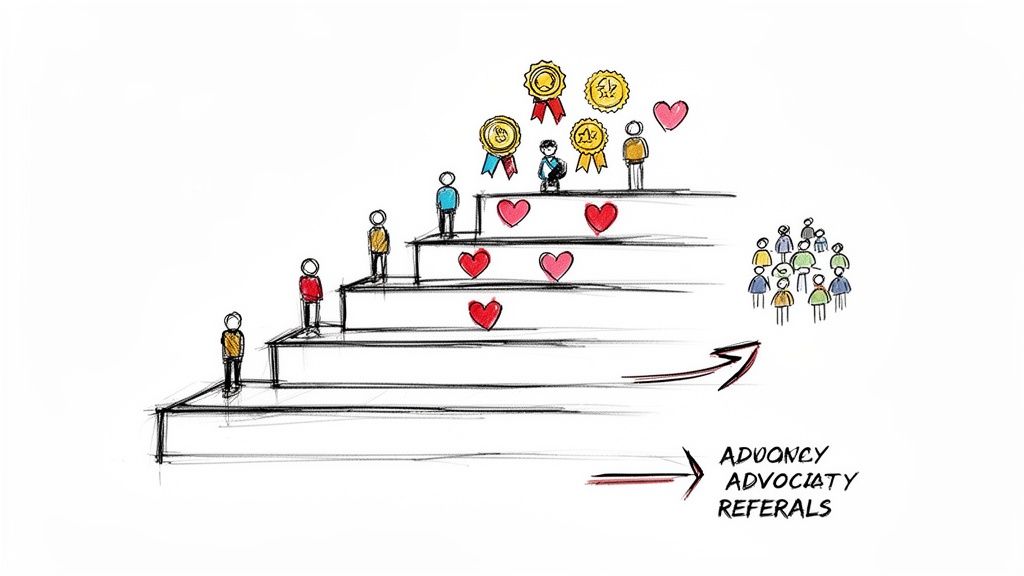
The structure of your program dictates how you can engage customers on a psychological level. While a simple points system is a valid starting point, other models can drive far stronger long-term retention.
The best loyalty programs don't just offer coupons; they deliver emotional and experiential rewards. Exclusivity, early access, and a sense of community are often more valuable to a loyal customer than a simple 10% discount.
The key is to select a model that aligns with your brand identity and resonates with your customers' values. A tiered system is ideal for aspirational brands, while a value-based model is perfect for companies with a strong social mission.
The rewards you offer are the currency of your program. If they are uninspired, the entire initiative will fail. The optimal strategy is a mix of transactional and experiential perks that delight customers without eroding your profit margins.
Avoid relying too heavily on deep discounts, as this can devalue your brand and attract bargain hunters rather than true fans. Instead, focus on high-perceived-value, low-cost rewards that feel special.
Actionable Takeaway: Implement these rewards in your program.
For Shopify stores, integrating a loyalty app like Smile.io or Yotpo with your email and SMS platforms like Klaviyo is essential. This creates a seamless experience, allowing you to automate notifications when members earn rewards or reach new tiers. This continuous communication loop keeps the program top-of-mind and feeling responsive. When you're ready, you can learn how to turn your loyalty members into advocates by combining these perks with intelligent engagement campaigns.
True personalization extends far beyond using a tag in an email. To effectively increase client retention, you must make each customer feel individually seen and understood. This requires a strategic shift where every communication feels like a one-to-one conversation, guided by their specific actions, preferences, and history with your brand.
This is no longer a luxury; it's a baseline expectation. Consumers are conditioned by the hyper-relevant experiences delivered by platforms like Netflix and Amazon. They now expect that same level of curation from you. Delivering on this expectation builds a bond that transcends simple transactions.
The foundation of any effective personalization strategy is data. Your Shopify store and integrated marketing tools are goldmines of behavioral information. The key is to connect these data points to create a holistic profile of each customer, enabling you to anticipate their needs and communicate in a way that resonates.
Think of it as a feedback loop: customer actions trigger marketing reactions. Every click, product view, and purchase is a signal. By listening to these signals, you can automate experiences that feel incredibly personal and are delivered at the perfect moment.
Here is the essential data to track and leverage:
By syncing data from Shopify with a platform like Klaviyo, you can build dynamic customer segments that update in real-time. This is how you move away from "batch-and-blast" marketing and toward sending the right message, to the right person, at the right time.
Let's move from theory to practice. Here’s how this works for a Shopify store selling skincare.
Scenario 1: The Abandoned Browse
A customer, Jane, previously purchased your Vitamin C serum. She recently visited your site and viewed your new SPF 50 moisturizer multiple times but did not add it to her cart.
Scenario 2: The Post-Purchase Cross-Sell
Mark just made his second purchase—a replenishing face wash. He is now part of your "loyal, repeat buyer" segment.
By transforming data into dialogue, you shift the customer relationship from transactional to relational. Every personalized touchpoint reinforces their decision to choose your brand, making them less likely to churn and more likely to become a lifelong advocate.
This data-driven approach demonstrates that you are paying attention to individual interests, not just sales data. This is the kind of thoughtful engagement that separates high-growth brands from the rest, building brand loyalty that is difficult for competitors to replicate.
Executing brilliant retention strategies is only half the battle. If you aren't measuring their impact with the right metrics, you're operating without a clear sense of ROI.
To truly master client retention, you must anchor your efforts in hard data. This means moving beyond vanity metrics like website traffic and focusing on the Key Performance Indicators (KPIs) that reveal the true health of your customer relationships. These numbers tell the story of your business’s sustainability and turn "retention" from a vague concept into a measurable strategy with a direct impact on your bottom line.
Three core metrics form the foundation of any robust retention analysis: Customer Lifetime Value (LTV), Churn Rate, and Repeat Purchase Rate. Each provides a unique lens through which to view customer behavior and business stability.
Monitoring these KPIs isn't just about looking backward. It’s about generating insights that let you get ahead of problems, identify your absolute best customer segments, and make smarter bets on where to invest your marketing budget.
For Shopify merchants, this data is readily accessible. Your native Shopify Analytics dashboard includes reports on most of these key metrics, such as repeat customer rates and average order value. You can find them under "Analytics" > "Reports" in your admin panel.
For a more granular view, leverage tools like Klaviyo or other dedicated analytics platforms. They allow you to segment customer data by LTV, purchase frequency, and other behavioral attributes. This is precisely how you build the targeted, personalized campaigns discussed earlier. As you analyze this data, you'll also gain a clearer understanding of how your customer acquisition costs compare to the long-term value generated by retained customers.
Finally, supplement quantitative data with qualitative feedback. To get a deeper understanding of customer loyalty, understanding the Net Promoter System is invaluable. Combining hard data like LTV with direct customer feedback provides a complete view of customer health and a clear roadmap for improvement.
Diving into the specifics of customer retention can bring up key questions. Here are answers to some of the most common inquiries from ecommerce brands focused on building a loyal customer base.
This varies by industry, but a solid benchmark for ecommerce brands is a customer retention rate of over 30%. Top-tier brands often push this number above 35%. However, the most critical metric is your own momentum. Focusing on consistent, incremental improvements month-over-month is the key to building a sustainable and profitable brand.
Reducing churn requires a two-pronged approach: proactive engagement and reactive recovery.
Proactively, focus on creating an exceptional post-purchase experience, building a loyalty program that offers genuine value beyond discounts, and personalizing your communication via email and SMS.
Reactively, use data from Shopify and Klaviyo to identify at-risk customers—those who haven't purchased in a significant period. Target them with strategic re-engagement campaigns that use urgency to remind them of your brand's value and encourage them to return.
While Customer Lifetime Value (LTV) is the ultimate measure of long-term success, your Repeat Purchase Rate is the most critical leading indicator. It acts as the canary in the coal mine for customer loyalty.
This metric reveals the percentage of customers returning for that crucial second purchase. It provides an immediate, clear signal of customer satisfaction and the effectiveness of your initial experience. Improving your repeat purchase rate is one of the most direct ways to increase overall retention, which will naturally drive your LTV higher over time.
Ready to turn one-time buyers into brand advocates using the science of urgency? Quikly is the expert in urgency marketing, helping you build sophisticated, segmented campaigns that drive repeat purchases and skyrocket LTV. See how our platform transforms customer engagement.