

ecommerce conversion
customer experience strategy
digital customer experiences
The average e-commerce cart abandonment rate hovers around 70%, representing a massive loss in potential revenue. While many dismiss pop-ups as mere annoyances, a strategically deployed pop-up is a powerful tool grounded in proven behavioral psychology. This isn't about simple email capture; it's about transforming a moment of hesitation into a decisive purchase, turning a potential exit into an immediate sale. The goal is to move beyond basic countdown timers and leverage sophisticated behavioral triggers that enhance the entire shopper journey, turning fleeting interest into measurable ROI.
This listicle deconstructs specific examples of pop-up ads to reveal the underlying principles of urgency, scarcity, and social proof that drive action and protect profit margins. We will analyze high-converting campaigns from leading e-commerce brands, providing actionable takeaways for Shopify store owners and digital marketers. You will learn not just what works, but the psychological why behind each successful implementation, focusing on revenue generation over simple list-building. Ultimately, the goal of any pop-up is to drive conversions. For a comprehensive overview of strategies to maximize your website's conversion potential, you can explore conversion rate optimization best practices. Each example below offers replicable strategies to help you implement more sophisticated, psychology-driven campaigns immediately.
Exit-intent pop-ups are a powerful example of pop-up ads triggered by behavioral science. This technology monitors a user's mouse velocity and direction, deploying a pop-up at the precise moment their cursor moves towards the browser's exit or back button. This intervention acts as a final, targeted attempt to re-engage a departing visitor, turning a potential bounce into a conversion or a lead.
This method's effectiveness is rooted in its timing. By appearing just before abandonment, it interrupts a user's departure pattern without disrupting their initial browsing experience. For e-commerce stores, this is a critical moment to present a compelling offer that addresses common reasons for leaving, like price sensitivity or indecision.
The primary goal of an exit-intent pop-up is to recover otherwise lost revenue. By presenting a last-chance offer, brands can capture sales from shoppers who were on the fence. For Shopify Plus merchants, this is an essential tool for protecting profit margins and maximizing customer lifetime value.
Strategic Insight: The most successful exit-intent strategies go beyond simple discounts. By integrating advanced urgency tactics, you shift the psychological frame from a simple offer to an exclusive, time-sensitive opportunity, which can significantly boost conversion rates.
Time-triggered pop-ups represent a proactive example of pop up ads that capitalize on visitor engagement. Unlike exit-intent, which reacts to departure, this strategy deploys an offer after a user spends a set amount of time on a page or scrolls past a specific content threshold. This approach is based on the behavioral signal that a user who lingers or scrolls is actively interested and more receptive to a call-to-action.
This method’s power lies in its relevance. By triggering based on engagement metrics like time-on-page or scroll depth (e.g., 75% down a product page), the pop-up feels less like an interruption and more like a helpful next step. For content-heavy sites or long-form product pages, this is a prime opportunity to present a relevant offer, such as a discount or a related product guide, to a clearly invested shopper.
The primary objective of a time-triggered pop-up is to convert engaged browsers into active customers. By targeting visitors who have demonstrated clear interest, brands can strategically present offers that accelerate the buying decision. For Shopify Plus merchants, this is a crucial tactic for segmenting engaged traffic and improving on-site conversion funnels.
Strategic Insight: The most effective time-triggered strategies move beyond basic timers. They use engagement data to deliver hyper-relevant, urgent offers. By combining a 60-second time delay with a live countdown timer on a high-value collection page, you create a powerful moment of decision that leverages the visitor's proven interest and transforms it into immediate revenue.
Welcome or first-visit pop-ups are a foundational example of pop up ads designed to make an immediate, impactful first impression. Triggered when a new user lands on a site, they act as a digital greeting, often paired with an incentive to encourage instant engagement. This strategy is crucial for e-commerce brands looking to convert new traffic into tangible leads or first-time buyers from the very first interaction.
This method’s power lies in its timing. By presenting an offer right away (often with a 2-3 second delay to allow for page context), brands like Warby Parker and Glossier capitalize on the initial peak of a visitor's interest. It's a proactive approach to acquisition, turning a passive browser into an engaged subscriber or customer before they have a chance to navigate away.
The primary objective of a welcome pop-up is to start a customer relationship. For online stores, this means capturing an email for remarketing or driving an immediate first purchase. These pop-ups are particularly effective for initial engagement and to quickly grow your subscriber base; you can find strategic insights on how to build an email list that converts for long-term value.
Strategic Insight: A successful welcome pop-up isn't just a form; it's the first step in the customer journey. By combining a strong value proposition with psychological urgency, you create a powerful acquisition tool that boosts both your email list and initial sales.
Slide-in pop-ups and sticky banners are a more subtle yet persistent example of pop up ads. Unlike disruptive modals, slide-ins emerge from the corner or edge of a screen, while sticky banners remain fixed at the top or bottom as users scroll. This less intrusive approach provides continuous visibility for key messages without hijacking the entire user experience, making them ideal for sustained urgency-driven campaigns.
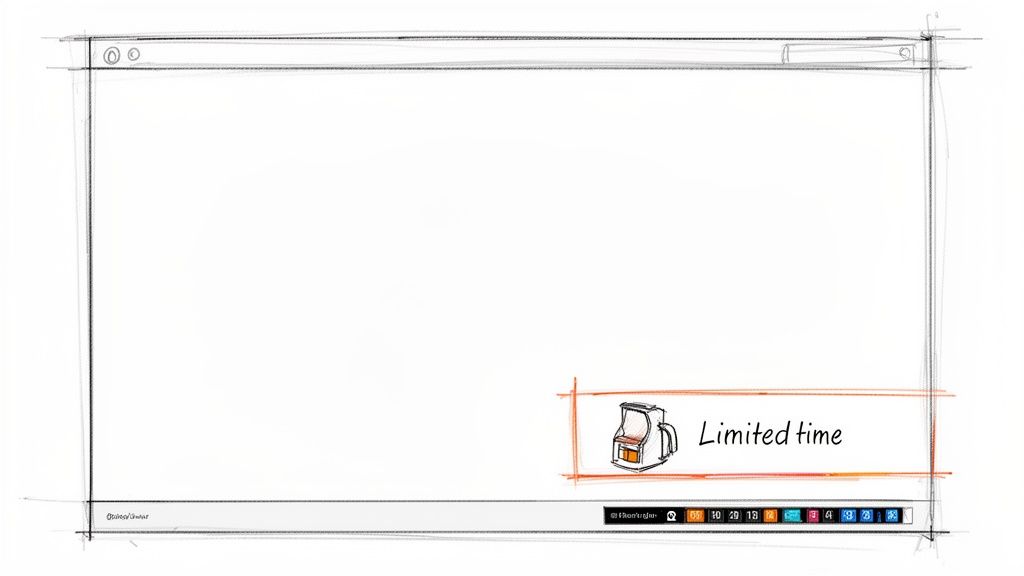
The effectiveness of this format lies in its balance of presence and politeness. By staying within the user's peripheral vision, these banners consistently reinforce an offer or deadline without causing "banner blindness" or frustration. This makes them perfect for displaying flash sale countdowns or promoting limited-time shipping deals, keeping the urgency top-of-mind throughout the browsing session.
The primary goal of a slide-in or sticky banner is to create pervasive urgency and drive action without interrupting the customer journey. For e-commerce stores, this is a powerful method to announce site-wide sales or special promotions, ensuring every visitor is aware of the time-sensitive opportunity, which directly impacts average order value and session conversion rates.
Strategic Insight: The true power of sticky banners is their ability to transform a passive browsing session into an active, decision-driven one. By integrating a live countdown, you're not just showing an ad; you're creating an environment of scarcity that compels users to act now rather than later, effectively shortening the consideration phase and accelerating purchases.
Full-screen pop-ups, also known as modals or overlays, are a high-impact example of pop up ads designed to command total user attention. This format covers the entire browser viewport, often with a semi-transparent background, compelling the visitor to engage with the message before they can continue browsing. Due to their intrusive nature, they are reserved for the most critical, high-priority announcements where capturing focus is paramount.
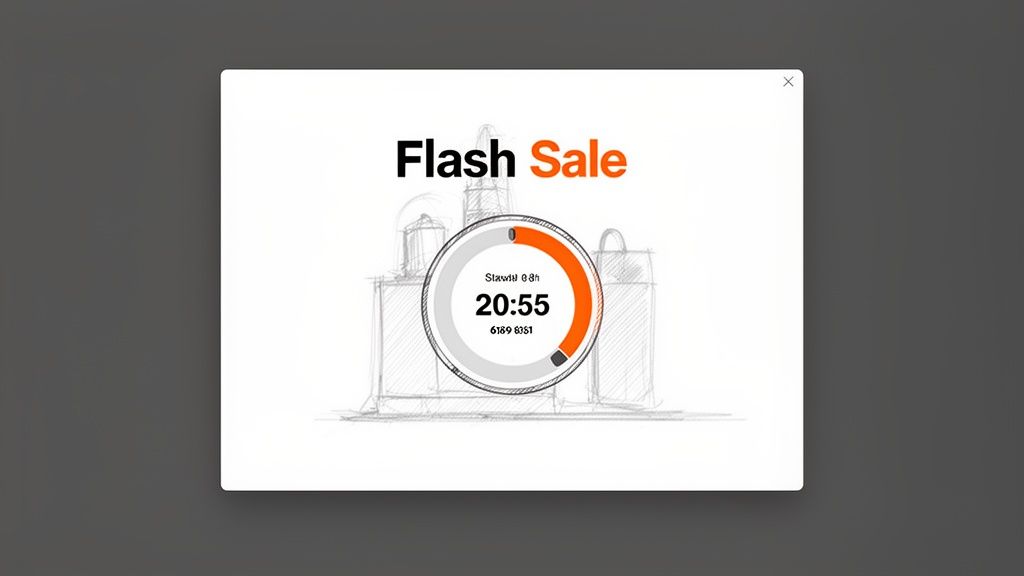
The effectiveness of this method is rooted in its ability to create an unmissable event. Brands like Shein and Sephora leverage this format for major flash sales or limited-edition product drops. By creating a temporary gate, they ensure every visitor is aware of the time-sensitive opportunity, which is crucial for maximizing participation in short-lived campaigns.
The primary goal of a full-screen pop-up is to drive mass participation in a key marketing event, such as a Black Friday sale or an exclusive inventory release. For Shopify Plus merchants, this is a powerful tool for launching products with maximum velocity and clearing inventory during high-stakes sales periods. The interruption is justified by the immense value or urgency of the offer.
Strategic Insight: A successful full-screen pop-up justifies its interruption with exceptional value. Pair the assertive format with a compelling psychological trigger, like a ranked offer where faster action yields a better discount. This transforms the intrusion into an exciting, competitive event, dramatically increasing engagement and driving immediate revenue.
Content lock pop-ups, also known as gated content pop-ups, serve as a strategic example of pop up ads that exchange value. This technique requires a visitor to perform a specific action, most commonly submitting their email address, to unlock access to premium content. This creates a powerful lead generation mechanism by placing a gate in front of high-value resources like in-depth guides, exclusive sale access, or ROI calculators.
This approach is highly effective because it leverages the principle of reciprocity. By offering something genuinely valuable first, you justify the request for a user's contact information. Instead of a generic "sign up for our newsletter," the exchange is specific and tangible, making users far more willing to opt-in. For e-commerce brands, this is a key strategy for building a high-intent email list for future marketing campaigns.
The primary objective of a content lock pop-up is to generate high-quality leads by offering exclusive, desirable content. This strategy moves beyond simple email capture to acquire contacts who have already demonstrated interest in a specific topic or offer, leading to higher engagement and conversion rates down the funnel.
Strategic Insight: The most advanced gated content strategies link the pop-up directly to a timed, exclusive event. By gating early access to a limited-time product drop, you not only capture a lead but also build powerful anticipation. This transforms a simple lead magnet into a revenue-driving event, creating a highly engaged audience segment primed for purchase.
Gamified pop-ups, such as the popular spin-to-win wheel, are a highly interactive example of pop up ads. They transform passive browsing into an active, engaging experience by inviting visitors to "play" for a reward. This method taps into the user's natural desire for competition and reward, creating a sense of psychological investment and entertainment that traditional pop-ups lack.
The effectiveness of this strategy lies in its ability to generate micro-commitments. By encouraging a user to enter their email for a chance to spin, you've already initiated a positive interaction. The anticipation of winning a prize makes the user more receptive to the subsequent offer, whether it's a discount, free shipping, or an exclusive product.
The primary goal of a gamified pop-up is to boost engagement and conversions by making the opt-in process feel like a fun event rather than a transactional exchange. For brands targeting younger demographics or those in competitive markets like beauty and fashion, this creates a memorable brand interaction that significantly increases lead capture rates.
Strategic Insight: The power of gamification is rooted in behavioral psychology. It leverages the "endowed progress effect," where users feel invested after winning a prize and are more likely to complete the purchase.
Survey and feedback pop-ups are a sophisticated example of pop-up ads that prioritize value exchange. Instead of immediately pushing a generic offer, they first engage visitors with a short series of questions about their preferences, needs, or browsing experience. This interaction provides valuable zero-party data while segmenting the audience in real-time.
This approach transforms a potentially intrusive ad into a personalized consultation. By gathering insights first, brands like Warby Parker and Bonobos can conditionally display highly relevant offers or product recommendations, justifying the interruption with a tailored reward. The pop-up feels less like an ad and more like a helpful guide.
The primary goal is to turn a passive browsing session into an active, data-driven engagement. This method gathers crucial customer intelligence that can inform marketing strategy, product development, and inventory management, all while guiding the user toward a purchase with a personalized incentive.
Strategic Insight: The power of this strategy lies in its reciprocity. By asking for an opinion, you make the shopper feel valued. Following up with a relevant, time-sensitive offer that reflects their stated preferences leverages the psychological principle of consistency, making them more likely to follow through with a purchase.
| Pop-up type | Implementation complexity | Resource requirements | Expected outcomes | Ideal use cases | Key advantages |
|---|---|---|---|---|---|
| Exit-Intent Pop-ups | Medium — requires accurate exit detection and fallbacks | JS mouse-tracking, UX design, A/B testing, mobile fallback strategy | High conversion lift for abandoning visitors (≈2–5%), recover carts, capture emails | E‑commerce last‑chance discounts, cart abandonment recovery | Targets users at moment of leave; contextual and high intent |
| Time-Triggered / Scroll-Triggered Pop-ups | Low–Medium — simple timers or scroll listeners | Timer/scroll scripts, responsive design, analytics, frequency caps | Steady conversions (≈1–3%), engages actively reading visitors | Mid‑funnel offers, product recommendations, content monetization | Reliable across devices, predictable and less intrusive |
| Welcome / First-Visit Pop-ups | Low — triggers on first visit via cookie/local storage | Cookie/local storage, simple form capture, design assets | Strong list growth (high opt-in rates possible), boost first purchases | New visitor acquisition, first‑time discounts, email capture | Excellent for top‑of‑funnel list building and first impressions |
| Slide-In Pop-ups & Sticky Banners | Low — CSS animations and fixed positioning | CSS/JS animations, responsive sizing, minor backend for CTAs | Moderate engagement (≈2–4%), persistent visibility without blocking content | Mobile promos, inventory alerts, live countdown displays | Non‑blocking, better UX perception, persistent urgency |
| Full-Screen / Modal Pop-ups | Medium — modal behavior and careful timing needed | Design assets, overlay behavior, extensive mobile testing, analytics | Very high visibility and conversion for urgent offers (≈2–6%) but higher bounce risk | Flash sales, major announcements, limited‑inventory drops | Unmissable attention, supports rich media and multiple CTAs |
| Content Lock / Gated Content Pop-ups | Medium–High — gating and access control required | Backend gating logic, CRM/email integration, high‑value content | High‑quality lead generation, fewer pageviews but better leads | Gated guides, exclusive early access, B2B lead capture | Justifiable interruption that trades value for contact info |
| Spin‑to‑Win / Gamified Pop-ups | High — interactive mechanics and prize logic | Interactive front‑end, prize distribution, redemption management, analytics | Exceptional engagement and opt-ins (20–40% email capture), shareability | Promotional engagement, mobile campaigns, younger demographics | Entertaining mechanics drive high opt‑in and time on site |
| Survey / Feedback Pop-ups with Conditional Offers | High — conditional logic and personalization required | Survey engine, conditional rules, CRM integration, data mapping | Personalized offers with notable conversion lift (≈15–25%), rich zero‑party data | Segmentation, tailored urgency offers, product recommendations | Delivers targeted offers and strong customer insights through responses |
Throughout this deep dive into various pop-up ad examples, a clear and powerful theme has emerged: the most effective pop-ups are not mere interruptions but are, in fact, strategic interventions. They succeed by aligning perfectly with shopper psychology, delivering the right message at the precise moment it will have the greatest impact. This is the fundamental shift from basic, intrusive pop-ups to sophisticated, profit-driving marketing moments.
The examples we've explored, from dynamic exit-intent offers to engaging gamified promotions, demonstrate that success is rooted in understanding and applying behavioral principles. Concepts like FOMO (Fear Of Missing Out), scarcity, and social proof are not just buzzwords; they are the psychological levers that, when pulled correctly, can dramatically increase conversion rates and, more importantly, overall revenue.
As you move from inspiration to implementation, remember these core principles that differentiate a generic pop-up from a high-performing one:
For Shopify and Shopify Plus merchants, putting these advanced concepts into practice is more accessible than ever. The key is to start with a clear objective. Identify the most significant point of friction in your customer journey. Is it a high bounce rate on product pages? Or is it the industry-standard 70% cart abandonment rate?
Once you have your target, select one example of pop up ads from this guide that directly addresses that challenge. Begin with a simple A/B test. For instance, pit a standard 10% off welcome pop-up against a psychologically-grounded offer triggered by user behavior. By focusing on the science of urgency and timing, you can transform your pop-up strategy from a simple list-building tool into an automated engine for revenue generation and intelligent inventory management.
Ready to move beyond basic pop-ups and implement the urgency science that drives real revenue growth? See how Quikly transforms every pop-up, banner, and email into a high-converting 'Moment' that leverages deep psychological triggers. Explore the platform at Quikly and discover how to automate sophisticated, profit-focused campaigns for your Shopify store.