

ecommerce psychology
brand loyalty
best brand experiences
When you hear e-commerce optimization, what comes to mind? For many brands, it’s a blur of A/B testing button colors or slapping a generic discount pop-up on the homepage.
Those tactics have their place, but they barely scratch the surface. True optimization is a holistic process grounded in consumer psychology. It's about meticulously refining every customer touchpoint—from the first ad they see to the follow-up email after their purchase—to maximize revenue and protect your profit margins. It's less about tech tweaks and more about applying the science of behavioral economics to drive tangible business growth.
The goal isn't just to capture an email address; it's to generate immediate revenue. This requires a shift in mindset. You have to get inside the shopper's head, understand the psychological drivers behind hesitation, and use that insight to build a more compelling, persuasive experience from start to finish.
The numbers don't lie. The average cart abandonment rate still hovers around a staggering 70%. Think about that from an ROI perspective. Seven out of ten shoppers who add an item to their cart leave without buying. That’s not just a lost sale; it's a clear symptom of a broken customer journey and a major drain on profitability.
To build a powerful, resilient e-commerce business, your optimization efforts need a solid foundation. The most effective strategies are structured around four interconnected pillars. Each one represents a critical stage where you can apply psychological triggers to guide customers forward and, ultimately, boost your bottom line.
This framework helps organize your efforts across the entire customer journey, ensuring you're not just plugging leaks but building a fundamentally stronger, more profitable business.
| Pillar | Primary Goal | Key Metric (ROI-Focused) | Psychological Principle |
|---|---|---|---|
| Acquisition | Attract high-intent shoppers ready to convert. | Customer Acquisition Cost (CAC) | Anticipation, Authority |
| On-Site | Turn your store into a dynamic, persuasive environment. | Average Order Value (AOV) | Social Proof, Scarcity |
| Checkout | Reduce friction and maintain momentum to the final step. | Cart Abandonment Rate | Loss Aversion, Commitment |
| Retention | Cultivate loyalty and increase lifetime value. | Customer Lifetime Value (CLV) | Reciprocity, Liking |
Looking at optimization through this lens is more important than ever. Global e-commerce sales are projected to hit $6.86 trillion by 2025—an 8.37% jump from 2024. That growth absolutely dwarfs the 3% seen in traditional retail. With 2.77 billion digital shoppers out there, the brands that master this stuff are the ones who will win. You can dig deeper into these global e-commerce trends and statistics to see the full picture.
True e-commerce optimization isn't about manipulation; it's about understanding human behavior. It's the science of ethically applying principles like scarcity, social proof, and loss aversion to create a shopping experience that feels both compelling and intuitive for the customer.
This is exactly where Quikly's expertise in urgency marketing science comes into play. As experts in the field, we help brands move beyond basic countdown timers and deploy sophisticated, psychology-driven "Moments"—like limited-time drops and ranked offers—that enhance banners, popups, and the entire shopper journey. It’s about creating genuine excitement and a compelling reason to purchase now, making a direct impact on your revenue and inventory velocity.
Any real e-commerce optimization effort has to start long before a visitor ever lands on your site. It all begins with attracting the right people—shoppers who are actually ready to buy. This means ditching the generic ad campaigns and starting to inject powerful psychological triggers right where you find your customers.
The old "spray and pray" method of blasting ads to huge, undefined audiences is a surefire way to drive up your Customer Acquisition Cost (CAC) and get a dismal Return on Ad Spend (ROAS). A much smarter approach is to use the principles of anticipation and scarcity to pre-qualify every single click. You want to ensure the traffic you’re paying for is already primed to convert.
Take a hard look at your current ad copy on platforms like Facebook or Google. Does it just announce a product? Or does it create an event? Instead of a boring "Shop Now" call to action, you should be framing your campaigns around a specific, time-sensitive opportunity.
For example, an ad for an upcoming product launch can build serious anticipation by inviting people to sign up for early access. This taps into the endowment effect—a principle from behavioral economics where people value things more if they feel a sense of ownership, even before they’ve bought anything. By signing up, they've made a micro-commitment, which makes them far more likely to follow through when the product actually drops.
By framing acquisition around an "event," you completely shift the dynamic. It’s no longer just a transaction; it's an anticipated experience. This psychological reframing is the secret to attracting shoppers who aren't just browsing—they're actively waiting to buy, directly impacting your ROI.
This is a world away from the basic "10% off for your email" popup. While that tactic captures an email, it often just attracts bargain hunters. Building anticipation, on the other hand, cultivates a high-intent audience that genuinely values the product itself, which is crucial for protecting your profit margins.
Your email and SMS lists are absolute goldmines. These subscribers have already raised their hands and said they’re interested. Your job is to turn that passive interest into active buying, using structured, psychology-driven campaigns. This is where seamless integrations with platforms like Klaviyo are a game-changer.
Instead of just sending out another generic newsletter, think about a multi-stage campaign for a new product drop:
An automated sequence like this transforms a routine product launch into a must-participate event. It's a fantastic way to generate new demand, which is what customer acquisition is all about. For a deeper dive, check out our guide on how to convert existing email subscribers into new customers.
It's time for a quick audit of your current acquisition strategy. Ask yourself these questions:
When you align your acquisition efforts with these behavioral triggers, you don't just get more traffic—you get better traffic. And that’s the first, most important step in a holistic e-commerce optimization strategy that actually drives revenue.
Once someone lands on your website, the clock starts ticking. You have just a few seconds to grab their attention and turn them from a casual browser into a confident buyer. This is where your on-site experience becomes the heart of your entire e-commerce strategy, shifting static product pages into dynamic, persuasive environments.
The challenge gets even bigger on mobile. With shorter attention spans and tiny screens, the shopper’s journey has to be seamless and compelling. This is absolutely critical, considering m-commerce is expected to make up 59% of all online sales in 2025, hitting an incredible $2.51 trillion. And with smartphones now driving 78% of e-commerce traffic, a mobile-first mindset isn’t just a good idea—it’s the foundation of modern retail.
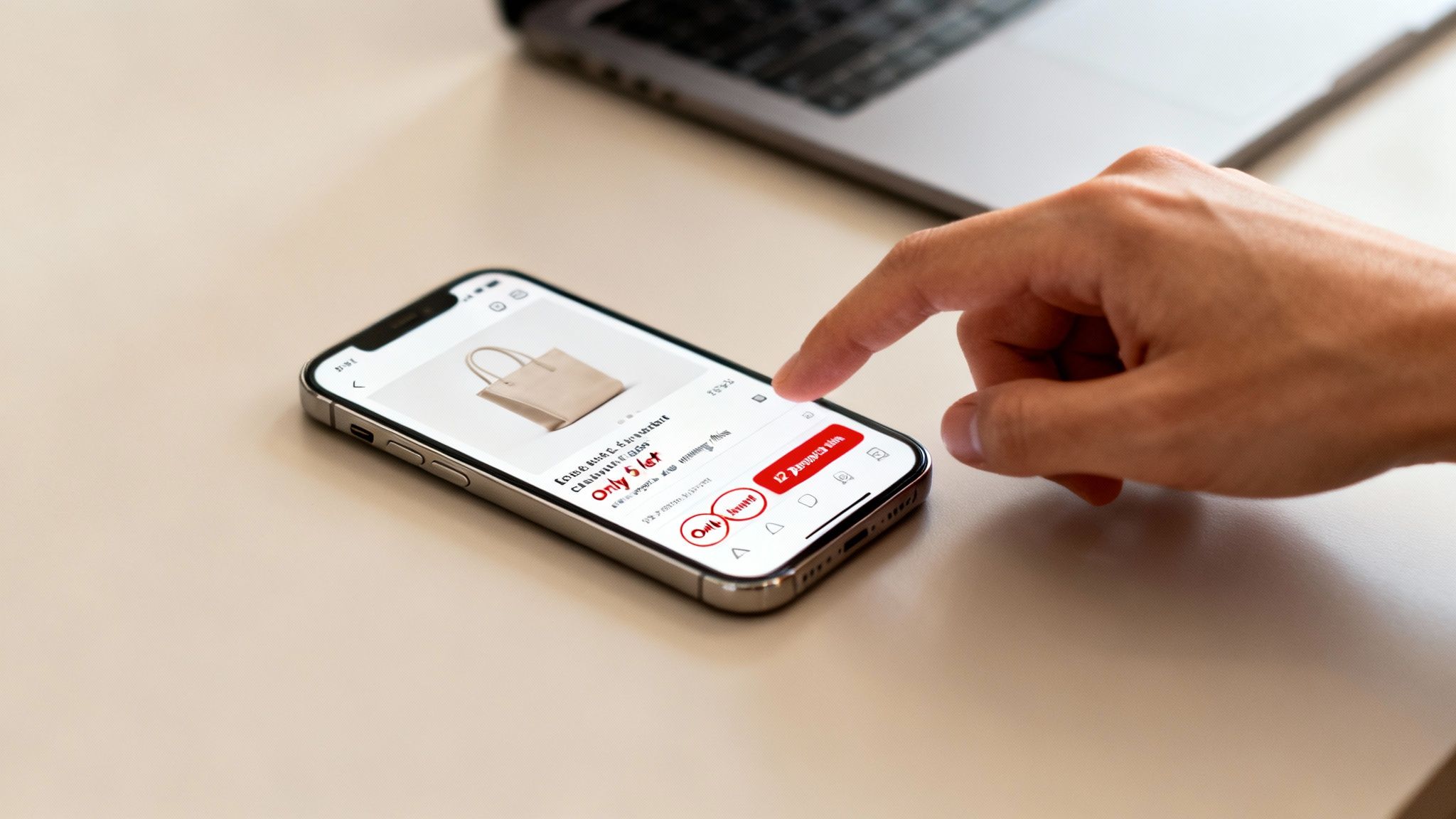
A standard product page gives you a photo, a price, and a description. A psychologically optimized page, on the other hand, tells a story of demand, value, and opportunity. This is where you graduate from basic pop-ups and timers and get into the real science of how people make decisions.
Two of the most powerful principles you can use are scarcity and social proof.
These are not manipulative tricks. They are valuable contextual cues that help shoppers make faster, more confident decisions.
To change the game, you need to embed these psychological triggers directly into the user journey. Forget a single, site-wide banner. Think about tailored "Moments" that appear at critical decision points.
The most effective on-site optimization makes the path to purchase feel both exciting and inevitable. It replaces shopper indecision with a clear, compelling reason to act now, directly impacting metrics like Add-to-Cart rate and Average Order Value (AOV).
Taking this a step further with strategies like AI-driven personalization can create truly exceptional customer experiences that drive serious results.
If you're running an enterprise-level brand on Shopify Plus, the stakes are even higher, especially during massive traffic events like flash sales or holiday promos. The main worry is deploying powerful marketing tools without killing your site speed. A slow-loading page is the ultimate conversion killer.
This is where sophisticated, server-side integrations become non-negotiable. Unlike basic Shopify apps that can bog down a site with heavy client-side scripts, a platform like Quikly is built to handle enterprise-level traffic. For a Shopify Plus merchant, this means you can run a complex, site-wide ranked offer during a Black Friday sale with total confidence, knowing your site will stay fast and responsive.
Plus, the automation is a lifesaver. Shopify Plus users can set up rules to trigger specific urgency campaigns based on user segments from tools like Klaviyo, inventory levels, or even geographic location. This allows for a deeply personal and effective on-site experience that drives revenue without needing constant manual work. For more ideas, check out our guide on building a website that converts.
The final stretch of the customer journey—the checkout—is where an unbelievable number of sales simply vanish. While standard advice like offering guest checkout is a decent starting point, real e-commerce optimization goes much deeper. It’s all about maintaining the psychological momentum a shopper has built up, guiding them smoothly from cart to confirmation.
This is where you shift from passive optimization to active conversion recovery. The average cart abandonment rate of around 70% is a flashing neon sign that friction and second-guessing are at their peak right before the finish line.
To combat this, you must tap into a powerful principle from consumer psychology: loss aversion. Behavioral economics research shows that the pain of losing something feels approximately twice as powerful as the pleasure of gaining something of equal value.

Instead of a static cart page, transform it into a dynamic environment that actively encourages completion. The way to do this is by introducing a real consequence if the shopper waits too long.
A simple yet incredibly effective tactic is a cart timer. When a customer adds an item, a visible timer starts, making it clear their items are only reserved for a limited time. This isn't a gimmick; it's tied directly to your inventory. This small change completely reframes the shopper's mindset from "I might buy this later" to "I might lose this if I don't act now."
This strategy also has a massive, direct impact on inventory management. For Shopify Plus merchants dealing with fast-moving stock, timed carts are a lifesaver. They stop valuable inventory from being locked up by indecisive shoppers, automatically releasing the stock back into circulation once the timer expires. This protects your revenue and makes sure your most popular products are available for customers ready to buy.
The goal is to make completing the purchase feel like the most natural, logical next step. By clearly communicating that the items in their cart are theirs for a limited time, you create a sense of ownership and urgency that a generic abandoned cart email could never match.
Even with an optimized cart, some shoppers will still leave. This is your chance to deploy smart automation that goes beyond a generic "You left something behind!" email. A powerful recovery sequence weaves urgency right into the message.
By connecting a platform like Quikly with your email and SMS tools (like Klaviyo), you can trigger personalized abandoned cart reminders that highlight the time-sensitive nature of their reserved items.
Here's what an effective Shopify-integrated flow could look like:
This multi-channel approach meets shoppers where they are and constantly reinforces that feeling of loss aversion. It’s an active recovery strategy that drives immediate action, not a passive reminder that's easy to ignore. You're shifting from begging them to come back to providing a helpful service: reminding them of an opportunity they're about to miss.
For more ideas on this, we've got a ton of information in our complete guide on how to reduce shopping cart abandonment.
Think about this real-world scenario: An apparel brand launches a limited-edition sneaker. They set up a 15-minute cart reservation timer. A shopper adds the last pair in their size but gets distracted.
Without a timer, that inventory is locked down, unavailable to other eager buyers. With the timer, the shopper gets an automated SMS after 10 minutes. That nudge creates enough urgency to bring them back to finish the purchase. If they hadn't returned, the sneakers would have been automatically released, giving another customer the chance to buy.
This isn't just about saving one sale. It’s about squeezing every bit of revenue potential out of your high-demand products.
To put it in perspective, let's compare how these advanced behavioral triggers stack up against the basic popups many stores rely on.
| Feature | Basic Popup Apps | Advanced Behavioral Triggers (Quikly) | Primary Business Impact |
|---|---|---|---|
| Primary Goal | Capture an email address before the user leaves. | Drive immediate purchase completion and recover abandoned revenue. | Shifts focus from lead gen to direct revenue generation. |
| User Experience | Often disruptive; can feel generic and interruptive. | Integrated into the shopping flow; creates a fair, exciting experience. | Higher on-site engagement and lower bounce rates. |
| Key Tactic | Exit-intent overlay offering a future discount (e.g., 10% off). | Real-time cart timers, inventory holds, and expiring offers. | Taps into loss aversion, creating a powerful psychological trigger. |
| Typical Outcome | A new email subscriber who may or may not convert later. | A completed sale now, plus higher overall conversion rates. | Measurable lift in AOV and revenue per visitor. |
| Inventory Impact | None. Offers no solution for inventory locked in abandoned carts. | Actively releases held inventory, maximizing sales potential for popular items. | Prevents lost sales on high-demand products and protects profit margins. |
The difference is clear. While building an email list is important, advanced urgency is about converting the customer who is right there, right now, ready to spend money. It's a direct line to increasing revenue and improving inventory velocity.
True e-commerce optimization doesn't stop when the thank you page loads. In fact, that post-purchase window is arguably the most valuable—and most overlooked—phase of the entire customer journey. It’s your golden opportunity to turn a one-time buyer into a loyal, high-value fan of your brand.
This is where the game shifts from chasing short-term conversions to building long-term relationships. By strategically applying urgency after the sale, you can dramatically boost customer lifetime value (LTV) and build a real community around your products.
Right after a customer buys something is when they are most engaged. They're excited about their order and more receptive to your brand's messages than at any other time. This is the perfect moment to tap into the psychological principle of reciprocity—the natural human tendency to give back after receiving something of value.
Instead of sending a generic "thanks for your order" email, imagine surprising them with a time-sensitive offer for their next purchase. This isn't just another discount; it's a reward. It makes the customer feel seen and appreciated, strengthening their bond with your brand and giving them a powerful reason to come back soon.
An exclusive, time-bound offer for a recent purchaser does more than just drive a repeat sale. It reinforces their decision to buy from you in the first place, turning a simple transaction into the beginning of a VIP relationship and significantly boosting LTV.
This contrasts sharply with the "spray and pray" discount emails that just eat into your profit margins. It's a targeted, psychology-driven strategy designed to reward loyalty and build sustainable growth.
The real magic here, especially for Shopify Plus merchants juggling thousands of orders, is smart automation. By integrating a platform like Quikly with your email and SMS tools (like Klaviyo), you can build a powerful post-purchase sequence that runs on autopilot.
Here’s a simple framework to get you started:
This automated sequence feels personal and exclusive, making customers feel like they're part of an inner circle. That personalization is becoming non-negotiable; 91% of shoppers are more likely to buy from brands that provide relevant recommendations. This is a massive market, expected to jump from $8.65 billion in 2025 to $22.60 billion by 2032. You can dig deeper into these e-commerce statistics and trends to see just how big this opportunity is.
Beyond individual offers, you can use post-purchase data to create an exclusive community of your best customers. This is where limited-edition drops and ranked offers become incredibly powerful retention tools.
Imagine segmenting your customer base into tiers based on their purchase history. Your most loyal customers could get early access to new product drops or be invited to special "Moments" where the fastest people to respond get the best deals.
This single tactic leverages several psychological triggers all at once:
When you create these high-engagement events for your best customers, you're doing more than just selling products—you're building a brand ecosystem. You're giving your community something to talk about and look forward to, which is far more powerful than any discount ever could be. This shifts your e-commerce optimization from a checklist of tactics to a cohesive strategy for creating true brand advocates.
Let's turn theory into revenue. It’s easy to get buried in an endless list of potential tweaks and optimizations. The key is to sidestep that feeling of being overwhelmed and instead build a clear, prioritized roadmap.
Focus your efforts on the highest-impact opportunities first. A good way to start is by auditing your current strategy across all four pillars we've discussed—Acquisition, On-Site, Checkout, and Retention. This will show you exactly where you can generate the most significant returns, fast.
If you want an immediate, actionable first step, try this: launch a single, targeted urgency campaign. You could create an exclusive, time-sensitive offer for recent purchasers to drive instant repeat business. This kind of focused approach gives you measurable results right away and builds momentum for your broader optimization plan.
This diagram breaks down the core flow of turning a first-time buyer into a loyal customer. It all hinges on strategic post-purchase engagement.
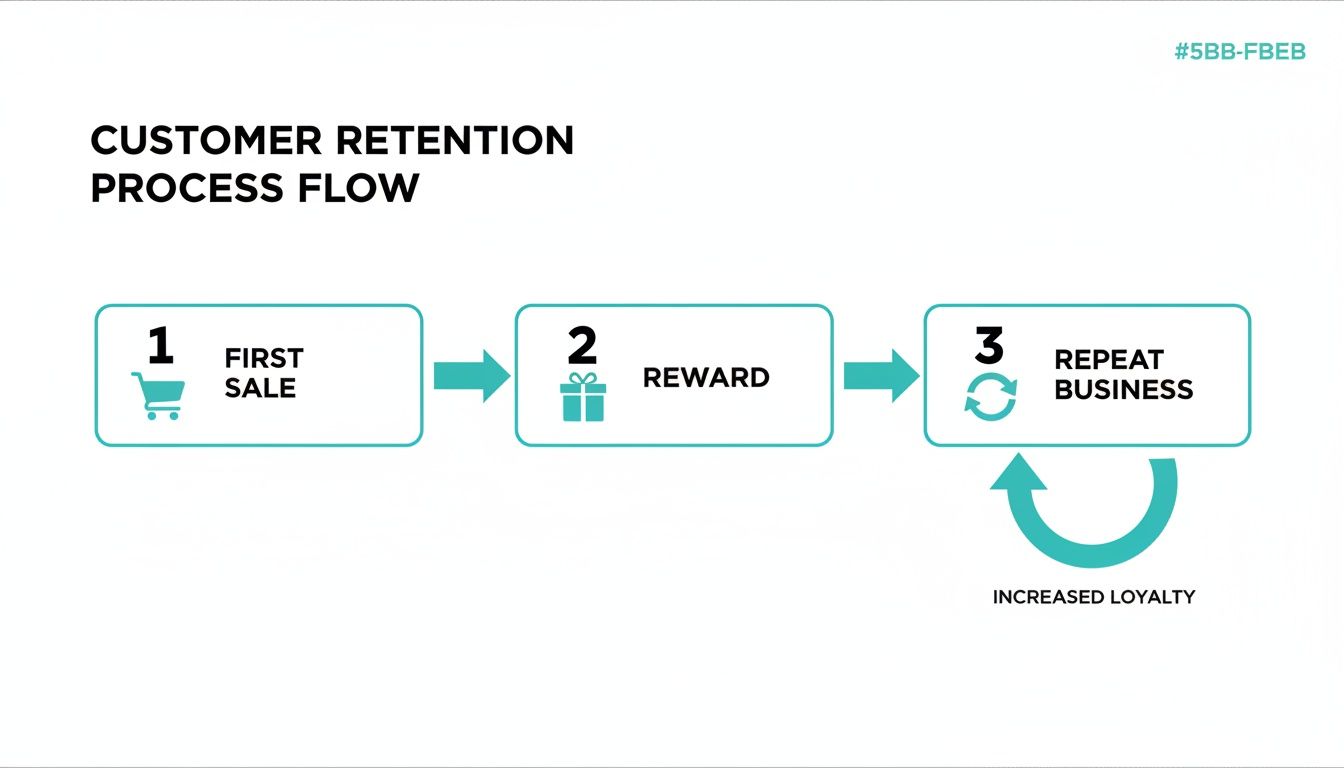
The big insight here? That timely reward after the first sale is the critical link. It's what transforms a one-off transaction into a recurring revenue stream and a loyal fan.
For a deeper dive into implementing these kinds of strategies, check out this a data-driven playbook for improving your e-commerce conversion rate.
The real goal is to move past basic tactics like generic pop-ups and countdown timers. By partnering with an expert in the science of urgency marketing, your brand can deploy sophisticated, psychology-driven campaigns that deliver sustained, meaningful revenue growth and a tangible impact on your bottom line.
As you start digging into e-commerce optimization, a few key questions always come up, especially when you’re moving beyond the basics. Let's tackle some of the most common ones we hear from brands.
Not even close. When we talk about urgency marketing, we’re talking about strategies grounded in real psychological principles—think scarcity, social proof, and loss aversion. This isn't about slapping a phony timer on a product page to create a false sense of pressure.
The real power comes from creating authentic urgency. This could be based on real-time inventory levels, a limited-edition product drop, or tiered offers that expire. The goal is to help guide a customer’s decision-making process in an ethical way, not to trick them. It’s a subtle but crucial difference that protects your brand’s integrity while giving your conversions a serious lift.
This is probably the most important question of all. A lot of optimization tactics out there rely heavily on discounts, which can absolutely crush your margins. A psychology-driven approach, however, can actually protect them.
By building up the perceived value of an offer and giving customers a compelling reason to buy now, you drive sales without having to slash prices. Timed offers for abandoned carts aren't just about winning back a sale; they're about moving inventory more efficiently. This cuts down on the costs of overstocking and frees up cash you had tied up in products just sitting on a shelf.
The big idea here is to boost the perceived value of your offer, not just cut the price. Getting this right is fundamental to building a more profitable, sustainable e-commerce business.
Yes, you can—and for enterprise-level stores, it’s a game-changer. Sophisticated platforms like Quikly are built to integrate directly with Shopify Plus. They're designed to handle the massive traffic spikes that come with major sales events without ever slowing your site down. That’s a huge step up from basic apps that can buckle under pressure.
The automation is where it gets really interesting for larger teams. You can set up and run complex, segmented campaigns—like a drop for VIPs only or offers targeted to specific regions—that bring in a ton of ROI. And the best part? It all runs without your team having to babysit it, freeing them up to think about the bigger picture. This is what scaling your e-commerce optimization strategy really looks like.
Ready to see what the science of urgency can do for your e-commerce strategy? Quikly gives you the tools to go beyond basic popups and build psychology-driven campaigns that boost revenue, protect your margins, and create customers for life. Find out how Quikly can transform your business.