

ecommerce psychology
brand loyalty
best brand experiences
In today's competitive landscape, generic e-commerce marketing strategies no longer deliver the necessary ROI. While the average e-commerce conversion rate hovers around a mere 2.5% and cart abandonment plagues nearly 70% of checkouts, top-performing brands aren't just spending more; they're operating smarter. They leverage the science of consumer psychology to build sophisticated, automated marketing engines that drive predictable revenue growth while protecting profit margins.
This guide moves beyond basic advice to provide a prioritized roundup of 12 actionable e-commerce marketing strategies grounded in behavioral economics. You will learn how to implement advanced tactics with a focus on measurable business impact and practical implementation for platforms like Shopify. We will cover everything from next-generation urgency campaigns that ethically accelerate purchases to automated customer journeys that build long-term loyalty.
Instead of vague tips, this article provides specific implementation details, key performance indicators (KPIs) to track, and a clear path to execution for each strategy. The goal is to equip you with the tools to transform your marketing from a cost center into a powerful, profitable growth engine. We'll explore how to combine technology with consumer psychology to not only acquire new customers but also maximize their lifetime value.
Urgency marketing is a powerful e-commerce marketing strategy that leverages psychological principles like Fear of Missing Out (FOMO) and scarcity to accelerate purchase decisions. This approach, grounded in behavioral economics, creates time-sensitive pressure through flash sales, countdown timers, and low-stock indicators, effectively converting browsing into immediate sales and increasing revenue. It directly combats the high average cart abandonment rate by making the decision to buy feel time-critical.
Unlike basic countdown timers that can feel manipulative, a sophisticated urgency strategy is grounded in consumer psychology. Platforms like Quikly help brands move beyond simple popups to create dynamic, tiered offers and gamified "Moments" that build anticipation and drive significant ROI. For example, instead of just capturing an email, these campaigns generate immediate revenue by motivating action, all while protecting profit margins and helping manage inventory flow.
For a deeper dive into the psychology behind these tactics, you can explore scarcity marketing in more detail. By focusing on genuine urgency, you can significantly lift conversion rates while protecting profit margins.
Email marketing remains one of the most effective e-commerce marketing strategies, offering a direct line of communication to build customer relationships and drive repeat sales. Abandoned cart recovery automations are a crucial component, specifically targeting high-intent shoppers who left without purchasing. These automated email sequences can recover a significant portion of lost revenue, often recapturing 10-20% of otherwise lost sales.
This strategy goes beyond simple reminders; it's a powerful tool for understanding and resolving customer hesitation. By sending a timely, personalized sequence of emails, brands can address common issues like unexpected shipping costs or technical glitches. For comprehensive guidance, exploring practical tactics to reduce shopping cart abandonment is vital to improving overall sales and customer retention. Platforms like Klaviyo and Shopify Email make it easy to trigger these workflows and measure their direct revenue impact.
To see how top brands structure their messaging, you can explore these abandoned cart email examples for inspiration. By implementing a strategic recovery sequence, you can turn a lost opportunity into a completed sale.
Social media marketing is a core e-commerce marketing strategy that uses platforms like Instagram, TikTok, and Facebook to build brand communities and drive direct sales. It moves beyond simple awareness by creating engaging content and leveraging influencer partnerships to amplify reach. By tapping into established, trusted audiences, brands can generate authentic endorsements that bypass ad fatigue and inspire immediate purchasing decisions, turning followers into loyal customers.
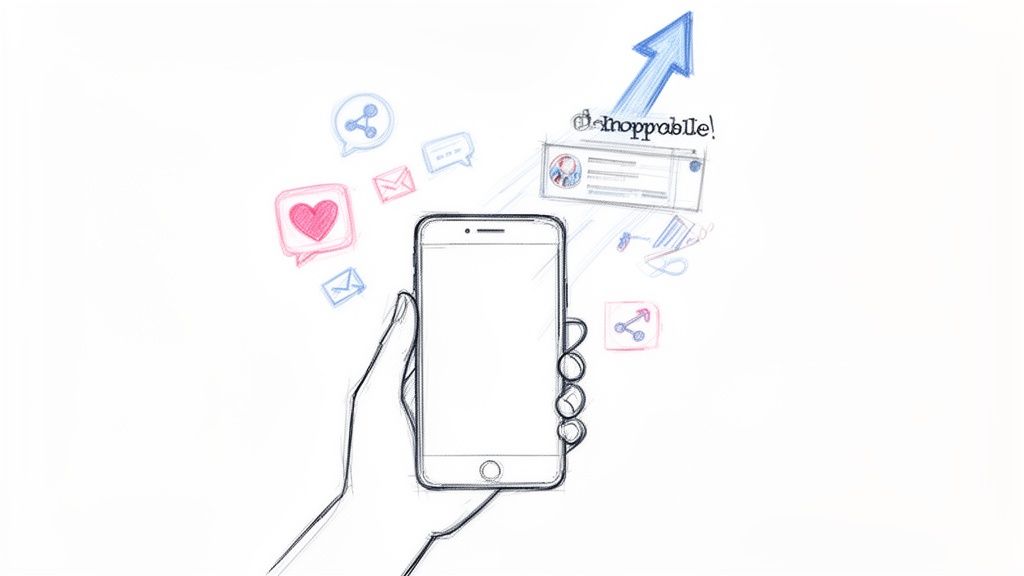
A modern social strategy integrates native shopping features, like TikTok Shop and Instagram Shopping, directly into the user experience. This frictionless path from discovery to checkout significantly shortens the sales cycle. For example, brands like Glossier have built empires not just on products, but on community-driven user-generated content, making every customer a potential micro-influencer and advocate for the brand.
To better understand the latest trends, you can explore more on the future of influencer and video marketing. By focusing on authentic partnerships and data-driven amplification, you can transform social channels into powerful revenue drivers.
Search Engine Optimization (SEO) is a long-term e-commerce marketing strategy focused on increasing organic visibility in search engine results. By optimizing your site’s structure, content, and authority, you can attract high-intent traffic without paying for every click. This is accomplished through content marketing, which builds trust and authority by creating valuable resources like blog posts, buying guides, and comparison articles that answer your customers’ key questions.
Unlike paid ads that stop delivering traffic when you stop paying, a strong SEO and content foundation becomes a durable asset that generates compounding returns. Brands like Backlinko and Shopify have built empires by creating exceptional resource hubs that rank for thousands of keywords, establishing themselves as the definitive authority in their niche. This approach directly captures users actively searching for solutions your products provide.
For a masterclass in creating content that ranks and converts, explore Neil Patel's blog on content strategy. By investing in SEO, you build a sustainable traffic engine that reduces customer acquisition costs over time.
Paid advertising is an essential e-commerce marketing strategy that provides immediate visibility and drives high-intent traffic to your store. This approach includes pay-per-click (PPC) ads on platforms like Google Shopping and display ads across social media and the web. Unlike organic methods that take time to build momentum, paid ads allow you to reach targeted customers actively searching for your products right now, making it a powerful tool for direct-response revenue generation.
Platforms like Google Ads and Meta for Business offer sophisticated targeting capabilities, allowing you to control budgets precisely and reach specific audience segments. For instance, Facebook's Dynamic Product Ads can automatically show products to people who have expressed interest on your website, a highly effective form of retargeting. This direct control over who sees your ads and when makes paid advertising a cornerstone for scaling e-commerce sales quickly.
Customer loyalty programs are a cornerstone e-commerce marketing strategy for driving retention and increasing customer lifetime value (LTV). By rewarding repeat business, these programs shift focus from expensive one-time acquisitions to building a profitable, long-term relationship. This approach fosters an emotional connection with your brand, turning satisfied buyers into vocal advocates.
Unlike transactional discounts, a well-designed loyalty program creates a value loop that incentivizes higher average order values and purchase frequency. Platforms like Smile.io or LoyaltyLion integrate seamlessly with Shopify and Klaviyo, allowing you to reward points for purchases, social follows, and referrals. This transforms the customer journey into a gamified experience, encouraging deeper brand engagement beyond the initial sale.
By investing in a loyalty program, you build a defensive moat around your customer base, making them less susceptible to competitor offers. To learn more about building a program that drives repeat revenue, you can explore loyalty marketing strategies.
Video marketing is an indispensable e-commerce marketing strategy that harnesses the power of visual storytelling to showcase products, forge emotional connections, and significantly boost conversions. This approach moves beyond static images to dynamic content, while live shopping events create real-time, interactive experiences that merge entertainment with instant purchasing, similar to QVC for the digital age. This strategy combats passive browsing by creating an engaging, must-see event.
Unlike pre-recorded ads, live shopping on platforms like TikTok Shop and Instagram Live builds a powerful sense of community and urgency. Viewers can ask questions and see products demonstrated in real-time, which removes purchase friction and builds immense trust. For Shopify merchants, apps like Livescale and Channelize.io can integrate this functionality directly into their storefront, creating a seamless brand-owned experience.
By integrating video, you can dramatically improve product understanding and customer confidence. To see how top brands are leveraging this, you can explore examples of successful live shopping streams.
Personalization is an advanced e-commerce marketing strategy that tailors the shopping experience to individual users based on their data, behavior, and preferences. It moves beyond a one-size-fits-all approach by using dynamic content to automatically adjust product recommendations, offers, and messaging. This creates a highly relevant and engaging journey, directly boosting conversion rates and average order value.
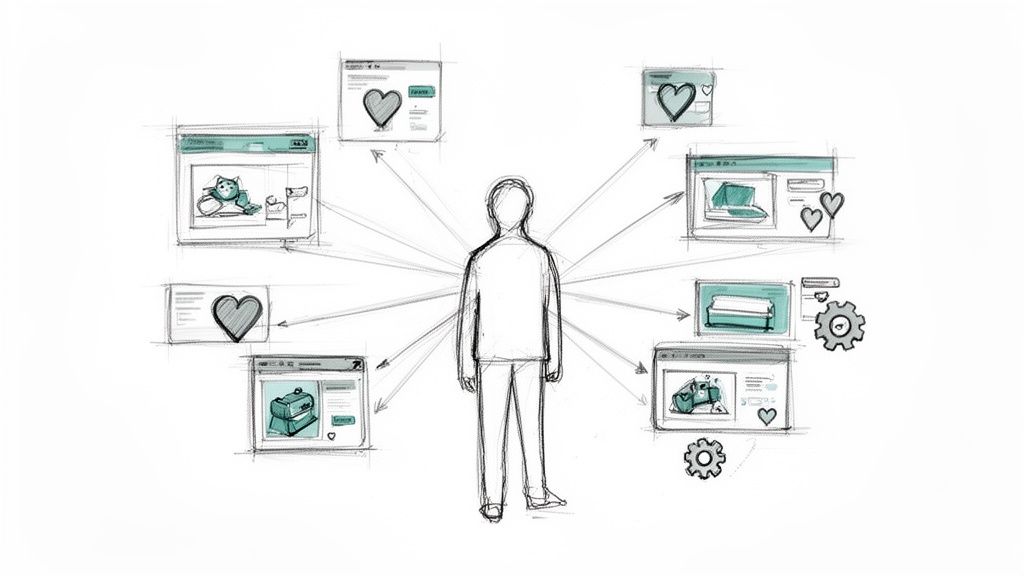
Pioneered by giants like Amazon and Netflix, this strategy is now accessible to Shopify stores through powerful apps and platforms. By analyzing customer data, you can present a shopper in a cold climate with winter apparel, while a user in a warmer region sees summer collections. This level of relevance not only increases immediate sales but also fosters long-term customer loyalty by making shoppers feel understood.
By transforming your storefront into a unique experience for each visitor, you can create a powerful competitive advantage. To learn more about advanced segmentation, explore Dynamic Yield's resources on the topic.
Conversion Rate Optimization (CRO) is one of the most vital e-commerce marketing strategies for maximizing revenue from your existing traffic. It's the systematic process of improving the percentage of visitors who complete a desired action, such as making a purchase. This data-driven approach uses A/B testing, user feedback, and analytics to remove friction points from the customer journey, turning more browsers into buyers and boosting profitability without increasing ad spend.
A crucial aspect of maximizing your e-commerce success is Conversion Rate Optimization (CRO); understanding how to improve website conversion rates is key to turning visitors into customers. Unlike simply driving more traffic, CRO focuses on making every visit more valuable. Small, incremental improvements to elements like your product page layout or checkout process can compound into significant, long-term revenue growth. Platforms like VWO and Optimizely have pioneered this field, enabling brands to test hypotheses scientifically.
Referral marketing is an e-commerce marketing strategy that turns your best customers into powerful brand advocates. It leverages the psychology of social proof and trust by incentivizing existing buyers to recommend your products to their network. This word-of-mouth engine significantly lowers customer acquisition costs (CAC) compared to paid ads, as recommendations from friends are inherently more credible and convert at a higher rate. It builds a sustainable, authentic growth loop fueled by genuine customer satisfaction.
Unlike broad advertising, referral and affiliate programs are performance-based, ensuring you only pay for actual results. Platforms like ReferralCandy or Ambassador automate the entire process, from generating unique referral links to tracking sales and issuing rewards. This strategy transforms loyal customers and strategic partners into a scalable, commission-based sales force, driving high-quality traffic with a strong intent to purchase.
Marketing automation is a cornerstone e-commerce marketing strategy that uses software to execute repetitive tasks and nurture leads. By visually mapping the customer journey from first touch to repeat purchase, you can automate personalized communications at key moments, creating a seamless experience that guides users toward conversion without manual intervention. This approach directly boosts customer lifetime value and frees up resources for strategic growth.
Platforms like Klaviyo and HubSpot have moved beyond simple email sequences. Today’s automation leverages deep integration with your e-commerce platform, like Shopify, to trigger workflows based on real-time behavioral data. For instance, a customer viewing a specific product category three times can automatically receive a targeted email with related items, transforming passive browsing into an active sales opportunity.
Effective automation isn't just about sending emails; it's about delivering value at every stage. For a deeper look at creating these workflows, explore how Klaviyo enables automated customer experiences.
Community building is an e-commerce marketing strategy focused on creating an engaged ecosystem around your brand. It moves beyond transactional relationships to foster authentic connections between customers, turning them into a loyal tribe. By facilitating peer-to-peer interaction in spaces like Discord servers or Facebook Groups, you create a powerful engine for word-of-mouth marketing, valuable user-generated content, and long-term brand advocacy. This transforms one-time buyers into lifelong evangelists.
This approach taps into the psychological need for belonging, making customers feel like insiders and co-creators of the brand. Companies like Glossier and Lego have built empires by treating their community as a core part of their product development and marketing. This strategy generates a self-sustaining marketing flywheel, reducing reliance on paid acquisition and significantly increasing customer lifetime value.
| Strategy | Implementation complexity | Resource requirements | Expected outcomes | Ideal use cases | Key advantages |
|---|---|---|---|---|---|
| Urgency Marketing & Scarcity Tactics | Low–Medium (timers, inventory hooks) | Moderate (timers, UI, inventory sync) | Immediate conversion spikes; reduced cart abandonment | Flash sales, clearance, limited-stock promotions | Rapid conversion lift via FOMO |
| Email Marketing & Abandoned Cart Recovery | Medium (segmentation, automation) | Moderate (ESP, content, analytics) | Recovered lost sales; high ROI and repeat purchases | Cart recovery, retention campaigns, lifecycle marketing | Direct, measurable channel with strong personalization |
| Social Media Marketing & Influencer Partnerships | Medium–High (content + partnership management) | High (creative, ad spend, influencer fees) | Increased brand awareness, engagement, referral traffic | New product launches, lifestyle/visual brands, awareness drives | Authentic reach and social proof; community building |
| SEO & Content Marketing | Medium–High (technical + content effort) | Moderate–High (writers, SEO tools, time) | Sustainable organic traffic and brand authority (long term) | Evergreen products, educational buying cycles, content-led growth | Cost-effective long-term traffic and credibility |
| Paid Advertising (PPC & Display Ads) | Medium (campaign setup and optimization) | High (ad budgets, tracking, creative) | Immediate visibility and scalable traffic; measurable ROAS | Product launches, performance campaigns, high-intent keywords | Fast, targetable, and highly measurable acquisition |
| Customer Loyalty Programs & Rewards | Medium (program design and ops) | Moderate (platform, reward budget, CRM) | Higher customer lifetime value and repeat purchases | Subscription, repeat-purchase categories, retention focus | Increases retention and customer value over time |
| Video Marketing & Live Shopping | High (production and live operations) | High (production, talent, streaming tech) | Strong engagement; demo-driven conversions; reduced returns | Product demos, launches, influencer-led sales, live events | Visual persuasion and real-time purchase opportunities |
| Personalization & Dynamic Content | High (data, algorithms, integrations) | High (CDP, AI, engineering) | Higher conversion rates and average order value | Large catalogs, returning customers, data-rich sites | Relevance at scale; personalized shopping experiences |
| Conversion Rate Optimization (CRO) | Medium–High (testing infrastructure) | Moderate (A/B tools, analytics, UX resources) | Incremental revenue gains without higher acquisition cost | High-traffic pages, checkout funnels, landing pages | Data-driven improvements that compound across funnel |
| Referral Marketing & Affiliate Programs | Medium (tracking & partner management) | Moderate (affiliate platform, commissions) | Low-cost customer acquisition; referral-driven growth | Viral products, network effects, growth-stage acquisition | Performance-based, trust-driven customer acquisition |
| Marketing Automation & Customer Journey Mapping | Medium–High (setup and integrations) | Moderate–High (automation tools, data integration) | Streamlined nurture flows; improved conversion efficiency | Multi-touch sales cycles, lifecycle campaigns, B2C e-commerce | Scales timely, personalized communications and saves ops time |
| Community Building & Brand Advocacy | Medium (ongoing management) | Moderate (community managers, platform, events) | Long-term loyalty, UGC, organic referrals and feedback | Niche/lifestyle brands, high-engagement products, advocacy programs | Authentic advocacy, sustained engagement, product insights |
Navigating the landscape of e-commerce marketing strategies can feel overwhelming, but it's crucial to remember that these are not isolated tactics. The true power lies in creating an interconnected, customer-centric system where each element amplifies the others. You’ve seen how sophisticated urgency marketing, powered by behavioral psychology, can ethically drive demand, and how automated email flows can recover nearly-lost revenue. You've explored the long-term value of organic growth through SEO and the immediate impact of targeted paid advertising.
The key is to move from theory to implementation. Instead of trying to master all twelve strategies at once, focus on a disciplined, phased approach. Identify the one or two areas that address your most significant bottlenecks right now. Is your cart abandonment rate alarmingly high? Prioritize a robust abandoned cart sequence integrated with dynamic content. Are you struggling to stand out in a crowded market? A powerful community-building and brand advocacy program could be your differentiator.
To transform this knowledge into tangible results, start with a simple audit.
Mastering these e-commerce marketing strategies is not just about increasing sales; it's about building a resilient, profitable business that can adapt and thrive. By moving beyond basic timers and pop-ups to sophisticated, psychology-backed automation, you create a shopping experience that feels dynamic, relevant, and compelling. This strategic focus is what separates fleeting success from enduring brand loyalty and sustainable revenue growth.
Ready to elevate your urgency marketing beyond simple countdowns? See how Quikly uses behavioral science to create sophisticated, revenue-generating 'Moments' that integrate seamlessly with your Shopify store and email platforms. Explore the next generation of e-commerce marketing strategies at Quikly and start turning shopper psychology into predictable profit.