

ecommerce psychology
brand loyalty
best brand experiences
Have you ever heard of captive product pricing? It's a powerful strategy where a core product is sold at an attractive, low price, while the essential, proprietary add-ons needed for it to function are priced at a premium. The real revenue isn't generated from that initial sale; it's captured over time through repeat purchases of those "captive" items.
This approach fundamentally shifts the business focus from a one-off transaction to cultivating long-term customer relationships and maximizing lifetime value.
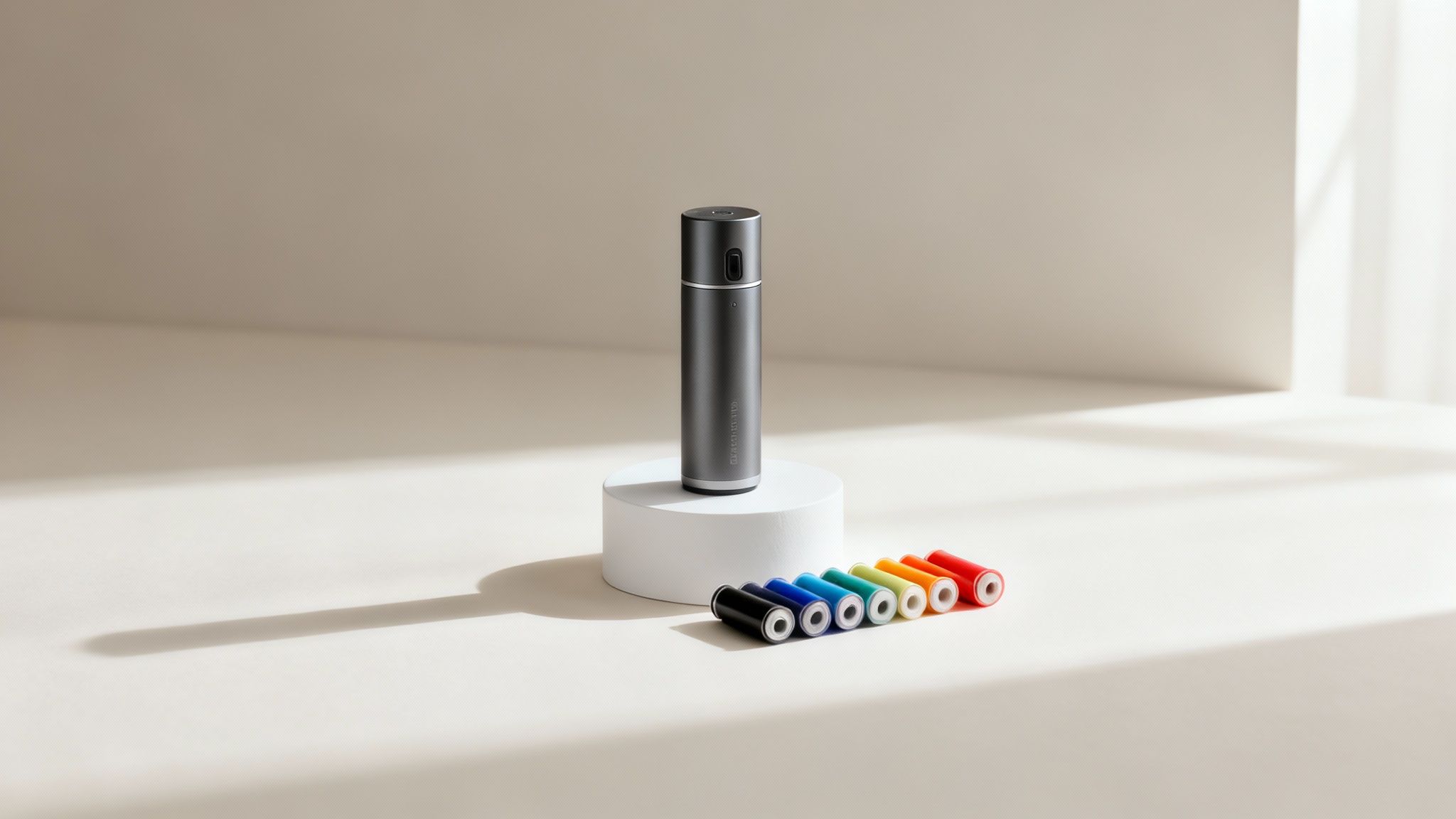
At its heart, this pricing strategy is about creating a profitable ecosystem around your customer. The initial, low-cost product acts as a hook, dramatically lowering the barrier to entry and locking customers into your brand's technology. Once they've made that initial investment, they are compelled to return for the proprietary captive products to continue using their original purchase.
The most famous example is the razor-and-blades model. A high-tech razor handle might be sold for a surprisingly low price, sometimes even at a loss. The manufacturer understands that the true profit engine is the steady stream of high-margin, proprietary replacement blades customers will need to purchase for years.
This flips the traditional business dynamic. Instead of maximizing profit on a single sale, the primary goal is to maximize customer lifetime value (CLV). A lower upfront cost attracts a broader audience, which then becomes a source of predictable, recurring revenue, boosting ROI and protecting long-term profit margins.
Successful implementation requires a clear understanding of the two distinct product components.
The model's power is rooted in behavioral economics. Once a consumer commits to the core product, the path of least resistance is to continue purchasing compatible components from the original brand. This creates a highly reliable and sustainable business model.
This isn't just a pricing tactic; it's a strategic framework for building a more resilient business. While a single-sale model requires a constant, expensive hunt for new customers, the captive model focuses on cultivating a loyal base that provides a steady, forecastable income.
This predictability simplifies business operations—from inventory management and financial forecasting to building deeper customer relationships. For Shopify merchants, it's a powerful way to shift the competitive focus from a single product's price to the value of a complete brand ecosystem.
To see how far pricing strategies have come, it’s worth checking out this strategic guide to AI in ecommerce pricing.

The true efficacy of captive product pricing isn't found on a spreadsheet; it's rooted in predictable consumer psychology. The strategy taps into powerful cognitive biases, creating a natural cycle of repeat purchases that can form the backbone of your long-term revenue and profitability.
At its foundation, this model leverages commitment bias. Once a shopper invests time, effort, and money into choosing your core product—like a specific coffee machine—they've made a psychological commitment. This initial decision makes them significantly more likely to stick with your brand for subsequent purchases.
From the consumer's perspective, after researching and purchasing a Keurig, buying K-Cup pods feels like the next logical step, not an entirely new decision. The commitment to the core device creates a powerful pull towards the captive products that make it work, turning repeat purchases into the path of least resistance.
A primary driver behind this behavior is the sunk cost fallacy, a well-documented principle in behavioral economics. This cognitive bias describes our tendency to continue an endeavor once an investment in money, effort, or time has been made.
In an e-commerce context, the price paid for the core product represents the sunk cost. Having already invested in the "razor handle," customers feel an internal pressure to "get their money's worth" by continuing to buy the "blades." To switch to a competitor would feel like admitting the initial purchase was a mistake—a negative feeling most people are psychologically wired to avoid.
This isn't about manipulation; it's about understanding the shopper's journey. The low initial price creates the perception of a smart investment. Subsequent higher-margin purchases feel like a natural continuation of that good decision, reinforcing their initial choice.
This psychological dynamic is what transforms a one-time buyer into a recurring revenue stream. The customer’s internal dialogue shifts from, "Should I buy this?" to, "I already own the device, so I need to buy the refill."
Another key psychological element is choice architecture—designing the shopping experience to make the desired decision the easiest one. By creating a closed ecosystem, you simplify the customer's decision-making process in a way that directly benefits your bottom line.
Here’s how it works:
By mastering these psychological drivers, you can implement a captive pricing model that does more than sell products. You build a customer journey that fosters loyalty, encourages repeat business, and drives customer lifetime value.
To dig deeper, you can learn more about the role of consumer psychology in marketing and how it shapes consumer behavior.
To fully grasp why captive product pricing is such a business powerhouse, we must look beyond theory to see how iconic brands have built empires on this model. This isn't just a strategy for global corporations; these examples offer a clear blueprint for Shopify stores aiming to build predictable, long-term revenue and protect profit margins.
The financial model is a game of two halves. First, the low-margin, high-appeal "core" product acquires customers and locks them into your ecosystem. Then, the high-margin, recurring-revenue "captive" product becomes the engine of profitability. Let's analyze the classics.
This is the quintessential example of captive pricing, a strategy so famous it has become synonymous with the concept. Brands like Gillette will often sell advanced razor handles at or near cost, sometimes even taking a loss. The initial purchase is an easy "yes" for the shopper.
The significant ROI is generated from the proprietary, high-margin replacement blade cartridges. Once a customer owns the handle, they are "captive"—they can only purchase compatible blades. A single transaction blossoms into a steady revenue stream, dramatically increasing customer lifetime value (CLV). It’s a masterclass in shifting from a focus on one-time profit to reliable, long-term income.
The tech industry has leveraged this model for decades, with the home printer as a prime example. Consumers can often find a sophisticated, all-in-one printer for a remarkably low price. The hardware is positioned as an easy investment for home offices and small businesses.
However, printer manufacturers recoup those low margins—and generate substantial profit—on the proprietary ink or toner cartridges. These are the consumables required to operate the machine, and they carry a massive profit margin. The printer is merely the platform; the recurring ink purchase is the cash cow that locks the customer into their ecosystem for years.
For a modern twist, look at the video game industry. Consoles like the Xbox are often sold at razor-thin margins, sometimes at a loss. The goal isn't to profit from the hardware but to establish a presence in as many households as possible. The real revenue comes from the ecosystem built around it.
This includes high-margin video games, online subscription services, and accessories like controllers. An Xbox console bundle perfectly illustrates this. The console might be $499, but a new game and an extra controller can easily add another $160. These bundles often include a small discount, making the ecosystem even more appealing while guaranteeing future high-margin purchases. You can dive deeper into the financials behind these popular pricing strategies.
You don't need a global supply chain to execute this strategy. These examples provide a clear roadmap for Shopify merchants. The key is to identify a core product in your niche and a necessary, consumable accessory that pairs with it.
The strategy is effective because it aligns with consumer psychology. The low-cost initial purchase feels like a victory for the shopper. Each subsequent purchase feels less like a new decision and more like simple maintenance of a smart investment.
Actionable Takeaway: How could this look for your Shopify store?
By implementing this model, you can move away from the constant chase for one-off sales. Instead, you can focus on building a loyal customer base that delivers a predictable, sustainable, and highly profitable revenue stream.
Translating the concept of captive product pricing into a functional strategy on your Shopify store is highly achievable. It’s not just for industry giants. With the right Shopify apps and strategic planning, you can build a profitable ecosystem that drives recurring revenue.
The objective is to create a customer journey so seamless that purchasing the captive product feels like the most logical and obvious next step. Here are three powerful, actionable methods you can implement today.
When mapped out, the customer's decision-making process in a captive model is straightforward:
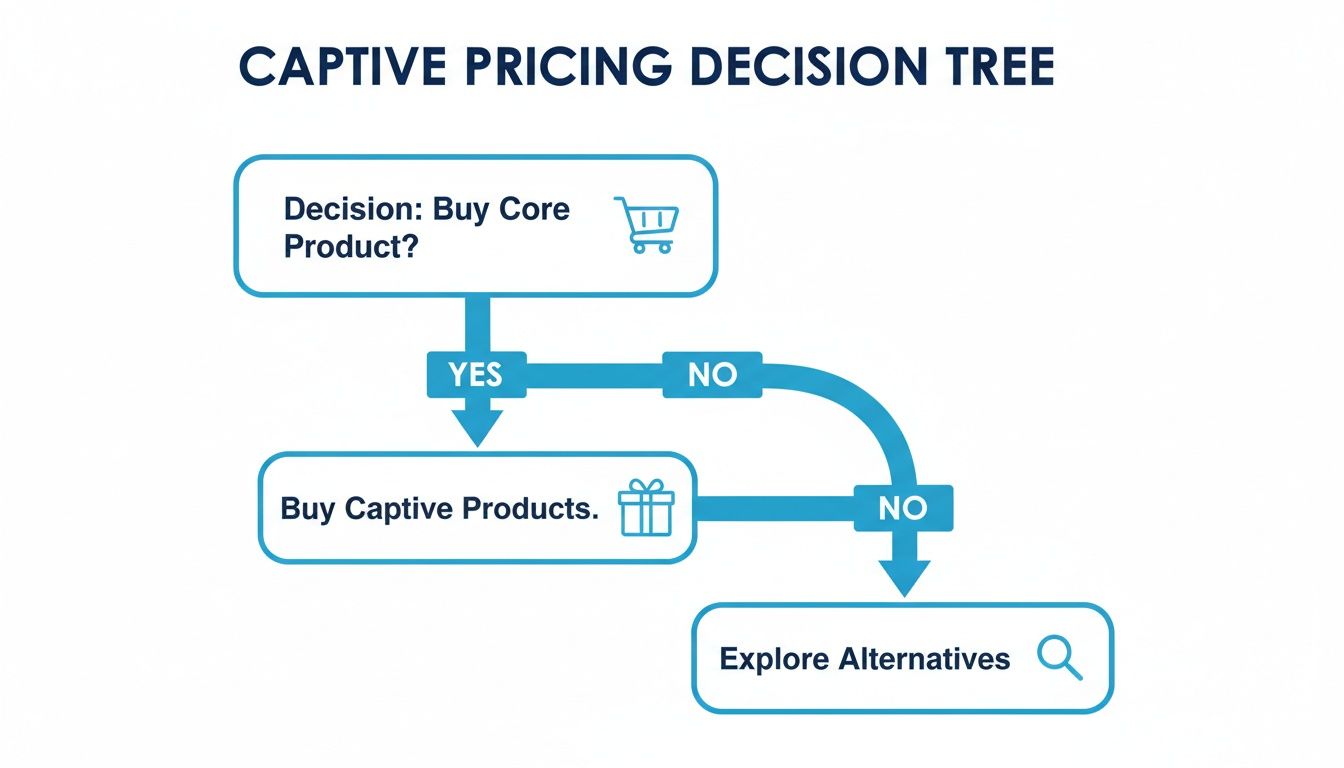
As you can see, the path of least resistance guides the customer from the core product directly to your high-margin consumables.
The most accessible entry point into captive pricing on Shopify is through product bundling. Instead of hoping customers will find the necessary accessories, you package the core product with its essential add-ons directly on the product page. This approach reduces friction for the shopper and immediately boosts your Average Order Value (AOV).
For a Shopify Plus merchant selling a high-end espresso machine (the core product), a starter bundle could include the machine plus a pack of proprietary coffee pods (the captive product). This single purchase initiates the customer into the brand's ecosystem.
Actionable Takeaway: Use a Shopify bundling app to:
To explore options, it’s worth reviewing a curated list of the best Shopify apps to increase sales, as many are designed for bundling and upselling.
For a more direct approach, you can implement a "forced add-on" or "required product." This works best when the core product genuinely cannot function without the captive item. Using certain Shopify apps, you can configure your store so a customer cannot add the core product to their cart without also adding the specified captive product.
Consider a specialized skincare device sold at a compelling price, but it requires a unique "activator serum" to function. With this method, when a shopper clicks "Add to Cart" on the device, the serum is automatically added as well.
This tactic solidifies the relationship between your core and captive items from day one. It frames the captive product as an essential, non-negotiable part of the experience, setting the stage for all future refill orders.
It's a decisive move that guarantees the first high-margin sale and ensures the customer begins their journey within your ecosystem.
The ultimate goal of captive pricing is to build a recurring revenue stream. Subscription upsells are the most powerful way to achieve this on Shopify. This strategy involves offering customers a significant discount on the core product, but only if they agree to subscribe to regular shipments of the captive product.
Here’s how you can position this on a product page:
The psychology here is potent. The large upfront savings makes the subscription feel like an intelligent financial choice. You're not just making a single sale; you are securing a long-term customer and predictable revenue, which drastically increases your CLV. This requires a robust subscription management app that integrates seamlessly with Shopify's checkout and tools like Klaviyo for retention marketing.
To help you decide which approach fits your store, here's a quick comparison.
| Method | Description | Best For | Required Shopify Apps |
|---|---|---|---|
| Product Bundles | Pairing the core product with its captive consumables in a single offering or suggestion. | Increasing initial AOV and introducing customers to the ecosystem without being too aggressive. | Product bundle apps, "Frequently Bought Together" apps (e.g., Bundler, Rebuy). |
| Forced Add-Ons | Requiring a captive product to be added to the cart along with the core product. | Products that are truly non-functional without the captive item; guarantees the first captive sale. | Apps with "required product" or forced add-on functionality (e.g., Bold Product Options). |
| Subscription Upsells | Offering a large discount on the core product in exchange for a subscription to the captive product. | Maximizing Customer Lifetime Value and building a predictable, recurring revenue stream. | Robust subscription management apps (e.g., Recharge, Skio, Bold Subscriptions). |
Each method represents a different level of commitment, so choose the one that aligns with your products and business goals.
No matter which strategy you select, a seamless checkout is critical. For a deeper dive, review this guide on optimizing e-commerce payment solutions. A smooth payment experience is the final step in converting these smart pricing strategies into sustained revenue.
Once your captive product pricing model is in place, urgency marketing acts as the accelerator. It transforms a solid strategy into a high-performance revenue engine. By applying psychological triggers, you can compel customers to act at every stage—from the initial core product purchase to subsequent refills. Instead of passively waiting for orders, you provide compelling reasons to buy now.
The true impact comes from moving beyond basic countdown timers, which consumers often ignore and can erode trust. Sophisticated urgency marketing, the kind Quikly champions, is rooted in behavioral science. It leverages scarcity, anticipation, and the Fear of Missing Out (FOMO) to create authentic, high-impact marketing "Moments" that align perfectly with your captive pricing goals and drive immediate ROI.
The first major challenge in any captive model is getting the core product into the hands of as many customers as possible. A limited-time "drop" or a tiered offer can generate a massive surge of initial sales that a standard launch cannot match. By framing the purchase as a rare opportunity, you tap into the psychological principle of scarcity, which increases the perceived value of an item simply because it is exclusive.
Actionable Takeaway: Launch your core product with a tiered offer:
This structure creates friendly competition, motivating shoppers to purchase quickly to secure the best deal. It’s a highly effective way to kickstart your ecosystem and build a loyal customer base from day one. For more ideas, explore these 10 urgency marketing tactics that can spark immediate action.
Urgency is not just for customer acquisition. It is a powerful tool for increasing the purchase frequency of your high-margin captive products. By targeting existing customers with exclusive, time-sensitive promotions, you can drive significant immediate revenue and manage inventory effectively.
Imagine sending a targeted email or SMS to customers who haven't purchased refills in 60 days. The message announces a 24-hour flash sale on their specific consumable, offering a compelling discount. This is far more effective than a generic newsletter because it’s personal, timely, and has a firm deadline. It moves beyond basic pop-ups focused on email capture to become a direct revenue-generation tool.
A well-executed urgency campaign transforms marketing from a passive announcement into an active, revenue-generating event. Quikly helps orchestrate these Moments, shifting the shopper's mindset from "I'll buy it later" to "I need to get this now." This is what separates high-growth brands.
The captive product strategy is gaining significant momentum. The related captive portal market is projected to grow from USD 1.15 billion to USD 2.20 billion between 2025 and 2030, a compound annual growth rate of 13.9%. This trend highlights the increasing reliance on ecosystem-based models, making the tools that support them more critical than ever. You can read the full research on these market drivers.
By pairing the long-term, sustainable model of captive pricing with the immediate ROI of sophisticated urgency marketing, Shopify merchants can build a formidable business. You not only secure predictable recurring revenue but also gain the ability to inject sales velocity precisely when needed.
Launching a captive product pricing model is the beginning, not the end. Continuous monitoring is essential to ensure the strategy is profitable and maintains customer satisfaction.
A successful model is not just about the initial sale; it's about building an ecosystem where customers choose to stay. This requires looking beyond surface-level metrics like conversion rates and digging into the data that reveals the true health of your strategy—the numbers that indicate whether you're building a loyal following or experiencing high churn.
The data that matters most shifts from single transactions to the entire customer journey. Your Shopify dashboard, combined with analytics tools, provides the necessary insights.
The single greatest risk with captive pricing is creating customer resentment. If customers feel they are being exploited with overpriced refills, this negative sentiment can damage your brand's reputation and lead them to seek alternatives.
Success lies in finding the balance between profitability and perceived fairness. The price of the captive product must feel justified by its quality, convenience, and performance—not like a penalty for buying the core item.
Another common mistake is a lack of transparency. Be upfront about ongoing costs. Clearly displaying the price of refills on the core product's page builds trust and prevents the negative surprise that leads to poor reviews and increased customer service demands.
This ecosystem-based strategy is becoming increasingly prevalent. The captive portal market (e.g., paid hotel Wi-Fi) was valued at USD 1.95 billion in 2024 and is projected to reach USD 6.20 billion by 2033. This massive growth underscores how critical these models are for maximizing customer value. You can learn more about this growing market on grandviewresearch.com.
By focusing on long-term value and maintaining transparency, you can build a captive pricing strategy that creates a loyal, profitable community instead of a revolving door of frustrated buyers.
Adopting a new pricing strategy naturally raises questions. This is a positive sign—it means you're critically evaluating what is best for your business. Let's address some of the most common inquiries from Shopify merchants about captive product pricing.
Absolutely. When executed with transparency, captive product pricing is a completely legal and widely accepted business strategy used by many leading global brands.
The ethical consideration hinges on transparency. Issues arise when a brand attempts to obscure long-term costs or prices captive products so high that customers feel exploited. By being upfront about the total cost of ownership, you build trust rather than break it.
This is a frequent point of confusion, but the distinction is critical. A loss leader is any product sold at a loss to attract customers into a store, with the hope they will purchase other, more profitable items. Think of a grocery store selling milk for $1; they are banking on you also buying cereal, bread, and other high-margin products.
Captive pricing is far more direct and strategic. The low-cost "core" product is functionally dependent on a required, high-margin "captive" product. The razor handle is useless without the blades specifically designed for it. This creates a built-in, recurring revenue stream, not just a hope for adjacent purchases.
Finding the optimal price point is a blend of art and science, but it revolves around balancing three key factors: your total product costs, your competitors' pricing for similar systems, and your target customer lifetime value (CLV).
Your core product must be priced to overcome initial purchase hesitation—low enough to be an easy "yes." Meanwhile, your captive product must carry the financial weight, with a price that covers the initial discount on the core item and generates a healthy profit over the customer's lifecycle. It is a continuous balancing act between winning the customer today and maximizing their long-term value.
Ready to supercharge your pricing strategy with authentic urgency? Quikly is the expert in urgency marketing science, helping Shopify merchants enhance banners, pop-ups, and the entire shopper's journey. We turn captive product launches and refill campaigns into high-ROI events that build loyalty and drive immediate sales. Learn how Quikly can transform your marketing efforts today.