

ecommerce psychology
brand loyalty
best brand experiences
To drive sustainable growth for an e-commerce brand, you must first understand the psychology of your customers. The buyer decision making process isn't just a marketing theory; it's the real-world, five-stage journey every person takes before clicking "buy." It begins the moment they recognize a need and continues long after the package arrives.
For online brands, mapping this psychological path is how you increase revenue, protect profit margins, and turn a one-time browser into a loyal advocate. It’s not about a single sale—it's about mastering the entire customer story.
The modern path to purchase is not a straight line. Consumers don't move neatly from one step to the next. Think of it less like a funnel and more like a winding road, with consumer psychology in the driver's seat. By navigating its twists and turns, you’ll unlock consistent revenue growth and genuine brand loyalty.
The buyer decision making process is the series of steps a consumer goes through when making a purchase. It typically includes five stages: need recognition, information search, evaluation of alternatives, purchase decision, and post-purchase behavior.
This map helps visualize the journey not as a finish line, but as a continuous loop.
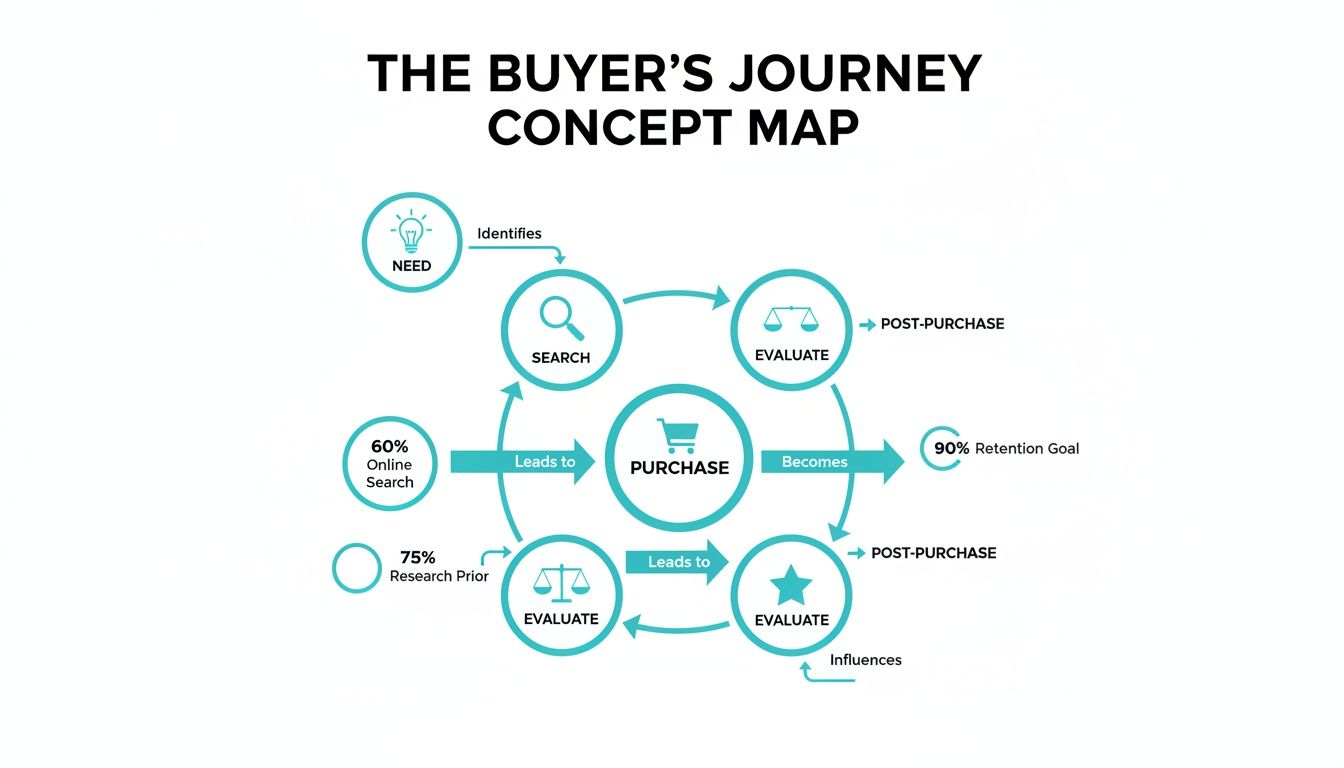
As you can see, what happens after the sale directly feeds back into the beginning. A great experience plants the seed for the next purchase and builds powerful loyalty.
For a quick overview, this table breaks down what’s happening in your customer’s mind at each point and what your main business objective should be.
| Stage | Customer's Primary Question | E-commerce Marketing Objective |
|---|---|---|
| Need Recognition | "I have a problem/desire. How can I solve it?" | Create awareness and connect their need to your solution. |
| Information Search | "What are my options out there?" | Be discoverable and provide helpful, educational content. |
| Evaluation | "Which of these options is the best for me?" | Differentiate your brand and build trust with social proof. |
| Purchase | "Is this the right time and place to buy?" | Remove friction, create urgency, and make checkout seamless. |
| Post-Purchase | "Did I make the right choice?" | Reassure, delight, and build a long-term relationship. |
Understanding these individual moments is the first step. The next is influencing them.
In today's crowded market, a good product isn't enough to win. The real competitive advantage lies in creating a superior experience at every touchpoint. When you understand how your customers think, you can anticipate their needs, eliminate friction, and build genuine trust.
This is where sophisticated, psychology-driven urgency marketing comes in.
By strategically using psychological principles like scarcity, social proof, and anticipation, you can ethically guide customers through their decision-making process. This is not about manipulation; it's about aligning your marketing with established behavioral economics. Your brand simply becomes the most natural and obvious choice.
This entire journey mirrors the path through the marketing funnel, from awareness to advocacy. By matching specific urgency tactics to each stage, you create a powerful system that drives revenue and builds a community around your brand.
As we go, we'll break down the exact strategies you can use to optimize every stage. You can also get a broader overview by checking out these 5 stages of the consumer journey.
The image of a customer leisurely strolling through a digital marketplace is outdated. Today, the buyer's journey kicks off at lightning speed. The first two stages, Need Recognition and Information Search, are practically fused. The second a customer feels a need, their phone is in hand, and the hunt for a solution is on.
This fusion creates a critical, make-or-break window for your brand to appear. If you're not there the instant that search begins, you’re invisible for the rest of their journey. Your objective is to become the definitive source of information, steering their path from the very beginning.
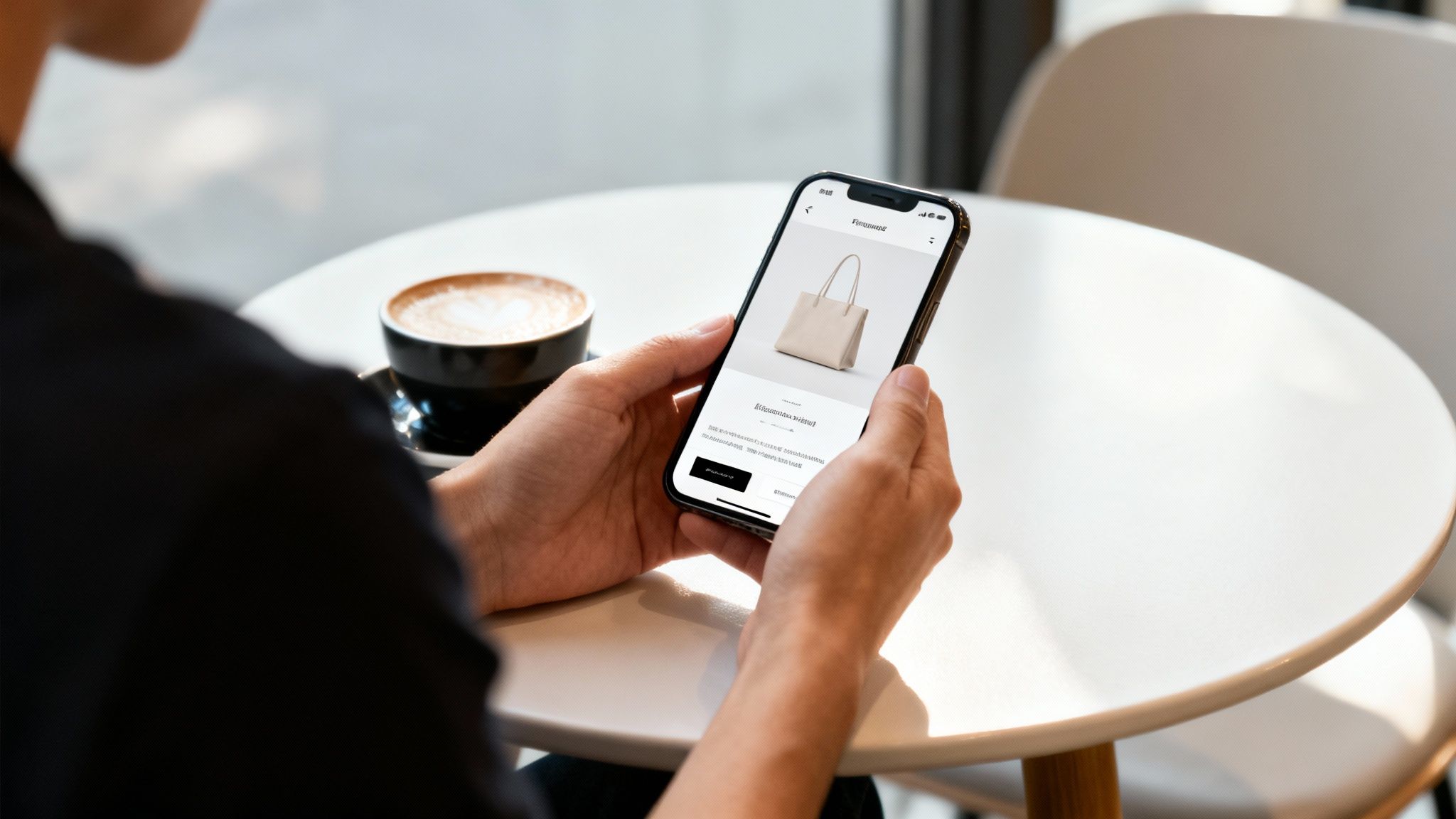
At its core, need recognition is simple psychology. It’s the gap between a customer's current state and their desired state. This could be as simple as running out of coffee or as significant as deciding to live a healthier lifestyle. The Information Search that immediately follows is their attempt to close that gap.
For Shopify merchants, this means your SEO, content, and ads must be perfectly synchronized to answer the exact questions your ideal customers are typing into Google. Think less about selling a product and more about solving their immediate problem.
While competitors focus on showing up during the search, leading brands create the need themselves by tapping into a powerful psychological trigger: anticipation. Instead of waiting for customers to come looking, you give them something to look forward to.
By announcing a future limited-edition drop or an exclusive one-day sale, you plant a seed of desire. This tactic, grounded in consumer psychology, shifts a shopper's mindset from "I need to solve a problem" to "I need to get that specific product before it's gone." This is the science of urgency marketing, expertly applied at the top of the funnel.
This is where Quikly’s sophisticated “Moments” change the game. Unlike a basic countdown timer that only appears once a user is on your site, Quikly allows you to build buzz before the sale even starts. Announce a product drop through integrations with Klaviyo and other platforms, prompting users to opt-in for a chance to be first in line.
This strategy achieves several critical business goals at once:
Today's shoppers are self-directed researchers. This is especially true in B2B, where buyers conduct extensive research before engaging with sales. That same self-serve mentality is now dominant in e-commerce, which means your Shopify store must become a go-to research hub. This involves creating a content ecosystem that addresses every potential customer question, which is how you start earning the attention of distracted consumers.
This is the make-or-break moment. The evaluation stage is where a shopper decides if your brand is the choice or just another tab to close. They’ve done their research and are now comparing your products against the competition, weighing everything from price and features to brand trust.
To stand out, you need to move beyond basic tactics. This requires strategic urgency that makes your offer undeniable.
Forget simple countdown timers that savvy shoppers ignore. We're talking about advanced, behavior-driven urgency that your competitors can't easily replicate. It’s the difference between a generic "10% off" pop-up designed for email capture and a dynamic, multi-tiered offer that generates immediate revenue.

Your shoppers are running a complex mental calculation to determine who offers the most value. Price is a huge part of that equation. Recent consumer research shows that a staggering 79% of consumers are ‘trading down’ to cheaper options, and over half are actively hunting for deals on every purchase.
This price-conscious environment pressures brands to differentiate while protecting profit margins. Exploring product differentiation examples is a great start, but you need another tool.
This is where the psychology of scarcity and social proof becomes your strategic advantage. Instead of offering a flat discount, an advanced urgency platform lets you build layered incentives that reward the fastest movers while protecting your margins.
Imagine launching a ranked offer like this:
This approach, rooted in behavioral economics, turns a simple transaction into a competitive event. Your offer feels far more valuable and urgent than a competitor's static discount.
A tiered strategy has a direct, positive impact on your ROI. Basic pop-up apps that offer a single discount to capture an email often erode margins without guaranteeing a sale.
In contrast, a sophisticated platform like Quikly automates these multi-layered campaigns. You can set firm limits on high-value discounts, ensuring you never over-discount. This protects profits and serves as an excellent inventory management tool.
For Shopify Plus merchants juggling large catalogs, this is a game-changer. You can strategically clear seasonal items or slow-moving stock without resorting to site-wide sales that devalue your brand.
For Shopify store owners, implementing these advanced urgency tactics is seamless with the right tools. Quikly is an expert in enhancing the shopper's journey, plugging directly into your product catalog and customer data to put complex campaign management on autopilot. It's a massive step up from manually creating discount codes.
Here’s how it works in practice:
This level of automation is a world away from the generic feel of basic timer apps, making your value proposition far more compelling during the critical evaluation stage.
To see more, dive deeper into these strategies with our guide on advanced Shopify urgency tactics. Once you master this phase, the purchase decision becomes the logical next step for your customer.
This is the final hurdle. It’s the critical moment where a customer’s intent either becomes revenue or contributes to the nearly 70% of online shopping carts that are abandoned. Mastering the purchase stage is a direct lever for immediate profitability.
The goal is to eliminate friction and provide a compelling, psychologically-sound reason to click "complete purchase" now. This isn't about hard-selling; it's about reassurance and motivation, turning a potential loss into a revenue win.
The customer has decided to buy but is vulnerable to last-second hesitation. This doubt often stems from anxiety about payment security, surprise shipping costs, or decision fatigue.
This is where intelligent urgency marketing, based on behavioral economics, makes a difference. It’s not about a generic timer; it’s about applying principles to overcome hesitation.
The checkout is not just a form; it's the climax of the customer's journey. Here, you can ethically use concepts like loss aversion and reciprocity to overcome final doubts and secure the sale.
Instead of a generic pop-up, imagine a system that delivers a personalized trigger when it detects hesitation. This transforms your checkout from a static form into a dynamic, responsive experience.
Mastering this stage has a massive impact on your business. Reducing your cart abandonment rate by even a few points can significantly boost revenue without additional ad spend. It's about maximizing the traffic you already have.
Here are a few tactics, grounded in consumer psychology, that Shopify merchants can implement:
For enterprise-level merchants on Shopify Plus, manually managing these triggers is impossible. This is where the difference between a basic app and an intelligent urgency platform becomes clear.
A simple popup app might offer a generic discount to every visitor, eroding profits. In contrast, a system like Quikly's “Moments” automates these psychological nudges with precision, delivering the right message to the right person at the right time.
Integrating these advanced tactics into your Shopify store is straightforward with the right platform. The key is to connect it to your other marketing tools for a seamless experience.
By moving beyond basic timers and focusing on the science of why people buy, you can transform the purchase decision from a point of friction into your most powerful conversion driver.
The sale is not the finish line; it's the starting line for your most profitable customer relationship. The post-purchase stage is your greatest opportunity to turn a single transaction into high lifetime value (LTV). It's your chance to eliminate buyer's remorse, build a community, and secure future revenue.
Many brands send a generic "thank you" email and stop there, missing a huge opportunity. The goal is to move beyond a transactional exchange and create a genuine emotional connection. This stage is less about the product they bought and more about validating their smart decision to buy from you.
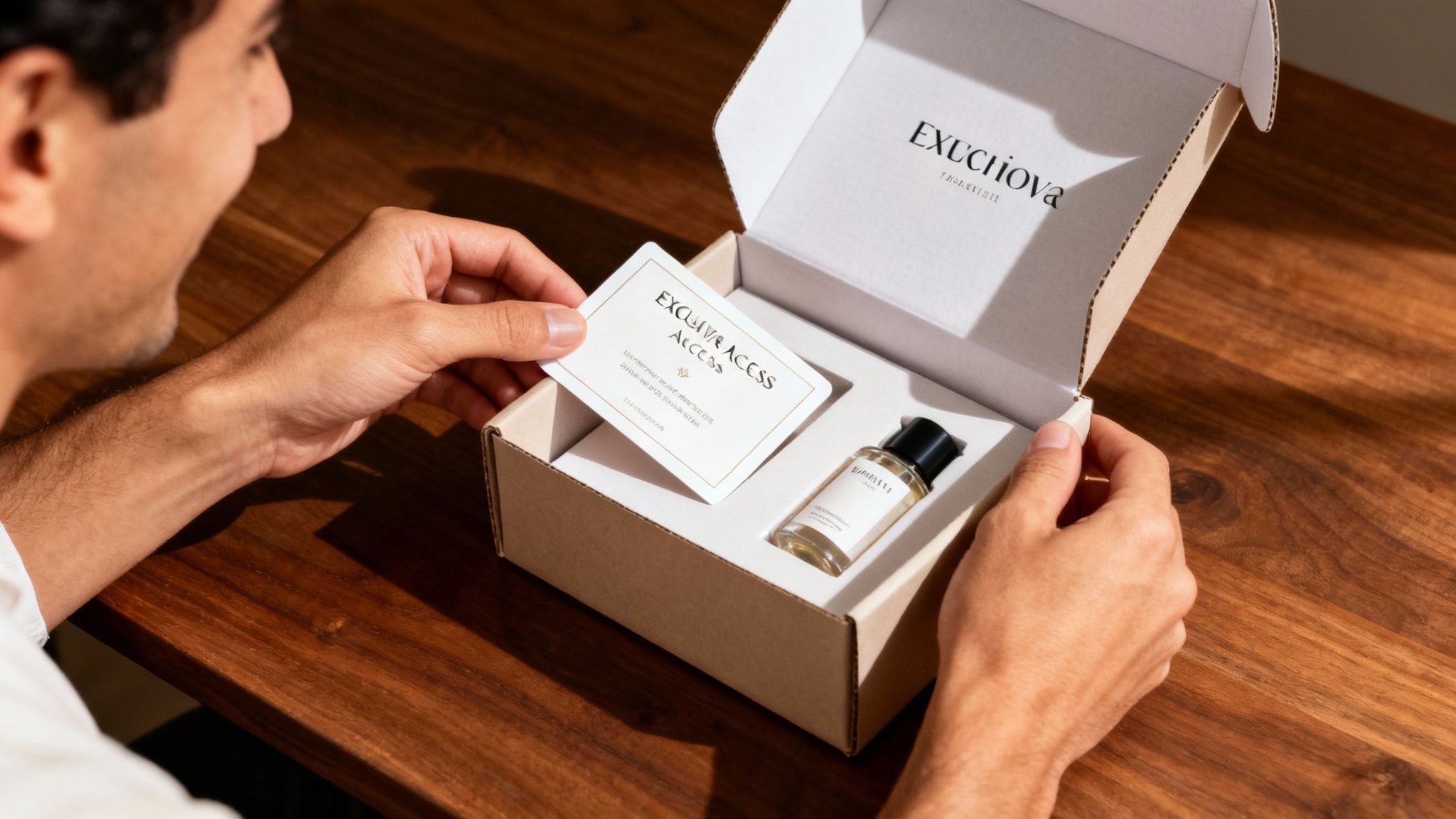
After a customer buys, their brain seeks validation. Did I make the right call? Your job is to make the answer an emphatic "yes." Here, you can use urgency and exclusivity not just to drive a sale, but to deepen the relationship.
Creating special experiences for existing customers taps into the powerful psychological trigger of exclusivity. Making someone feel like a valued insider is one of the fastest ways to build lasting loyalty. It shifts their identity from "a person who bought something" to "a member of the brand community."
Instead of just asking for a review, give recent buyers a compelling reason to engage again. Advanced platforms excel here, focusing on long-term revenue and retention, not just one-off conversions.
Here are a few tactics Shopify merchants can implement immediately:
The real ROI of the post-purchase stage is retention. Acquiring a new customer can cost five times more than keeping an existing one. By mastering this final step, you directly and positively impact your profit margins.
For a Shopify Plus store managing thousands of customers, manual execution is not feasible. This is where intelligent automation is essential.
By integrating a platform like Quikly with your email and SMS tools like Klaviyo, you can automate these post-purchase "moments." Set up triggers that enroll new customers into exclusive communication flows, delivering targeted offers that build loyalty without manual effort. This is far beyond what basic apps can do, as they often lack the deep integration needed for truly personalized, automated retention marketing.
When you master this final stage, you create a powerful, self-sustaining cycle of repeat business and brand advocacy, turning one-time buyers into your most profitable, long-term brand champions.
Understanding the psychology behind the buyer's journey is the first step. Now, let's turn that knowledge into a revenue-generating plan for your Shopify store. This roadmap moves from theory to a clear, actionable strategy that delivers results.
This is about building a repeatable system that respects your customers' mindset and directly grows your bottom line.
Bringing this strategy to life requires syncing your tech and marketing channels. The goal is a seamless, automated system that nudges customers with the right psychological trigger at the perfect moment.
Get Your Tech Synced: First, connect your urgency platform, like Quikly, to your core marketing tools. Your email service provider (like Klaviyo) and SMS platform are essential. This enables personalized, behavior-driven campaigns to run automatically.
Plan Your Campaigns Strategically: Use a calendar to map your promotions to each stage of the buyer’s journey. For a new product launch (Need Recognition), plan a campaign that builds anticipation. For a major seasonal sale (Evaluation of Alternatives), run a tiered, ranked offer.
Segment Your Audience: One-size-fits-all offers are ineffective. Use your customer data to create specific segments like VIPs, first-time visitors, or cart abandoners. Each should receive a unique, psychology-driven offer designed for them.
To prove this approach works, you must track metrics beyond simple conversion rates. Success is measured by the direct impact on revenue, profit margins, and customer lifetime value. While basic pop-up apps focus on email capture, a sophisticated strategy is about ROI.
The ultimate goal is to prove direct business impact. Your analytics should tell a clear story of how psychology-driven marketing is reducing costs, increasing order value, and growing customer lifetime value—the core pillars of sustainable e-commerce growth.
Here are the KPIs you should be laser-focused on:
When you follow this checklist and focus on these KPIs, you create a powerful feedback loop. You can refine your approach based on what is actually working, moving from reactive promotions to proactively driving revenue with psychology.
Ready to move beyond basic pop-ups and build a sophisticated, revenue-generating system? Quikly is the expert in applying the science of urgency marketing, providing the advanced tools to weave psychology-driven triggers across the entire buyer journey.
Discover how Quikly can elevate your Shopify store's performance.